
Bulk Tauroursodeoxycholic Acid Powder Manufacturer in China
Home >> Bulk Ingredients >> Glandular Extracts >> Bulk TUDCA Powder
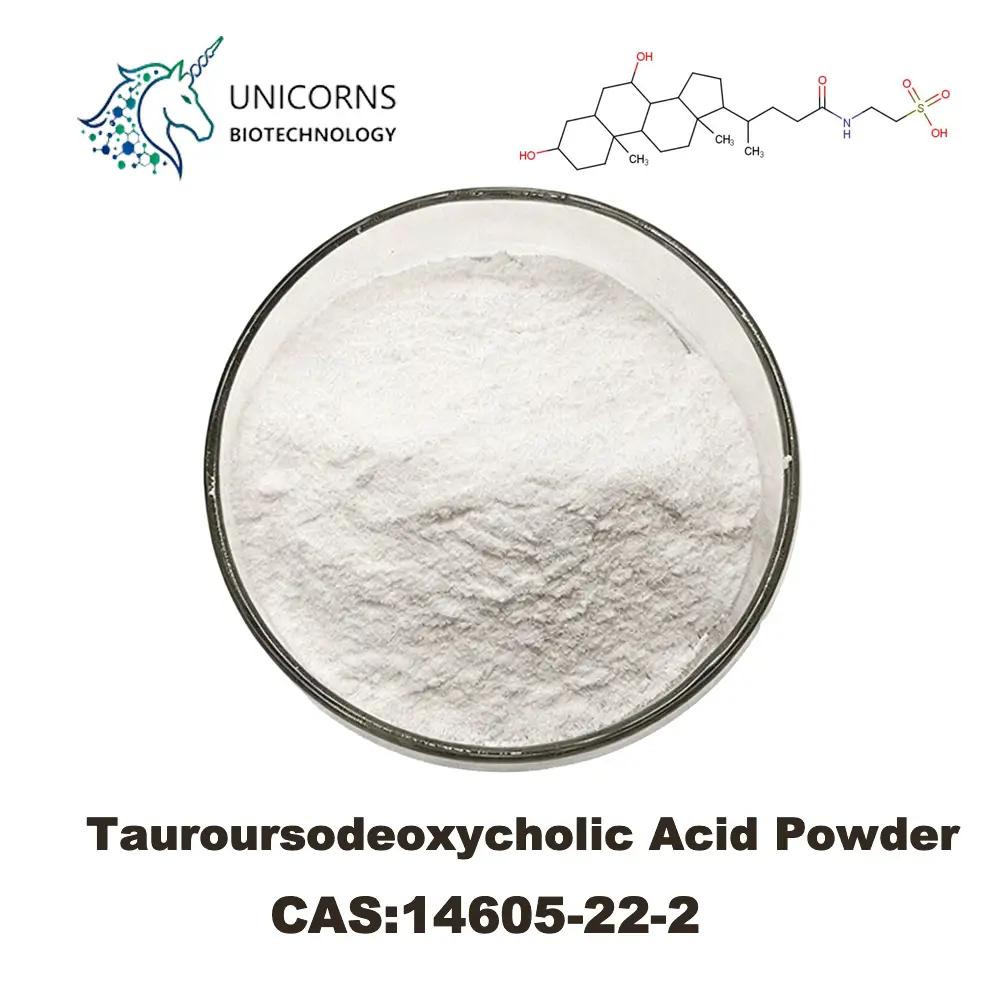
Bulk TUDCA Powder
| Product Name | Tauroursodeoxycholic Acid Powder |
| Other Names | TUDCA, Tauroursodeoxycholate, Ursodeoxycholyltaurine, Ursodoxicoltaurine, Taurursodiol, Tauro-UDCA, TUDC and TUDCA Bile Salt |
| CAS Number | 14605-22-2 |
| Molecular Formula | C26H45NO6S |
| Molecular Weight | 499.7 |
| Specifications | 99% TUDCA |
| Appearance / Color | White crystals |
| Applications | Support liver health, brain health |
| Bulk Package | 25kg/drum |
| OEM Services | Custom Formulation, Blending, Private Label Packaging, Custom Granulation & Particle Size, Capsules, Tablets, etc. |
Unicorns Biotechnology is a bulk Tauroursodeoxycholic Acid Powder manufacturer and supplier in China. We provide high-purity TUDCA to supplement brands, ingredient distributors, contract manufacturers, research companies, pharmaceutical businesses and private label companies.
Our standard TUDCA specification has an assay of at least 99.0%. It is supplied as white crystals with strict controls for related bile acids, heavy metals and microbial quality. Custom particle size, packaging, testing and finished dosage forms are available.
Our wider bile-acid and animal-derived ingredient operation supports large international orders and long-term supply programs. Related products include Ox Bile Extract Powder, cholic acid, bile salts, pancreatin and other glandular extracts.
OEM services are available for TUDCA capsules, tablets, bile-support blends and private label supplements. We can also develop formulas containing milk thistle, N-acetyl-L-cysteine, phosphatidylcholine, digestive enzymes or other approved ingredients.
What Is TUDCA?
TUDCA stands for tauroursodeoxycholic acid. It is a hydrophilic bile acid formed when ursodeoxycholic acid, or UDCA, is conjugated with taurine.
The human body naturally produces small amounts of TUDCA as part of bile-acid metabolism. It enters the intestinal bile-acid pool and participates in enterohepatic circulation between the liver and intestine.
TUDCA is also known as:
Tauroursodeoxycholic Acid, Tauroursodeoxycholate, Ursodeoxycholyltaurine, Ursodoxicoltaurine, Taurursodiol, Tauro-UDCA, TUDC and TUDCA Bile Salt.
The standard free acid has CAS No. 14605-22-2, the molecular formula C₂₆H₄₅NO₆S and a molecular weight of 499.70 g/mol.
TUDCA Chemical Information
| Item | Details |
|---|---|
| Full name | Tauroursodeoxycholic acid |
| Common abbreviation | TUDCA |
| Other names | Taurursodiol, ursodoxicoltaurine, ursodeoxycholyltaurine |
| CAS number | 14605-22-2 |
| Molecular formula | C₂₆H₄₅NO₆S |
| Molecular weight | 499.70 g/mol |
| Chemical type | Taurine-conjugated bile acid |
| Parent bile acid | Ursodeoxycholic acid, or UDCA |
| Standard purity | ≥99.0% |
| Appearance | White crystals |
| Country of origin | China |
| Packaging | 25 kg per drum |
Appearance, Solubility and Physical Properties
The attached specification describes the material as white crystals with a specific rotation between +41° and +47°. Its stated acidity range is pH 1.3 to 2.3, and moisture is controlled between 6.5% and 7.5%.
The specification lists solubility in methanol and ethanol and no solubility in water or acetone. Since solubility depends on whether the material is the free acid, sodium salt or hydrated form, buyers should confirm the exact chemical form and test method before formulation.
TUDCA should be stored in a tightly closed container and protected from light. Custom milling and particle-size control can be arranged for capsules, tablets and dry blends.
Is TUDCA a Bile Acid or a Bile Salt?
TUDCA is commonly described as both a conjugated bile acid and a bile salt. The exact term depends on its chemical state.
The name tauroursodeoxycholic acid refers to the protonated free acid. Tauroursodeoxycholate refers to its negatively charged conjugate base. When paired with sodium, it is called sodium tauroursodeoxycholate.
Finished-product labels and COAs should state the exact form rather than using these terms interchangeably.
Popular TUDCA Chemical Forms and Bile Salts
TUDCA does not have to be supplied only as a sodium salt. Commercial products include the free acid, sodium salt and dihydrate.
The choice depends on assay calculation, solubility, moisture, manufacturing process and finished dosage form. Buyers should compare materials on an anhydrous or active-equivalent basis.
| TUDCA Form | CAS Number | Molecular Formula | Molecular Weight | Common Use |
| Tauroursodeoxycholic acid | 14605-22-2 | C₂₆H₄₅NO₆S | 499.70 g/mol | Capsules, tablets, supplements and research |
| Sodium tauroursodeoxycholate | 35807-85-3 | C₂₆H₄₄NNaO₆S | 521.69 g/mol | Water-based systems, research and bile-salt applications |
| TUDCA dihydrate | 117609-50-4 | C₂₆H₄₅NO₆S·2H₂O | 535.73 g/mol | Crystalline pharmaceutical and research material |
TUDCA Free Acid
TUDCA free acid is the non-sodium form with a molecular weight of 499.70 g/mol. It is commonly used for high-purity TUDCA supplements and research materials.
The purity calculation, moisture content and hydration state must be reviewed when comparing suppliers.
TUDCA Sodium Salt
TUDCA sodium salt is also called sodium tauroursodeoxycholate. It has CAS No. 35807-85-3 and a molecular weight of 521.69 g/mol.
The sodium form is more ionized and may be selected for aqueous processing or laboratory applications. It should not be labeled as pure TUDCA free acid without stating the sodium content.
TUDCA Dihydrate
TUDCA dihydrate contains two molecules of water for each molecule of TUDCA. Its molecular weight is 535.73 g/mol.
The water of hydration affects assay calculations and finished-product dosage. Manufacturers should confirm whether the assay is reported on an as-is, dried or anhydrous basis.
Is TUDCA Unstable?
TUDCA is not automatically unstable or unusable in its free-acid form. Free acid, sodium salt and dihydrate products are all commercially available.
Stability depends on moisture, temperature, light, pH, packaging and chemical form. The correct form should be selected according to the formulation and storage requirements.
What Is TUDCA Made From?
TUDCA is chemically formed by joining ursodeoxycholic acid with taurine. The reaction creates an amide bond between the carboxyl group of UDCA and the amino group of taurine.
Commercial manufacturing may use chemical, semi-synthetic or enzyme-assisted processes. Common production routes begin with purified UDCA, which is activated and conjugated with taurine before purification and crystallization.
Some supply chains use bile-acid precursors obtained from animal bile. Other routes rely on synthetic or biotechnological intermediates. Buyers requiring animal-free, vegetarian or defined-origin TUDCA should request a written source statement.
Is TUDCA Made From Bear Bile?
TUDCA was historically associated with bear bile because bear bile contains higher amounts of UDCA and related taurine conjugates than human bile.
Modern commercial TUDCA does not need to be collected from bears. It can be manufactured from UDCA and taurine through controlled chemical or biocatalytic processes.
Buyers should request a raw-material origin statement rather than assuming that all TUDCA is either bear-derived or fully synthetic.
Does TUDCA Come From Ox Bile?
TUDCA and Ox Bile Extract are different products. Ox bile may provide bile-acid precursors in some production routes, but standard Ox Bile Extract Powder is not 99% TUDCA.
Ox bile is a natural mixture of cholic acid, conjugated bile acids, bile salts, pigments and other components. TUDCA is one defined compound.
Food Sources of TUDCA
There are no recognized everyday foods that provide a meaningful or standardized amount of TUDCA.
TUDCA occurs naturally in small amounts within the human bile-acid pool. It is formed through bile-acid metabolism when UDCA is conjugated with taurine.
Taurine-containing foods such as seafood and meat do not contain a predictable TUDCA dose. Eating taurine does not directly provide the same amount as a standardized TUDCA ingredient.
For manufacturers, purified TUDCA powder is the only practical way to deliver a measured amount in capsules or tablets.
Tauroursodeoxycholic Acid Powder Specifications
Unicorns Biotechnology supplies Tauroursodeoxycholic Acid Powder with an assay of at least 99.0%. Related impurities are tightly controlled, including ursodeoxycholic acid at no more than 0.5% and taurochenodeoxycholic acid at no more than 0.8%.
Other individual impurities are limited to 0.4%, while total other impurities must remain below 1.0%. Sulphated ash is limited to 0.1%, and heavy metals must remain below 20 ppm.
Microbial testing follows current USP-based requirements. Total aerobic microbial count is limited to 10,000 CFU/g, yeast and mould to 100 CFU/g, E. coli must be absent per gram, and Salmonella must be absent in 10 grams.
The standard specification does not list separate limits for lead, arsenic, cadmium, mercury or residual solvents. These tests can be added when required by the customer or destination market.
| Item | Specification |
| Product name | Tauroursodeoxycholic Acid |
| Abbreviation | TUDCA |
| Assay | ≥99.0% |
| Appearance | White crystals |
| Specific rotation | +41° to +47° |
| Acidity | pH 1.3 to 2.3 |
| Moisture | 6.5% to 7.5% |
| Sulphated ash | ≤0.1% |
| Heavy metals | ≤20 ppm |
| Ursodeoxycholic acid | ≤0.5% |
| Taurochenodeoxycholic acid | ≤0.8% |
| Other individual impurity | ≤0.4% |
| Total other impurities | ≤1.0% |
| Total aerobic microbial count | ≤10,000 CFU/g |
| Yeast and mould | ≤100 CFU/g |
| E. coli | Absent per gram |
| Salmonella | Absent in 10 grams |
| Solubility stated in specification | Soluble in methanol and ethanol |
| Storage | Well-closed container, protected from light |
| Standard packaging | 25 kg per drum |
| Country of origin | China |
Every batch is checked before release. Third-party laboratory testing can be arranged for purity, related bile acids, heavy metals, residual solvents, microbial quality and other customer requirements.
Potential TUDCA Benefits and Research Areas
TUDCA is studied for its role in bile-acid balance, cellular stress responses and liver health. However, evidence differs greatly between established bile-acid functions, animal studies and human clinical trials.
Finished-product claims must follow the laws of the destination market. TUDCA powder should not be advertised as a treatment for fatty liver, gallstones or other diseases unless that use is legally authorized.
Supports Healthy Bile-Acid Balance
TUDCA is a hydrophilic bile acid that enters the body’s bile-acid pool. It is used in formulas designed to support normal bile flow and bile-acid balance.
Supports Normal Liver Cell Function
Research has examined how TUDCA interacts with liver cells exposed to hydrophobic bile acids and other forms of cellular stress. This makes it a common ingredient in liver-support and bile-support supplements.
Supports the Cellular Stress Response
TUDCA is widely used in research involving endoplasmic reticulum stress, protein folding and the unfolded protein response. Much of this work remains preclinical and should not be converted into disease-treatment claims.
Supports Mitochondrial and Cell-Membrane Stability
Laboratory studies have examined TUDCA in relation to mitochondrial membranes, oxidative stress and programmed cell death. These findings explain its popularity in cell-health research, but they do not establish every proposed consumer benefit.
Participates in Fat Digestion and Absorption
Bile acids help disperse dietary fats and form micelles in the small intestine. TUDCA forms only one part of the complete bile-acid pool and should not be marketed as a replacement for all bile acids or digestive enzymes.
Research Interest in Metabolic Health
TUDCA has been studied in models of insulin resistance, obesity and fatty liver. Human evidence remains more limited than animal and laboratory data, so disease claims require care.
Research Interest in Brain and Eye Health
TUDCA appears in research on neurons, retinal cells and cellular stress. These uses remain research topics rather than established general supplement outcomes.
How Is TUDCA Powder Manufactured?
Commercial TUDCA production usually starts with purified UDCA and taurine. Controlled conjugation, purification and crystallization create a high-purity TUDCA product.
UDCA Raw-Material Preparation
Purified ursodeoxycholic acid is selected as the main bile-acid intermediate. Identity, purity, moisture and related bile acids are checked before production.
Activation of Ursodeoxycholic Acid
The carboxyl group of UDCA is activated so it can react efficiently with taurine. The reaction conditions are controlled to reduce isomer formation and unwanted bile-acid impurities.
Conjugation With Taurine
Activated UDCA reacts with taurine to form tauroursodeoxycholic acid. Temperature, pH, reaction time and molar ratio are monitored throughout this stage.
Purification
The crude product is purified to remove residual UDCA, taurochenodeoxycholic acid, reagents and other process impurities. Filtration, solvent treatment, washing and controlled precipitation may be used.
Salt Formation or Hydration Control
The purified material may remain as TUDCA free acid or be converted into a sodium salt. Crystallization conditions also determine whether the product is anhydrous or hydrated.
Crystallization and Drying
The purified TUDCA is crystallized and dried under controlled conditions. Moisture, temperature and light exposure are managed to maintain the selected chemical form.
Milling, Blending and Testing
The dried crystals can be milled to the required particle size and blended for batch uniformity. Each lot is tested for assay, optical rotation, related impurities, moisture, ash, heavy metals and microbial quality.
Packaging
Approved powder is packed in sealed inner bags and protective drums. Standard bulk packaging is 25 kg per drum, with smaller and custom formats available.
TUDCA Powder Applications
High-purity TUDCA is used in dietary supplements, bile-support products, research materials and pharmaceutical development. The required grade depends on local law, intended use and final dosage form.
TUDCA Capsules and Tablets
Liver and Bile-Support Formulas
Scientific Research and Laboratory Reagents
Pharmaceutical and Clinical Development
TUDCA vs UDCA, Ox Bile and Milk Thistle
TUDCA, UDCA, Ox Bile Extract and milk thistle are often discussed together, but they are not interchangeable.
| Ingredient | Material Type | Main Characteristics | Common Formulation Position |
| TUDCA | Taurine-conjugated bile acid | Defined compound, hydrophilic, commonly ≥99% | Bile, liver and cellular-support formulas |
| UDCA | Unconjugated bile acid | Parent compound of TUDCA and prescription drug ingredient | Pharmaceutical hepatobiliary products |
| Ox Bile Extract | Natural bovine bile mixture | Contains several bile acids, bile salts and minor components | Digestive enzyme and fat-digestion formulas |
| Milk thistle | Botanical extract | Supplies silymarin or silybin flavonolignans | Botanical liver-support supplements |
TUDCA vs UDCA
TUDCA is the taurine-conjugated form of UDCA. UDCA has a carboxylic acid group, while TUDCA contains UDCA linked to taurine through an amide bond.
| Item | TUDCA | UDCA |
| Full name | Tauroursodeoxycholic acid | Ursodeoxycholic acid |
| Common abbreviation | TUDCA | UDCA |
| CAS number | 14605-22-2 | 128-13-2 |
| Molecular formula | C₂₆H₄₅NO₆S | C₂₄H₄₀O₄ |
| Molecular weight | 499.70 g/mol | 392.57 g/mol |
| Chemical relationship | UDCA conjugated with taurine | Parent bile acid |
| Ionic behavior | More readily present as tauroursodeoxycholate | Less strongly ionized at some physiological conditions |
| Regulatory use | Varies by country and product category | Established prescription uses in several markets |
TUDCA and UDCA should not be treated as identical on a milligram-for-milligram basis. They have different molecular weights, chemical behavior and regulatory status.
Tauroursodeoxycholic Acid vs Ursodeoxycholic Acid
“Tauroursodeoxycholic acid vs ursodeoxycholic acid” means the same comparison as TUDCA vs UDCA.
The added taurine group changes molecular weight, charge, hydrophilicity and transport. It does not automatically make TUDCA superior for every use.
Product selection should be based on the formulation goal, local regulation, target dose and evidence for the intended application.
Ox Bile vs TUDCA
Ox Bile Extract is a broad animal-derived bile mixture. TUDCA is one purified bile-acid conjugate.
Ox bile is commonly standardized by cholic acid or total bile acids and used in digestive enzyme products. TUDCA is commonly standardized to 98% or 99% and used in specialized liver, bile and research formulas.
A manufacturer should choose Ox Bile Extract when a wider bile mixture is required. TUDCA is more suitable when a defined single ingredient is needed.
TUDCA vs Milk Thistle
TUDCA is a bile-acid compound. Milk thistle is a botanical ingredient containing flavonolignans known collectively as silymarin.
TUDCA is often selected for bile-acid and cellular-stress formulas. Milk thistle is used in botanical liver-support products and may be standardized by total silymarin or silybin.
There is no strong basis for claiming that one is universally better. They act through different pathways and can be used separately or in the same formulation.
| Feature | TUDCA | Milk Thistle Extract |
| Source | Bile-acid derivative | Silybum marianum seeds |
| Main marker | Tauroursodeoxycholic acid | Silymarin or silybin |
| Typical assay | ≥98% or ≥99% | Often 70% to 80% silymarin |
| Main formulation theme | Bile acid and liver support | Botanical antioxidant and liver support |
| Suitable for vegetarian formulas | Depends on source and process | Usually yes |
| Common dosage form | Capsules and tablets | Capsules, tablets and blends |
TUDCA Bile Salts vs General Bile Salts
TUDCA is one specific conjugated bile acid. A general bile-salts product may contain sodium cholate, sodium deoxycholate, glycocholate, taurocholate or a natural bile extract.
The product name alone does not show the composition. Buyers should review the CAS number, assay, chromatographic profile and source before purchasing.
TUDCA for Fatty Liver
TUDCA has been studied in laboratory and animal models of fatty liver, metabolic stress and insulin resistance. Some studies report changes in liver fat, inflammation, cellular stress or metabolic markers.
Human evidence is not yet strong enough to market ordinary TUDCA supplements as proven treatments for fatty liver disease. Fatty liver also has several causes and requires medical assessment.
For B2B product pages, suitable language includes:
“TUDCA is widely studied for liver health, bile-acid metabolism and cellular stress.”
Avoid statements such as:
“TUDCA cures fatty liver” or “TUDCA reverses fatty liver disease.”
TUDCA for Gallstones
TUDCA has been studied for biliary cholesterol saturation and cholesterol gallstones. Older human studies compared it with UDCA, but TUDCA was not consistently superior for gallstone dissolution.
UDCA, also called ursodiol, has established prescription uses in several markets. TUDCA should not be presented as an automatic substitute for prescription ursodiol.
Gallstone treatment depends on the stone type, size, gallbladder function and presence of bile-duct obstruction. Consumer supplement pages should not provide a self-treatment dose for gallstones.
Suitable B2B wording includes:
“TUDCA is used in bile-acid research and hepatobiliary formulation development.”
Avoid promising that a finished TUDCA supplement will dissolve or prevent gallstones.
Where to Buy Bulk TUDCA Powder
Unicorns Biotechnology supplies bulk Tauroursodeoxycholic Acid Powder directly from China. We serve supplement manufacturers, ingredient distributors, private label brands, contract manufacturers, pharmaceutical companies and research suppliers.
Our standard TUDCA grade has a purity of at least 99.0%. Related bile acids and other impurities are controlled under the attached specification. Custom particle size, analytical testing, packaging and OEM services are available.
| Unicorns Biotechnology Advantage | Details |
| Main product | Tauroursodeoxycholic Acid Powder |
| Standard purity | ≥99.0% |
| Chemical form | Confirmed according to order and COA |
| Appearance | White crystals |
| Impurity control | UDCA, TCDCA and other impurities tested |
| Standard packaging | 25 kg per drum |
| Custom packaging | Available for distributors and manufacturers |
| Finished dosage forms | Capsules, tablets and combination formulas |
| OEM services | Formula, filling, bottles, labels and private label |
| Quality documents | COA, MSDS and product specification |
| Third-party testing | Available according to buyer requirements |
| Samples | Free samples for qualified B2B projects |
| Related products | Ox Bile Extract, cholic acid, bile salts and pancreatin |
Frequently Asked Questions (FAQs)
TUDCA buyers usually need to confirm the exact chemical form, assay basis, source, impurity profile and regulatory suitability. The following answers address common questions from supplement brands, distributors, laboratories and contract manufacturers.
Frequently Asked Questions (FAQs)
What is the full name of TUDCA?
TUDCA stands for tauroursodeoxycholic acid. It is also called taurursodiol, ursodoxicoltaurine and ursodeoxycholyltaurine.
Is your product TUDCA free acid or sodium salt?
TUDCA is not stable, and often in the sodium salt form. Contact us to get more info and pricing on this ingredient.
Why is the exact TUDCA form important?
Free acid, sodium salt and dihydrate have different molecular weights, solubility and active-equivalent calculations. Using the wrong form can change the amount of active TUDCA delivered per capsule.
Is TUDCA the same as UDCA?
No. TUDCA is UDCA conjugated with taurine. They have different molecular formulas, molecular weights, chemical behavior and regulatory status.
What documents can you provide?
Available documents may include the COA, MSDS, product specification, origin statement, allergen statement and other quality documents. Additional reports can be arranged according to the project.
Can you supply sodium tauroursodeoxycholate?
Sodium tauroursodeoxycholate can be reviewed as a custom requirement. Please provide the required CAS number, assay, moisture, sodium content, solubility and application.
Can you provide a chromatogram with each batch?
A chromatogram or analytical data package can be arranged according to the project. Buyers should state whether they require a standard HPLC chromatogram, impurity profile or full method-validation package.
Is third-party laboratory verification available?
Yes. Independent testing can be arranged for assay, identity, bile-acid impurities, heavy metals, residual solvents, microbiology or other selected parameters.
Can I request a free TUDCA sample?
Yes. Free samples are available for qualified B2B buyers, formulation tests and technical evaluations. Shipping costs depend on the destination.