
Bulk Vegan 7-Dehydrocholesterol Powder Manufacturer in China
Home >> Bulk Ingredients >> Glandular Extracts >> Wholesale Vegan 7-Dehydrocholesterol Powder
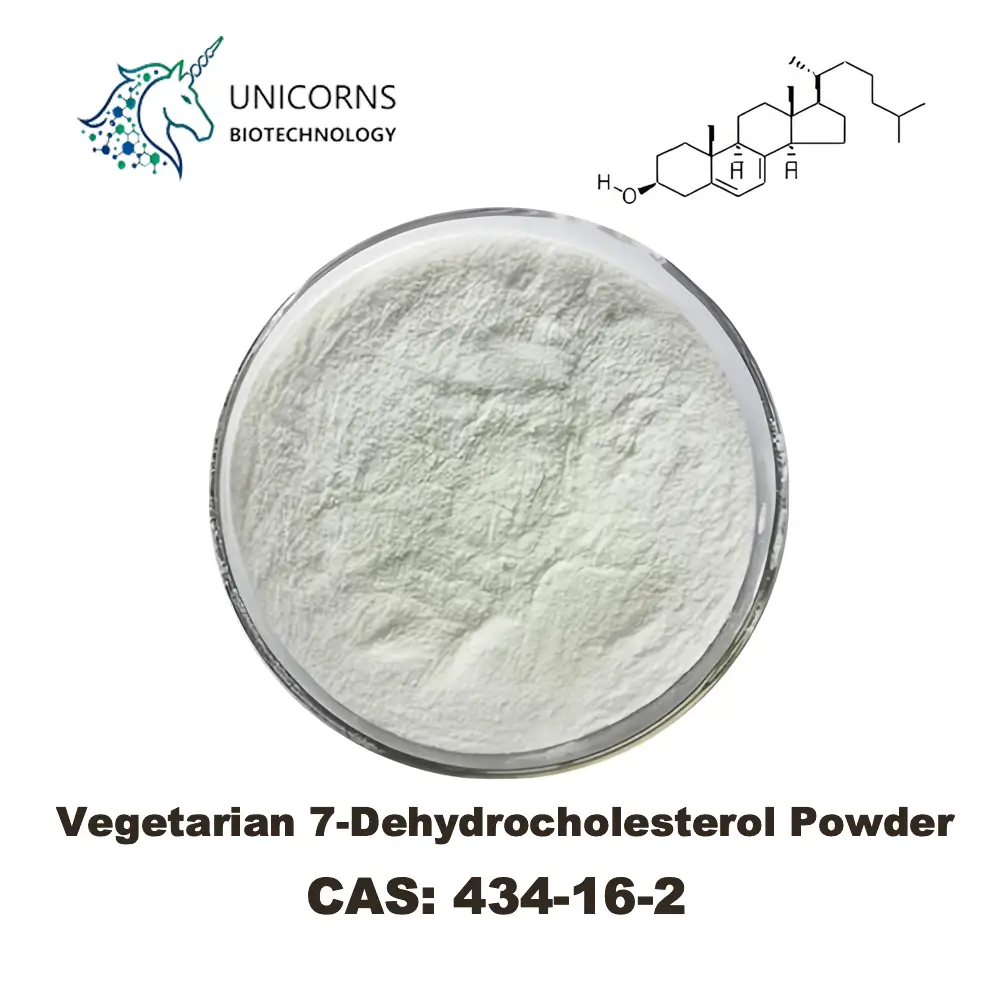
Plant-derived 7-Dehydrocholesterol Bulk Powder (7-DHC)
| Product Name | Vegan 7-Dehydrocholesterol Powder |
| Other Names | Vegetarian 7-Dehydrocholesterol Powder, Plant-Based 7-DHC, Non-Animal 7-Dehydrocholesterol, Non-GMO Soybean-Derived 7-DHC, Vegan Provitamin D3, Vegetarian Vitamin D3 Precursor, Phytosterol-Derived 7-DHC |
| Source | NON-GMO Soybean |
| CAS Number | 434-16-2 |
| Molecular Formula | C27H44O |
| Molecular Weight | 384.64 |
| Specifications | ≥95.0% 7-DHC |
| Appearance / Color | White to Light Yellow Crystalline Powder |
| Bulk Package | 25kg/drum |
| OEM Services | Custom Formulation, Blending, Private Label Packaging, Custom Granulation & Particle Size, Capsules, Tablets, etc. |
Henan Unicorns Biotechnology Co., Ltd. is a professional Vegan 7-Dehydrocholesterol Powder manufacturer in China. We supply plant-derived 7-DHC to vitamin producers, pharmaceutical companies, ingredient distributors, research suppliers, contract manufacturers, and vegan nutrition brands.
Our Vegan 7-DHC starts from phytosterols obtained from non-GMO soybean. It does not use lanolin or fish oil as the starting sterol source. The standard product contains at least 95% 7-Dehydrocholesterol and appears as a white to light-yellow crystalline powder.
Our production and export system supports up to 600 tons annually across this ingredient line. We provide custom testing, particle size, packaging, private-label drum labels, export documents, and third-party laboratory reports.
Unicorns Biotechnology also supplies standard 7-Dehydrocholesterol, Cholesterol Powder, Vegetarian Cholesterol Powder, Bile Acids Powder, Ox Bile Extract, TUDCA Powder, and other glandular extracts and sterol derivatives.
What Is Vegan 7-Dehydrocholesterol?
Vegan 7-Dehydrocholesterol is a plant-derived form of 7-DHC produced from phytosterol starting materials rather than animal-derived cholesterol.
It is chemically the same compound as conventional 7-Dehydrocholesterol. Its CAS number, molecular formula, molecular weight, and function remain unchanged. The main difference is the raw-material origin and production route.
7-Dehydrocholesterol is also called 7-DHC or Provitamin D3. It is the direct precursor used to produce vitamin D3 through ultraviolet irradiation and controlled thermal conversion. NIST lists 7-DHC as C27H44O with a molecular weight of 384.64 g/mol and CAS number 434-16-2.
Is Vegan 7-DHC Extracted Directly From Soybeans?
Vegan 7-DHC is not simply extracted from whole soybeans.
Soybean provides phytosterols that serve as plant-derived starting materials. These sterols are isolated, purified, and converted through controlled chemical steps into a cholesterol-type intermediate and then into 7-Dehydrocholesterol.
Published patent routes describe the production of vegan cholesterol and vitamin D3 from crude phytosterols. The route converts plant sterols into cholesterol-related intermediates before producing 7-DHC and vitamin D3.
A more accurate description is:
Vegan 7-Dehydrocholesterol is produced from non-GMO soybean phytosterols through controlled synthesis and purification.
Is Vegan 7-DHC Chemically Different?
No. Plant-derived and animal-derived 7-DHC have the same molecular identity when they meet the same chemical specification.
Both have:
- CAS number 434-16-2
- Molecular formula C27H44O
- Molecular weight 384.64 g/mol
- The same role as a vitamin D3 precursor
The difference lies in the source, production history, traceability, and suitability for vegan supply chains.
Non-GMO Soybean Source and Traceability
The source of Vegan 7-DHC matters to vitamin manufacturers, supplement brands, and ingredient distributors. Buyers often need proof that the raw material does not come from wool grease, fish oil, or animal tissue.
Non-GMO Soybean Phytosterols
Our standard Vegan 7-Dehydrocholesterol uses phytosterols sourced from non-GMO soybean. Soybean phytosterols are plant sterols with structures related to cholesterol.
The phytosterol fraction is purified before chemical conversion. The finished 7-DHC is not soybean flour, soybean protein, or soybean oil.
No Lanolin or Fish-Oil Starting Material
Conventional 7-DHC is often produced from cholesterol obtained from lanolin or fish oil.
Our Vegan 7-DHC uses soybean-derived phytosterols as the starting source. This supports manufacturers seeking a plant-origin alternative for vegan vitamin D3 production.
Vegan and Animal-Free Documentation
A plant starting source alone does not always prove that every manufacturing stage is vegan.
For projects requiring a formal vegan claim, buyers should review:
- Starting-material source
- Processing aids
- Catalysts and filtration materials
- Production-line cross-contact
- Cleaning procedures
- Packaging components
- Animal-free declarations
Unicorns Biotechnology can provide available source and processing documents for buyer review.
Soy Allergen Considerations
The starting source is soybean, but the product undergoes extensive chemical conversion and purification.
The final allergen status should be based on the manufacturing process, residual protein data, and any available soy-protein testing. Buyers should not assume that a highly purified soybean-derived sterol is automatically exempt from all allergen requirements.
A product-specific allergen statement can be supplied for regulatory and labeling review.
TSE and BSE Risk
Vegan 7-DHC is not produced from ruminant tissue or lanolin. This reduces concerns linked to animal-origin sterol sources.
TSE and BSE statements can be provided when required by pharmaceutical, supplement, or international ingredient buyers.
Vegan 7-Dehydrocholesterol Powder Specifications
Unicorns Biotechnology supplies Vegan 7-Dehydrocholesterol with a standard assay of at least 95.0%.
The product is a white to light-yellow crystalline powder. Loss on drying is limited to 5.0%, while total heavy metals must not exceed 10 ppm.
Individual heavy-metal limits include arsenic and lead at no more than 2 ppm, cadmium at no more than 1 ppm, and mercury at no more than 0.1 ppm.
Microbiological limits include a total plate count of no more than 1,000 CFU/g and yeast and mold below 100 CFU/g. E. coli and Salmonella must test negative.
The standard source is non-GMO soybean, and the standard packaging is 25 kg per drum. These limits are based on the attached Vegan 7-Dehydrocholesterol specification.
Standard Vegan 7-DHC Specification
| Test Item | Specification | Typical Test Method |
| Identification | Conforms to reference standard | HPLC or IR |
| 7-Dehydrocholesterol Assay | ≥95.0% | HPLC |
| Appearance | White to light-yellow crystalline powder | Visual |
| Loss on Drying | ≤5.0% | Gravimetric |
| Total Heavy Metals | ≤10 ppm | ICP-MS or ICP-OES |
| Arsenic | ≤2 ppm | ICP-MS |
| Lead | ≤2 ppm | ICP-MS |
| Cadmium | ≤1 ppm | ICP-MS |
| Mercury | ≤0.1 ppm | ICP-MS |
| Total Plate Count | ≤1,000 CFU/g | Plate count |
| Yeast and Mold | ≤100 CFU/g | Plate count |
| E. coli | Negative | Microbiological test |
| Salmonella | Negative | Microbiological test |
| Source | Non-GMO soybean | Source documentation |
| Particle Size | 80 mesh or customized | Sieve test |
| Packaging | 25 kg per drum | Inspection |
| Country of Origin | China | Origin documentation |
Additional tests can be arranged according to the buyer’s requirements.
These may include:
| Optional Test | Purpose |
| Related Sterols | Controls the impurity profile |
| Residual Solvents | Confirms compliance with agreed solvent limits |
| Soy Protein | Supports allergen review |
| GMO Testing | Supports non-GMO verification |
| Oxidation Products | Checks storage and process stability |
| Pesticide Residues | Supports market-specific requirements |
| Melting Range | Supports identity and purity review |
| Third-Party Assay | Provides independent purity confirmation |
Each approved batch can be supplied with a COA, MSDS, product specification, source statement, and available quality documents.
Vegan vs Lanolin-Derived 7-Dehydrocholesterol
Vegan and lanolin-derived 7-DHC perform the same chemical role. Both are used as precursors for vitamin D3 production.
The main differences involve the starting source, traceability, market positioning, documentation, and price.
| Item | Vegan 7-Dehydrocholesterol | Lanolin-Derived 7-Dehydrocholesterol |
| Starting Source | Non-GMO soybean phytosterols | Wool grease or lanolin cholesterol |
| Source Category | Plant-derived | Animal-derived |
| CAS Number | 434-16-2 | 434-16-2 |
| Molecular Formula | C27H44O | C27H44O |
| Standard Assay | ≥95% | ≥95% |
| Main Function | Vitamin D3 precursor | Vitamin D3 precursor |
| Suitable for Vegan Supply Chains | Yes, subject to process review | No |
| Lanolin-Free | Yes | No |
| Fish-Oil-Free | Yes | Usually yes |
| Animal-Origin Documentation | Animal-free source statement | Lanolin source statement |
| TSE/BSE Concern | Lower source-related concern | Source review may be required |
| Typical Buyer | Vegan vitamin and plant-based ingredient manufacturer | Standard vitamin and pharmaceutical manufacturer |
| Market Availability | More specialized | More widely available |
| Typical Price | Usually higher | Usually lower |
Plant origin does not automatically make the finished ingredient more active or more bioavailable.
The commercial benefit is its suitability for non-animal and vegan product supply chains.
Vegan 7-DHC vs Lichen Vitamin D3
Vegan 7-DHC and lichen vitamin D3 are not the same type of product.
Vegan 7-DHC is an upstream manufacturing intermediate. It still requires ultraviolet conversion and further purification before becoming vitamin D3.
Lichen vitamin D3 is normally sold as a finished cholecalciferol ingredient or formulation for direct use in supplements.
| Item | Vegan 7-DHC | Lichen Vitamin D3 |
| Ingredient Stage | Industrial precursor | Finished vitamin ingredient |
| Main Compound | 7-Dehydrocholesterol | Cholecalciferol |
| CAS Number | 434-16-2 | 67-97-0 |
| Main Buyer | Vitamin D3 manufacturer | Supplement and food manufacturer |
| Requires UV Conversion | Yes | No |
| Direct Use in Capsules | Usually no | Yes, after formulation |
| Main Selling Point | Plant-derived D3 production route | Ready-to-formulate vegan vitamin D3 |
Vitamin manufacturers should buy Vegan 7-DHC when they need a plant-derived precursor. Finished-product manufacturers normally buy a standardized vitamin D3 preparation.
Technical Benefits of Vegan 7-DHC
Vegan 7-Dehydrocholesterol is mainly an industrial raw material. Its benefits relate to manufacturing, sourcing, and product positioning rather than direct consumer supplementation.
Plant-Derived Vitamin D3 Precursor
7-DHC is converted into previtamin D3 by ultraviolet irradiation. Controlled heating then forms cholecalciferol.
Patent literature describes both phytosterol-to-vitamin-D3 routes and ultraviolet production of vitamin D3 from 7-DHC.
Support for Vegan Product Lines
Soybean-derived 7-DHC gives vitamin manufacturers an alternative to lanolin-based production.
It can support vegan vitamin D3 crystals, oils, beadlets, premixes, tablets, capsules, gummies, and fortified products after downstream conversion.
Source Traceability
A defined non-GMO soybean source helps buyers document the origin of the sterol starting material.
Source statements, non-GMO documents, allergen declarations, and production records can support customer audits and finished-product claims.
Consistent Chemical Starting Material
A minimum assay of 95% gives vitamin manufacturers a controlled 7-DHC input.
Consistent purity, related-sterol limits, and residual-solvent control help improve batch records, conversion calculations, and purification planning.
Reduced Dependence on Animal Sterols
Plant-derived 7-DHC gives buyers another sourcing option when lanolin supply, animal-origin restrictions, or vegan market requirements affect purchasing decisions.
It also allows ingredient distributors to serve both standard and vegan vitamin markets.
How Vegan 7-Dehydrocholesterol Is Manufactured
The manufacturing process begins with phytosterols obtained from non-GMO soybean.
The plant sterol fraction is separated and purified to remove unwanted oils, waxes, proteins, and other components. The refined phytosterols are then converted through controlled synthesis into a cholesterol-type sterol intermediate.
Further chemical processing introduces the required 5,7-diene structure. This creates 7-Dehydrocholesterol.
The crude 7-DHC is separated from unreacted sterols and reaction by-products. Recrystallization and purification raise the assay to at least 95%.
The finished material is dried under controlled conditions, milled, sieved, tested, and packed in light-resistant drums.
A typical process flow includes:
Non-GMO soybean phytosterols → Purification → Sterol conversion → Cholesterol-type intermediate → 7-DHC formation → Separation → Recrystallization → Drying → Milling → Testing → Packaging
Published synthesis routes confirm that phytosterols can be used to produce vegan cholesterol and vitamin D3 intermediates.
Exact reaction agents, temperatures, yields, and processing conditions depend on the approved factory process.
Applications of Vegan 7-Dehydrocholesterol Powder
Vegan 7-DHC is mainly used by vitamin manufacturers, pharmaceutical intermediate producers, research suppliers, and plant-based ingredient companies.
Its main value is its non-animal source and its ability to serve as a precursor for vegan vitamin D3 production.
Vegan Vitamin D3 Manufacturing
Pharmaceutical and Nutraceutical Intermediates
Vegan Sterol Research
Contract Synthesis and Specialty Ingredients
Where to Buy Bulk Vegan 7-Dehydrocholesterol Powder
Henan Unicorns Biotechnology Co., Ltd. is a wholesale Vegan 7-Dehydrocholesterol Powder supplier and factory in China.
We supply ≥95% plant-derived 7-DHC made from non-GMO soybean phytosterols. The material is suitable for vegan vitamin D3 production, sterol research, pharmaceutical processing, and contract synthesis.
Our services cover bulk supply, custom testing, samples, third-party reports, private-label drums, export documents, and international shipment.
Why Buy Vegan 7-DHC From Unicorns Biotechnology?
| Advantage | What Buyers Receive |
| Plant-Based Source | Non-GMO soybean phytosterol starting material |
| Animal-Origin Alternative | No lanolin or fish-oil starting sterol |
| Standard Purity | ≥95.0% 7-Dehydrocholesterol |
| Factory Supply | Direct wholesale price and production support |
| Source Traceability | Non-GMO, plant-origin, and source documents |
| Quality Control | Assay, moisture, heavy metals, and microbial testing |
| Custom Testing | Related sterols, solvents, soy protein, and oxidation products |
| Third-Party Testing | Independent reports based on buyer requirements |
| Standard Packaging | 25 kg drums with sealed inner packaging |
| Custom Packaging | Smaller packs, private labels, and branded drum labels |
| Free Sample | Evaluation sample for qualified B2B projects |
| Technical Documents | COA, MSDS, specification, and flow chart |
| International Shipping | Air, sea, or approved courier delivery |
| Related Ingredients | Standard 7-DHC, cholesterol, bile acids, and glandular extracts |
Contact Unicorns Biotechnology for the latest Vegan 7-Dehydrocholesterol Powder wholesale price, MOQ, sample, lead time, source documents, and custom testing quotation.
Frequently Asked Questions (FAQs)
Buyers usually want to confirm the source, purity, vegan status, production route, documentation, storage, and commercial terms before approving plant-derived 7-DHC. Unicorns Biotechnology supplies ≥95% soybean-based provitamin D3 for vitamin D3 manufacturers, pharmaceutical companies, ingredient distributors, research suppliers, and contract producers. We support source verification, samples, custom testing, bulk packaging, private-label drum labels, and international shipment.
Frequently Asked Questions (FAQs)
What makes this 7-DHC plant-derived?
This grade starts from phytosterols obtained from non-GMO soybean rather than cholesterol from lanolin, fish oil, or animal tissue.
The plant sterols are purified and converted through controlled synthesis into 7-dehydrocholesterol. The finished molecule has the same chemical identity as conventional 7-DHC, but its source and production route are different.
Is soybean-derived 7-dehydrocholesterol chemically different from standard 7-DHC?
No. Both grades have CAS number 434-16-2, molecular formula C27H44O, and molecular weight 384.64 g/mol.
The difference is the starting raw material. Plant-origin material uses soybean phytosterols, while standard grades often use lanolin-derived or fish-derived cholesterol.
Is plant-based 7-DHC the same as vitamin D3?
No. It is an upstream vitamin D3 precursor.
Controlled ultraviolet irradiation converts 7-DHC into previtamin D3. Thermal conversion then forms cholecalciferol, which is vitamin D3.
Can this ingredient be used to manufacture vegan vitamin D3?
Yes. Its main commercial use is as a non-animal precursor for vegan cholecalciferol production.
The final vitamin D3 manufacturer must still control irradiation, purification, formulation, and supporting vegan documentation.
Is the product directly extracted from soybeans?
No. The finished sterol is not simply extracted from whole soybeans.
Soybean provides the phytosterol starting material. These plant sterols are separated, purified, converted, recrystallized, dried, and tested before the finished 7-DHC is released.
Which soybean compounds are used as starting materials?
The starting fraction contains plant sterols, commonly referred to as soybean phytosterols.
These may include beta-sitosterol, campesterol, stigmasterol, and related sterols. The exact composition depends on the approved raw-material source and manufacturing route.
Is the material free from lanolin?
Yes. This plant-origin grade does not use lanolin as the starting sterol source.
A source declaration can be provided for customer review. Buyers with strict vegan requirements should also review processing aids and production-line controls.
Can you provide a non-GMO statement?
Yes. A non-GMO source statement can be provided for the standard soybean-derived grade.
Analytical GMO testing may also be discussed when required by the buyer or destination market.
Is the ingredient certified vegan?
Plant origin and vegan certification are not always the same.
We can provide available plant-origin, animal-free, source, and processing documents. Formal vegan certification must be confirmed against the current certificate scope before any finished-product claim is made.
Does soybean-based 7-DHC contain soy protein?
The manufacturing process removes and converts the original soybean components. However, allergen status should be confirmed through a product-specific allergen statement or residual soy-protein testing.
Buyers should review local labeling rules before making a soy-free claim.
Can you provide an allergen statement?
Yes. Our OEM services mainly cover bulk repacking, custom drum labels, private-label packaging, smaller inner packs, source-specific documentation, and buyer-branded export cartons.
Because 7-DHC is mainly an industrial intermediate, it is not normally packed as a direct consumer supplement. Finished vitamin D3 capsules, tablets, softgels, or premixes require separate formulation and regulatory review.