
Bulk Freeze-Dried Yellow Mealworm Powder Manufacturer in China
Home >> Bulk Ingredients >> Other Animal Glandular Powders >> Wholesale Yellow Mealworm Powder
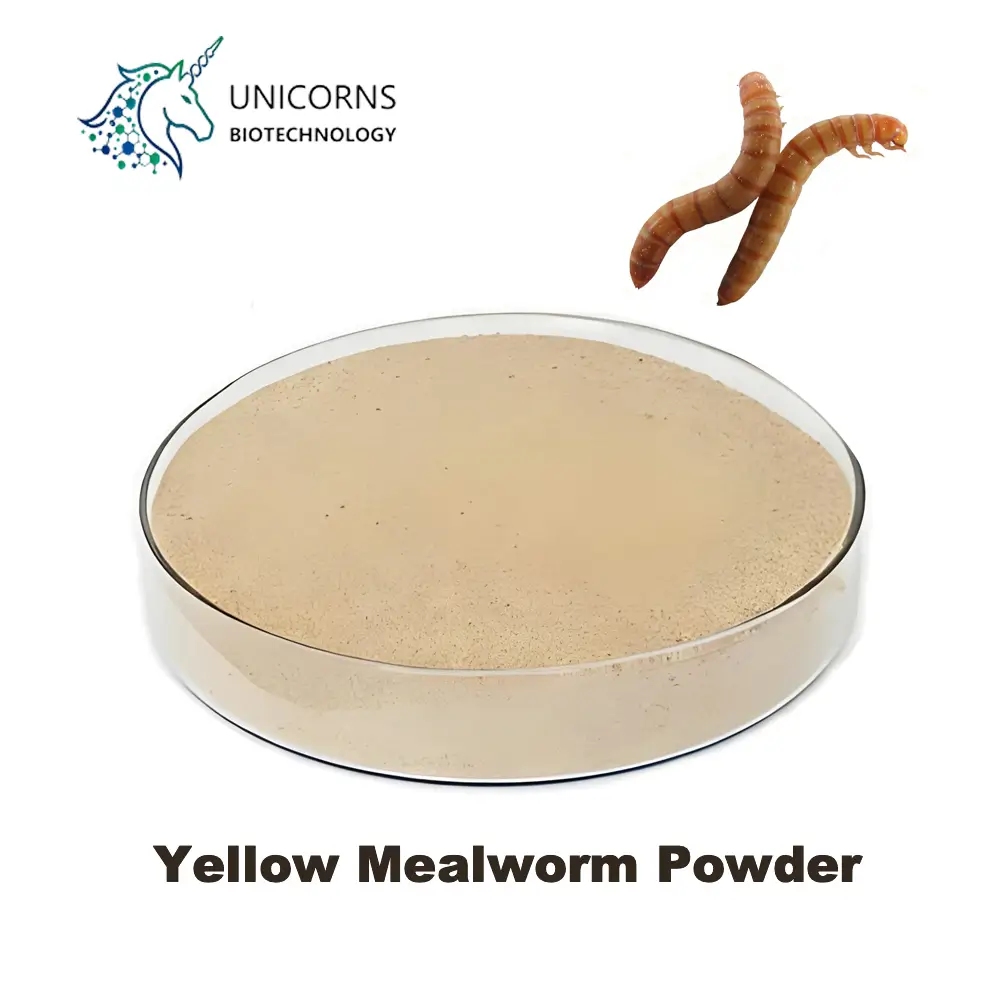
Bulk Mealworm Powder
| Product Name | Yellow Mealworm Powder |
| Other Names | Tenebrio molitor powder, dried mealworms, mealworm meal, Tenebrio molitor larvae, Insect Protein Powder, Defatted Mealworm Powder, Whole Mealworm Powder, Full-Fat Mealworm Powder, Vers de farine powder, huangfenchong fen, mianbaochong fen |
| Source | Tenebrio molitor |
| Drying Method | Freeze Dried or Spray Dried Optional |
| Appearance | Brown Yellow Fine Powder |
| Country of Origin | China |
| Applications | animal feed, supplements |
| Documents Available | COA, Specification, MSDS, Allergen Statement, Non-GMO Statement |
| Manufacturing Capability | 600 tons annually |
| OEM services | Custom formulation, capsules, tablets, blends, contract manufacturing, softgels |
| Bulk Packaging | 20kg Vacuum Sealed Foil Bags, 25kg/drum, or custom bulk packaging |
Unicorns Biotechnology is a wholesale Yellow Mealworm Powder manufacturer in China. We supply dried and ground Tenebrio molitor larvae to food manufacturers, nutrition brands, pet food companies, feed mills, ingredient distributors, private label companies, and contract manufacturers.
Our factory supports annual production of up to 600 tons. Available options include whole mealworm powder, full-fat mealworm powder, and defatted mealworm protein powder. Drying method, protein target, fat level, particle size, packaging, and testing can be adjusted for each project.
Mealworm meal contains protein, essential amino acids, unsaturated fatty acids, chitin, iron, zinc, magnesium, potassium, and several B vitamins. It works in bakery products, pasta, protein bars, savoury foods, meat alternatives, pet nutrition, aquaculture feed, and poultry feed.
We also supply Black Soldier Fly Larvae Powder, Cricket Powder, and Black Ant Powder. OEM blending, custom packing, private labels, and product development support are available.
What Is Yellow Mealworm Powder?
Yellow Mealworm Powder is made from the dried and ground larvae of the darkling beetle Tenebrio molitor. The larvae are raised under controlled conditions, separated from their feed substrate, cleaned, heat-treated, dried, and milled.
Common names include:
- Tenebrio molitor powder
- Yellow mealworm flour
- Mealworm meal
- Dried mealworm powder
- Insect protein powder
- Whole mealworm powder
- Full-fat mealworm powder
- Defatted mealworm powder
- Tenebrio molitor larvae powder
- Vers de farine powder
- Huangfenchong fen
- Mianbaochong fen
This ingredient does not have one CAS number. It is a whole biological material containing proteins, lipids, carbohydrates, chitin, vitamins, and minerals. CAS numbers are generally used for defined chemical substances rather than whole insect powders.
The standard product is a brown-yellow fine powder with a mild nutty or savoury aroma. It disperses in water but does not form a fully clear solution. Protein, fat, chitin, and mineral particles remain suspended.
An 80-mesh powder suits many dry blends, bakery mixes, protein bars, and feed premixes. Coarser and finer particle sizes can be supplied for extrusion, pasta, beverages, meat analogues, and pet food.
Unicorns Biotechnology supplies wholesale mealworm flour with custom protein levels, particle sizes, packaging, private labels, and OEM formulations.
Available Yellow Mealworm Powder Grades
The right grade depends on protein target, fat level, flavour, shelf life, and final processing method. Buyers should define the grade before requesting a quotation.
| Product Grade | Typical Characteristics | Common Uses |
|---|---|---|
| Whole mealworm powder | Whole dried larvae, natural protein and fat balance | Bakery, pasta, snacks, pet food, animal feed |
| Full-fat mealworm powder | Retains most natural oils and has a richer flavour | Savoury products, meat alternatives, pet nutrition |
| Defatted mealworm powder | Part of the oil is removed to raise relative protein content | Protein blends, bars, premixes, extruded foods |
| Freeze-dried mealworm powder | Low-temperature dehydration with light colour and controlled texture | Premium food, research, nutrition, pet products |
| Spray-dried mealworm powder | Homogenized material dried into a uniform fine powder | Dry blends and products requiring even dispersion |
| UV-treated whole mealworm powder | A separate EU novel-food form with raised vitamin D content | Specific authorised EU food categories only |
Commercial whole and full-fat grades commonly contain about 45% to 60% crude protein. Defatted grades may target 60% to 70%, depending on the oil-removal process. Every protein claim should be tied to a batch COA.
Natural Nutrients in Tenebrio Molitor Powder
Yellow mealworm powder acts as a dense source of protein, fat, and micronutrients. Its exact composition changes with larval feed, harvest age, drying temperature, and fat removal.
EFSA data for dried mealworm forms reported average crude protein of about 46.5%, average fat of 25.8%, and average moisture of 4.9%. The authorised specification reviewed in the same opinion covered 56% to 64% crude protein, 19% to 35% fat, and 3.5% to 8.2% chitin for dried or powdered forms.
Protein and Essential Amino Acids
Mealworm protein contains all nine essential amino acids. These include lysine, leucine, isoleucine, valine, threonine, histidine, phenylalanine, methionine, and tryptophan.
Leucine, lysine, valine, and isoleucine make it useful in blended protein systems. Sulfur-containing amino acids, mainly methionine and cysteine, may be limiting in some protein-quality assessments.
How to Read Mealworm Protein Claims
Crude protein is usually calculated by multiplying total nitrogen by 6.25. This method also counts nitrogen from chitin, so it can overstate the amount of true protein.
EFSA noted that a conversion factor of 4.76 gives a lower estimate of true protein in whole yellow mealworm. Buyers should ask whether a quoted protein result uses nitrogen × 6.25 or another calculation method.
For B2B comparison, the COA should state:
- Test method, such as Kjeldahl or Dumas
- Nitrogen-to-protein conversion factor
- Crude protein result
- Moisture basis
- Amino acid profile, when required
Natural Fatty Acids
Full-fat mealworm powder contains a large share of unsaturated fat. Oleic acid and linoleic acid are the main fatty acids, while palmitic acid is the main saturated fatty acid.
EFSA reported that monounsaturated fatty acids made up roughly 33% to 36% of total fat. Polyunsaturated fatty acids accounted for about 41% to 43%.
Defatting lowers the oil content and can improve protein concentration. It may also reduce oxidation risk and change flavour, flow, and water dispersion.
Chitin
Chitin is the structural carbohydrate in the mealworm exoskeleton. Dried mealworm specifications assessed by EFSA contained about 3.5% to 8.2% chitin.
Chitin is not readily digested in the human small intestine. It should not automatically be marketed as a proven prebiotic fibre without supporting product-specific evidence.
Vitamins and Minerals
Yellow mealworm powder can provide iron, zinc, magnesium, phosphorus, potassium, niacin, thiamin, riboflavin, vitamin B6, and folate.
EFSA batch data for powdered forms reported approximately:
| Nutrient | Reported Range |
|---|---|
| Iron | 3.1 to 5.8 mg/100 g |
| Magnesium | 170 to 320 mg/100 g |
| Potassium | 1,100 to 1,200 mg/100 g in tested batches |
| Niacin | 11.1 to 12.8 mg/100 g |
| Thiamin | 0.389 to 0.467 mg/100 g |
| Riboflavin | 0.322 to 0.413 mg/100 g |
| Folate | 87.5 to 122 μg/100 g |
Vitamin B12 was below 0.25 μg/100 g in the tested powder batches. It should not be promoted as a rich B12 source without a supporting batch analysis.
Is Yellow Mealworm Powder a Novel Food in Europe?
Yes. Yellow mealworm is listed in the European Union as a novel food, but the approval is not a general permit for every mealworm powder or every supplier.
The EU Union list contains several separate Tenebrio molitor authorisations. Each entry has its own production method, specifications, food categories, use levels, labelling rules, and data-protection status.
Dried Yellow Mealworm Under Regulation 2021/882
Commission Implementing Regulation (EU) 2021/882 authorised dried Tenebrio molitor larvae, whole or in powder. The listed uses include protein products, biscuits, legume-based dishes, and pasta products at up to 10 g per 100 g.
The legal text set 22 June 2026 as the end of the proprietary data-protection period. That period has now passed, but a product must still match the Union-list identity, specification, uses, and labelling conditions.
Frozen, Dried, and Powder Forms Under Regulation 2022/169
Regulation (EU) 2022/169 authorised frozen, dried, and powdered yellow mealworm forms for a wider range of foods. These include bakery products, cereal bars, pasta, sauces, meat analogues, soups, snacks, whey powder, and chocolate products.
This entry remains subject to proprietary data protection for Fair Insects BV until 1 March 2027. Other suppliers cannot rely on that protected authorisation during the stated period without their own legal route or the applicant’s agreement.
UV-Treated Mealworm Powder Under Regulation 2025/89
Regulation (EU) 2025/89 covers a specific UVB-treated powder made from whole, heat-treated, and ground yellow mealworm larvae. It does not cover ordinary freeze-dried, spray-dried, defatted, or full-fat mealworm powder.
The protected applicant is Nutri’Earth. Its data-protection period runs until 10 February 2030. During that period, only Nutri’Earth can use the protected authorisation unless another applicant obtains separate approval or receives the applicant’s agreement.
The authorised UV-treated grade contains 50% to 55% crude protein, 30% to 37% fat, 5.5% to 8.5% chitin, and 35 to 79 μg vitamin D3 per 100 g. Its listed maximum use levels range from 1% in cheese products to 4% in bread, rolls, and cakes.
What EU Buyers Should Confirm
A standard COA or food-grade certificate does not prove EU novel-food compliance. European importers should confirm:
- The exact authorised Union-list entry
- Larval species and identity testing
- Rearing substrate
- Production and drying process
- Whole, full-fat, defatted, or UV-treated status
- Product specification
- Permitted food categories
- Maximum use levels
- Allergen wording
- Applicant rights and data-protection status
- EU importer and food business operator duties
Unicorns Biotechnology can prepare product specifications, process flows, allergen statements, test reports, and samples for buyer review. Final EU market acceptance must be confirmed by the importer or a qualified regulatory adviser.
Yellow Mealworm Powder Specifications
Unicorns Biotechnology’s standard Mealworm Powder is sourced from Tenebrio molitor and supplied as a brown-yellow fine powder. Freeze-dried and spray-dried options are available. The ingredient is non-GMO, antibiotic-free, and non-irradiated.
The standard quality limits include loss on drying of no more than 10.0% and ash of no more than 5.0%. Total heavy metals are limited to 10 ppm. Lead and arsenic are each limited to 2 ppm, cadmium to 1 ppm, and mercury to 0.1 ppm.
Total aerobic microbial count is limited to 10,000 CFU/g. Yeast and mould are limited to 100 CFU/g. E. coli must be absent per gram, and Salmonella must be absent in 10 grams.
| Item | Standard Specification |
|---|---|
| Product name | Yellow Mealworm Powder |
| Scientific source | Tenebrio molitor |
| Source material | Dried mealworm larvae |
| Country of origin | China |
| Drying method | Freeze-dried or spray-dried |
| Appearance | Brown-yellow fine powder |
| Particle size | 80 mesh standard, custom sizes available |
| GMO status | Non-GMO |
| Antibiotics | Antibiotic-free |
| Irradiation | Non-irradiated |
| Carrier | None unless agreed |
| Loss on drying | ≤10.0% |
| Ash | ≤5.0% |
| Total heavy metals | ≤10 ppm |
| Lead | ≤2 ppm |
| Arsenic | ≤2 ppm |
| Cadmium | ≤1 ppm |
| Mercury | ≤0.1 ppm |
| Total aerobic microbial count | ≤10,000 CFU/g |
| Yeast and mould | ≤100 CFU/g |
| Escherichia coli | Absent/g |
| Salmonella | Absent/10 g |
| Protein method | Kjeldahl or Dumas |
| Heavy metal method | ICP-MS or AAS |
| Residual solvents | Tested when solvent defatting is used |
| Packaging | PE-lined bag or fibre drum, custom options |
| OEM service | Blends, custom packs, and private labels |
Mechanical oil pressing does not require an extraction solvent. When solvent defatting is requested, the solvent type, extraction conditions, and residual solvent limits must be included in the purchase specification.
EU Novel Food Specification Benchmark
The table below is based on the dried or powdered novel food assessed in the attached 2025 EFSA opinion. It is a regulatory reference, not an automatic specification for every commercial mealworm powder.
| Parameter | EFSA Novel Food Specification |
|---|---|
| Moisture | 2% to 8% |
| Crude protein, N × 6.25 | 56% to 64% |
| Fat | 19% to 35% |
| Dietary fibre | 1.5% to 7.0% |
| Chitin | 3.5% to 8.2% |
| Ash | <6.0% |
| Water activity | <0.6 |
| Peroxide value | ≤5 meq O₂/kg fat |
| Lead | ≤0.01 mg/kg |
| Cadmium | ≤0.1 mg/kg |
| Mercury | ≤0.01 mg/kg |
| Arsenic | <0.06 mg/kg |
| Aerobic mesophilic bacteria | ≤100,000 CFU/g |
| Enterobacteriaceae | ≤100 CFU/g |
| E. coli | <10 CFU/g |
| Salmonella | Not detected in 25 g |
| Listeria monocytogenes | Not detected in 25 g |
| Bacillus cereus | <100 CFU/g |
| Yeast and mould | ≤100 CFU/g |
The EFSA review also covered pesticide residues, mycotoxins, PAHs, PFAS, dioxins, PCBs, histamine, and processing contaminants. Contaminant control depends heavily on the larvae’s feed substrate, so substrate records are a key part of supplier qualification.
Nutritional and Formulation Benefits
Dense Protein Source
Whole and defatted mealworm powders provide concentrated protein in a small serving volume. They work best as part of a mixed protein system rather than the only protein source.
Defatted powder offers a higher protein-to-fat ratio. Full-fat powder supplies more energy and natural oils.
Broad Amino Acid Profile
The ingredient supplies all essential amino acids. It can complement cereal, legume, dairy, or plant proteins in bars, pasta, bakery products, and savoury formulas.
Protein quality varies with processing and chitin content. Buyers developing nutrition claims should test amino acid composition and digestibility for the selected grade.
Unsaturated Fat Content
Whole mealworm powder contains oleic and linoleic acids. These natural oils support energy density and add body to meat alternatives, savoury snacks, and pet food.
Oil-rich grades require oxidation controls. Peroxide value, packaging barrier, oxygen exposure, and storage temperature should be monitored.
Iron, Zinc, and B Vitamins
Mealworm powder adds iron, zinc, magnesium, niacin, thiamin, riboflavin, and folate to finished formulations.
Any “source of” or “high in” claim must be based on the final product’s tested nutrient level and the rules of the destination market.
Mild Savoury Flavour
The ingredient has a mild nutty, toasted, or umami profile. It pairs well with grains, cocoa, spices, nuts, legumes, and savoury seasonings.
Defatted grades usually have a lighter mouthfeel. Full-fat grades provide a richer taste and softer texture.
Mealworm Powder vs Whey Protein
Mealworm powder and whey serve different formulation goals. Whey is a dairy protein, while mealworm meal is a whole insect ingredient containing protein, fat, chitin, and minerals.
| Comparison | Mealworm Powder | Whey Protein |
|---|---|---|
| Source | Tenebrio molitor larvae | Dairy |
| Protein format | Whole-food protein with chitin and fat | Concentrated dairy protein |
| Protein level | Often 45% to 70%, depending on grade | Usually higher in whey isolates |
| Fat | Moderate to high in full-fat grades | Usually low in isolates |
| Fibre or chitin | Present | Absent |
| Flavour | Nutty, toasted, or savoury | Milky and relatively neutral |
| Water solubility | Dispersible, not fully soluble | Usually more soluble |
| Main allergen concern | Mealworm proteins, crustacean and mite cross-reactivity | Milk |
| Best uses | Bars, pasta, bakery, savoury foods, meat analogues | Shakes, beverages, bars, dairy foods |
| EU status | Novel food with specific conditions | Conventional food ingredient |
Mealworm protein should not be described as nutritionally identical to whey. EFSA found wide variation in reported digestibility and DIAAS results, depending on processing method and test model.
Yellow Mealworm Powder Manufacturing Process
Mealworm powder production begins with controlled breeding and documented larval feed. Feed substrate quality affects nutrients, allergens, pesticides, mycotoxins, and heavy metals in the final product.
The larvae are harvested before pupation and separated from feed residue, frass, and shed skins. A fasting period of at least 24 hours can be used to clear the digestive tract. The larvae are then washed and thermally treated to lower microbial load and stop enzyme activity.
Drying may use freeze-drying, hot-air drying, or another validated method. The dried larvae are milled into whole mealworm powder or mechanically pressed before milling to produce a defatted grade.
The powder is sieved to the required mesh size, passed through metal detection, sampled, and tested. Approved batches are packed in moisture-resistant, food-contact packaging.
A typical process flow is:
Controlled rearing → Larvae harvesting → Separation and cleaning → Fasting → Blanching or thermal treatment → Drying → Optional defatting → Milling → Sieving → Metal detection → Testing → Packaging
The production route reviewed by EFSA included controlled rearing, a 24-hour fasting period, blanching in boiling water, drying, mechanical grinding, and storage in food-contact packaging.
Food Grade vs Feed Grade Mealworm Powder
The same insect species can produce very different commercial grades. Food-grade and feed-grade material should not be treated as interchangeable.
| Requirement | Food Grade | Feed Grade |
|---|---|---|
| Rearing substrate | Documented food or feed materials accepted for the target market | Approved animal-feed substrate |
| Facility controls | Food GMP and HACCP expected | Feed GMP or equivalent controls |
| Microbiology | Food-category limits | Feed-category limits |
| Contaminant testing | Wider testing may include pesticides, mycotoxins, PAHs, PFAS, and dioxins | Based on feed rules and species |
| Allergen control | Full allergen and substrate review | Required for workers and relevant pet uses |
| Regulatory status | Novel-food rules may apply | Animal-feed approval depends on country and species |
| Packaging | Food-contact packaging | Feed-contact packaging |
| Labelling | Food ingredient and allergen rules | Feed material rules |
Buyers should state the intended market, food category, target animal, and legal standard before requesting a sample.
Applications of Yellow Mealworm Powder
Mealworm flour combines protein, natural fat, chitin, minerals, and a mild savoury flavour. Whole, full-fat, and defatted grades perform differently, so the product form should match the finished formula.
Bakery, Pasta, and Savoury Foods
Protein Bars and Active Nutrition
Meat Alternatives and Pet Nutrition
Aquaculture and Poultry Feed
Where to Buy Bulk Yellow Mealworm Powder
Henan Unicorns Biotechnology Co., Ltd. supplies bulk Yellow Mealworm Powder from China for food, nutrition, pet food, aquaculture, and animal feed projects.
Available formats include whole mealworm powder, full-fat mealworm meal, and defatted insect protein powder. Custom protein targets, mesh sizes, drying methods, test plans, packaging, and OEM blends can be discussed.
| Factory Advantage | B2B Supply Details |
|---|---|
| Direct manufacturer | Factory-direct quotation and production support |
| Production capacity | Up to 600 tons annually |
| Product grades | Whole, full-fat, and defatted powder |
| Drying options | Freeze-dried or spray-dried |
| Custom specifications | Protein, fat, moisture, ash, and particle size |
| Standard testing | Identity, protein, moisture, ash, heavy metals, and microbiology |
| Extended testing | Amino acids, fatty acids, allergens, pesticides, mycotoxins, and oxidation |
| Documents | COA, SDS or MSDS, process flow, non-GMO statement, and allergen statement |
| Third-party testing | Independent laboratory analysis can be arranged |
| OEM services | Blending, private labels, and custom packs |
| Samples | Free evaluation samples available, subject to freight terms |
| Packaging | Moisture-resistant bags or fibre drums |
| Export support | Commercial invoice, packing list, origin documents, and technical files |
| Certificates | GMP, HACCP, Halal, or Kosher documents subject to facility and product scope |
To receive a quotation, send your intended use, target protein level, required fat range, annual volume, destination country, particle size, packaging, and test requirements.
Frequently Asked Questions (FAQs)
These answers cover the main sourcing, formulation, safety, and regulatory questions asked by food brands, feed manufacturers, ingredient distributors, and private label companies.
Frequently Asked Questions (FAQs)
What is Tenebrio molitor powder?
Tenebrio molitor powder is made from dried and ground yellow mealworm larvae. It can be supplied as whole, full-fat, or defatted powder.
The ingredient contains protein, amino acids, natural oils, chitin, vitamins, and minerals.
Is Yellow Mealworm Powder legal in Europe?
Certain dried, frozen, powdered, and UV-treated yellow mealworm forms are authorised as novel foods in the EU.
Each authorisation applies to a defined product, process, specification, food category, use level, and labelling condition. A generic powder is not automatically EU compliant.
Is every mealworm powder approved under Regulation 2025/89?
No. Regulation (EU) 2025/89 applies only to UV-treated powder made from whole, thermally treated Tenebrio molitor larvae.
The protected authorisation belongs to Nutri’Earth until 10 February 2030. It does not cover ordinary freeze-dried or defatted mealworm powder from another supplier.
What is the difference between whole and defatted mealworm powder?
Whole powder retains the larvae’s natural protein and oil. It has a richer taste and higher energy value.
Defatted powder has part of the oil removed. This raises the relative protein level and may improve flow, stability, and use in protein blends.
How much protein does mealworm powder contain?
Whole or full-fat powder often contains about 45% to 60% crude protein. Defatted grades may reach 60% to 70%.
The exact value depends on the larvae, feed substrate, moisture, processing, and test method. Use the batch COA rather than a general marketing range.
Is mealworm protein a complete protein?
It contains all nine essential amino acids. However, sulfur-containing amino acids may be limiting in some formulas.
“Complete protein” does not mean that it has the same digestibility or amino acid score as whey, egg, or another animal protein.
Is Yellow Mealworm Powder highly bioavailable?
Protein digestibility varies with processing, particle size, fat level, chitin, and testing method.
EFSA reviewed studies with widely different protein-quality results. Buyers making sports nutrition products should request amino acid and digestibility data for the actual grade.
Is mealworm powder water-soluble?
No. It is water-dispersible but not fully soluble.
Protein, chitin, minerals, and fat can cause sediment, cloudiness, or separation. Defatting and finer milling can improve dispersion.
What allergens are associated with mealworm powder?
Mealworm proteins may cause allergic reactions. People allergic to crustaceans, dust mites, or molluscs may react through cross-reactivity.
Wheat, gluten, soy, or other allergens from the feed substrate may also be present.
Can mealworm powder be used in protein shakes?
It can be used in powdered protein blends, but it is less soluble than whey or many protein isolates.
Flavour masking, suspension, fine milling, and emulsification may be needed. EU use must fit an authorised novel-food category and use level.
Can you supply custom protein and fat levels?
Yes. Protein and fat targets can be adjusted through raw-material selection and controlled defatting.
The agreed limits should be written into the purchase specification and confirmed on each batch COA.
Do you provide free samples?
Yes. Samples are available for identity testing, flavour trials, colour checks, blending, extrusion, and laboratory analysis.
The sample size and shipping terms depend on the grade and destination.
Do you offer OEM and private label services?
Yes. Unicorns Biotechnology can support custom mealworm blends, protein powders, pet nutrition formulas, feed premixes, retail packaging, and private labels.
Buyers should provide the target market, formula, pack size, label language, and annual quantity.
How should the powder be stored?
Keep the powder sealed in a cool, dry place away from sunlight, heat, humidity, and strong odours.
Full-fat powder needs stronger oxidation control than defatted powder. Nitrogen flushing and high-barrier packaging can be discussed for sensitive formulas.