
Bulk Freeze-Dried House Cricket Powder Manufacturer in China
Home >> Bulk Ingredients >> Other Animal Glandular Powders >> Wholesale House Cricket Powder
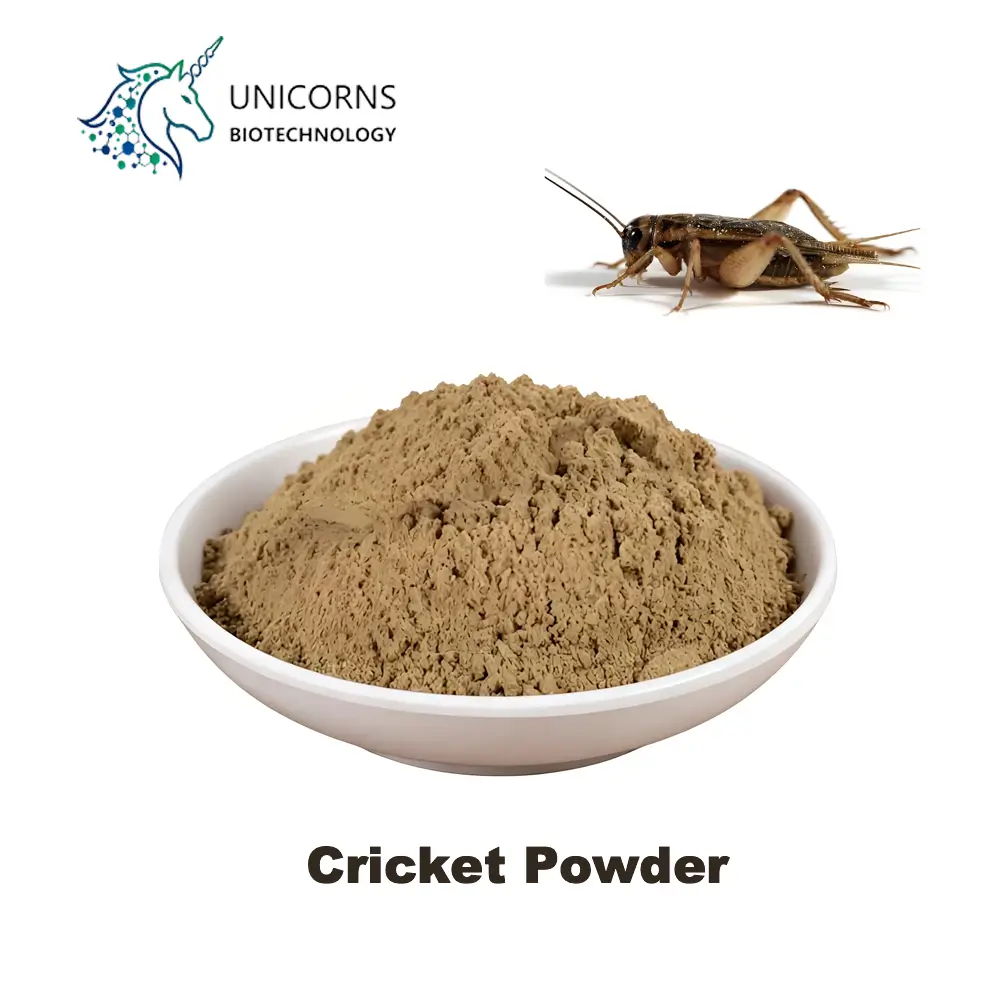
Bulk House Cricket Powder
| Product Name | House Cricket Powder |
| Other Names | Cricket Protein Powder, Cricket Flour, Acheta domesticus Powder, Dried Cricket Powder, Freeze-Dried Cricket Powder, Whole Cricket Powder, Full-Fat Cricket Powder, Defatted Cricket Powder, Partially Defatted Cricket Powder, Acheta domesticus Partially Defatted Powder, Edible Cricket Powder, Edible Insect Protein Powder, Cricket Meal, Ground House Cricket, Acheta Powder |
| Source | Acheta domesticus |
| Drying Method | Freeze Dried or Spray Dried Optional |
| Appearance | Brown Yellow Fine Powder |
| Country of Origin | China |
| Applications | animal feed, supplements |
| Documents Available | COA, Specification, MSDS, Allergen Statement, Non-GMO Statement |
| Manufacturing Capability | 600 tons annually |
| OEM services | Custom formulation, capsules, tablets, blends, contract manufacturing, softgels |
| Bulk Packaging | 20kg Vacuum Sealed Foil Bags, 25kg/drum, or custom bulk packaging |
Unicorns Biotechnology is a bulk Cricket Powder manufacturer in China. We supply dried and finely ground house cricket ingredients to food manufacturers, nutrition brands, ingredient distributors, pet food companies, feed mills, private label brands, and contract manufacturers.
Our factory supports annual production of up to 600 tons. Available options include whole Cricket Powder, full-fat powder, and partially defatted cricket protein. Buyers can specify the drying method, protein content, fat range, powder mesh, packaging, and test plan.
Cricket Powder provides concentrated protein, essential amino acids, natural fatty acids, chitin, vitamins, and minerals. It can be used in protein bars, bakery mixes, pasta, savoury foods, meat alternatives, pet nutrition, aquaculture feed, and poultry feed.
Unicorns Biotechnology also supplies Yellow Mealworm Powder, Black Soldier Fly Larvae Powder, and Black Ant Powder. Custom blends, OEM packing, private labels, and export documents are available for qualified projects.
What Is Cricket Powder?
Cricket Powder is a finely milled ingredient made from cleaned, heat-treated, dried, and ground crickets. The product on this page comes from the house cricket, scientifically known as Acheta domesticus.
It is also called:
- House Cricket Powder
- Cricket Protein Powder
- Cricket Flour
- House Cricket Flour
- Acheta domesticus Powder
- Dried Cricket Powder
- Freeze-Dried Cricket Powder
- Whole Cricket Powder
- Full-Fat Cricket Powder
- Defatted Cricket Powder
- Partially Defatted Cricket Powder
- Edible Cricket Powder
- Cricket Meal
- Edible Insect Protein Powder
Cricket Powder does not have one CAS number. It is a whole biological ingredient, not a single chemical substance. It contains proteins, fats, carbohydrates, chitin, minerals, and other natural compounds.
The standard product is a brown-yellow fine powder with a mild roasted, nutty, or savoury aroma. It disperses in water but does not form a clear solution. Protein, chitin, fat, and mineral particles remain suspended.
An 80-mesh powder works well in dry blends, bakery premixes, bars, pasta, and feed products. Coarser or finer milling can be supplied for extrusion, beverages, meat analogues, and pet food.
Unicorns Biotechnology supplies bulk Cricket Powder with custom protein targets, particle sizes, packaging, third-party tests, private labels, and OEM formulation services.
Types of Cricket Powder
Cricket Powder is not one fixed ingredient. Protein, fat, flavour, shelf life, and processing behaviour change with the product grade.
Whole Cricket Powder
Whole Cricket Powder is made by drying and grinding the complete house cricket. It retains the natural balance of protein, oils, chitin, and minerals.
EU specifications for dried or powdered whole Acheta domesticus list 55% to 65% crude protein, 29% to 35% fat, 3% to 6% dietary fibre, and 5.3% to 10% chitin.
This grade suits bakery products, protein foods, savoury snacks, pasta, pet food, and feed formulas where natural fat is acceptable.
Full-Fat Cricket Powder
Full-fat Cricket Powder retains most of the insect’s natural oil. It has a richer taste, higher energy value, and softer mouthfeel than defatted powder.
Its higher fat level requires good oxidation control. Peroxide value, oxygen exposure, storage temperature, and packaging barrier should be checked during shelf-life testing.
Partially Defatted Cricket Powder
Partially defatted Cricket Powder has part of the natural oil removed by mechanical pressing. This raises the relative protein content and lowers the total fat level.
The EU novel-food specification under Regulation (EU) 2023/5 sets crude protein at 74% to 78%, fat at 9% to 12%, moisture at 3% to 6%, crude fibre at 8% to 10%, and chitin at 4% to 8.5%.
This grade is suitable for protein bars, powdered nutrition products, dry mixes, meat alternatives, and protein-enriched foods.
Freeze-Dried Cricket Powder
Freeze-drying removes water at a low temperature and helps retain natural colour, aroma, and heat-sensitive nutrients. It creates a porous material that mills easily.
Freeze-dried Cricket Powder is often chosen for premium foods, research projects, nutrition formulas, and pet products.
Spray-Dried Cricket Powder
Spray-dried powder is produced from a homogenised cricket slurry. It provides a fine and even particle size for blending into powdered formulas.
The heat treatment, carrier status, protein level, and final solubility should be defined before production.
Common Edible Cricket Species
The word “cricket” does not identify one species. Commercial cricket ingredients may come from several species, and they should not be treated as interchangeable.
| Common Name | Scientific Name | Commercial Relevance |
|---|---|---|
| House cricket | Acheta domesticus | Main source used for this Cricket Powder page and covered by specific EU novel-food entries |
| Two-spotted cricket | Gryllus bimaculatus | Commonly farmed for food and feed in Asia |
| Banded cricket | Gryllodes sigillatus | Also called tropical house cricket and used in edible insect production |
| Jamaican field cricket | Gryllus assimilis | Used as an alternative farmed cricket species |
| Field cricket | Gryllus species | Broad commercial term that may cover several species |
House cricket, two-spotted cricket, banded cricket, and Jamaican field cricket appear in edible-insect production and product authentication research.
Our standard Cricket Powder is made from Acheta domesticus. The species should appear on the specification, COA, allergen statement, and customs documents.
A product made from another species cannot automatically use the same regulatory file, nutrition data, or legal status.
Is Cricket Powder Approved as Food in the European Union?
Yes. The European Union has authorised defined forms of Acheta domesticus as novel foods. However, EU approval is tied to specific product forms, specifications, use levels, labels, and authorised applicants.
It does not mean every Cricket Powder from every factory can automatically enter the EU food market.
Whole Frozen, Dried, and Powdered House Cricket
Commission Implementing Regulation (EU) 2022/188 authorised frozen, dried, and powdered forms of whole Acheta domesticus. The listed powder is made from thermally processed, freeze-dried, and ground whole house crickets.
The authorisation covers uses such as:
- Protein products
- Bread and rolls
- Bakery products
- Cereal bars
- Biscuits
- Pasta products
- Soups
- Sauces
- Meat preparations
- Meat alternatives
- Corn snacks
- Chocolate products
- Fermented milk products
The authorisation is based on protected data belonging to Fair Insects BV until 3 March 2027. During that period, another supplier needs its own legal authorisation, access rights, or another valid route to market.
Partially Defatted House Cricket Powder
Commission Implementing Regulation (EU) 2023/5 authorised Acheta domesticus partially defatted powder as a novel food. The authorised production process includes fasting, freezing, washing, thermal treatment, drying, mechanical oil extraction, and grinding.
Permitted food categories include multigrain bread, crackers, cereal bars, baked-product premixes, biscuits, pasta, sauces, pizza, meat analogues, soups, maize snacks, chocolate, nuts, oilseeds, and meat preparations. Maximum levels vary by food category.
This authorisation is based on protected data belonging to Cricket One Co. Ltd until 24 January 2028.
What European Buyers Need to Verify
A COA marked “food grade” does not prove that a shipment is covered by an EU novel-food authorisation.
Before buying Cricket Powder for Europe, confirm:
- The exact species is Acheta domesticus.
- The form is whole powder or partially defatted powder.
- The manufacturing process matches the relevant Union-list entry.
- The chemical and microbiological specifications match that entry.
- The intended food category and use level are authorised.
- The supplier has a valid legal route under the applicable data-protection conditions.
- The finished label contains the required ingredient name and allergy warning.
The European Commission confirms that house cricket forms and partially defatted house cricket powder are authorised novel foods, but authorisation remains product-specific and subject to Novel Food Regulation requirements.
Natural Nutrients in Cricket Powder
Cricket Powder is a whole-food protein ingredient. Its composition depends on species, feed, growth stage, drying method, and fat removal.
Protein and Amino Acids
Whole house cricket powder commonly contains about 55% to 65% crude protein. Partially defatted grades may contain 74% to 78% crude protein under the relevant EU specification.
Cricket protein contains essential amino acids, including:
- Leucine
- Lysine
- Isoleucine
- Valine
- Threonine
- Phenylalanine
- Histidine
- Methionine
- Tryptophan
The amino acid profile makes Cricket Powder useful in blended protein formulas. A batch-specific amino acid report should support nutrition claims.
Natural Fatty Acids
Whole Cricket Powder contains much more fat than partially defatted powder. Natural cricket oils commonly include oleic, linoleic, palmitic, and stearic acids.
Full-fat powder provides more energy and a richer flavour. Defatted powder gives a higher protein-to-fat ratio and may be easier to use in dry protein blends.
Chitin and Fibre
Chitin forms part of the cricket’s outer structure. EU specifications list 5.3% to 10% chitin in whole dried powder and 4% to 8.5% in partially defatted powder.
Chitin contributes insoluble material and affects texture, protein testing, digestibility, and water dispersion. It should not be promoted as a proven prebiotic without product-specific evidence.
Vitamins and Minerals
Cricket Powder naturally contains minerals such as iron, zinc, calcium, potassium, magnesium, phosphorus, copper, and manganese. It may also contain B vitamins.
Exact levels vary by batch. Claims such as “high in iron” or “source of vitamin B12” require laboratory data and must meet the rules of the destination market.
Cricket Powder Specifications
Unicorns Biotechnology supplies Cricket Powder from Acheta domesticus in freeze-dried or spray-dried forms. The standard grade is non-GMO, antibiotic-free, and non-irradiated.
The standard specification sets loss on drying at no more than 10.0% and ash at no more than 5.0%. Total heavy metals are limited to 10 ppm. Lead and arsenic are each limited to 2 ppm, cadmium to 1 ppm, and mercury to 0.1 ppm.
Total aerobic microbial count is limited to 10,000 CFU/g. Yeast and mould are limited to 100 CFU/g. E. coli must be absent per gram, while Salmonella must be absent in 10 grams.
| Item | Standard Specification |
|---|---|
| Product name | House Cricket Powder |
| Core commercial name | Cricket Powder |
| Scientific source | Acheta domesticus |
| Country of origin | China |
| Drying method | Freeze-dried or spray-dried |
| Appearance | Brown-yellow fine powder |
| Particle size | 80 mesh standard, custom sizes available |
| GMO status | Non-GMO |
| Antibiotics | Antibiotic-free |
| Irradiation | Non-irradiated |
| Added colours | None |
| Added preservatives | None unless agreed |
| Loss on drying | ≤10.0% |
| Ash | ≤5.0% |
| Total heavy metals | ≤10 ppm |
| Lead | ≤2 ppm |
| Arsenic | ≤2 ppm |
| Cadmium | ≤1 ppm |
| Mercury | ≤0.1 ppm |
| Total aerobic microbial count | ≤10,000 CFU/g |
| Yeast and mould | ≤100 CFU/g |
| Escherichia coli | Absent/g |
| Salmonella | Absent/10 g |
| Standard mesh | 80 mesh |
| Packaging | PE-lined bags or fibre drums |
| Custom service | Protein, fat, mesh, testing, and packaging |
Protein can be tested by Kjeldahl or Dumas methods. Heavy metals can be measured by ICP-MS or atomic absorption. Microbiological methods should be agreed according to the intended food or feed market.
Mechanical defatting does not require an extraction solvent. When solvent extraction is requested, the solvent type and residual limit must be written into the purchase specification.
EU Novel Food Specification Benchmarks
The following figures are regulatory benchmarks. They are not automatic specifications for every Cricket Powder supplied by Unicorns Biotechnology.
| Parameter | Whole Dried Cricket Powder | Partially Defatted Cricket Powder |
|---|---|---|
| Crude protein, N × 6.25 | 55% to 65% | 74% to 78% |
| Fat | 29% to 35% | 9% to 12% |
| Moisture | ≤5% | 3% to 6% |
| Dietary or crude fibre | 3% to 6% | 8% to 10% |
| Chitin | 5.3% to 10% | 4% to 8.5% |
| Ash | 2.9% to 5.1% | ≤5.6% |
| Peroxide value | ≤5 meq O₂/kg fat | ≤5 meq O₂/kg fat |
| Lead | ≤0.05 mg/kg | ≤0.1 mg/kg |
| Cadmium | ≤0.06 mg/kg | ≤0.025 mg/kg |
| Total aerobic count | ≤100,000 CFU/g | ≤100,000 CFU/g |
| Yeast and mould | ≤100 CFU/g | ≤100 CFU/g |
| E. coli | ≤50 CFU/g | ≤50 CFU/g |
| Salmonella | Absent in 25 g | Not detected in 25 g |
| Listeria monocytogenes | Absent in 25 g | Not detected in 25 g |
| Bacillus cereus | ≤100 CFU/g | ≤100 CFU/g |
The benchmarks come from Regulations (EU) 2022/188 and 2023/5. The regulations also set limits for mycotoxins, dioxins, PCBs, and other parameters.
For an EU food project, request a dedicated specification rather than relying on our general commercial standard.
Benefits of Cricket Powder in Food Formulation
Concentrated Protein
Cricket Powder adds a high amount of protein without requiring a large inclusion volume. Whole and defatted grades allow formulators to choose a suitable protein-to-fat ratio.
It works best as one part of a balanced food or nutrition formula.
Complete Amino Acid Profile
House cricket protein contains all nine essential amino acids. It can complement cereal, legume, dairy, and plant protein systems.
An amino acid report is recommended for sports nutrition and high-protein label claims.
Natural Micronutrients
Cricket Powder can contribute iron, zinc, magnesium, phosphorus, potassium, and B vitamins.
The finished product should be tested before making any mineral or vitamin claim.
Mild Savoury Taste
The powder has a mild roasted, nutty, or umami flavour. It pairs well with grains, cocoa, nuts, tomato, herbs, spices, and savoury seasonings.
Whole powder has a richer flavour. Partially defatted powder usually has a lighter mouthfeel.
Flexible Protein and Fat Options
Whole Cricket Powder brings protein and natural oils. Partially defatted powder brings more protein with less fat.
This choice helps manufacturers manage texture, energy value, flavour, oxidation, and processing behaviour.
Cricket Powder vs Whey Protein
Cricket Powder and whey protein are both used to raise protein content, but they are different ingredients.
| Comparison | Cricket Powder | Whey Protein |
|---|---|---|
| Source | Whole house crickets | Milk |
| Main form | Whole-food powder | Protein concentrate or isolate |
| Typical protein | 55% to 78%, depending on grade | Often 70% to 90% |
| Natural fat | Moderate to high in whole powder | Usually low in isolate |
| Chitin | Present | Absent |
| Taste | Roasted, nutty, or savoury | Mild dairy flavour |
| Water solubility | Dispersible, not fully soluble | Usually more soluble |
| Allergen concern | Cricket, crustacean, mollusc, and mite cross-reactions | Milk |
| Best uses | Bars, pasta, bakery, savoury foods, meat alternatives | Drinks, shakes, bars, and dairy products |
| EU status | Novel food with defined conditions | Conventional food ingredient |
Cricket Powder should not be marketed as a direct one-for-one replacement for whey. Flavour, suspension, fat, fibre, allergen control, and protein content differ.
Cricket Powder Manufacturing Process
Good Cricket Powder starts with controlled farming, clean feed, and clear species identification.
House crickets are raised on an approved feed under managed temperature and hygiene conditions. Feed quality affects nutrients, allergens, heavy metals, pesticides, and mycotoxins in the final material.
The crickets are harvested at the selected growth stage. A fasting period may be used to clear their digestive contents. They are then sorted, washed, and thermally treated to lower the microbial load.
Whole crickets are frozen, freeze-dried, hot-air dried, or processed through another validated drying method. For partially defatted powder, natural oil is removed through mechanical pressing.
The dried material is milled, sieved, passed through metal detection, sampled, and tested. Approved batches are packed in sealed, moisture-resistant packaging.
A typical manufacturing flow is:
Controlled rearing → Harvesting → Fasting → Sorting and washing → Thermal treatment → Drying → Optional mechanical defatting → Milling → Sieving → Metal detection → Laboratory testing → Packaging
The specific EU process for partially defatted house cricket powder includes a 24-hour fasting period, freezing, washing, thermal processing, drying, mechanical oil extraction, and grinding.
Main Applications of Cricket Powder
Cricket Powder is used in food, nutrition, pet food, and feed products. Each market requires its own grade, specification, label, and regulatory review.
Protein Bars and Nutrition Foods
Bakery, Pasta, and Savoury Products
Meat Alternatives and Pet Food
Aquaculture and Poultry Feed
Where to Buy Bulk Cricket Powder
Henan Unicorns Biotechnology Co., Ltd. supplies bulk Cricket Powder from its factory in China. We serve food manufacturers, nutrition brands, ingredient distributors, pet food companies, feed mills, and private label businesses.
Available options include whole Cricket Powder, full-fat Cricket Powder, defatted Cricket Powder, and custom protein grades. Food projects and feed projects are handled under separate specifications.
| Supply Advantage | B2B Service |
|---|---|
| Direct factory | Factory quotation and production support |
| Annual capacity | Up to 600 tons |
| Source species | Acheta domesticus |
| Available grades | Whole, full-fat, and partially defatted |
| Drying options | Freeze-dried or spray-dried |
| Custom particle size | 80 mesh standard, other sizes available |
| Standard testing | Identity, protein, fat, moisture, ash, heavy metals, and microbiology |
| Extended testing | Amino acids, fatty acids, allergens, pesticides, mycotoxins, and oxidation |
| Technical documents | COA, SDS or MSDS, specification, process flow, non-GMO and allergen statements |
| Third-party testing | Independent reports can be arranged |
| OEM services | Custom blends, retail packing, and private labels |
| Packaging | PE-lined bags, fibre drums, or custom packs |
| Samples | Free evaluation sample, subject to courier terms |
| Export support | Commercial documents and technical files |
| Certificates | GMP, HACCP, Halal, or Kosher documents subject to scope |
Send us the intended market, product application, target protein, fat range, annual volume, destination country, particle size, and required tests. We will prepare a matching specification, quotation, sample, and document list.
Frequently Asked Questions (FAQs)
Is Cricket Powder the same as House Cricket Powder?
Cricket Powder is the broad commercial term. House Cricket Powder identifies the species as Acheta domesticus.
Our page uses Cricket Powder as the core keyword, while the product title keeps House Cricket for species clarity.
Is Cricket Powder approved as food in Europe?
Defined frozen, dried, whole-powder, and partially defatted forms of Acheta domesticus are authorised as EU novel foods.
The authorisations do not automatically cover every manufacturer. The product, production process, specification, use, applicant rights, and label must match the applicable Union-list entry.
Can Unicorns Biotechnology automatically sell its Cricket Powder as an EU novel food?
Not based on a standard COA alone. EU access requires a valid legal route under the relevant authorisation.
European buyers should complete a regulatory match covering identity, process, specifications, uses, data protection, and labelling before purchase.
What is the protein content of Cricket Powder?
Whole Cricket Powder commonly targets about 55% to 65% crude protein. Partially defatted grades may target 74% to 78%.
The final value depends on the cricket batch, moisture, fat removal, and analytical method.
What is the difference between whole and partially defatted Cricket Powder?
Whole powder retains most natural cricket oil. It has more fat, more energy, and a richer flavour.
Partially defatted powder has some oil removed. It contains more protein relative to fat and works well in protein-enriched products.
Does Cricket Powder contain all essential amino acids?
House cricket protein contains all nine essential amino acids. The exact amounts vary by batch.
Buyers should request an amino acid profile when developing sports nutrition or high-protein products.
Is Cricket Powder gluten-free?
The cricket itself does not contain wheat gluten. However, wheat or other gluten-containing grains may be used in cricket feed.
A gluten-free claim requires a substrate review, cross-contact controls, and finished-product testing.
Is Cricket Powder suitable for people with shellfish allergies?
It may not be suitable. Cross-reactions can occur in people allergic to crustaceans, molluscs, and dust mites.
Food products must carry the applicable allergy warning in markets where required.
What particle size is available?
The common specification is 80 mesh. Coarser and finer sizes can be produced for extrusion, bakery, beverages, bars, and feed.
Particle distribution can be confirmed by sieve testing.
Can you provide a free sample?
Yes. Samples are available for identity testing, nutrition analysis, colour checks, flavour trials, blending, baking, and extrusion tests.
Courier charges and sample size depend on the destination.
Do you offer OEM and private label services?
Yes. We support custom Cricket Powder blends, nutrition powders, food premixes, pet food formulas, feed products, retail packs, and private labels.
Do you provide free samples before a bulk order?
Yes. Free evaluation samples are available for qualified supplement brands, manufacturers and ingredient distributors. Buyers normally cover international courier costs. Samples can be supplied with a specification sheet and recent COA.