
Bulk Cholesterol Powder Manufacturer in China
Home >> Bulk Ingredients >> Glandular Extracts >> Wholesale Cholesterol Powder
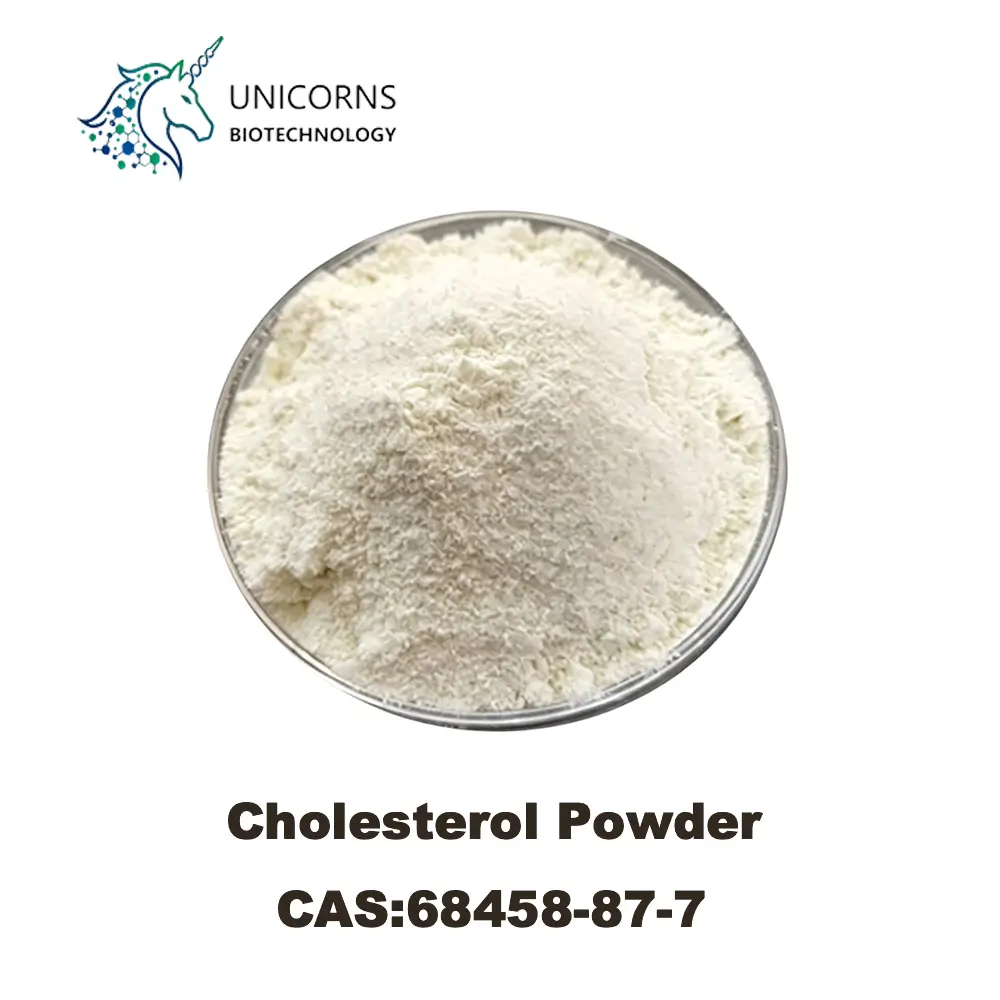
Bulk Cholesterol Powder
| Product Name | Cholesterol Powder |
| Other Names | Lanolin Cholesterol, Fish Oil Cholesterol, 5-cholesten-3β-ol, Wool Grease Cholesterol, Marine Cholesterol, Cholesterin, Cholesterine, Cholesteryl Alcohol, 5-Cholesten-3β-ol, 3β-Hydroxy-5-cholestene, NF Grade Cholesterol, Feed Grade Cholesterol |
| Source | Lanolin or Fish Oil |
| Appearance | White plate crystal |
| Testing Standard | USP-NF Standard and EP Standard |
| Applications | animal feed, supplements |
| Manufacturing Capability | 600 tons annually |
| OEM services | Custom formulation, capsules, tablets, blends, contract manufacturing, softgels |
| Bulk Packaging | 20kg Vacuum Sealed Foil Bags, 25kg/drum, or custom bulk packaging |
Henan Unicorns Biotechnology Co., Ltd. is a wholesale Cholesterol Powder manufacturer and supplier in China. We supply lanolin-derived cholesterol, fish oil cholesterol, feed-grade cholesterol, and plant-derived Vegan Cholesterol to pharmaceutical manufacturers, vitamin producers, aquaculture feed mills, ingredient distributors, research companies, medical nutrition brands, and contract manufacturers.
Our factory supports annual production and export capacity of up to 600 tons across cholesterol and related sterol ingredients. Available services include custom assay, source selection, powder mesh, carrier system, drum packaging, private-label packing, and batch-specific quality testing.
In addition to bulk cholesterol raw materials, Unicorns Biotechnology supplies related glandular extracts and derivatives, including 7-Dehydrocholesterol Powder, Vegetarian 7-Dehydrocholesterol, Vegetarian Cholesterol Powder, Bilirubin Powder, Bile Acids Powder, Ox Bile Extract Powder, Porcine Bile Extract, and Tauroursodeoxycholic Acid Powder.
What Is Cholesterol?
Cholesterol is a naturally occurring, fat-like sterol found in animal cells. It is a 27-carbon compound with a four-ring steroid structure, a hydrocarbon side chain, and a hydroxyl group. Its chemical name is 5-cholesten-3β-ol, and it is an essential structural component of cell membranes and a biological precursor for steroid hormones, bile acids, and the vitamin D pathway.
In industrial supply, Cholesterol Powder normally refers to purified crystalline cholesterol used as a pharmaceutical raw material, chemical intermediate, feed ingredient, analytical reagent, or formulation component. It is not a cholesterol-lowering supplement.
Specially formulated, non-flavored enteral cholesterol products may be used for individuals with certain sterol synthesis disorders who cannot obtain an appropriate cholesterol intake from a normal diet. However, a bulk industrial grade should not be marketed as a ready-to-consume medical nutrition product unless it has been specifically formulated, tested, registered, and released for that purpose. Clinical cholesterol supplementation for disorders such as Smith-Lemli-Opitz syndrome should only be managed by qualified healthcare professionals.
Other Names for Cholesterol Powder
Cholesterol Powder is also known as:
Lanolin Cholesterol, Wool Grease Cholesterol, Fish Oil Cholesterol, Marine Cholesterol, Cholesterin, Cholesterine, Cholesteryl Alcohol, 5-Cholesten-3β-ol, 3β-Hydroxy-5-cholestene, NF Grade Cholesterol, Feed Grade Cholesterol, Vegan Cholesterol, Vegetarian Cholesterol, and Plant-Derived Cholesterol.
The source name should always be stated clearly because lanolin, fish oil, and phytosterol-derived cholesterol serve different buyer preferences and regulatory documentation requirements.
The CAS number, molecular formula, and molecular weight identify cholesterol as a specific chemical substance regardless of whether its starting material is lanolin, fish oil, or plant phytosterols. Source origin affects traceability and marketing status, but properly purified cholesterol has the same basic molecular identity.
Natural Food Sources of Cholesterol
Cholesterol naturally occurs in foods of animal origin, including egg yolk, organ meat, meat, poultry, fish, shellfish, and dairy products. Plants primarily contain phytosterols rather than cholesterol.
Therefore, Vegan Cholesterol is not simply cholesterol extracted directly from soybean or another plant. It is generally produced by isolating plant phytosterols and converting them through controlled processing into cholesterol with the same C₂₇H₄₆O molecular structure.
Solubility and Bioavailability
Cholesterol is lipophilic and does not dissolve in water. Its absorption and performance depend on particle size, dispersion, carrier selection, dietary fat, bile acids, and the design of the final formulation. For enteral or nutritional products, manufacturers may use an oil-based suspension, emulsifier, phospholipid system, or another validated delivery format rather than adding untreated crystalline cholesterol directly to an aqueous product.
Unicorns Biotechnology supplies wholesale bulk Cholesterol Powder with custom source, assay, particle size, carrier system, packaging, drum labels, export documents, and OEM services.
Cholesterol Powder Grades and Source Options
Unicorns Biotechnology supplies different cholesterol grades according to the intended pharmaceutical, feed, nutritional, or industrial application. Buyers should select the grade by assay, source, pharmacopoeial requirements, carrier composition, residual solvent limits, microbiological requirements, and destination-market regulations.
Lanolin Cholesterol NF Grade
Lanolin Cholesterol is extracted and purified from wool grease sterol fractions. It is generally supplied as a white, odorless crystalline powder containing at least 95% cholesterol, while the current attached specification provides an assay of not less than 97.0%.
This grade is tested against agreed USP-NF or EP parameters and is commonly purchased as a starting sterol for pharmaceutical processing, vitamin D3 manufacturing, steroid intermediate production, artificial bezoar formulations, and other controlled industrial applications.
Standard packaging options include 25 kg drums and, subject to order requirements, 50 kg drums. The attached standard specification confirms 25 kg drum packaging.
Lanolin Feed Grade Cholesterol
Lanolin Feed Grade Cholesterol is available with typical cholesterol contents of 96.5%, 90%, and 80%. It is formulated as a free-flowing white powder by blending purified cholesterol with calcium carbonate, silica, or an agreed carrier system.
The carrier improves flowability, dispersion, weighing accuracy, and distribution within premixes and compound feed. This grade is mainly intended for aquaculture feed, especially formulas developed for shrimp, prawns, crabs, and other species with specific dietary sterol requirements.
Fish Oil Feed Grade Cholesterol
Fish Oil Feed Grade Cholesterol is produced from marine oil sterol fractions and is typically standardized to 90% cholesterol. The remaining portion consists of calcium carbonate, silica, or another approved feed carrier used to improve flowability and mixing performance.
It provides a marine-origin option for aquaculture feed manufacturers that prefer fish-derived raw materials or need an alternative to lanolin cholesterol. Source traceability, fish species information, allergen documentation, oxidation parameters, and feed compliance documents can be prepared according to the order.
Plant-Derived Vegan Cholesterol
Vegan Cholesterol, also called Vegetarian Cholesterol or Plant-Derived Cholesterol, is manufactured from phytosterol starting materials rather than lanolin, fish oil, or other animal-derived sterols.
Plant-derived grades can be developed from non-GMO soybean phytosterols and provide several source-related advantages:
- No lanolin, wool grease, fish oil, or other animal-derived starting material
- TSE and BSE are not applicable to the plant starting material
- Suitable for vegan or vegetarian product positioning when supported by complete traceability
- Non-GMO documentation available for qualified grades
- Consistent molecular identity after conversion and purification
“Free from animal gene residues” is not a conventional chemical specification for purified cholesterol. A more accurate B2B statement is that the manufacturing route uses no animal-derived starting material and is supported by source, non-GMO, and TSE/BSE documentation.
Safety and suitability still depend on purity, impurities, residual solvents, microbiology, intended use, dosage, and local regulatory requirements. A plant source alone should not be treated as proof that every grade is suitable for food, pharmaceutical, or clinical use.
Available Cholesterol Powder Grades
| Grade | Source | Typical Assay | Composition | Main Applications | Packaging |
| NF Grade Cholesterol | Lanolin | ≥95% or custom ≥97% | Purified cholesterol | Vitamin D3, steroid intermediates, artificial bezoar, pharmaceutical processing | 25 kg or 50 kg/drum |
| High-Assay Feed Grade | Lanolin | 96.5% | Cholesterol with flow carriers if required | Concentrated aquaculture premixes | 25 kg/drum |
| Feed Grade Cholesterol | Lanolin | 90% | Cholesterol, calcium carbonate, silica | Shrimp and aquatic feed | 25 kg/drum |
| Feed Grade Cholesterol | Lanolin | 80% | Cholesterol, calcium carbonate, silica | General aquaculture feed | 25 kg/drum |
| Fish Oil Cholesterol | Fish oil | 90% | Cholesterol, calcium carbonate, silica | Marine-origin aquaculture feed | 25 kg/drum |
| Vegan Cholesterol | Plant phytosterols | Customized | Purified plant-derived cholesterol | Vegan pharmaceutical, nutrition, and industrial formulations | Customized |
Cholesterol Composition and Carrier Systems
Cholesterol is a defined single chemical substance rather than a botanical extract containing multiple active compounds. Its main functional component is cholesterol itself, so composition should be explained by grade, assay, related sterols, impurities, and carrier system rather than by vitamins or nutrient percentages.
Purified Cholesterol Grades
NF and high-purity grades typically contain at least 95% cholesterol. The attached Unicorns Biotechnology specification establishes an assay of not less than 97.0%. The remaining fraction may include moisture, closely related sterols, process-related impurities, and trace residues controlled through the agreed specification and analytical methods.
Feed Grade Cholesterol Premixes
Feed grades may contain 96.5%, 90%, or 80% cholesterol. The approximate remaining 3.5%, 10%, or 20% consists of the approved carrier system and controlled manufacturing variation.
Calcium carbonate is used as a mineral carrier and diluent, while silica supports flowability and reduces caking. The exact ratio between calcium carbonate and silica should be confirmed in the formulation sheet or batch documentation rather than assumed from the cholesterol assay.
Source-Related Sterol Profile
Lanolin and fish oil contain cholesterol together with naturally occurring related sterols. Purification, crystallization, and analytical control are used to increase cholesterol concentration and limit unwanted sterol impurities.
Plant-derived cholesterol begins with phytosterols, but the final purified molecule is converted into cholesterol. Buyers requiring animal-free status should review the complete manufacturing flow chart and source statement instead of relying only on the final chemical name.
Cholesterol Powder Specifications
Unicorns Biotechnology supplies lanolin-derived or fish oil-derived Cholesterol Powder tested against agreed USP-NF and EP parameters. The standard product appears as white plate-like crystals, has an assay of at least 97.0%, a melting range of 147°C to 150°C, specific rotation from −34° to −38°, loss on drying not more than 0.3%, and residue on ignition not more than 0.1%.
The product is insoluble in water, slightly soluble in alcohol, and soluble in ether, chloroform, and acetone. Batch-specific testing can include identification, assay, related sterols, moisture, ignition residue, residual solvents, heavy metals, microbiology, particle size, and source verification according to the grade and application.
Standard packaging is 25 kg per drum. COA, SDS or MSDS, source statement, allergen statement, non-GMO statement, TSE/BSE statement, residual solvent report, manufacturing flow chart, and third-party laboratory reports can be provided when applicable.
Standard Cholesterol Specification
| Test Item | Specification |
| Product name | Cholesterol |
| Source | Lanolin or fish oil |
| Testing standard | USP-NF and EP parameters |
| Country of origin | China |
| Appearance | White plate-like crystals |
| Solubility characteristics | Soluble in ether, chloroform, and acetone; slightly soluble in alcohol; insoluble in water |
| Solution clarity | No sediment or turbidity |
| Melting range | 147°C–150°C |
| Specific rotation | −34° to −38° |
| Loss on drying | ≤0.3% |
| Residue on ignition | ≤0.1% |
| Acidity | ≤0.3 |
| Assay | ≥97.0% |
| Standard particle size | 80 mesh or customized |
| Packaging | 25 kg/drum |
The table reflects the attached product specification. Any additional limits for heavy metals, residual solvents, related sterols, microbial count, or endotoxins should be established in a buyer-approved specification before commercial production.
Cholesterol Powder vs Cholestyramine Powder
Cholesterol Powder and Cholestyramine Powder are completely different substances with opposite commercial and physiological purposes.
Cholesterol Powder is the sterol itself. It is purchased as an industrial raw material, feed ingredient, formulation component, chemical intermediate, or specialized nutrition ingredient.
Cholestyramine is a synthetic anion-exchange resin and a prescription drug active. It remains in the gastrointestinal tract, binds bile acids, and increases their elimination. This causes the body to convert more cholesterol into replacement bile acids, which can reduce circulating LDL cholesterol. Cholestyramine is not cholesterol and does not supply cholesterol to the body.
Detailed Comparison
| Comparison Item | Cholesterol Powder | Cholestyramine Powder |
| Substance | Cholesterol itself | A synthetic anion-exchange resin |
| Chemical class | Sterol and steroid alcohol | Cross-linked polymeric resin |
| Common CAS number | 57-88-5 | 11041-12-6 |
| Molecular identity | Defined molecule, C₂₇H₄₆O | Polymeric resin rather than a simple sterol molecule |
| Main source | Lanolin, fish oil, or converted plant phytosterols | Synthetic chemical manufacturing |
| Typical appearance | White crystalline powder or plate-like crystals | Yellow, cream, or pale-yellow formulated powder |
| Water behavior | Insoluble in water | Hydrophilic but insoluble in water |
| Gastrointestinal absorption | Cholesterol may be absorbed and metabolized | Resin is not absorbed from the digestive tract |
| Primary function | Supplies cholesterol or serves as a sterol raw material | Binds bile acids in the intestine |
| Effect on bile acids | Cholesterol is a precursor used to produce bile acids | Removes bile acids by forming an insoluble complex |
| Effect on blood cholesterol | Not a cholesterol-lowering ingredient | Prescription agent used to reduce elevated LDL cholesterol |
| Typical applications | Vitamin D3 processing, steroid intermediates, artificial bezoar, aquaculture feed, research, specialized nutrition | Prescription treatment for hypercholesterolemia and certain bile-acid-related conditions |
| Product status | Industrial, feed, pharmaceutical raw material, or specialty formulation ingredient, depending on grade | Finished prescription drug active or formulated oral suspension |
| Common buyers | Vitamin manufacturers, pharmaceutical companies, feed mills, ingredient distributors, formulation companies | Pharmaceutical manufacturers, pharmacies, hospitals, and prescription medicine distributors |
| Typical formulation | Pure crystals or cholesterol blended with feed carriers | Resin mixed with flavor, sweeteners, suspending agents, or other excipients |
| Consumer use | Not intended for unsupervised general supplementation | Used under medical direction as a prescription medicine |
| Main quality parameters | Assay, sterol profile, melting range, rotation, moisture, residual solvents, source | Resin activity, drug content, excipients, dosage, pharmaceutical release requirements |
| Main safety concern | Grade suitability, source, purity, dosage, oxidation, and intended use | Constipation, medicine interactions, nutrient absorption, and other labeled precautions |
DailyMed identifies cholestyramine as the chloride salt of a basic anion-exchange resin. It is insoluble, is not absorbed from the gastrointestinal tract, and binds intestinal bile acids to form an excreted complex. Its labeled uses and precautions are entirely different from those of a bulk cholesterol ingredient.
Which Product Should a Buyer Choose?
Choose Cholesterol Powder when the formulation requires cholesterol as a sterol raw material, feed nutrient, pharmaceutical intermediate, artificial bezoar component, membrane lipid, or medically supervised nutrition ingredient.
Choose Cholestyramine only when manufacturing a regulated bile-acid-sequestrant medicine under an approved pharmaceutical process. It is not a substitute for cholesterol in vitamin D3, steroid, aquaculture, artificial bezoar, liposome, or enteral cholesterol formulations.
Cholesterol Benefits and Physiological Roles
Cholesterol is essential to normal human and animal physiology, but this does not mean that healthy consumers need cholesterol supplements. The following are established biological roles of cholesterol rather than general health claims for taking bulk Cholesterol Powder.
Cell Membrane Structure
Cholesterol is an important component of animal cell membranes. It helps regulate membrane organization, permeability, stability, and fluidity, allowing cells to maintain a functional boundary and support membrane-associated processes.
Steroid Hormone Production
Cholesterol is the biological starting material for steroid hormones, including cortisol, aldosterone, progesterone, estrogen, and testosterone. This relationship also explains its importance as an upstream sterol in pharmaceutical steroid processing.
Bile Acid Synthesis
The liver converts cholesterol through multiple enzymatic steps into primary bile acids. Bile acids then support the emulsification, digestion, and absorption of dietary fats and fat-soluble nutrients.
Vitamin D Production Pathway
Cholesterol supports the vitamin D pathway through related sterol intermediates. More precisely, 7-Dehydrocholesterol is the direct biological precursor that is converted into vitamin D3 under ultraviolet light.
In industrial manufacturing, cholesterol may serve as an upstream starting sterol that is first converted into 7-Dehydrocholesterol and subsequently processed into vitamin D3. Cholesterol should therefore not be described as turning directly into vitamin D3 in a single step.
Specialized Sterol Nutrition
Crystalline cholesterol may be incorporated into professionally formulated nutrition products for diagnosed sterol synthesis disorders. GeneReviews describes cholesterol supplementation using egg yolk or crystalline cholesterol in oil-based or aqueous suspension for Smith-Lemli-Opitz syndrome, while also noting that long-term randomized dietary evidence is limited. Such use requires medical and nutritional supervision.
Cholesterol Powder Manufacturing Process
The Cholesterol Powder manufacturing process depends on whether the starting material is lanolin, fish oil, or plant phytosterols. A typical process includes raw-material qualification, sterol fraction separation, saponification or conversion where required, solvent extraction, fractionation, purification, crystallization, washing, vacuum drying, milling, sieving, testing, and sealed packaging.
For lanolin cholesterol, wool grease is processed to separate the unsaponifiable sterol fraction before cholesterol is concentrated and crystallized. Fish oil cholesterol is recovered from qualified marine lipid fractions and purified to the required assay. Plant-derived cholesterol requires controlled conversion of isolated phytosterols, followed by purification to obtain the cholesterol molecule.
Feed grades undergo an additional blending stage. Purified cholesterol is mixed with calcium carbonate, silica, or another approved carrier to produce a free-flowing 96.5%, 90%, or 80% premix. Blend uniformity, flowability, assay, moisture, and particle distribution are checked before packing.
The precise solvents, catalysts, temperatures, purification stages, and in-process controls depend on the manufacturer’s validated process and the buyer-approved specification.
Cholesterol Powder Applications
Bulk Cholesterol Powder is used in pharmaceutical synthesis, aquaculture nutrition, bile-related formulations, specialty nutrition, and lipid research. The correct source and grade should be selected according to the destination market, regulatory category, purity requirement, and final dosage form.
Vitamin D3 and Steroid Intermediate Manufacturing
Artificial Bezoar Formulations
Aquaculture and Shrimp Feed
Specialized Nutrition and Lipid Formulations
Custom Cholesterol Powder and OEM Services
Unicorns Biotechnology supports custom development for pharmaceutical, feed, nutrition, and industrial buyers. Available options include:
| Custom Service | Options |
| Source | Lanolin, fish oil, or plant phytosterols |
| Assay | ≥97%, 96.5%, 90%, 80%, or custom |
| Grade | NF, EP-aligned, feed, research, or custom industrial grade |
| Carrier | Calcium carbonate, silica, or buyer-approved carrier |
| Particle size | Standard 80 mesh or customized |
| Packaging | 25 kg drum, 50 kg drum, or custom bulk packaging |
| Testing | Buyer-defined assay, impurities, solvents, heavy metals, and microbiology |
| Labels | Neutral labels, customer labels, and private-label drum markings |
| Documents | COA, SDS, origin statement, flow chart, non-GMO and TSE/BSE documents |
| OEM support | Premix development, blending, repacking, and export documentation |
Capsule, tablet, sachet, or finished enteral product projects require a separately approved food, pharmaceutical, or medical nutrition specification. Feed-grade premixes should not be repacked directly as human dietary supplements.
Where to Buy Bulk Cholesterol Powder
Henan Unicorns Biotechnology Co., Ltd. is a professional Cholesterol Powder factory and bulk supplier in China. We provide high-quality Lanolin Cholesterol, Fish Oil Cholesterol, NF Grade Cholesterol, Feed Grade Cholesterol, and Plant-Derived Vegan Cholesterol at factory-direct wholesale prices.
We serve pharmaceutical manufacturers, vitamin D3 producers, steroid intermediate companies, aquaculture feed mills, artificial bezoar manufacturers, animal nutrition companies, ingredient distributors, research suppliers, and contract formulation companies.
Why Choose Unicorns Biotechnology?
| Advantage | Details |
| Multiple source options | Lanolin, fish oil, and plant-derived sterol routes |
| Flexible specifications | ≥97%, 96.5%, 90%, 80%, and custom assay |
| Industrial production | Up to 600 tons annual production and export capacity across the ingredient line |
| Factory pricing | Direct bulk and wholesale prices from China |
| Quality verification | Batch-specific COA and optional third-party testing |
| Export support | SDS, MSDS, origin statement, flow chart, packing list, and customs documents |
| Custom manufacturing | Particle size, carriers, source, assay, packaging, and labeling |
| Sample service | Free evaluation sample available for qualified B2B projects |
| Related ingredients | 7-DHC, Vegan 7-DHC, bile acids, bilirubin, ox bile extract, and TUDCA |
| Long-term supply | Production scheduling and supply planning for repeat commercial orders |
Contact Unicorns Biotechnology for the latest Cholesterol Powder wholesale price, free sample, specification, COA, third-party test report, minimum order quantity, production lead time, and source-specific documentation.
Frequently Asked Questions (FAQs)
The following frequently asked questions explain the main differences between Cholesterol Powder and Cholestyramine Powder, available source options, grade selection, assay levels, applications, packaging, testing, and regulatory documents. They are designed to help pharmaceutical manufacturers, aquaculture feed producers, ingredient distributors, and formulation companies select the right cholesterol grade for vitamin D3 production, steroid intermediates, artificial bezoar, feed premixes, and other industrial uses.
Is Cholesterol Powder the same as cholestyramine?
No. Cholesterol Powder is purified cholesterol, while cholestyramine is a synthetic bile-acid-binding prescription resin. Cholesterol supplies or uses a sterol ingredient. Cholestyramine lowers circulating cholesterol by preventing intestinal bile-acid reabsorption.
Does Cholesterol Powder lower cholesterol?
No. Cholesterol Powder should not be marketed as a cholesterol-lowering supplement. Search results that describe a powder used to lower LDL cholesterol are normally referring to cholestyramine or another cholesterol-lowering product.
What sources of cholesterol are available?
Unicorns Biotechnology supplies cholesterol derived from lanolin and fish oil. Plant-derived Vegan Cholesterol produced from phytosterol starting materials is also available for qualified projects.
Is Lanolin Cholesterol vegan?
No. Lanolin is obtained from wool grease, so lanolin-derived cholesterol is animal-derived and is not suitable for vegan product positioning.
Is Fish Oil Cholesterol the same molecule as Lanolin Cholesterol?
After proper purification, both products contain cholesterol with CAS number 57-88-5 and molecular formula C₂₇H₄₆O. Their starting material, traceability, secondary sterol profile, allergen considerations, and customer acceptance may differ.
Is Vegan Cholesterol extracted directly from soybean?
Not exactly. Soybean phytosterols serve as plant-derived starting materials. They are isolated and converted through controlled processing into cholesterol, followed by purification and crystallization.
What is the difference between NF Grade and Feed Grade Cholesterol?
NF grade is a high-purity crystalline raw material tested against pharmaceutical quality parameters. Feed grade may be supplied as a standardized premix containing 96.5%, 90%, or 80% cholesterol with calcium carbonate, silica, or another feed carrier.
Can Cholesterol Powder be used in shrimp feed?
Yes, feed-grade cholesterol is commonly developed for aquaculture feed and premixes. The appropriate inclusion rate must be determined by the feed formulator according to species, life stage, total diet composition, applicable feed regulations, and nutritional targets.
Can cholesterol be used to produce vitamin D3?
Cholesterol can serve as an upstream industrial sterol. It is first converted into 7-Dehydrocholesterol, which is then transformed into vitamin D3 through controlled ultraviolet and thermal processing.
Is Cholesterol Powder a raw material for artificial bezoar?
Yes, cholesterol may be used as one component in artificial bezoar formulations. The required source, assay, impurity profile, and pharmacopoeial testing should be defined by the artificial bezoar manufacturer.
Is the standard ≥97% product suitable for injectable liposomes or LNPs?
Not automatically. Injectable liposome and lipid nanoparticle products may require much higher purity, defined related-substance limits, low endotoxin, controlled bioburden, elemental impurity limits, residual solvent control, and pharmaceutical manufacturing documentation. Suitability must be assessed against the customer’s complete specification.
What documents are available?
Available documents may include a batch-specific COA, SDS or MSDS, specification sheet, manufacturing flow chart, origin statement, allergen statement, non-GMO statement, TSE/BSE statement, residual solvent report, heavy metal report, microbiological report, and third-party test report.
Can Unicorns Biotechnology customize the particle size?
Yes. Standard 80-mesh powder and custom particle sizes are available according to downstream blending, feed, pharmaceutical, or formulation requirements.
How is Cholesterol Powder packed?
The standard specification uses 25 kg fiber drums with sealed inner packaging. Selected NF-grade orders may also be discussed in 50 kg drums or other customized bulk packaging.