
Bulk Bovine Spleen Peptide Powder Manufacturer in China
Home >> Bulk Ingredients >> Glandular Extracts >> Wholesale Bovine Spleen Peptide Powder
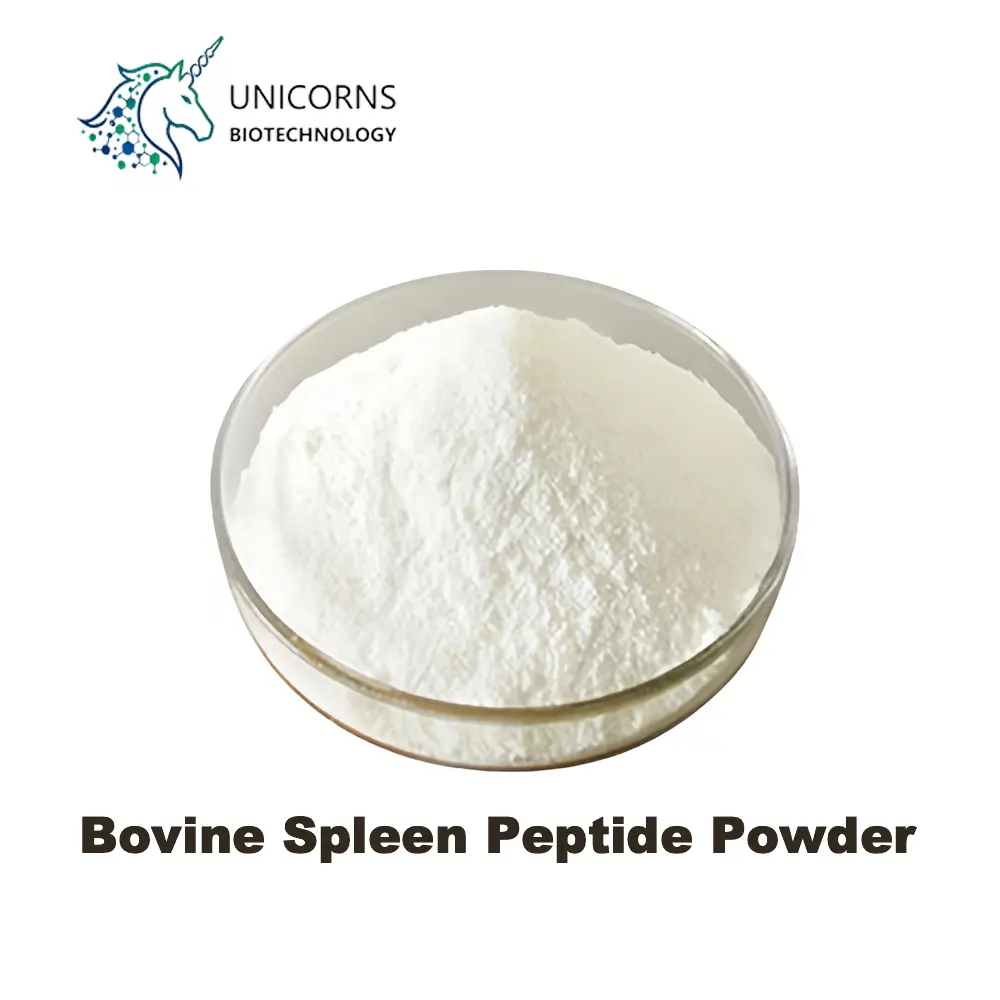
Bulk Beef Spleen Peptide Powder
| Product Name | Cholesterol Powder |
| Other Names | Lanolin Cholesterol, Fish Oil Cholesterol, 5-cholesten-3β-ol, Wool Grease Cholesterol, Marine Cholesterol, Cholesterin, Cholesterine, Cholesteryl Alcohol, 5-Cholesten-3β-ol, 3β-Hydroxy-5-cholestene, NF Grade Cholesterol, Feed Grade Cholesterol |
| Source | Lanolin or Fish Oil |
| Appearance | White plate crystal |
| Testing Standard | USP-NF Standard and EP Standard |
| Applications | animal feed, supplements |
| Manufacturing Capability | 600 tons annually |
| OEM services | Custom formulation, capsules, tablets, blends, contract manufacturing, softgels |
| Bulk Packaging | 20kg Vacuum Sealed Foil Bags, 25kg/drum, or custom bulk packaging |
Henan Unicorns Biotechnology Co., Ltd. is a wholesale Bovine Spleen Peptide Powder manufacturer in China. We supply bovine-derived spleen peptides to supplement brands, ingredient distributors, functional nutrition companies, contract manufacturers, private-label businesses and pet nutrition producers.
Our factory has an annual production capacity of 600 tons for animal-derived peptide ingredients. The standard bovine spleen hydrolysate contains at least 70% protein and 65% peptides on a dry basis. At least 85% of the measured peptide fraction has a relative molecular weight below 500 Da.
The product is suited to capsules, tablets, instant powders, sachets and selected liquid formulas. Unicorns Biotechnology also provides OEM formulation, particle-size adjustment, custom packaging and private labeling.
Related animal ingredients include Bovine Spleen Powder, Bovine Liver Peptide Powder, Bovine Liver Powder, Bovine Kidney Powder, Bovine Thymus Powder, Ox Bile Extract Powder and other glandular extracts and derivatives.
What Is Bovine Spleen Peptide?
Bovine Spleen Peptide is a hydrolyzed animal protein ingredient made from fresh, healthy bovine spleen tissue. Controlled protease digestion breaks large spleen proteins into shorter peptide chains and free amino acids.
It differs from ordinary bovine spleen powder, which normally contains dried whole tissue and mostly intact proteins. The peptide grade undergoes hydrolysis, separation, concentration and drying to produce a lighter-colored, water-soluble powder.
Other Names
Bovine Spleen Peptide Powder is also known as:
- Beef Spleen Peptide Powder
- Bovine-Derived Spleen Peptides
- Bovine Spleen Protein Hydrolysate
- Beef Spleen Protein Hydrolysate
- Hydrolyzed Bovine Spleen Protein
- Bovine Spleen Hydrolysate Powder
- Small-Molecule Bovine Spleen Peptides
- Bovine Spleen Oligopeptide Powder
- Enzymatically Hydrolyzed Beef Spleen
- Spleen Peptide Powder
Bovine Spleen Extract Powder is related but not always identical. An extract may contain soluble spleen components without a defined peptide level or molecular-weight profile.
Basic Product Information
| Property | Description |
|---|---|
| Source | Fresh, healthy bovine spleen |
| Country of origin | China |
| Product form | Enzymatically hydrolyzed protein powder |
| CAS number | No single universal CAS number |
| Molecular formula | No single molecular formula |
| Molecular weight | A distribution of many peptides |
| Key size specification | ≥85% of peptides below 500 Da |
| Appearance | White to light-yellow powder |
| Standard particle size | 80 mesh available, customizable |
| Water solubility | Soluble at pH 5.4 to 6.0 |
| Main use | Supplement, nutrition and specialty formulation ingredient |
The product does not have one CAS number or molecular formula because it is a mixture of peptides rather than one purified compound.
Solubility and Processing Stability
The standard grade is soluble in water at pH 5.4 to 6.0. Trace white particles may remain after dispersion due to peptide substances.
The specification states stability between pH 4.0 and 9.0. It also states tolerance for 30 minutes at 100°C and 20 minutes at 121°C. These values are useful for early formulation work, but finished products should still undergo pilot stability testing.
Unicorns Biotechnology can supply bulk raw material and OEM capsules, tablets, sachets and powder blends. Particle size, packaging, labels and selected quality limits can be adjusted for qualified orders.
Bovine Spleen and Protein Composition
Bovine Spleen Peptide Powder is defined by its peptide level, protein content and molecular-weight distribution. It should not be marketed as a standardized vitamin or mineral ingredient unless those nutrients are tested separately.
Main Composition
| Component | Standard specification | Role in the ingredient |
|---|---|---|
| Protein | ≥70.0%, dry basis | Main protein-derived material |
| Peptides | ≥65.0%, dry basis | Primary standardized fraction |
| Peptides below 500 Da | ≥85.0% of measured distribution | Small-molecule peptide profile |
| Moisture | ≤7.0% | Controls caking and storage quality |
| Ash | ≤9.0% | Limits total mineral residue |
| Amino acids and other solids | Remaining fraction | Result from hydrolysis and natural tissue solids |
The hydrolysate contains short peptide chains and free amino acids produced from bovine spleen proteins. The exact amino acid profile depends on the raw material, protease system and degree of hydrolysis.
Does It Contain Tuftsin?
Tuftsin is a specific tetrapeptide with the sequence threonine-lysine-proline-arginine. Early research identified it as a naturally occurring peptide associated with phagocytic activity.
However, this does not mean every bovine spleen hydrolysate contains a standardized or clinically active amount of tuftsin. Do not list tuftsin as an active ingredient unless it has been measured with a validated method.
The same rule applies to splenopentin, transfer factors and other named immune peptides. The current product is standardized for total peptides, protein and molecular-weight distribution, not for those individual compounds.
Vitamins, Minerals and Other Spleen Nutrients
Fresh bovine spleen naturally contains proteins, minerals and other tissue components. Hydrolysis, purification and drying can change their final levels.
The current specification does not quantify:
- Iron
- Vitamin B12
- Selenium
- Copper
- Heme compounds
- Immunoglobulins
- Transfer factors
Claims for these nutrients require batch-specific laboratory results.
Bovine Spleen Peptide Powder Specifications
Unicorns Biotechnology controls Bovine Spleen Peptide Powder through protein, peptide, molecular-weight, moisture, ash, solubility and stability testing. The standard product contains ≥70% protein, ≥65% peptides and ≥85% peptides below 500 Da.
Standard Specification Table
| Test Item | Specification |
|---|---|
| Product name | Bovine Spleen Peptide Powder |
| Part used | Fresh, healthy bovine spleen |
| Country of origin | China |
| Color | White to light yellow |
| Odor and taste | Characteristic, with no abnormal taste or odor |
| Physical state | Free-flowing powder |
| Foreign matter | No visible foreign impurities |
| Protein | ≥70.0%, dry basis |
| Peptides | ≥65.0%, dry basis |
| Peptides below 500 Da | ≥85.0% |
| Moisture | ≤7.0% |
| Ash | ≤9.0% |
| Water solubility | Soluble at pH 5.4 to 6.0 |
| pH stability | Stable from pH 4.0 to 9.0 |
| Heat stability | 30 minutes at 100°C |
| High-temperature stability | 20 minutes at 121°C |
| Particle size | 80 mesh available, customizable |
| Standard packaging | 25 kg fiber drums with inner liners |
| Origin | China |
Additional Quality Controls for Bulk Orders
The uploaded specification does not list heavy-metal, microbiological or residual-solvent limits. These should be added to the commercial purchasing specification before export.
| Quality Control | Recommended Requirement |
|---|---|
| Lead, arsenic, cadmium and mercury | Contract limits based on destination market |
| Total aerobic count | Batch microbiological test |
| Yeast and mold | Batch microbiological test |
| E. coli | Absent or within local limit |
| Salmonella | Absent in the required test quantity |
| Protein method | Kjeldahl, Dumas or validated equivalent |
| Peptide content | Validated peptide assay |
| Molecular-weight distribution | HPLC, SEC-HPLC or validated equivalent |
| Residual solvents | Statement based on the actual production process |
| Bovine tissue identity | Raw-material and species declaration |
| TSE and BSE status | Product-specific statement |
| Specified risk material | Non-SRM declaration where required |
| Amino acid profile | Available through third-party testing |
| Shelf life | Confirmed through product stability data |
A water-based enzymatic process may not use organic extraction solvents. The supplier should still issue a residual-solvent statement that matches the actual manufacturing flow.
Batch-specific COA, SDS, product specification, flow chart, GMO statement, allergen statement, country-of-origin document and third-party reports can be provided according to the order.
Bovine Spleen Peptide Powder vs Bovine Spleen Powder
Both ingredients come from bovine spleen, but they are not processed in the same way.
| Feature | Bovine Spleen Peptide Powder | Bovine Spleen Powder |
|---|---|---|
| Starting material | Fresh bovine spleen | Fresh or frozen bovine spleen |
| Main process | Enzymatic hydrolysis and purification | Drying and milling |
| Protein form | Short peptides and amino acids | Mostly intact proteins |
| Peptide standardization | ≥65% peptides | Usually not standardized |
| Molecular-weight control | ≥85% below 500 Da | Usually not tested |
| Protein content | ≥70%, dry basis | Depends on drying method |
| Water solubility | Soluble grade | Usually limited |
| Appearance | White to light yellow | Tan, brown or reddish-brown |
| Taste and odor | Characteristic peptide taste | Stronger organ taste |
| Best formats | Drinks, sachets, capsules and tablets | Capsules, tablets and organ blends |
| Whole-organ nutrients | May be reduced during processing | More representative of whole tissue |
Choose the peptide powder when solubility, defined peptide content and smaller molecular size matter. Choose whole spleen powder when the formula is based on minimally processed organ nutrition.
Bovine Spleen Peptides vs Bovine Liver Peptides
These products share a similar hydrolysis process but use different organ tissues.
| Feature | Bovine Spleen Peptides | Bovine Liver Peptides |
|---|---|---|
| Organ source | Bovine spleen | Bovine liver |
| Main product position | Spleen-derived peptide nutrition | Liver-derived peptide nutrition |
| Standard protein | ≥70% for the current grade | Grade dependent |
| Standard peptides | ≥65% for the current grade | Grade dependent |
| Common formulas | Immune-focused and organ blends | Liver and general organ blends |
| Color | White to light yellow | White to light yellow |
| Solubility | Water-soluble grade | Water-soluble grade |
Neither product should be described as repairing the matching human organ. The correct distinction is the source tissue and tested composition.
Is Bovine Spleen Peptide the Same as Transfer Factor?
No. Transfer factor is a separate commercial and research term used for certain low-molecular-weight immune-related preparations.
The current Bovine Spleen Peptide Powder is standardized by:
- Total protein
- Total peptides
- Peptides below 500 Da
- Moisture
- Ash
- Solubility
- Processing stability
It is not standardized by transfer-factor activity. Do not market it as “bovine transfer factor” without a separate identity test and supporting documentation.
Benefits of Bovine Spleen Peptide Powder
The strongest product claims come from its measured peptide composition and formulation properties. The supplied files do not contain human clinical studies on this exact grade.
Concentrated Peptide Nutrition
The powder supplies at least 65% peptides and 70% protein on a dry basis. It allows formulators to add spleen-derived peptides without relying only on dried whole-organ powder.
Small-Molecule Peptide Profile
At least 85% of the measured peptide fraction is below 500 Da. Enzymatic hydrolysis has already broken much of the source protein into short peptide chains.
This supports a digestibility-focused position. It does not prove direct absorption into cells or the repair of spleen tissue.
Water-Soluble Format
The powder dissolves in water within its stated pH range. This gives product developers more choices than conventional spleen powder.
It can be tested in instant beverages, oral liquids, sachets, dairy drinks and soluble nutrition blends. Some trace sediment may remain.
Useful for Immune-Nutrition Formulas
The spleen is associated with immune-cell activity, which explains its use in traditional organ-based nutrition concepts. Research has also identified individual immune-active peptides linked with spleen biology, including tuftsin.
This research provides formulation context, but it does not establish that the commercial powder treats infection, inflammation or immune disease. Finished-product claims must match local regulations and supporting evidence.
Broad Processing Range
The stated pH stability from 4.0 to 9.0 supports use in several dry and liquid systems. The listed heat tolerance also allows early testing in pasteurized or high-temperature processes.
Color, taste, peptide integrity and sediment should be checked in the complete finished formula.
Bovine Spleen Peptide Powder Manufacturing Process
Bovine Spleen Peptide Powder is produced through controlled enzymatic hydrolysis. The process converts spleen tissue proteins into a peptide-rich, water-soluble powder.
1. Bovine Spleen Selection
Fresh, healthy bovine spleens are sourced from qualified processing facilities. Each lot is checked for tissue identity, freshness and veterinary status.
2. Cleaning and Trimming
Blood residue, connective tissue and unwanted material are removed. The cleaned spleen is prepared under controlled hygienic conditions.
3. Low-Temperature Homogenization
The raw tissue is minced and homogenized into a uniform slurry. Temperature control helps maintain protein quality before hydrolysis.
4. Degreasing
Native fat is reduced to support powder stability, filtration and taste control.
5. Protease-Directed Hydrolysis
Selected food-grade proteases break larger proteins into peptides. Temperature, pH, enzyme level and reaction time control the final peptide profile.
6. Enzyme Inactivation
Controlled heating stops the hydrolysis reaction after the required degree of breakdown is reached.
7. Centrifugation and Filtration
Insoluble tissue, fat and coarse particles are removed. Membrane filtration may be used when a tighter molecular-weight range is required.
8. Concentration
The clarified peptide solution is concentrated under controlled conditions before drying.
9. Spray Drying
The concentrated liquid is spray-dried into a white to light-yellow, free-flowing powder.
10. Sieving and Quality Control
The powder is sieved and tested for protein, peptide content, molecular-weight distribution, moisture, ash, solubility and hygiene.
11. Packaging
Released batches are packed in food-grade inner liners and export fiber drums. Custom bags, drums and private labels are available.
Process flow: Fresh bovine spleen → Cleaning → Homogenization → Degreasing → Enzymatic hydrolysis → Enzyme inactivation → Filtration → Concentration → Spray drying → Sieving → Testing → Packaging
Applications of Bovine Spleen Peptide Powder
Bovine Spleen Peptide Powder works best in products that need a concentrated, soluble animal peptide ingredient. Final use must follow the food, supplement, feed or pet-food rules of the destination market.
Dietary Supplement Capsules and Tablets
Instant Drinks and Sachets
Functional Foods and Nutrition Blends
Pet and Veterinary Nutrition
Where to Buy Bulk Bovine Spleen Peptide Powder
Henan Unicorns Biotechnology Co., Ltd. supplies wholesale Bovine Spleen Peptide Powder from China for supplement brands, nutrition companies, animal extract distributors and contract manufacturers.
We provide bulk powder, OEM capsules, tablets, sachets and private-label formulas. Peptide content, particle size, molecular-weight range, packaging and testing plans can be discussed based on order volume and destination market.
Why Choose Unicorns Biotechnology?
| Advantage | What Buyers Receive |
|---|---|
| Direct China manufacturer | Factory pricing and direct technical communication |
| Defined raw material | Fresh, healthy bovine spleen |
| High peptide content | ≥65% on a dry basis |
| High protein content | ≥70% on a dry basis |
| Small peptide profile | ≥85% below 500 Da |
| Water-soluble grade | Suitable for powders and selected liquid products |
| Processing stability | Stated pH and temperature tolerance |
| Annual capacity | 600 tons |
| Custom specifications | Mesh size, testing, blending and packaging options |
| OEM services | Capsules, tablets, sachets and private labels |
| Quality documents | COA, SDS, TDS and supporting statements |
| Third-party testing | Available according to buyer requirements |
| Free sample | Available to qualified B2B customers |
| Related animal extracts | Bovine powders, peptides and glandular ingredients |
| Export support | Commercial and technical shipping documents |
Contact Unicorns Biotechnology with your required peptide content, molecular-weight target, dosage format, packaging size and destination market. Our team will prepare the suitable specification, free evaluation sample and wholesale quotation.
Frequently Asked Questions (FAQs)
Bovine spleen peptide grades can differ in source, hydrolysis level, peptide assay and molecular-weight distribution. These questions help buyers compare supplier quotations.
Is it the same as bovine spleen powder?
No. Conventional spleen powder contains mostly intact whole-tissue proteins. The peptide powder is hydrolyzed, purified and standardized by peptide content.
What does “85% below 500 Da” mean?
It means at least 85% of the measured peptide molecular-weight distribution is below 500 Daltons. The test method should be listed on the COA or supporting report.
Is it the same as bovine transfer factor?
No. The product is standardized by protein, peptide and molecular-weight values. It is not defined by transfer-factor activity.
Does it contain tuftsin?
It may contain many spleen-derived peptide fragments, but the standard specification does not test or guarantee tuftsin. A specific assay would be required.
Can you customize the peptide specification?
Custom peptide content, molecular-weight targets and particle size may be discussed. Feasibility depends on the test method, order volume and process validation.
Do you provide free samples?
Yes. Qualified manufacturers, distributors and formulation companies may request samples for solubility, taste and pilot-production testing.