
Bulk Porcine Bile Extract Manufacturer in China
Home >> Bulk Ingredients >> Glandular Extracts >> Wholesale Porcine Bile Extract
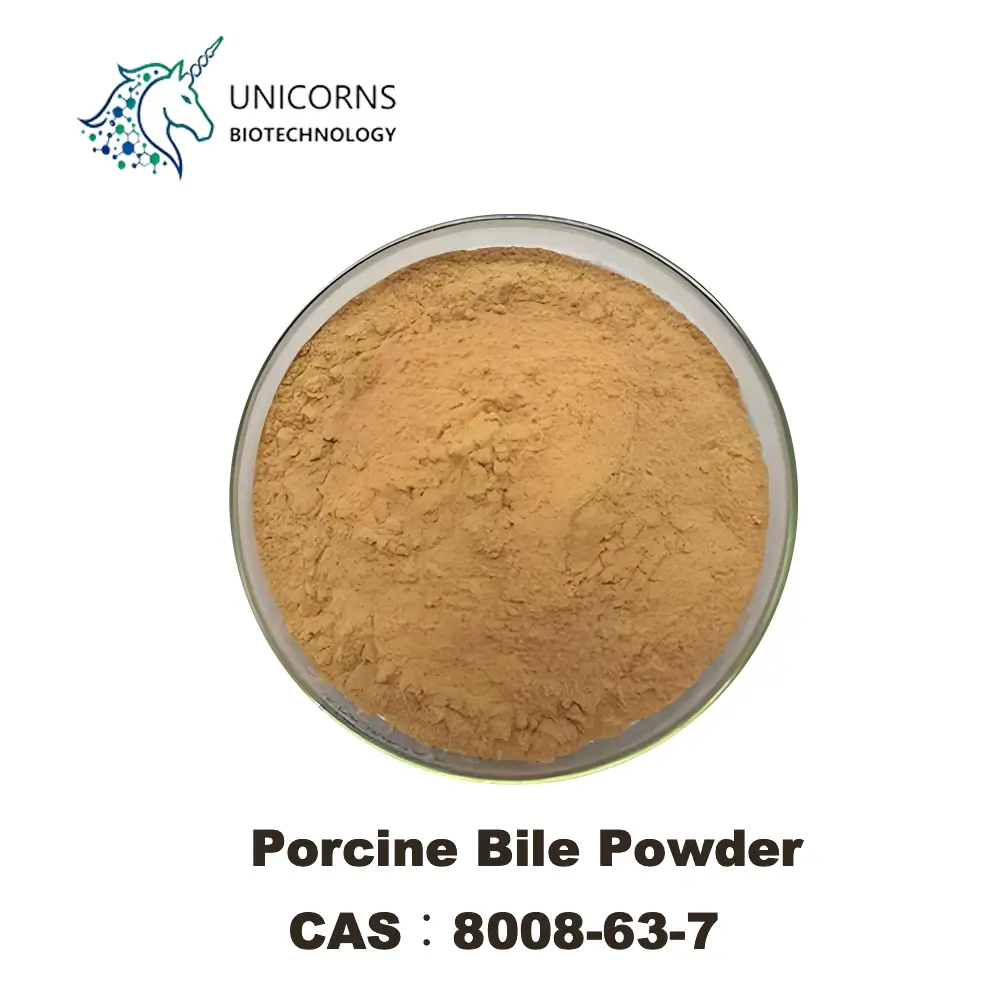
Bulk Pig Bile Extract
| Product Name | Porcine Bile Extract |
| Other Names | Bile extract porcine, Porcine bile acids, Pig bile powder, Pulvis Fellis Suis, Zhu Dan, Powdered Swine Bile, Zhudanfen |
| Appearance | Yellow Powder |
| Country of Origin | China |
| Applications | supplements |
| Documents Available | COA, Specification, MSDS, Allergen Statement, Non-GMO Statement |
| Manufacturing Capability | 600 tons annually |
| OEM services | Custom formulation, capsules, tablets, blends, contract manufacturing, softgels |
| Bulk Packaging | 1kg, 5kg, 10kg aluminum foil vacuum bag; or 20kg, 25kg Fiber Drum |
Henan Unicorns Biotechnology Co., Ltd. manufactures and exports bulk Porcine Bile Extract from China. We supply supplement brands, ingredient distributors, nutrition companies, contract manufacturers, research suppliers and private-label businesses.
Our standard yellow powder is made from healthy porcine bile and standardized to at least 2% taurohyodeoxycholic acid. It dissolves easily in water and passes strict limits for heavy metals and microbiological quality. The product is declared antibiotic-free, non-irradiated, non-GMO and free from bovine BSE risk.
Unicorns Biotechnology supports annual production of up to 600 tons across bile-derived and glandular ingredients. OEM capsules, tablets, powder blends, custom specifications and export packaging are available. Related products include Bile Acids Powder, Ox Bile Extract Powder, Cholic Acid, TUDCA, Bilirubin Powder and other glandular extracts and derivatives.
What Is Porcine Bile Extract?
Porcine Bile Extract is a dried animal extract produced from pig bile collected from the gallbladder. The liquid bile is filtered, concentrated, dried and milled into a yellow, bitter powder.
The ingredient contains a natural mixture of bile acids, conjugated bile salts, bile pigments, phospholipids, cholesterol, fatty acids, proteins and mineral salts. Its exact profile depends on the raw material and production method.
Pig bile has a different bile acid profile from bovine bile. Porcine bile is associated with hyocholic acid and hyodeoxycholic acid families, including taurine-conjugated forms. Hyodeoxycholic acid is a characteristic component of hog bile.
Other Names
Common names include:
- Pig Bile Extract
- Porcine Bile Extract Powder
- Pig Bile Powder
- Porcine Bile Powder
- Hog Bile Extract
- Hog Bile Powder
- Dried Porcine Bile
- Porcine Gallbladder Extract
- Porcine Gall Extract
- Porcine Bile Concentrate
- Pig Gall Powder
“Pig Bile Powder” may refer to simply dried whole bile. “Porcine Bile Extract” often refers to a filtered or standardized grade. Buyers should compare the bile acid marker, manufacturing method and COA rather than relying only on the name.
Basic Product Information
| Property | Product Information |
|---|---|
| Biological source | Healthy porcine bile |
| Animal source | Pig |
| Country of raw material | China |
| Country of manufacture | China |
| Product form | Dried bile extract powder |
| Marker compound | Taurohyodeoxycholic acid |
| Standard marker assay | ≥2.0% |
| Appearance | Yellow powder |
| Taste | Bitter |
| Water behavior | Dissolves easily in water |
| Moisture behavior | Hygroscopic and deliquescent |
| Particle size | ≥95% through 80 mesh |
| GMO status | Declared non-GMO |
| Irradiation status | Non-irradiated |
| Antibiotic status | Declared antibiotic-free |
CAS Number and Molecular Formula
Porcine Bile Extract does not have one universal CAS number, molecular formula or molecular weight. It is a mixture of many bile-derived compounds rather than one purified chemical.
Each bile acid has its own identity. Examples include:
| Bile Acid | CAS Number | Type |
|---|---|---|
| Hyodeoxycholic acid | 83-49-8 | Characteristic porcine bile acid |
| Hyocholic acid | 547-75-1 | Porcine primary bile acid |
| Chenodeoxycholic acid | 474-25-9 | Primary bile acid |
| Cholic acid | 81-25-4 | Primary bile acid |
| Deoxycholic acid | 83-44-3 | Secondary bile acid |
The Unicorns Biotechnology grade is standardized by taurohyodeoxycholic acid content, not by one universal extract CAS number.
Solubility and Storage Behavior
Porcine Bile Extract dissolves readily in water. The powder also absorbs moisture quickly from the air.
Keep the package tightly sealed after opening. Store it in a cool, dry place away from heat, light and humidity. Moisture-resistant inner liners are needed for bulk shipping and warehouse storage.
Composition of Porcine Bile Extract
Porcine Bile Extract contains several classes of bile-derived compounds. Taurohyodeoxycholic acid is the measured marker in the standard Unicorns Biotechnology specification.
Bile Acids and Bile Salts
The bile acid fraction may contain:
- Taurohyodeoxycholic acid
- Hyodeoxycholic acid
- Hyocholic acid derivatives
- Chenodeoxycholic acid derivatives
- Cholic acid derivatives
- Taurine-conjugated bile acids
- Other minor porcine bile acids
The exact profile should be confirmed by chromatographic testing. A 2% taurohyodeoxycholic acid specification does not mean the product contains only 2% total bile acids.
Bile Pigments
Natural porcine bile may contain bile pigments such as bilirubin and related compounds. These pigments contribute to the yellow color of the finished powder.
Their levels vary with raw material quality and purification depth. The standard product is not sold as a standardized bilirubin ingredient.
Phospholipids and Lipids
Porcine bile can contain phospholipids, lecithin, cholesterol and fatty acids. These compounds form part of the natural bile matrix.
Filtration and purification may reduce their final levels. Buyers requiring a detailed lipid profile should request batch-specific testing.
Proteins, Mucins and Mineral Salts
Small amounts of proteins, mucins and inorganic salts may remain in the extract. Natural mineral components can include sodium, potassium, calcium, magnesium, chloride and iron.
The current specification does not assign fixed percentages to these components. They should not be marketed as standardized nutrients without testing. The supplied product notes list bile acids, bile pigments, phospholipids, fatty acids, proteins, choline, cholesterol and inorganic substances as expected composition groups.
Porcine Bile Extract Specifications
Unicorns Biotechnology’s standard Porcine Bile Extract contains at least 2.0% taurohyodeoxycholic acid. At least 95% of the powder passes through an 80-mesh sieve, while loss on drying is limited to 5.0%.
The specification also controls arsenic, lead, mercury, cadmium and microbial contamination. Identification is performed through chromatographic comparison with a reference product.
Standard Specification Table
| Test Item | Specification |
|---|---|
| Product name | Porcine Bile Extract |
| Source | Healthy porcine bile |
| Raw material origin | China |
| Country of manufacture | China |
| Appearance | Yellow powder |
| Taste | Bitter |
| Water solubility | Dissolves easily in water |
| Moisture behavior | Deliquescent in air |
| Identification | Chromatographic color spot matches reference |
| Particle size | ≥95% through 80 mesh |
| Taurohyodeoxycholic acid | ≥2.0% |
| Loss on drying | ≤5.0% |
| Arsenic | ≤2 ppm |
| Lead | ≤2 ppm |
| Mercury | ≤0.1 ppm |
| Cadmium | ≤1 ppm |
| Total plate count | ≤1,000 CFU/g |
| Mold and yeast | ≤100 CFU/g |
| E. coli | Negative |
| Salmonella | Negative |
| Staphylococcus | Negative |
| GMO status | Non-GMO declaration |
| Irradiation | Non-irradiated |
| Antibiotics | Declared antibiotic-free |
| BSE status | Declared BSE-free |
| Allergen status | Declared allergen-free |
| Standard particle size | 80 mesh |
| Typical bulk packaging | PE-lined fiber drum |
| Custom packaging | Available |
Testing and Quality Documents
The marker compound should be tested by a suitable chromatographic method, such as HPLC or another validated laboratory method. The final test method should appear on the approved specification or COA.
Available purchasing documents may include:
- Batch-specific COA
- SDS or MSDS
- Product specification
- Technical data sheet
- Manufacturing flow chart
- Porcine-origin declaration
- Antibiotic-free statement
- Non-irradiation statement
- GMO statement
- Allergen statement
- Heavy-metal report
- Microbiological report
- Residual-solvent statement
- Country-of-origin document
- Third-party laboratory report
The standard process is water-based and does not require the extract to be described as solvent-extracted. Buyers should confirm the actual process before using a residual-solvent claim.
Porcine Bile Extract vs Bile Acids Powder
Porcine Bile Extract and Bile Acids Powder may come from the same animal source, but they are not identical.
Porcine Bile Extract retains a broader bile matrix. It may contain bile acids, bile salts, pigments, phospholipids, cholesterol and minor proteins. Bile Acids Powder is usually more purified and standardized by total bile acid content or selected bile acids.
| Feature | Porcine Bile Extract | Bile Acids Powder |
|---|---|---|
| Source | Porcine bile | Usually porcine bile-derived material |
| Composition | Broad bile extract | Concentrated bile acid fraction |
| Standard marker | THDCA ≥2% for this grade | Total bile acids or specified acids |
| Bile pigments | May remain | Usually reduced |
| Phospholipids | May remain | Usually reduced |
| Purification level | Moderate | Higher |
| Appearance | Yellow powder | White, off-white, yellow or brown |
| Main use | Broad bile-derived formulations | Standardized bile acid formulations |
| Buyer focus | Natural bile profile | Active bile acid concentration |
Choose Porcine Bile Extract when the formula needs a wider bile-derived composition. Choose Bile Acids Powder when total bile acid concentration and a more refined active profile matter.
Porcine Bile Extract vs Ox Bile Extract
Both ingredients contain bile-derived compounds, but their animal sources and bile acid profiles differ.
| Feature | Porcine Bile Extract | Ox Bile Extract |
|---|---|---|
| Animal source | Pig | Cattle |
| Technical source | Porcine gallbladder bile | Bovine gallbladder bile |
| Characteristic profile | Hyocholic and hyodeoxycholic acid families | Cholic and deoxycholic acid families |
| Standard marker | THDCA ≥2% for this grade | Often total bile acids or cholic acid |
| Appearance | Yellow powder | Yellow, tan or brown powder |
| Water solubility | Readily soluble | Depends on grade |
| BSE concern | No bovine source | Requires bovine risk documents |
| Main positioning | Porcine bile formulas | Bovine digestive bile formulas |
| Religious suitability | Not suitable for halal or kosher formulas | Depends on source and certification |
Neither ingredient is automatically better. Selection depends on the required animal source, bile acid profile, specification and destination-market rules.
Functional Properties of Porcine Bile Extract
The most defensible product claims relate to bile chemistry and formulation use. Porcine Bile Extract should not be marketed as a treatment for hepatitis, jaundice, gallbladder disease or other medical conditions without approved evidence.
Supports Fat Emulsification
Bile acids have water-compatible and fat-compatible regions. This allows them to gather around dietary fat and form micelles.
Micelle formation increases the surface area available to digestive lipases. It also helps keep lipid digestion products dispersed in the intestinal environment.
Supports Absorption of Fat-Soluble Nutrients
Bile salts help disperse fatty acids, cholesterol and fat-soluble vitamins. Vitamins A, D, E and K depend on normal fat digestion for absorption.
A finished-product benefit will depend on the total bile acid profile, dose and intended user. The 2% THDCA marker alone does not define the full digestive effect.
Water-Soluble Bile-Derived Ingredient
The powder dissolves readily in water. This supports use in capsules, tablets, soluble blends and selected liquid systems.
Its hygroscopic nature requires moisture control during blending, filling and storage.
Traditional Porcine Bile Positioning
Pig bile powder has a history of use in traditional Chinese materia medica. Traditional descriptions refer to bitter and cooling properties.
Those traditional uses should be kept separate from modern supplement claims. Disease names and treatment language are not suitable for a general international ingredient page.
Porcine Bile Extract Manufacturing Process
Porcine Bile Extract is produced by converting liquid pig bile into a stable, standardized powder. The exact process may vary by grade.
1. Porcine Bile Collection
Bile is collected from healthy pigs processed at qualified facilities. Source records and veterinary inspection documents are maintained.
2. Raw Material Inspection
The liquid bile is checked for appearance, odor, contamination and source identity before production.
3. Filtration
Coarse tissue, suspended solids and unwanted matter are removed through filtration.
4. Purification
The filtered bile may undergo clarification or other controlled purification steps to improve consistency and reduce unwanted solids.
5. Concentration
The purified liquid is concentrated under controlled temperature conditions.
6. Drying
The concentrate is dried into a yellow powder. Spray drying or another controlled drying process may be used according to the product grade.
7. Milling and Sieving
The dried material is milled and sieved. At least 95% of the standard powder passes through 80 mesh.
8. Standardization
The product is blended or adjusted to meet the required taurohyodeoxycholic acid specification.
9. Quality Testing
Each batch is tested for identity, THDCA, loss on drying, heavy metals and microbiological quality.
10. Moisture-Resistant Packaging
The powder is packed in sealed inner liners and export drums. Packaging must limit moisture uptake because the product is deliquescent.
Process flow: Healthy porcine bile → Inspection → Filtration → Purification → Concentration → Drying → Milling → Sieving → Standardization → Testing → Packaging
Applications of Porcine Bile Extract
Porcine Bile Extract is used where a pig-derived bile matrix is preferred over purified single bile acids. Final use must comply with the rules of the destination country.
Digestive Supplement Capsules and Tablets
Traditional Animal-Derived Formulas
Bile Acid and Organ Ingredient Blends
Research and Specialized Formulation
Where to Buy Bulk Porcine Bile Extract
Henan Unicorns Biotechnology Co., Ltd. supplies wholesale Porcine Bile Extract Powder from China for supplement manufacturers, ingredient distributors, research suppliers and private-label businesses.
We provide factory-direct bulk powder, OEM capsules, tablets and blended formulas. Custom marker content, particle size, packaging and testing can be discussed based on order volume and destination market.
Why Choose Unicorns Biotechnology?
| Factory Advantage | Buyer Benefit |
|---|---|
| Direct China manufacturer | Factory pricing and direct technical contact |
| Defined porcine source | Healthy pig bile from China |
| Standardized marker | Taurohyodeoxycholic acid ≥2.0% |
| Controlled particle size | ≥95% through 80 mesh |
| Low moisture | Loss on drying ≤5.0% |
| Heavy-metal control | As ≤2 ppm, Pb ≤2 ppm, Cd ≤1 ppm, Hg ≤0.1 ppm |
| Microbial control | TPC ≤1,000 CFU/g and yeast/mold ≤100 CFU/g |
| Pathogen testing | E. coli, Salmonella and Staphylococcus negative |
| Annual capacity | Up to 600 tons across bile-derived ingredients |
| Custom specifications | Marker assay, mesh and packaging options |
| OEM services | Capsules, tablets, blends and private labels |
| Technical documents | COA, SDS, TDS and source declarations |
| Third-party testing | Available according to buyer requirements |
| Free sample | Available to qualified B2B customers |
| Related products | Bile acids, ox bile, cholic acid, TUDCA and bilirubin |
Available GMP, ISO and other factory certificates should be confirmed for the ordered grade. Halal and Kosher certification do not apply to porcine-origin products.
Contact Unicorns Biotechnology with your required THDCA content, order volume, packaging size and destination country. Our team will prepare a technical file, free evaluation sample and wholesale quotation.