
Bulk Bovine Heart Peptide Powder Manufacturer China
Home >> Bulk Ingredients >> Glandular Extracts >> Wholesale Bovine Heart Peptide Powder Factory China
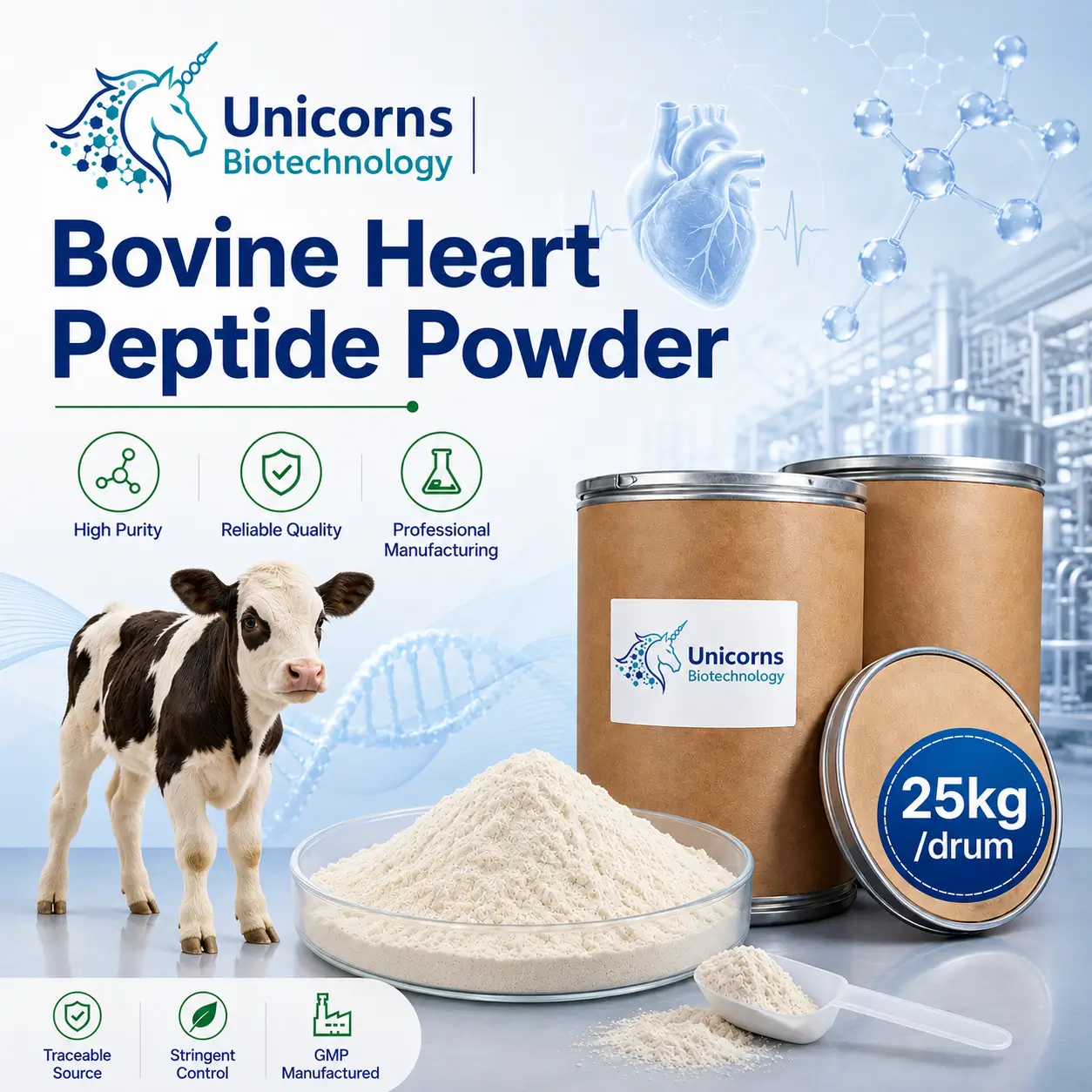
Bulk Bovine Cardiac Peptide Powder
| Product Name | Bovine Cardiac Muscle Peptide Powder |
| Other Names | Bovine Heart Peptide Powder, Bovine Cardiac Peptide, Beef Heart Peptide Powder, Myocardial Peptide, Heart Muscle Peptide, Cattle Myocardial Peptide, Bovine Heart Hydrolysates, Bovine Myocardium Peptide Powder, Bovine Heart Hydrolysate Bovine Heart Protein Hydrolysate, Hydrolyzed Bovine Heart Protein, Bovine Heart Small Molecule Active Peptide Powder, Freeze-Dried Bovine Heart Hydrolysate |
| Appearance | White To Light Yellow |
| Country of Origin | China |
| Applications | supplements |
| Documents Available | COA, Specification, MSDS, Allergen Statement, Non-GMO Statement |
| Manufacturing Capability | 600 tons annually |
| OEM services | Custom formulation, capsules, tablets, blends, contract manufacturing, softgels |
| Bulk Packaging | 1kg, 5kg, 10kg aluminum foil vacuum bag; or 20kg, 25kg Fiber Drum |
Unicorns Biotechnology is a wholesale Bovine Cardiac Muscle Peptide Powder manufacturer in China, supplying supplement brands, nutrition companies, ingredient distributors, private-label businesses, contract manufacturers, formulation laboratories, and international importers.
Our Bovine Heart Peptide Powder is manufactured from fresh bovine cardiac muscle sourced from cattle raised in the Xilin Gol grasslands of Inner Mongolia. Low-temperature homogenization, degreasing, and directed protease hydrolysis break down cardiac muscle proteins into smaller peptide fractions. The standard specification contains at least 70% protein, at least 65% peptides, and at least 85% peptides with a relative molecular weight below 500 Da.
With an annual manufacturing capacity of 600 tons, Unicorns Biotechnology supports sample evaluation, commercial bulk orders, long-term supply contracts, customized specifications, and finished-product development. OEM services include custom formulations, capsules, tablets, powder blends, softgels subject to formulation feasibility, private labels, and contract manufacturing.
We also supply Bovine Heart Powder, Bovine Liver Peptide Powder, Bovine Spleen Peptide Powder, Heme Iron Polypeptide Powder, porcine organ peptides, ovine peptides, and other glandular extracts and animal-derived ingredients for customized supplement formulas.
What Is Bovine Cardiac Peptide Powder?
Bovine Cardiac Peptide Powder is a hydrolyzed animal-protein ingredient produced from bovine heart muscle. It is made by using proteolytic enzymes to separate the larger proteins naturally present in cardiac muscle into smaller peptides and amino-acid-containing fractions.
Unlike conventional Bovine Heart Powder, which generally contains dried and milled whole heart tissue, Bovine Cardiac Muscle Peptide Powder has undergone enzymatic hydrolysis. This processing produces a more water-soluble material with a standardized peptide concentration and molecular-weight distribution.
The product is also known as:
- Bovine Heart Peptide Powder
- Bovine Cardiac Peptide
- Beef Heart Peptide Powder
- Bovine Myocardial Peptide
- Myocardial Peptide Powder
- Heart Muscle Peptide
- Cattle Myocardial Peptide
- Bovine Heart Hydrolysate
- Bovine Heart Hydrolysates
- Bovine Myocardium Peptide Powder
- Bovine Heart Protein Hydrolysate
- Hydrolyzed Bovine Heart Protein
- Bovine Heart Small Molecule Active Peptide Powder
- Freeze-Dried Bovine Heart Hydrolysate
CAS Number, Molecular Formula, and Molecular Weight
Bovine Cardiac Muscle Peptide Powder is a complex mixture of peptides and amino-acid-containing protein hydrolysates, not one isolated chemical compound. It therefore does not have one universally applicable molecular formula, fixed molecular weight, or single definitive CAS number.
The current commercial specification focuses instead on peptide content and molecular-weight distribution:
- Protein: ≥70.0%
- Peptides: ≥65.0%
- Peptides below 500 Da: ≥85.0%
These values provide more useful information for supplement formulation than a single nominal molecular weight.
Source and Food Origin
The source of Bovine Heart Peptide Powder is fresh bovine cardiac muscle, also called beef heart or bovine myocardium. It is an animal-derived nutritional ingredient rather than a chemically synthesized peptide.
The supplied product data sheet identifies the raw material as fresh, healthy bovine cardiac muscle from cattle raised in the Xilin Gol grassland region of Inner Mongolia.
Appearance and Organoleptic Properties
The finished ingredient is a white to light yellow, free-flowing powder without visible foreign impurities. It has the product’s characteristic taste and odor without an abnormal taste.
Because it is a protein hydrolysate, finished formulas may have a mild savory, meaty, or peptide-related taste. Flavor masking, encapsulation, blending, or coating can be evaluated for consumer-facing products.
Solubility and Stability
Bovine Cardiac Muscle Peptide Powder is soluble in water at approximately pH 5.4-6.0. Trace white particles may remain after dispersion because of peptide substances within the ingredient.
The supplied specification describes the product as stable between pH 4.0 and 9.0. It can withstand heating at 100°C for 30 minutes and 121°C for 20 minutes under the stated test conditions. These characteristics make it suitable for a range of dry and liquid formulation processes, although finished-product stability must be validated in the complete formula.
Particle Size and Custom Specifications
Particle size can be customized according to capsule filling, tablet compression, powder blending, beverage dispersion, and packaging requirements. An 80-mesh grade can be discussed for projects requiring a fine, uniform powder.
Unicorns Biotechnology can also customize peptide concentration, molecular-weight distribution, moisture, microbiological limits, packaging size, testing panels, and finished-product format.
Beef Heart Peptide Powder Composition and Nutritional Profile
Beef Heart Peptide Powder is a complex hydrolysate rather than a single isolated peptide. Its primary standardized components are protein and peptide fractions produced from bovine myocardial proteins.
The supplied specification guarantees at least 70% protein on a dry basis and at least 65% peptides. At least 85% of the peptide fraction has a relative molecular weight below 500 Da.
Peptide and Protein Composition
| Composition category | Standardized level | Formulation significance |
|---|---|---|
| Total protein | ≥70.0% dry basis | Provides concentrated animal-derived protein nutrition |
| Total peptides | ≥65.0% dry basis | Confirms extensive enzymatic hydrolysis |
| Peptides below 500 Da | ≥85.0% of peptide fraction | Provides a high proportion of low-molecular-weight peptides |
| Moisture | ≤7.0% | Supports powder stability and handling |
| Ash | ≤9.0% | Controls total inorganic residue |
| Free amino acids | Not standardized in the current specification | Can be tested through an optional amino acid profile |
| Individual peptide sequences | Not standardized | Can be studied through LC-MS/MS or peptide profiling if required |
Parent Proteins and Amino Acids
Bovine heart muscle naturally contains contractile, structural, and metabolic proteins. Enzymatic hydrolysis may generate peptide fragments from proteins such as myosin, actin, titin, troponin, mitochondrial proteins, collagen, and other myocardial proteins.
The resulting hydrolysate can provide essential and non-essential amino acids, including leucine, isoleucine, valine, lysine, arginine, glycine, proline, glutamic acid, and aspartic acid. However, individual amino-acid percentages are not included in the current standard specification and should be confirmed through batch-specific testing when required.
CoQ10, Taurine, Vitamins, and Minerals
Whole bovine heart tissue may naturally contain nutrients such as coenzyme Q10, taurine, B vitamins, iron, and other compounds. However, these substances are not standardized in the supplied Bovine Cardiac Muscle Peptide Powder specification.
Brands should not claim a specific CoQ10, taurine, vitamin, or mineral content unless the relevant compound has been tested in the finished ingredient or formulation.
Bovine Heart Protein Hydrolysate Specifications
Unicorns Biotechnology controls Bovine Heart Protein Hydrolysate through sensory, physicochemical, heavy-metal, and microbiological testing. The standard grade contains at least 70% protein, at least 65% peptides, and at least 85% peptides below 500 Da.
Heavy-metal limits include arsenic ≤1.0 ppm, cadmium ≤0.1 ppm, mercury ≤0.1 ppm, lead ≤0.7 ppm, and chromium ≤2.0 ppm. Microbiological limits include total plate count ≤10,000 CFU/g, yeast and mold ≤100 CFU/g, and negative results for Staphylococcus and E. coli. Testing methods follow the stated GB and GB/T standards.
| Test item | Specification | Test method |
|---|---|---|
| Color | White to light yellow | Sensory examination |
| Odor and taste | Characteristic, without abnormal taste | Sensory examination |
| Physical state | Free-flowing powder, no visible foreign impurities | Sensory examination |
| Protein, dry basis | ≥70.0% | GB 5009.5 |
| Peptides, dry basis | ≥65.0% | GB/T 22729 |
| Peptides below 500 Da | ≥85.0% | GB/T 22729 |
| Moisture | ≤7.0% | GB 5009.3 |
| Ash | ≤9.0% | GB 5009.4 |
| Water solubility | Soluble at pH 5.4-6.0, possible trace peptide particles | Internal specification |
| Stability | Stable at pH 4.0-9.0 | Internal specification |
| Heat stability | 100°C for 30 minutes; 121°C for 20 minutes | Internal specification |
| Arsenic | ≤1.0 ppm | GB 5009.11 |
| Cadmium | ≤0.1 ppm | GB 5009.15 |
| Mercury | ≤0.1 ppm | GB 5009.17 |
| Lead | ≤0.7 ppm | GB 5009.12 |
| Chromium | ≤2.0 ppm | GB 5009.123 |
| Total plate count | ≤10,000 CFU/g | GB 4789.2 |
| Yeast and mold | ≤100 CFU/g | GB 4789.3 |
| Staphylococcus | Negative | GB 4789.15 |
| E. coli | Negative | GB 4789.4 |
Residual solvents are not listed in the current standard specification. Because the described manufacturing route uses homogenization, degreasing, and enzymatic hydrolysis, buyers should confirm whether any processing aids or solvents are used for the selected grade. A customized residual-solvent test can be arranged when required.
Optional testing may include:
- Complete amino acid profile
- Molecular-weight distribution
- Degree of hydrolysis
- Peptide mapping
- Protein identity
- CoQ10 and taurine
- Veterinary drug residues
- Pesticide residues
- BSE/TSE documentation
- Allergen evaluation
- Microbiological testing
- Independent third-party laboratory analysis
Batch-specific acceptance limits, testing methods, and regulatory requirements should be agreed before commercial production.
Bovine Heart Protein Hydrolysate vs Bovine Heart Powder
Bovine Heart Protein Hydrolysate and Bovine Heart Powder come from the same organ source, but they are different ingredients with different processing methods, compositions, and formulation characteristics.
| Feature | Bovine Heart Protein Hydrolysate | Bovine Heart Powder |
|---|---|---|
| Raw material | Bovine cardiac muscle | Whole bovine heart tissue |
| Main processing | Enzymatic hydrolysis | Freeze-drying or spray-drying and milling |
| Protein form | Predominantly peptides and hydrolyzed proteins | Mostly intact tissue proteins |
| Peptide standardization | Peptides ≥65% | Usually not standardized for peptide content |
| Molecular-weight control | ≥85% of peptides below 500 Da | Normally not controlled |
| Appearance | White to light yellow | Usually brown-yellow |
| Water behavior | Soluble or readily dispersible | Generally less soluble |
| Taste | Characteristic peptide or savory taste | Characteristic organ taste |
| Typical use | Peptide supplements, drink powders, capsules, tablets | Whole-organ supplements and glandular blends |
| Formulation positioning | Hydrolyzed protein and small-peptide ingredient | Whole-food and ancestral organ ingredient |
Brands should use Bovine Heart Peptide Powder only for an enzymatically hydrolyzed product with supporting peptide and molecular-weight data. A non-hydrolyzed, dried heart ingredient should be labeled Bovine Heart Powder or Beef Heart Powder.
Potential Benefits of Bovine Heart Peptide Powder
Bovine Heart Peptide Powder provides concentrated protein and low-molecular-weight peptide nutrition. Its most defensible product benefits relate to its nutritional composition, processing characteristics, and suitability for supplement formulation.
Concentrated Peptide Nutrition
The ingredient contains at least 65% peptides and 70% protein on a dry basis. It can provide amino-acid-containing peptide fractions in a smaller molecular form than intact bovine heart protein.
Hydrolyzed Protein for Digestion and Formulation
Enzymatic hydrolysis breaks large proteins into smaller peptide fragments. This can improve water dispersion and reduce the digestive work needed to break down intact proteins, although actual absorption and bioavailability depend on peptide sequence, digestion, dosage, formulation, and individual physiology.
Organ-Specific Supplement Positioning
Bovine cardiac peptides can be used in heart-focused, organ-derived, ancestral nutrition, active-lifestyle, and multi-glandular supplement concepts. This allows brands to differentiate the ingredient from conventional collagen, whey, plant protein, or whole-organ powders.
Amino Acid and Protein Support
As a protein hydrolysate, Beef Heart Peptide Powder supplies peptide-bound amino acids that contribute to dietary protein intake. Finished-product claims should be based on the actual serving size and applicable protein-claim regulations.
Emerging Cardiovascular Research
Recent laboratory research has identified peptides in bovine heart hydrolysates with ACE-I and neprilysin inhibitory activity. Another study investigated protective effects of bovine myocardium hydrolysates in cellular oxidative-stress models. These findings support continued research into bovine cardiac peptides, but they do not prove that commercially consumed Bovine Heart Peptide Powder prevents or treats hypertension, heart failure, myocardial injury, or other cardiovascular diseases.
Responsible Supplement Claims
Suitable structure-function positioning may include:
- Animal-derived peptide nutrition
- Hydrolyzed bovine heart protein
- Low-molecular-weight peptide source
- Protein and amino acid support
- Cardiovascular wellness formula ingredient
- Organ-based nutrition
- Active-lifestyle nutrition
Disease-treatment claims such as treating heart disease, myocarditis, coronary artery disease, arrhythmia, hypertension, ischemia, or heart failure should not be used without appropriate clinical evidence and regulatory authorization.
Bovine Cardiac Muscle Peptide Manufacturing Process
Bovine Cardiac Muscle Peptide Powder is produced through controlled raw-material preparation, low-temperature processing, degreasing, protease-directed enzymatic hydrolysis, separation, concentration, drying, sieving, quality testing, and packaging.
1. Raw Material Selection
Fresh, healthy bovine cardiac muscle is selected and inspected according to sourcing, traceability, and quality requirements. The standard product uses bovine heart tissue from cattle raised in the Xilin Gol grasslands of Inner Mongolia.
2. Cleaning and Tissue Preparation
The cardiac muscle is cleaned, trimmed, and prepared to remove unsuitable connective tissue, excess surface fat, and foreign matter.
3. Low-Temperature Homogenization
The prepared heart tissue is homogenized at a controlled low temperature. This reduces the tissue into a uniform material while limiting unnecessary heat exposure.
4. Degreasing
Excess fat is separated to improve protein concentration, processing consistency, powder stability, and dispersibility.
5. Protease-Directed Enzymatic Hydrolysis
Selected proteases break larger myocardial proteins into shorter peptide chains. Enzyme type, pH, temperature, processing time, and enzyme-to-protein ratio influence the degree of hydrolysis and final peptide profile.
Scientific research confirms that enzyme selection can significantly affect the molecular-weight distribution and biological activity of bovine heart hydrolysates.
6. Separation and Filtration
The hydrolyzed material is separated and filtered to remove insoluble residues and obtain a consistent peptide-containing liquid.
7. Concentration
The filtered hydrolysate is concentrated under controlled conditions before drying.
8. Drying
The concentrated peptide solution may be spray-dried into a stable powder. A freeze-dried Bovine Heart Hydrolysate grade can be discussed separately when required, because drying method can affect cost, handling, moisture, and finished-product characteristics.
9. Milling, Sieving, and Blending
The dried powder is milled, sieved, and blended to achieve consistent particle size, flowability, color, and composition.
10. Quality Control and Packaging
Finished batches are tested for protein, peptides, molecular-weight distribution, moisture, ash, heavy metals, and microbiological quality before release. Approved material is packed in food-grade inner bags and protective cartons or fiber drums.
Applications of Bovine Heart Peptide Powder
Bovine Cardiac Muscle Peptide Powder is mainly used in dietary supplements and customized nutrition products. Its high peptide content, low-molecular-weight profile, water solubility, and light-colored appearance make it suitable for multiple delivery formats.
Cardiovascular Wellness Supplements
Capsules and Tablets
Powder Blends, Sachets, and Drink Formulas
Organ Nutrition and Active-Lifestyle Formulas
Bovine Cardiac Peptide Powder OEM Services
Unicorns Biotechnology supplies bulk raw materials and provides finished-product manufacturing for supplement companies, private-label brands, distributors, nutrition businesses, and contract manufacturing projects.
| OEM service | Available options |
|---|---|
| Custom formulation | Single-ingredient and multi-ingredient formulas |
| Capsule manufacturing | Custom shell, fill weight, capsule size, count, bottle, and label |
| Tablet manufacturing | Custom dosage, shape, hardness, coating, and packaging |
| Powder blends | Custom ratios, carriers, flavors, sweeteners, and sachets |
| Softgel development | Subject to peptide compatibility and formulation feasibility |
| Private labeling | Custom branding, labels, bottles, cartons, and shipping cases |
| Contract manufacturing | Pilot batches and commercial-scale production |
| Custom specifications | Peptide content, molecular weight, mesh size, moisture, and testing limits |
| Third-party testing | Independent testing according to buyer requirements |
| Packaging customization | Retail packaging and bulk industrial packaging |
| Export documentation | COA, specification, MSDS, Allergen Statement, Non-GMO Statement, and supporting files |
Where to Buy Bovine Cardiac Muscle Peptide Powder
Henan Unicorns Biotechnology Co., Ltd. is a bulk Bovine Cardiac Muscle Peptide Powder manufacturer and supplier in China. We provide high-quality bovine animal extracts, heart protein hydrolysates, glandular ingredients, organ peptides, and customized supplement solutions for global B2B buyers.
Our 600-ton annual manufacturing capability supports free samples, trial orders, commercial bulk production, wholesale pricing, customized specifications, long-term supply contracts, private-label supplements, and OEM manufacturing.
| Why choose Unicorns Biotechnology? | Buyer advantage |
|---|---|
| Direct manufacturer in China | Factory-direct communication and wholesale pricing |
| 600-ton annual capability | Stable support for commercial and long-term orders |
| Fresh bovine cardiac muscle | Clearly identified animal and tissue source |
| Peptides ≥65% | Standardized hydrolyzed peptide content |
| Protein ≥70% | High-protein dry-basis specification |
| ≥85% below 500 Da | Controlled low-molecular-weight peptide distribution |
| Comprehensive quality controls | Heavy-metal and microbiological limits |
| Free samples | Ingredient and formulation evaluation before ordering |
| Third-party testing | Independent laboratory analysis can be arranged |
| Custom specifications | Flexible peptide, particle-size, testing, and packaging requirements |
| OEM manufacturing | Capsules, tablets, blends, softgels, and private labels |
| Flexible bulk packaging | 1 kg to 25 kg packaging options |
| Technical documents | COA, specification, MSDS, Allergen, and Non-GMO statements |
| Related animal ingredients | Bovine, porcine, ovine, poultry, and specialty glandular extracts |
| Export support | Documentation, production coordination, and international shipment assistance |
Contact Unicorns Biotechnology for a free sample, current Bovine Heart Peptide Powder wholesale price, batch specification, third-party test options, customized molecular-weight requirements, bulk quotation, or OEM supplement proposal.
Frequently Asked Questions (FAQs)
The following FAQs address the most common questions from supplement brands, contract manufacturers, ingredient distributors, and private-label companies sourcing Bovine Heart Peptide Powder. Topics include bovine cardiac muscle origin, protein and peptide content, molecular-weight distribution below 500 Da, water solubility, recommended applications, quality testing, available documents, bulk packaging, free samples, customized specifications, third-party laboratory testing, and OEM manufacturing for capsules, tablets, blends, and finished supplements.
Is Bovine Cardiac Muscle Peptide Powder the same as Bovine Heart Peptide Powder?
Yes. Bovine Cardiac Muscle Peptide Powder and Bovine Heart Peptide Powder generally describe the same type of hydrolyzed ingredient produced from bovine heart muscle. The exact equivalence should be confirmed by comparing peptide content, molecular-weight distribution, source, and manufacturing method.
Is Beef Heart Peptide Powder the same as Beef Heart Powder?
No. Beef Heart Peptide Powder is enzymatically hydrolyzed and standardized for peptide content. Beef Heart Powder is usually dried whole heart tissue containing mostly intact proteins and other naturally occurring tissue components.
What is the peptide content?
The standard specification contains at least 65% peptides on a dry basis. Total protein is at least 70%.
What percentage of the peptides is below 500 Da?
At least 85% of the peptide fraction has a relative molecular weight below 500 Da under the stated GB/T 22729 testing method.
Is Bovine Heart Protein Hydrolysate water soluble?
The standard product is described as soluble in water at pH 5.4-6.0. Trace white peptide particles may be visible after dispersion.
Does the product contain CoQ10 or taurine?
Bovine heart tissue can naturally contain CoQ10 and taurine, but these compounds are not standardized in the current specification. A specific content claim requires analytical testing.
Can the powder be used in capsules and tablets?
Yes. Unicorns Biotechnology can supply bulk powder or provide OEM capsule and tablet manufacturing. Excipients, dosage, flowability, compression, taste, and stability should be evaluated during formulation development.
Can Unicorns Biotechnology customize the molecular-weight distribution?
Custom molecular-weight requirements can be discussed. Feasibility depends on enzyme selection, hydrolysis conditions, filtration technology, target peptide content, and order volume.
Are free samples available?
Yes. Free samples can be provided for identity evaluation, solubility testing, formulation trials, sensory assessment, and third-party laboratory testing.
What packaging sizes are available?
Available options include 1 kg, 5 kg, and 10 kg vacuum aluminum foil bags, as well as 20 kg and 25 kg fiber drums. Customized packaging can be arranged.
What documents are available?
Available documents include COA, specification, MSDS, Allergen Statement, and Non-GMO Statement. Additional quality and export documents can be discussed according to buyer requirements.