
Bulk Bovine Eye Peptide Powder Manufacturer in China
Home >> Bulk Ingredients >> Glandular Extracts >> Wholesale Bovine Eye Peptide Powder Factory in China
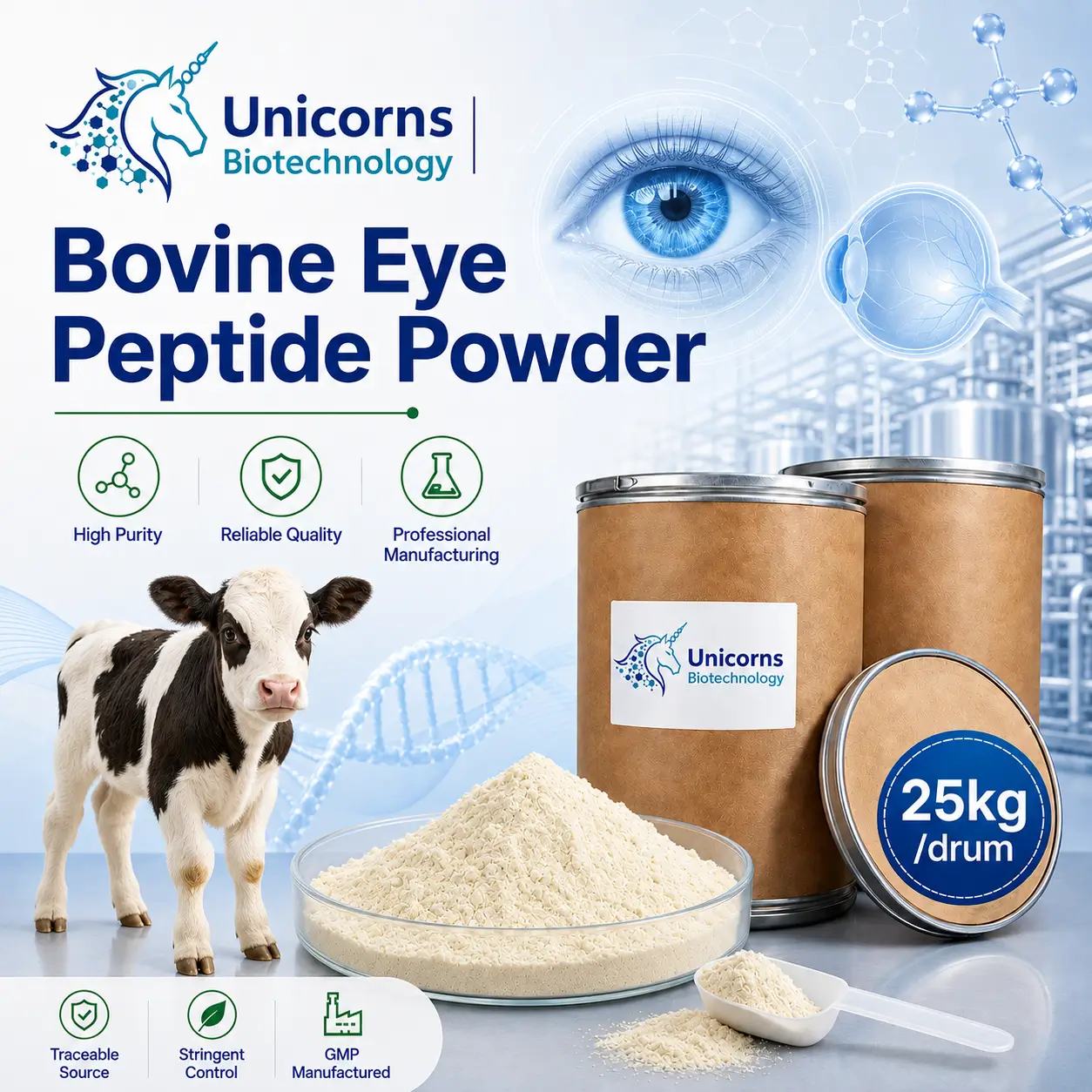
Bulk Bovine Eye Peptide Powder
| Product Name | Bovine Eye Peptide Powder |
| Other Names | Ocular Bioactive Peptides (Bovine), Bovine Ocular Peptides, Hydrolyzed Bovine Eye Protein, Bovine Eye Peptide Powder, Bovine Ocular Peptide Powder, Beef Eye Peptide Powder, Bovine Eyeball Peptide Powder, Bovine Eye Protein Hydrolysate, Hydrolyzed Bovine Eye Protein, Bovine Ocular Tissue Hydrolysate, Bovine Eye Hydrolysate, Bovine Retina Peptide Powder, Bovine Retinal Peptide Powder, Bovine Lens Peptide Powder, Bovine Vitreous Peptide Powder, Hydrolyzed Cattle Eye Peptide, Ox Eye Peptide Powder |
| Appearance | White To Light Yellow |
| Country of Origin | China |
| Applications | supplements |
| Documents Available | COA, Specification, MSDS, Allergen Statement, Non-GMO Statement |
| Manufacturing Capability | 600 tons annually |
| OEM services | Custom formulation, capsules, tablets, blends, contract manufacturing, softgels |
| Bulk Packaging | 1kg, 5kg, 10kg aluminum foil vacuum bag; or 20kg, 25kg Fiber Drum |
Unicorns Biotechnology is a wholesale Bovine Eye Peptide Powder manufacturer in China, supplying bovine-derived peptide ingredients to dietary supplement brands, nutrition companies, private-label businesses, ingredient distributors, contract manufacturers, formulation laboratories, and international importers.
Bovine Eye Peptide Powder is produced from bovine ocular tissue through controlled tissue preparation and protein hydrolysis. The process converts larger ocular proteins into smaller peptide and amino-acid-containing fractions suitable for supplement formulation. The finished ingredient is supplied as a white to light yellow powder for capsules, tablets, powder blends, sachets, and customized formulas.
Our factory has an annual manufacturing capability of 600 tons. Unicorns Biotechnology supports bulk ingredient supply, customized specifications, private-label development, capsules, tablets, powder blends, contract manufacturing, and softgel development subject to formulation compatibility.
We can also supply related animal-derived ingredients, including Bovine Heart Peptide Powder, Bovine Liver Peptide Powder, Bovine Spleen Peptide Powder, Heme Iron Polypeptide Powder, porcine organ peptides, sheep organ peptides, bile extracts, glandular powders, and other glandular extract derivatives. The current Unicorns Biotechnology range covers bovine, porcine, sheep, deer, horse, poultry, and specialty animal-derived ingredients.
What Is Bovine Eye Peptide?
Bovine Eye Peptide is a hydrolyzed animal-protein ingredient derived from bovine ocular tissue. Depending on the agreed raw-material specification, the tissue source may include whole bovine eyes or selected ocular structures such as the retina, lens, cornea, sclera, or vitreous-associated tissues.
The source material is homogenized and treated with selected proteolytic enzymes. Enzymatic hydrolysis breaks larger ocular proteins into shorter peptide chains and free amino-acid fractions. The hydrolysate is then separated, filtered, concentrated, dried, milled, and standardized into a fine powder.
Bovine Eye Peptide Powder is therefore a complex protein hydrolysate, not one isolated peptide or chemically uniform compound. The exact composition depends on the tissues used, hydrolysis conditions, filtration system, drying method, and final product specification. The uploaded background document similarly describes bovine eye peptides as protein fractions or amino-acid sequences derived from ocular tissues.
Other Names for Bovine Eye Peptide Powder
Bovine Eye Peptide Powder may also be marketed or described as:
- Ocular Bioactive Peptides, Bovine
- Bovine Ocular Peptides
- Bovine Ocular Peptide Powder
- Beef Eye Peptide Powder
- Bovine Eyeball Peptide Powder
- Bovine Eye Protein Hydrolysate
- Hydrolyzed Bovine Eye Protein
- Bovine Ocular Tissue Hydrolysate
- Bovine Eye Hydrolysate
- Hydrolyzed Cattle Eye Peptide
- Ox Eye Peptide Powder
- Small-Molecule Bovine Eye Peptides
The following names should only be used when the raw-material source specifically matches the name:
- Bovine Retina Peptide Powder
- Bovine Retinal Peptide Powder
- Bovine Lens Peptide Powder
- Bovine Vitreous Peptide Powder
For example, Bovine Retina Peptide Powder should not be used as an exact synonym for whole-eye hydrolysate unless the ingredient is produced specifically from bovine retinal tissue.
CAS Number, Molecular Formula, and Molecular Weight
Bovine Eye Peptide Powder does not have one universally applicable CAS number, molecular formula, or fixed molecular weight because it contains a mixture of hydrolyzed proteins, peptides, and amino acids rather than one chemically defined substance.
The product should instead be characterized through commercially useful parameters such as:
- Total protein
- Total peptide content
- Molecular-weight distribution
- Degree of hydrolysis
- Amino-acid profile
- Water solubility
- Moisture
- Ash
- Particle size
- Heavy metals
- Microbiological limits
Where a low-molecular-weight grade is requested, the target molecular-weight distribution should be stated in the purchase specification and verified through an appropriate analytical method.
Appearance, Taste, and Odor
The standard product is supplied as a white to light yellow powder. As an animal-protein hydrolysate, it may have a mild characteristic peptide or savory odor and taste. Actual color and sensory properties can vary according to the tissue source, purification level, hydrolysis process, and drying conditions.
Flavor masking, encapsulation, blending, coating, or suitable excipient systems can be considered for finished consumer products.
Water Solubility and Dispersion
Enzymatic hydrolysis generally improves the water dispersion of animal proteins by breaking larger proteins into smaller peptide fractions. Actual solubility must still be confirmed for the selected Bovine Eye Peptide Powder grade because some structural proteins or partially hydrolyzed fractions may produce light turbidity or small amounts of sediment.
Solubility testing should be conducted under the intended formulation conditions, including the selected pH, concentration, temperature, mineral content, and other active ingredients.
Particle Size
An 80-mesh powder is commonly requested for capsule filling, tablet manufacturing, and dry blending. Unicorns Biotechnology can discuss alternative particle-size distributions according to the buyer’s equipment and finished-product format.
Bioavailability
Small peptides can differ from intact dietary proteins in digestion, transport, and absorption behavior. However, the bioavailability of a commercial Bovine Eye Peptide Powder cannot be determined solely from its tissue origin or product name. It depends on peptide size, sequence, digestive stability, formulation, serving level, and the finished product.
Claims such as “rapidly absorbed,” “retina-targeted,” or “organ-specific delivery” require product-specific evidence and should not be made solely because the raw material originated from bovine ocular tissue.
Bovine Ocular Peptide Composition
Bovine Eye Peptide Powder contains hydrolyzed proteins originating from complex ocular tissues. The eye includes multiple protein-rich compartments with distinct biological structures. Proteomic research shows that the retina and vitreous contain diverse protein populations, while the lens is particularly rich in crystallin proteins.
The exact peptide profile of the finished ingredient depends on whether the manufacturer uses whole-eye tissue or selected structures.
Potential Parent Protein Categories
| Ocular source | Potential protein categories before hydrolysis | Possible hydrolysate contribution |
|---|---|---|
| Retina | Structural, metabolic, signaling, cytoskeletal, and photoreceptor-associated proteins | Mixed retinal protein-derived peptides |
| Lens | Alpha, beta, and gamma crystallin proteins | Crystallin-derived peptide fractions |
| Cornea | Collagen, proteoglycan-associated proteins, and structural proteins | Collagenous and non-collagenous peptides |
| Sclera | Collagen-rich connective-tissue proteins | Collagen-derived peptide fractions |
| Vitreous-associated tissue | Collagen, opticin, glycoproteins, and other extracellular proteins | Extracellular-matrix-derived peptides |
| Whole ocular tissue | Combined proteins from several ocular structures | Broad bovine ocular peptide profile |
These categories describe the biology of ocular tissues, not the guaranteed composition of the commercial product. A batch-specific peptide map, amino-acid profile, collagen assay, or molecular-weight distribution is required to substantiate detailed composition claims.
Peptides and Amino Acids
Proteolytic hydrolysis can generate:
- Oligopeptides
- Short-chain peptides
- Free amino acids
- Collagen-derived peptides
- Crystallin-derived peptide fragments
- Structural protein-derived peptides
- Metabolic protein-derived peptides
The resulting amino-acid profile may include glycine, proline, hydroxyproline, glutamic acid, aspartic acid, leucine, valine, lysine, arginine, alanine, serine, threonine, phenylalanine, tyrosine, and other amino acids. Their actual percentages must be confirmed by analytical testing.
No Verified Composition Percentages Supplied
The supplied product information does not provide verified values for:
- Total protein
- Total peptide content
- Percentage of peptides below a defined molecular weight
- Collagen content
- Retinal protein content
- Crystallin content
- Individual amino-acid percentages
- Specific bioactive peptide sequences
For this reason, no fixed protein, peptide, retinal-peptide, or collagen percentage should be published until supported by the approved specification or batch COA.
Bovine Eye Peptide Powder Specifications
Unicorns Biotechnology can customize Bovine Eye Peptide Powder specifications according to the buyer’s formulation, destination market, and quality requirements. The current source materials confirm the product name, bovine positioning, appearance, country of origin, applications, manufacturing capability, packaging, and available documents, but they do not provide a finalized numerical specification for assay, heavy metals, residual solvents, or microbiology.
The table below therefore identifies the commercial parameters that should be included in the final purchase specification rather than presenting unsupported limits.
| Test item | Commercial requirement |
|---|---|
| Product identity | Bovine ocular tissue protein hydrolysate |
| Biological source | Bovine eye tissue or specifically declared ocular tissue |
| Appearance | White to light yellow powder |
| Odor and taste | Characteristic, without abnormal odor |
| Physical state | Free-flowing powder without visible foreign impurities |
| Total protein | Customized and confirmed by specification |
| Total peptides | Customized and confirmed by specification |
| Molecular-weight distribution | Customized according to buyer requirement |
| Degree of hydrolysis | Available as an optional technical parameter |
| Particle size | 80 mesh or customized |
| Water solubility | Confirm according to selected grade |
| Moisture | To be specified and batch tested |
| Ash | To be specified and batch tested |
| Lead | Destination-market limit to be agreed |
| Arsenic | Destination-market limit to be agreed |
| Cadmium | Destination-market limit to be agreed |
| Mercury | Destination-market limit to be agreed |
| Total plate count | Limit to be agreed in the purchase specification |
| Yeast and mold | Limit to be agreed in the purchase specification |
| E. coli | Negative or destination-market requirement |
| Salmonella | Negative or destination-market requirement |
| Staphylococcus aureus | Available when required |
| Residual solvents | Test according to the manufacturing process and buyer requirement |
| Veterinary drug residues | Optional market-specific testing |
| Pesticide residues | Optional market-specific testing |
| Bovine species verification | Optional DNA or protein identity testing |
| BSE/TSE documentation | Confirm availability before ordering |
| Shelf life | Confirm through the approved product specification |
| Packaging | 1-10 kg foil bags or 20-25 kg fiber drums |
Testing methods, acceptance limits, sampling procedures, and release criteria should be confirmed before commercial production. Independent third-party testing can be arranged for identity, protein, peptide profile, heavy metals, microbiology, molecular-weight distribution, and other buyer-specified parameters.
Bovine Eye Peptide Powder vs Bovine Eye Powder
Bovine Eye Peptide Powder and Bovine Eye Powder may originate from similar ocular tissues, but their manufacturing methods and ingredient characteristics are different.
| Feature | Bovine Eye Peptide Powder | Bovine Eye Powder |
|---|---|---|
| Primary processing | Enzymatic hydrolysis | Drying and milling |
| Protein form | Hydrolyzed proteins and peptides | Mostly intact tissue proteins |
| Molecular-weight control | Can be standardized | Usually not standardized |
| Water behavior | Generally more dispersible | Often less soluble |
| Color | Usually white to light yellow | May be yellow, tan, or brownish |
| Typical positioning | Peptide supplement ingredient | Whole-tissue glandular ingredient |
| Technical name | Bovine eye protein hydrolysate | Dried bovine ocular tissue powder |
| Suitable formats | Capsules, tablets, blends, sachets | Capsules, tablets, and organ blends |
A product should only be called Bovine Eye Peptide Powder when enzymatic hydrolysis and peptide characteristics can be supported by manufacturing records and specifications.
Is Bovine Eye Peptide Powder the Same as Bovine Collagen Peptide Powder?
No. Bovine Eye Peptide Powder and Bovine Collagen Peptide Powder are different ingredients.
| Feature | Bovine Eye Peptide Powder | Bovine Collagen Peptide Powder |
|---|---|---|
| Source | Bovine ocular tissue | Bovine hide, bone, cartilage, or other collagen-rich tissues |
| Parent proteins | Mixed ocular proteins | Predominantly collagen |
| Peptide profile | Ocular tissue-dependent | Collagen-derived peptides |
| Main amino-acid emphasis | Depends on the ocular tissues used | Typically glycine, proline, and hydroxyproline-rich |
| Product positioning | Bovine ocular or organ peptide ingredient | Collagen and connective-tissue peptide ingredient |
| Interchangeable | No | No |
Although bovine ocular tissues may contain some collagenous structures, this does not make the finished Bovine Eye Peptide Powder equivalent to standardized Bovine Collagen Peptides.
Potential Benefits and Formulation Value
Concentrated Hydrolyzed Animal Protein
Bovine Eye Peptide Powder provides hydrolyzed bovine proteins in peptide form. It can be used in formulations seeking an animal-derived peptide ingredient rather than an intact whole-tissue powder.
Small-Peptide Supplement Positioning
When supported by molecular-weight testing, the ingredient can be positioned as a low-molecular-weight bovine peptide hydrolysate. The exact molecular-weight claim must match the approved specification and analytical report.
Organ-Specific Product Differentiation
Bovine ocular peptides can provide a distinctive ingredient story for eye-wellness, organ-based nutrition, glandular supplement, and premium animal-derived formulations. This positioning may help differentiate a finished product from standard collagen, whey, plant-protein, or whole-organ supplements.
Protein and Amino-Acid Contribution
As a protein hydrolysate, Bovine Eye Peptide Powder supplies peptide-bound and free amino-acid fractions. Finished-product protein claims should be based on the tested protein content and the amount supplied per serving.
Flexible Finished-Product Development
The powder can be evaluated for hard capsules, tablets, sachets, custom powder blends, and combination formulas. Particle size, taste, odor, moisture sensitivity, flowability, and bulk density should be considered during formulation development.
Bovine Eye Protein Hydrolysate Manufacturing Process
Bovine Eye Protein Hydrolysate is manufactured through controlled raw-material selection, tissue preparation, low-temperature homogenization, optional degreasing, enzymatic hydrolysis, separation, filtration, concentration, drying, milling, sieving, quality testing, and packaging.
Enzymatic hydrolysis uses selected proteases to break animal proteins into shorter peptides. This process is commonly used to produce peptide-containing animal protein hydrolysates and can be controlled through enzyme selection, pH, temperature, hydrolysis time, and enzyme-to-substrate ratio.
1. Raw-Material Selection
Bovine ocular tissues are selected according to the agreed source, age, health, veterinary, traceability, and quality requirements. Buyers should confirm whether the product uses whole eyes or selected tissues such as retina, lens, or vitreous-associated structures.
2. Cleaning and Preparation
The ocular tissue is cleaned, inspected, and trimmed to remove unsuitable material, excess connective tissue, surface fat, and foreign matter.
3. Low-Temperature Homogenization
The prepared tissue is reduced to a uniform material under controlled low-temperature conditions. This improves enzyme access while reducing unnecessary thermal exposure.
4. Degreasing
Where necessary, excess lipids are removed to improve hydrolysis efficiency, powder stability, color, and consistency.
5. Protease-Directed Enzymatic Hydrolysis
Selected food-grade proteases break larger ocular proteins into shorter peptide chains. Processing conditions are controlled to achieve the target peptide content, molecular-weight profile, taste, solubility, and degree of hydrolysis.
6. Separation and Filtration
Insoluble residues are removed through separation and filtration. Ultrafiltration or membrane separation may be applied when a specific peptide molecular-weight range is required.
7. Concentration
The clarified peptide liquid is concentrated under controlled conditions before drying.
8. Drying
The concentrated hydrolysate may be spray-dried into a stable powder. Freeze-dried Bovine Eye Hydrolysate can be discussed separately when the buyer requires a different drying method.
9. Milling, Sieving, and Blending
The dried powder is milled, sieved, and blended to obtain a consistent particle size, appearance, and bulk composition.
10. Quality Control and Packaging
The finished Bovine Eye Peptide Powder is tested according to the agreed specification and packed in vacuum-sealed foil bags, protective cartons, or fiber drums.
Applications of Bovine Eye Peptide Powder
Bovine Eye Peptide Powder is primarily developed for supplement and custom-nutrition applications. The intended dosage, product claims, regulatory classification, and finished format should be assessed for each destination market.
Eye-Wellness Supplement Formulas
Capsules and Tablets
Powder Blends and Sachets
Multi-Glandular and Organ Peptide Formulas
Bovine Ocular Peptide OEM Services
Unicorns Biotechnology supplies bulk raw materials and provides finished-product manufacturing for supplement brands, private-label companies, distributors, importers, and contract manufacturing projects.
| OEM service | Available options |
|---|---|
| Custom formulation | Single-ingredient and multi-ingredient formulas |
| Capsule manufacturing | Custom capsule shell, size, fill weight, count, bottle, and label |
| Tablet manufacturing | Custom dosage, shape, size, coating, hardness, and packaging |
| Powder blending | Custom ratios, carriers, flavors, sweeteners, and sachets |
| Softgel development | Subject to ingredient compatibility and formulation feasibility |
| Private labeling | Custom branding, bottle, label, carton, and shipping case |
| Contract manufacturing | Pilot batches and commercial-scale production |
| Custom specifications | Protein, peptide profile, molecular weight, particle size, and microbiology |
| Third-party testing | Independent analysis according to buyer requirements |
| Packaging customization | Retail packaging and industrial bulk packaging |
| Export support | Product and shipment documentation according to project requirements |
Where to Buy Bulk Bovine Eye Peptide Powder
Henan Unicorns Biotechnology Co., Ltd. is a bulk Bovine Eye Peptide Powder manufacturer and supplier in China. We provide bovine animal extracts, organ peptides, protein hydrolysates, glandular powders, and custom supplement ingredients for global B2B buyers.
Our factory supports free samples, trial orders, commercial bulk production, wholesale pricing, customized specifications, private-label products, and OEM manufacturing for capsules, tablets, blends, sachets, and contract-manufactured supplements.
| Why choose Unicorns Biotechnology? | Buyer advantage |
|---|---|
| Direct manufacturer in China | Factory-direct communication and wholesale pricing |
| 600-ton annual capability | Support for commercial orders and long-term supply |
| Clearly declared bovine source | Defined animal-origin positioning |
| Customized tissue specification | Whole-eye or selected ocular tissue options can be discussed |
| Custom peptide specifications | Protein, peptide content, molecular weight, and particle size |
| Free samples | Evaluate color, odor, solubility, flow, and formulation compatibility |
| Third-party testing | Independent laboratory analysis can be arranged |
| Flexible packaging | 1 kg to 25 kg bulk packaging options |
| OEM manufacturing | Capsules, tablets, blends, sachets, and private labels |
| Custom formulation | Single-ingredient and multi-ingredient product development |
| Quality documents | COA, Specification, MSDS, Allergen, and Non-GMO statements |
| Related animal extracts | Access to bovine, porcine, sheep, poultry, and other glandular ingredients |
| Export support | Assistance with documentation, production, packaging, and international shipment |
Contact Unicorns Biotechnology for a free Bovine Eye Peptide Powder sample, current wholesale price, approved specification, batch COA, third-party testing options, custom molecular-weight requirements, packaging quotation, or OEM supplement proposal.
Frequently Asked Questions (FAQs)
The following Eye Peptide Powder FAQs address the questions most frequently asked by supplement brands, contract manufacturers, ingredient distributors, and private-label companies. They cover bovine ocular tissue sourcing, peptide composition, molecular-weight specifications, water solubility, manufacturing methods, quality testing, available documents, free samples, minimum order quantities, lead times, bulk packaging, third-party laboratory testing, international shipment, and OEM services for capsules, tablets, blends, and customized supplement formulas.
Is Bovine Eye Peptide Powder the same as Bovine Ocular Peptide Powder?
They are commonly used as equivalent commercial names. Buyers should still confirm the exact ocular tissues used, peptide content, hydrolysis method, and molecular-weight specification.
Is Bovine Eye Peptide Powder made from whole bovine eyes?
It may be made from whole bovine ocular tissue or selected structures. The exact raw-material definition should contact Unicorns Biotech company.
Is Bovine Retina Peptide Powder the same as Bovine Eye Peptide Powder?
Not necessarily. Bovine Retina Peptide Powder should specifically contain peptides produced from bovine retinal tissue. Bovine Eye Peptide Powder may contain a broader mixture of ocular tissues.
Is Bovine Eye Peptide Powder the same as bovine collagen peptides?
No. Bovine collagen peptides are produced primarily from collagen-rich hides, bones, cartilage, or connective tissues. Bovine Eye Peptide Powder contains hydrolyzed proteins from ocular tissue and has a different parent-protein profile.
Can you provide a molecular-weight distribution?
Yes, molecular-weight testing and custom distribution requirements can be discussed. Feasibility depends on the hydrolysis process, membrane separation, target specification, and order quantity.
Can Bovine Eye Peptide Powder be used in capsules?
Yes. Bulk powder and OEM capsule manufacturing are available. Capsule size, fill weight, flow agents, dosage, and packaging can be customized.
Can it be used in tablets?
Yes. Tablet development is available, subject to compression, flowability, taste, disintegration, stability, and excipient compatibility testing.
Are private-label products available?
Yes. Unicorns Biotechnology offers custom formulation, private labeling, capsules, tablets, blends, sachets, packaging design, and contract manufacturing.
Can you provide Halal, Kosher, GMP, or BSE/TSE documentation?
Availability should be confirmed for the selected product, raw-material source, manufacturing facility, and batch before placing the order.
Are free samples available?
Yes. Free samples can be provided for identity evaluation, solubility testing, sensory assessment, formulation development, and third-party laboratory testing.
What documents are available?
Available documents include COA, Product Specification, MSDS, Allergen Statement, and Non-GMO Statement. Additional documents can be discussed according to the destination market.
What is the minimum order quantity?
The MOQ depends on the selected specification, packaging, testing requirements, and whether the order is for bulk powder or an OEM finished product. Contact Unicorns Biotechnology for the current quotation and MOQ.
Can Unicorns Biotechnology customize the particle size?
Yes. Standard 80-mesh powder and custom particle sizes are available according to downstream blending, feed, pharmaceutical, or formulation requirements.