
The regulatory status of Glandular Supplements in the United States affects more than the label on a bottle. They shape which ingredients you can source, how you qualify a supplier, and what you must check before a shipment leaves the factory.
A bovine liver powder and an isolated thyroid constituent can raise different legal questions. Species, tissue, processing, intended intake, and marketing claims all matter. A supplier’s “food-grade” statement does not answer those questions.
Some animal-derived ingredients can qualify as dietary supplements. FDA does not grant blanket approval to glandular supplements or organ powders. Manufacturers and distributors must establish a lawful basis for their products and meet the rules that apply to their activities.
For a procurement manager, the task starts before the purchase order. Build the evidence around the exact material you plan to buy.
| Review area | Question to resolve before purchase |
|---|---|
| Ingredient status | Does this material qualify as a dietary ingredient? |
| NDI assessment | Does its history or food use support an exception, or must someone submit a notification? |
| Animal sourcing | Do the species, tissue, and origin meet applicable sourcing and entry rules? |
| Safety and quality | Do the specifications and evidence support the intended use? |
| Manufacturing | Which Part 111 and Part 117 requirements apply? |
| Imports | Who handles customs entry, APHIS requirements and FSVP? |
| Marketing | Do the label and claims meet FDA and FTC requirements? |
This guide provides sourcing information, not a product-specific legal opinion. Seek US regulatory review for your ingredient, formula and claims.
Glandular Ingredients Under FDA Rules and DSHEA
What counts as a glandular ingredient?
The industry uses “glandular” for materials from animal glands and organs. Buyers may encounter bovine, porcine, or ovine powders from liver, kidney, heart, spleen, thymus, pancreas, adrenal, or thyroid tissue.
Whole-organ powders differ from extracts that concentrate selected compounds. Defatting, hydrolysis and fractionation can change composition. A trade name such as “protomorphogen” does not establish a legal category.
Placenta and reproductive tissues need their own assessment. Collagen, colostrum and bone broth belong to the wider animal-derived ingredient market, but they do not share one regulatory status with glandular powders.
How does DSHEA apply?
The Dietary Supplement Health and Education Act of 1994, or DSHEA, amended the Federal Food, Drug, and Cosmetic Act. The dietary ingredient definition includes certain dietary substances and their concentrates, constituents, and extracts.
That wording does not approve every animal tissue or isolated compound. Your review must connect the actual material to the definition in 21 U.S.C. 321(ff), including its exclusions. Intended use affects whether food, supplement, or drug rules apply. LII / Legal Information Institute
FDA does not approve dietary supplements before sale through the drug approval process. The business must address ingredient eligibility, safety, manufacturing, and labeling. FDA can act against products that violate the law.
A facility registration number does not establish ingredient approval. An NDI submission or a third-party certificate does not establish product approval either.
FDA, USDA, FTC and Buyer Responsibilities
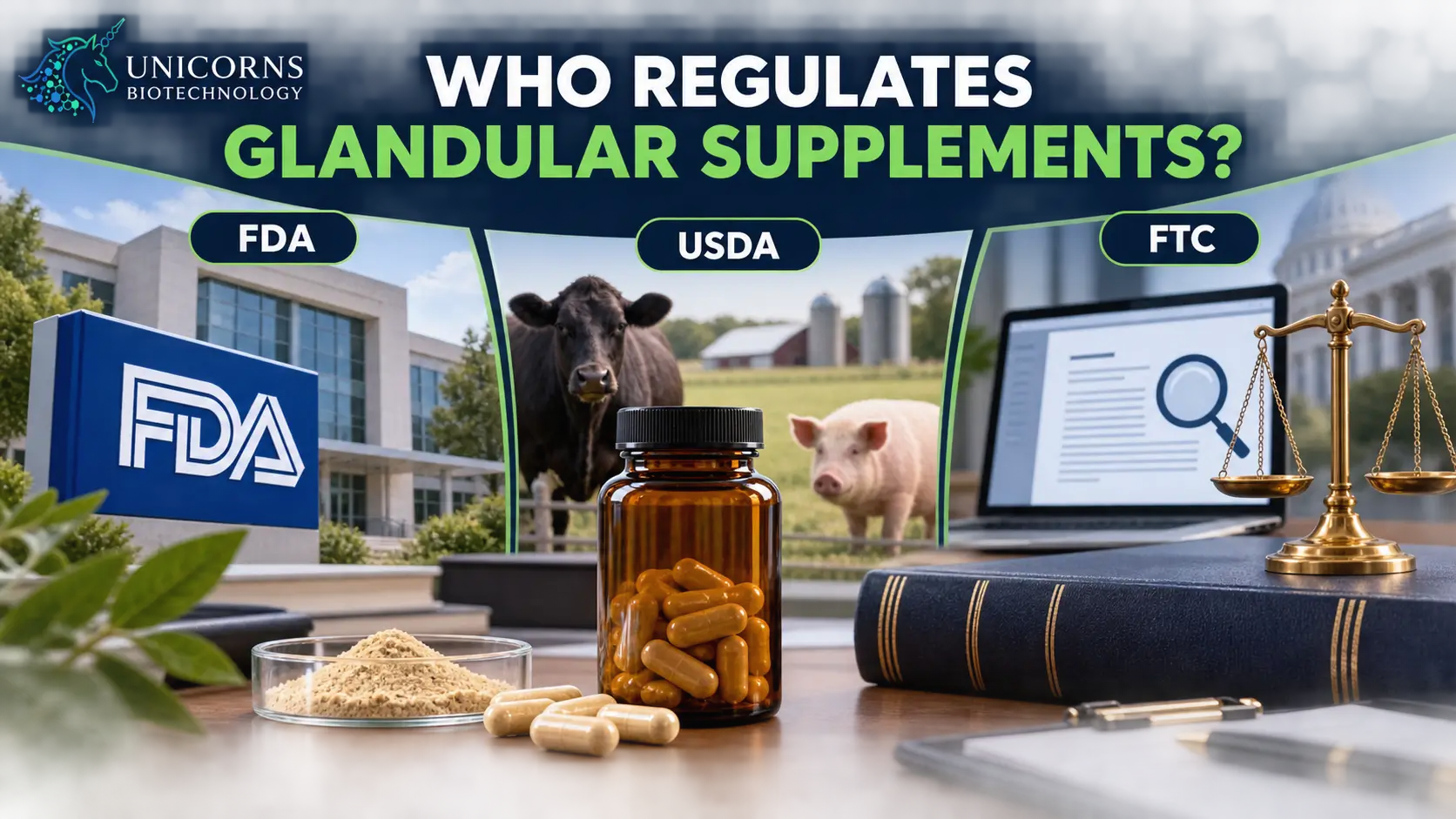
Several agencies can affect the same glandular ingredient shipment. Clear ownership prevents gaps between the factory, importer, contract manufacturer, and brand.
| Agency | Main role for animal-derived ingredients |
|---|---|
| FDA | Oversees dietary ingredient and supplement safety, manufacturing, labeling and relevant import controls |
| USDA APHIS | Controls animal health risks through commodity, origin, processing, and permit requirements |
| USDA FSIS | Oversees meat, poultry and other products within its jurisdiction |
| CBP | Handles customs entry, tariff classification and origin marking |
| FTC | Enforces advertising and endorsement requirements |
| State authorities | Enforce applicable warning, sales and consumer protection rules |
FDA’s Human Foods Program oversees dietary supplements through its relevant offices. APHIS addresses foreign animal disease risks; an FDA-compliant label cannot resolve an APHIS entry restriction.
Outsourcing leaves work for the brand. FDA’s cGMP guidance explains that a distributor selling a contract-manufactured supplement under its own label must understand the manufacturing activities that support release decisions.
Use a quality agreement to assign specifications, deviations, complaints, and recalls. Name the party that approves each lot and the person who reviews supplier changes.
Old Dietary Ingredients, NDI Notifications and GRAS
What proves pre-1994 dietary ingredient status?
A new dietary ingredient, or NDI, means a dietary ingredient that lacked US marketing before October 15, 1994. FDA does not maintain an authoritative list of every ingredient that meets the earlier marketing cutoff.
Request dated labels, catalogs, invoices, or other records that identify the material. Check whether those records describe the same species, tissue and preparation that you intend to purchase.
A history of eating liver does not, by itself, prove US dietary ingredient marketing before the cutoff. It may support a separate food-use analysis. Overseas supplement sales do not establish the required US marketing history.
When does a glandular extract need an NDI notification?
An NDI assessment starts with identity. A whole thymus powder, hydrolyzed thymus preparation, and isolated peptide may need different conclusions.
Where the notification requirement applies, the manufacturer or distributor must submit the safety basis to FDA at least 75 days before introducing the product into interstate commerce. The submission must address the proposed conditions of use. LII / Legal Information Institute
The law provides an exception for supplements whose dietary ingredients have a qualifying food-supply history without chemical alteration. Do not confuse that exception with proof that an ingredient predates DSHEA.
Processing changes need case-specific review. Freeze-drying alone does not settle NDI status, while a process that changes composition may alter the assessment. FDA discusses these distinctions in its revised draft NDI guidance, which does not carry the force of a regulation.
Does GRAS status replace an NDI review?
No. Generally Recognized as Safe, or GRAS, addresses a conventional food ingredient’s safety under specified conditions of use. It does not replace the dietary ingredient definition or every NDI requirement.
A GRAS conclusion alone does not prove actual presence in the food supply. Check the food-use evidence, chemical form, and proposed supplement use before relying on an exception.
| Supplier statement | Evidence the buyer should examine |
|---|---|
| “Old dietary ingredient” | US marketing records that match the ingredient |
| “Food-use exception applies” | Qualifying food use and an assessment of chemical alteration |
| “We submitted an NDI notification” | Submission, FDA response, specifications, process and covered conditions of use |
| “GRAS” | The conclusion’s scope and a separate dietary supplement status review |
Hormones and the Supplement–Drug Boundary
How do composition and claims change the assessment?
Both the substance and the intended use matter. Claims that a product treats hypothyroidism or another disease can establish drug intended use.
The dietary supplement definition excludes certain articles with drug approval or investigation histories, subject to statutory conditions and exceptions. Review that history when you assess isolated hormones or peptides. LII / Legal Information Institute
A whole-organ powder does not gain a legal exemption just because of its name. A “hormone-free” laboratory result does not resolve ingredient eligibility, drug exclusions, or disease claims.
Why does thyroid glandular need closer review?
FDA distinguishes prescription animal-derived thyroid medication from FDA-approved synthetic thyroid drugs. Its current information states that animal-derived thyroid medications, including desiccated thyroid extract products, lack FDA approval.
FDA treats these animal-derived thyroid medications as biological products under the Public Health Service Act. Do not present their prescription availability as proof that a thyroid powder qualifies as a supplement.
Published testing gives buyers another reason to check composition. The studies below document findings in the products the researchers purchased; they do not describe every current supplier or lot.
| Study | Products examined | Reported findings |
|---|---|---|
| Kang et al., 2013 | 10 thyroid-health supplements | Researchers detected T3 in nine products and T4 in five |
| Akturk et al., 2018 | 12 adrenal-support supplements | Researchers detected thyroid hormone in all 12 and at least one steroid hormone in most |
The adrenal study covered products with herbal and/or animal-derived ingredients. It did not isolate one ingredient type as the source of every finding. PubMed
For thyroid, adrenal, pituitary, and reproductive tissues, assess the relevant constituents and the proposed daily exposure. Ask the laboratory which compounds it measures and how low its method can detect them.
A report that says “not detected” needs a method and detection limit. It does not mean absolute zero or settle the product’s legal status.
BSE Safeguards and Prohibited Cattle Materials
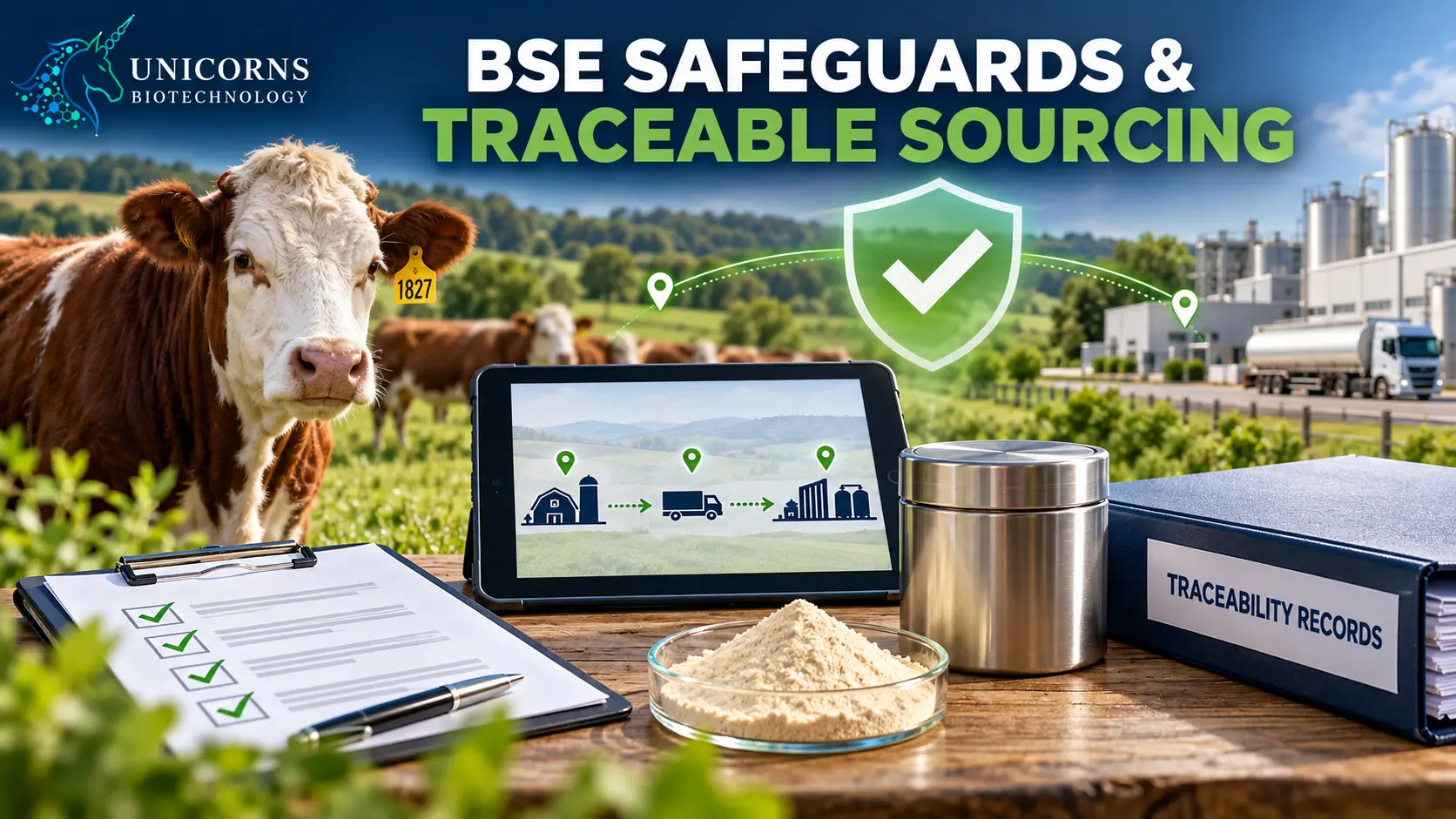
Bovine spongiform encephalopathy, or BSE, is a transmissible spongiform encephalopathy. For bovine glandular sourcing, 21 CFR 189.5 restricts prohibited cattle materials in human food, including dietary supplements.
| Cattle material | Rule to examine |
|---|---|
| Brain, skull, eyes, trigeminal ganglia, spinal cord, specified vertebral column portions and dorsal root ganglia | SRM definition covers cattle aged 30 months or older |
| Tonsils and distal ileum | SRM definition covers cattle of all ages |
| Materials from nonambulatory disabled cattle | Prohibited cattle material definition |
| Materials from cattle that did not pass inspection for human consumption | Prohibited cattle material definition |
| Mechanically separated beef | Prohibited cattle material definition |
Read the full rule’s definitions and exceptions. It addresses intestinal removal procedures, certain excluded materials, and FDA country designations. Liver’s absence from the SRM list does not establish complete supplement compliance.
Covered manufacturers and processors must retain supporting records for two years after creation. The rule also sets importer affirmation and record-access requirements.
For procurement, request records that connect species, tissue, and origin to the lot. Examine slaughter eligibility, age where relevant, and controls that prevent mixing with prohibited material.
“Grass-fed” describes a sourcing attribute. A country name or international BSE risk classification does not answer every US regulatory question.
Treat a supplier’s BSE/TSE statement as a starting document. A routine COA cannot demonstrate the full sourcing history or prove zero prion risk.
Glandular Ingredient Safety and Testing
What belongs in the safety dossier?
Start with a precise ingredient description. Record the species, tissue, process, composition, and specifications, then connect them to daily intake and intended users.
For a liver-rich formula, assess relevant nutrient exposure across the full blend. For an endocrine tissue, assess relevant hormone constituents. A concentrated extract may require evidence beyond the history of eating the source organ.
Keep safety evidence separate from benefit claims. A record supporting safe use does not prove the ingredient delivers the advertised outcome.
Which tests should the specifications cover?
Part 111 requires applicable specifications for identity, purity, strength, composition and contaminant limits. It does not supply one glandular powder test panel for every species and process.
| Review area | Practical question for the supplier or laboratory |
|---|---|
| Identity | Does the method establish the claimed species, tissue or relevant chemical profile? |
| Microbiology | Which organisms and limits fit the material and manufacturing process? |
| Elemental contaminants | Do the results support exposure at the proposed daily intake? |
| Hormones | Which relevant analytes, detection limits and units does the report cover? |
| Residues | Do processing solvents or veterinary treatments create risks that need assessment? |
| Allergens | Which ingredients and shared operations create cross-contact concerns? |
| Stability | Which data support storage conditions and any stated shelf life? |
Species DNA testing does not, by itself, establish organ identity. A bovine result cannot distinguish liver from every other bovine tissue. Combine suitable analytical work with tissue collection and traceability records.
Set acceptance limits before ordering. A low number means little if the method cannot measure the target compound in that powder.
Manufacturing: Part 111, Part 117 and COA Qualification
Which cGMP rules apply to bulk glandular ingredients?
Part 111 covers applicable dietary supplement manufacturing, packaging, labeling, and holding activities. A raw ingredient operation that supplies manufacturers for further processing can fall under a different framework.
FDA explains that dietary ingredient operations do not receive the finished-supplement exemption from Part 117 preventive controls. Other exemptions may apply, so assess the actual operation. Bulk form alone does not determine the answer.
For example, a powder that another company merely repacks as a finished supplement can trigger Part 111 obligations. Review the business activity, not the drum size or the supplier’s preferred label.
Third-party GMP certification can support supplier qualification. It cannot replace legal compliance or prove that a particular ingredient has a lawful market basis.
When can you rely on a supplier COA?
Under 21 CFR 111.75, manufacturers must conduct at least one appropriate identity test or examination for each dietary ingredient component before use, unless FDA grants an applicable exemption.
The rule permits reliance on supplier COAs for certain other specifications under defined conditions. Those conditions include supplier qualification, reliability confirmation, supporting records, and periodic reconfirmation. A COA must contain the required method and result information.
Check the lot number, methods, limits, units, and results before release. Resolve missing data and out-of-specification findings through the quality system, not a purchasing email.
How should the process and shelf life support product quality?
Ask the factory to explain its controls from tissue collection through final packaging. Review temperature control before drying, hygienic handling, and the evidence behind microbial controls.
Do not treat the words “freeze-dried” as proof of a validated pathogen reduction step. Ask what the process controls are and how the manufacturer verifies that control.
Part 111 does not require an expiration date. FDA advises firms to keep data supporting any expiration or shelf-life date they choose to place on the label.
Requires change notification for source, species, tissue, manufacturing site, and process. A supplier change can affect safety, specifications, NDI reasoning, and import eligibility at the same time.
Glandular Supplement Labeling Requirements
A finished glandular supplement needs the applicable identity statement, net quantity, Supplement Facts, and ingredient information. The label must also identify the responsible firm and provide the required domestic address or phone number for adverse event reports.
Under 21 CFR 101.36, the Supplement Facts panel follows specific rules for dietary ingredients and quantities. Proprietary blends have their own total-weight and ingredient-order requirements; they do not remove the manufacturer’s need for full formulation records.
Use ingredient names that match the material. “Bovine liver powder” gives clearer sourcing information than a vague “glandular complex,” but the final label still needs a complete regulatory review.
Allergen analysis depends on the formula. Colostrum can introduce milk protein, while marine ingredients may introduce fish or crustacean shellfish allergens.
Bovine and porcine origin do not appear among the nine federal major food allergens. That distinction does not remove the need for truthful source claims or cross-contact controls. Halal and Kosher requirements create separate sourcing questions.
Review country-of-origin statements with the customs facts. CBP has ruled that encapsulating a powder does not, by itself, create a substantial transformation. Do not assume US encapsulation establishes US origin.
Do not use a consumer Supplement Facts panel as your bulk ingredient specification. Your purchasing file needs composition, process, and lot details that a retail label cannot supply.
Structure/Function Claims and FTC Advertising Rules
The claim category determines the review. A statement about normal body function differs from a nutrient content claim or a claim about treating disease.
| Claim category | Example to review | Main compliance issue |
|---|---|---|
| Structure/function | “Supports normal immune function” | Evidence, context, required disclaimer and applicable FDA notification |
| Nutrient content | “High in vitamin B12” | Eligibility under the relevant nutrient claim rules |
| Health claim | A relationship between a substance and reduced disease risk | FDA authorization or an applicable qualified-claim pathway |
| Disease claim | “Treats hypothyroidism” | Drug intended use and approval requirements |
For applicable structure/function claims, firms must notify FDA no later than 30 days after first marketing the supplement with the claim. They must also hold substantiation and use the required disclaimer. A disclaimer cannot cancel a disease claim.
“Adrenal support” and “thyroid support” need context review. Nearby statements about hormone replacement, disease treatment, or “adrenal fatigue” can change what the message tells a buyer.
FTC expects competent and reliable scientific evidence for health claims. Match that evidence to the ingredient, dose, formula, population, and promised result.
An animal study or a paper on an isolated compound may not support a finished whole-organ product’s claimed benefit. Testimonials do not replace scientific substantiation. Review influencer disclosures and the overall message across ads, email, and social media. Federal Trade Commission
Importing Glandular Ingredients into the United States
Which entry requirements apply to the shipment?
Before shipment, document the species, tissue, source country, processing countries, manufacturing steps, and intended use. Give the importer and broker the same description that appears in the technical file.
Check applicable food facility registration and FDA prior notice requirements. Foreign facilities that must register also need a US agent; registration does not grant product approval.
Use the APHIS Veterinary Services Permitting Assistant to assess permits and commodity conditions. BSE represents one animal health issue. Porcine and poultry materials can face different controls, including restrictions linked to foreign animal diseases.
Check FSIS jurisdiction where relevant. Neither capsule form nor a “dietary supplement ingredient” description removes every animal-product entry requirement. Animal and Plant Health Inspection Service
Who handles FSVP and customs entry?
The importer of record, FSVP importer, and foreign facility’s US agent perform different roles. One business may fill several roles, but the parties must establish each responsibility.
| Role | Main responsibility |
|---|---|
| Importer of record | Handles customs entry obligations |
| FSVP importer | Meets applicable foreign supplier verification duties |
| Foreign facility’s US agent | Serves the facility’s FDA registration contact role |
For FSVP, FDA looks first to the US owner or consignee at entry. If none exists, the rule provides for a US agent or representative of the foreign owner or consignee with signed consent. That role does not arise from facility registration alone.
Section 1.511 provides modified requirements for certain dietary supplement imports and components under specified conditions. It does not give every glandular ingredient importer a blanket FSVP exemption.
For component imports, some provisions depend on whether the importer or its customer establishes and verifies the applicable Part 111 specifications. Qualifying customer arrangements require written assurances.
Which documents should accompany the compliance review?
Keep the invoice, packing list, and entry description consistent. Add the lot COA, specifications, and traceability records to the compliance file.
Permits, veterinary certificates, and origin declarations depend on the shipment’s requirements. Separate those requirements from supporting documents that the buyer requests for qualification.
A broker can submit entry data, but missing safety or sourcing evidence can still stop the shipment. FDA can detain products, refuse admission or use an import alert to support detention without physical examination.
State Requirements and Postmarket Duties
California Proposition 65 focuses on exposure to listed chemicals. A lead result in parts per million does not answer the warning question without the daily intake and applicable legal analysis.
Assess the finished product’s exposure and any relevant exemption or safe-harbor level. Do not place a warning on every glandular product by default.
New York restricts sales of certain weight-loss and muscle-building supplements to people under 18. Marketing and product characteristics affect coverage; the law does not target every organ supplement.
After launch, maintain complaint intake, investigation, and escalation procedures. The responsible person must report qualifying serious adverse events to FDA within 15 business days and retain required adverse event records for six years.
Additional medical information can trigger follow-up reporting. The label’s domestic contact details must support that reporting channel.
Keep distribution records and clear recall responsibilities. Reassess the product when the supplier changes a source, process, or specification.
FDA Enforcement Lessons and the 2026 Watchlist
FDA’s April 24, 2025 online advisory letter to Ancestral Supplements addressed its Ancestral Grassfed Beef Thyroid product. FDA cited website statements about hypothyroidism and Graves’ disease as evidence of drug intended use.
The letter also directed attention to testimonials, metatags and other promotional material. For brands, the lesson extends beyond the bottle: review every channel that communicates the product’s intended use.
Import Alert 54-14 provides another example. Entries for certain Imuregen products cite identity testing, finished-product specifications and cattle-material recordkeeping concerns.
Those entries concern identified products and firms. They do not ban all bovine ingredients.
For 2026 sourcing, monitor FDA’s thyroid medication updates, NDI guidance, import alerts and APHIS requirements. Check the status of each document before applying it: a draft guidance, proposal, and final regulation carry different weight.
FDA describes a risk-based enforcement approach for unapproved animal-derived thyroid medications. Its published page discusses planned guidance. Use the agency’s current wording rather than claims of a universal thyroid-product ban.
Supplier Due Diligence Before a Bulk Order
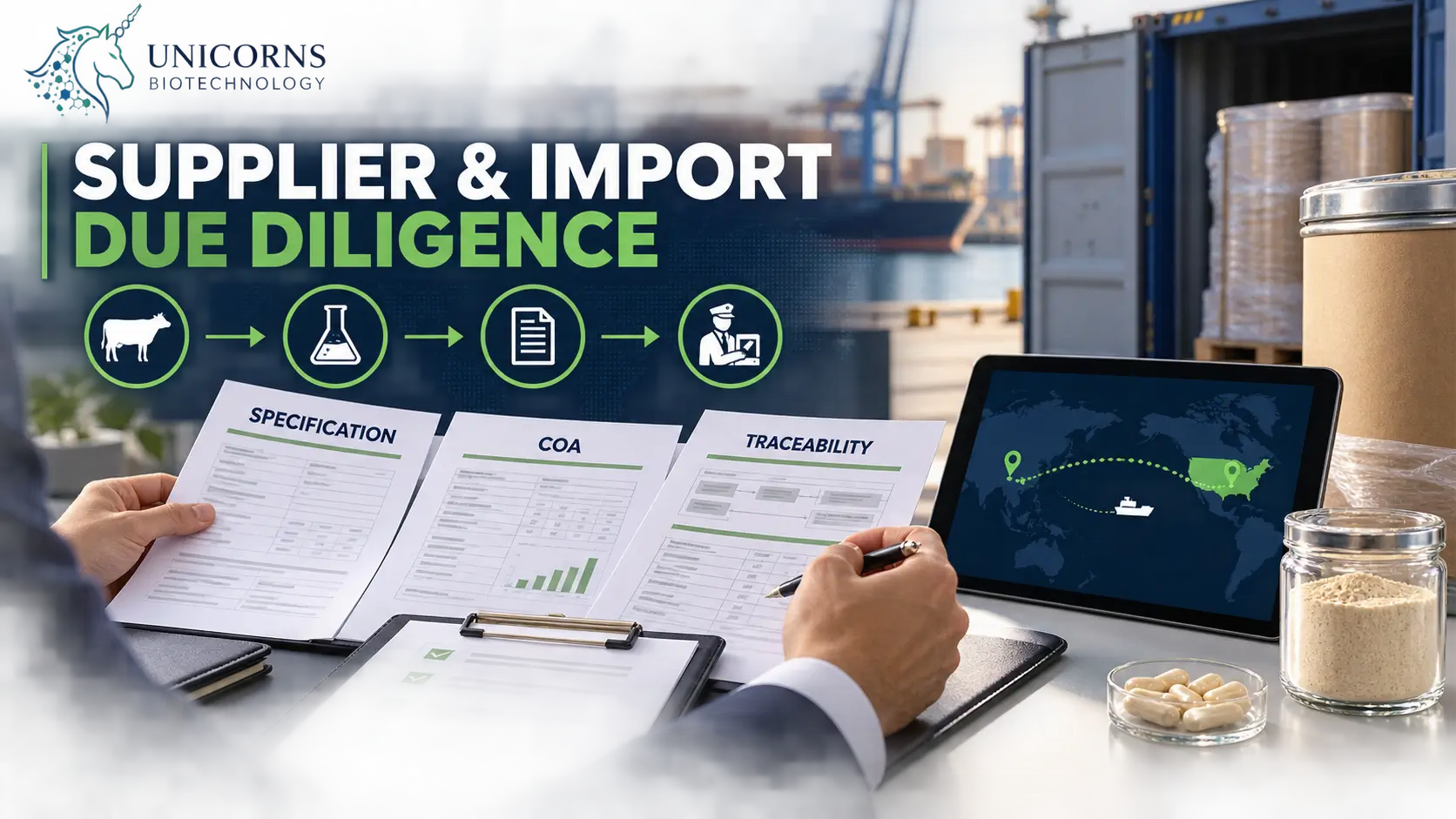
A usable compliance file connects every claim to the material you will receive. It should let procurement, quality, and regulatory staff reach the same conclusion.
Use this matrix to structure a glandular ingredient document request. The status column distinguishes underlying legal duties from useful purchasing records; it does not make every document mandatory for every shipment.
| Review area | Record to request | Status or purpose |
|---|---|---|
| Ingredient eligibility | Written identity and regulatory rationale | Support for the product’s lawful basis |
| NDI status | Matching marketing evidence, exception rationale or notification records | Depends on ingredient and use |
| Safety | Evidence tied to composition and intended intake | Supports safety assessment |
| Bovine sourcing | Applicable prohibited-cattle-material records | Legal duties depend on material and business role |
| Import eligibility | Applicable permits and veterinary documents | Shipment-specific |
| Quality | Specifications, lot COA, methods and verification plan | Supports required quality controls |
| Manufacturing | Applicable audit evidence and corrective actions | Buyer qualification |
| Change control | Written notification and approval terms | Recommended quality agreement |
| Religious certification | Relevant Halal or Kosher records | Customer or market requirement |
Challenge statements such as “FDA-approved glandular powder” or “all organs qualify as pre-1994 ingredients.” Ask the supplier to identify the rule and provide the underlying evidence.
Food, feed, and cosmetic grades do not establish the same intended-use basis. A low bulk price cannot offset the cost of a material that fails your regulatory review.
For a wider purchasing framework, read our guide to choosing a glandular powder manufacturer. Use it alongside the ingredient-specific review above.
Frequently Asked Questions
Does FDA approve glandular supplements?
FDA does not approve dietary supplements through the drug approval process before sale. Manufacturers and distributors must meet the applicable ingredient, safety, manufacturing, and labeling requirements.
Can companies sell glandular supplements in the United States?
Some products can meet US dietary supplement requirements. Assess the exact ingredient, intended use, and claims rather than relying on the category name.
Does bovine liver powder qualify as an old dietary ingredient?
The product name does not prove pre-1994 status. Review US marketing evidence for the material or assess whether another lawful basis applies.
Does freeze-drying make an ingredient an NDI?
Freeze-drying alone does not answer the question. Ingredient history, identity, and chemical alteration determine the analysis.
Does GRAS status remove the need for an NDI review?
No. Assess dietary ingredient eligibility and the notification rules, including any food-use exception.
Is thyroid glandular powder the same as prescription desiccated thyroid?
A shared source does not establish the same composition, intended use, or legal status. FDA treats animal-derived thyroid medications under a separate drug and biological-product framework.
Can a glandular supplement contain hormones?
A test result alone cannot determine whether the product qualifies as a supplement. Review the constituent, exposure, safety, intended use, and applicable drug exclusions.
Which cattle tissues face SRM restrictions?
The rule covers specified nervous-system tissues from cattle aged 30 months or older. It also covers tonsils and distal ileum from cattle of all ages, alongside other prohibited cattle materials and defined exceptions.
Can I import bovine adrenal or porcine pancreas powder?
The ingredient name does not establish admissibility. Check species, origin, processing, intended use, and current FDA, APHIS, and other applicable requirements.
Does my glandular ingredient shipment need an FSVP?
Assess the importer and product against the FSVP rules. Section 1.511 offers modified requirements under defined conditions, not a blanket exemption.
Which supplier records should I request first?
Start with identity, process, origin, specifications, and a lot COA. Then request the ingredient status, safety, and import evidence that your review identifies.
Can my brand claim “adrenal support” or “thyroid support”?
The wording needs evidence and context review. Disease references, testimonials or surrounding copy can turn a short support claim into a different regulatory message.
Source Bulk Glandular Ingredients with a Clear Review Process
Set the regulatory requirements before you compare quotations. Confirm ingredient eligibility, then align sourcing, testing, manufacturing, import responsibilities, and claims.
Unicorns Biotechnology is an animal-derived ingredients manufacturer in China. For your US project, share the species, tissue, target specification, and intended use, so our team can discuss the material and available supporting documents.
Contact Unicorns Biotechnology to request specifications, an available lot COA, sourcing information, and an R&D sample. Your regulatory team should review the documentation against the planned US use before commercial release.
References
Peer-reviewed research
Akturk, H. K., Chindris, A. M., Hines, J. M., Singh, R. J., & Bernet, V. J. (2018). Over-the-counter “adrenal support” supplements contain thyroid and steroid-based adrenal hormones. Mayo Clinic Proceedings, 93(3), 284–290. https://doi.org/10.1016/j.mayocp.2017.10.019.
Kang, G. Y., Parks, J. R., Fileta, B., Chang, A., Abdel-Rahim, M. M., Burch, H. B., & Bernet, V. J. (2013). Thyroxine and triiodothyronine content in commercially available thyroid health supplements. Thyroid, 23(10), 1233–1237. https://doi.org/10.1089/thy.2013.0101.
FDA guidance and regulatory resources
U.S. Food and Drug Administration. (2005, April). Dietary supplement labeling guide: Chapter I. General dietary supplement labeling.
https://www.fda.gov/food/dietary-supplements-guidance-documents-regulatory-information/dietary-supplement-labeling-guide-chapter-i-general-dietary-supplement-labeling
U.S. Food and Drug Administration. (2010, December). Small entity compliance guide: Current good manufacturing practice in manufacturing, packaging, labeling, or holding operations for dietary supplements.
https://www.fda.gov/regulatory-information/search-fda-guidance-documents/small-entity-compliance-guide-current-good-manufacturing-practice-manufacturing-packaging-labeling
U.S. Food and Drug Administration. (2013). Guidance for industry: Questions and answers regarding adverse event reporting and recordkeeping for dietary supplements as required by the Dietary Supplement and Nonprescription Drug Consumer Protection Act.
https://www.fda.gov/regulatory-information/search-fda-guidance-documents/guidance-industry-questions-and-answers-regarding-adverse-event-reporting-and-recordkeeping-dietary
U.S. Food and Drug Administration. (2024, April). Dietary supplements: New dietary ingredient notifications and related issues: Guidance for industry [Revised draft guidance].
https://www.fda.gov/media/99538/download
U.S. Food and Drug Administration. (2025, April 24). Ancestral Supplements, LLC [Online advisory letter, Reference No. 705505].
https://www.fda.gov/inspections-compliance-enforcement-and-criminal-investigations/ancestral-supplements-llc
U.S. Food and Drug Administration. (n.d.). Dietary supplements. Retrieved September 26, 2026, from
https://www.fda.gov/food/dietary-supplements
U.S. Food and Drug Administration. (n.d.). FDA’s actions to address unapproved thyroid medications. Retrieved September 26, 2026, from
https://www.fda.gov/drugs/enforcement-activities-fda/fdas-actions-address-unapproved-thyroid-medications
U.S. Food and Drug Administration. (n.d.). Final rule on Foreign Supplier Verification Programs (FSVP) at-a-glance. Retrieved September 26, 2026, from
https://www.fda.gov/food/food-safety-modernization-act-fsma/final-rule-foreign-supplier-verification-programs-fsvp-glance
U.S. Food and Drug Administration. (n.d.). Food allergies. Retrieved September 26, 2026, from
https://www.fda.gov/food/nutrition-food-labeling-and-critical-foods/food-allergies
U.S. Food and Drug Administration. (n.d.). Frequently asked questions on FSMA. Retrieved September 26, 2026, from
https://www.fda.gov/food/food-safety-modernization-act-fsma/frequently-asked-questions-fsma
U.S. Food and Drug Administration. (n.d.). Import alert 54-14. Retrieved September 26, 2026, from
https://www.accessdata.fda.gov/cms_ia/importalert_741.html
U.S. Food and Drug Administration. (n.d.). Importing food products into the United States. Retrieved September 26, 2026, from
https://www.fda.gov/food/food-imports-exports/importing-food-products-united-states
U.S. Food and Drug Administration. (n.d.). New dietary ingredients in dietary supplements: Background for industry. Retrieved September 26, 2026, from
https://www.fda.gov/food/new-dietary-ingredient-ndi-notification-process/new-dietary-ingredients-dietary-supplements-background-industry
U.S. Food and Drug Administration. (n.d.). Registration of food facilities and other submissions. Retrieved September 26, 2026, from
https://www.fda.gov/food/guidance-regulation-food-and-dietary-supplements/registration-food-facilities-and-other-submissions
U.S. Food and Drug Administration. (n.d.). Structure/function claims. Retrieved September 26, 2026, from
https://www.fda.gov/food/nutrition-food-labeling-and-critical-foods/structurefunction-claims
Core regulations
Prohibited cattle materials, 21 C.F.R. § 189.5 (2026).
https://www.ecfr.gov/current/title-21/chapter-I/subchapter-B/part-189/subpart-B/section-189.5
What specifications must you establish?, 21 C.F.R. § 111.70 (2026).
https://www.ecfr.gov/current/title-21/chapter-I/subchapter-B/part-111/subpart-E/section-111.70
What must you do to determine whether specifications are met?, 21 C.F.R. § 111.75 (2026).
https://www.ecfr.gov/current/title-21/chapter-I/subchapter-B/part-111/subpart-E/section-111.75
Nutrition labeling of dietary supplements, 21 C.F.R. § 101.36 (2026).
https://www.ecfr.gov/current/title-21/chapter-I/subchapter-B/part-101/subpart-C/section-101.36