
EU glandular supplement regulations don’t offer buyers a single approval route. A bovine liver powder, beef kidney powder, adrenal extract, and thyroid material can face different legal tests. Species, tissue, process, dose, claims, origin, and target country all shape the answer.
This creates risk before a procurement manager issues a purchase order. A clean certificate of analysis cannot fix incorrect Novel Food status, an animal by-product supply chain, or an invalid import route.
This guide explains the EU rules for glandular supplements and animal-derived food supplement ingredients. It covers Novel Food status, EFSA assessment, TSE controls, imports, labeling, health claims, testing, and national notification.
This article provides general B2B information. It does not provide legal or medical advice. Confirm each product with the competent authority and qualified EU regulatory counsel.
EU Glandular Supplement Regulations at a Glance
EU law treats food supplements as foods. It does not create a single license for all glandular supplements, organ powders, or animal extracts.
Buyers must build a product-specific compliance file. That file should connect the exact material to its source animal, organ, manufacturing process, daily dose, import route, label, and target Member State.
| Compliance question | Main rule or authority | Buyer action |
|---|---|---|
| Does the finished product qualify as a food supplement? | Directive 2002/46/EC | Confirm dose form, intended use, ingredient identity, and national implementation |
| Does the ingredient count as a Novel Food? | Regulation (EU) 2015/2283 | Prove significant EU food use before 15 May 1997 or follow the consultation or authorization route |
| Could authorities classify it as a medicine? | Directive 2001/83/EC | Review pharmacological activity, active hormones, dose, presentation, and claims |
| Did the tissue remain in the human food chain? | Regulations 178/2002, 852/2004, and 853/2004 | Trace collection and processing from an eligible food establishment |
| Did the tissue enter the animal by-product chain? | Regulation (EC) No 1069/2009 | Do not assume ABP material can enter a human supplement |
| Does the source meet TSE rules? | Regulation (EC) No 999/2001 | Check species, tissue, animal age where relevant, origin, SRM exclusion, and segregation |
| Can the consignment enter the EU? | Regulation (EU) 2017/625 and commodity-specific rules | Confirm country, establishment, certificate, BCP, TRACES, and CHED requirements |
| Can the brand use a health claim? | Regulation (EC) No 1924/2006 | Check the exact wording, substance, conditions of use, and EU Register entry |
Glandular Supplement Ingredients in EU Law
The trade uses “glandular” as a broad commercial term. It may describe whole organs, endocrine glands, tissue concentrates, peptide fractions, or multi-organ blends.
Common bovine, porcine, ovine, caprine, poultry, and marine ingredients include liver, heart, kidney, adrenal, thymus, spleen, pancreas, thyroid, pituitary, placenta, ovary, and testicle. Related animal-derived ingredients may include colostrum, cartilage, bone, collagen, and bone broth powders.
The legal analysis follows the actual material. A marketing name such as “organ complex,” “ancestral nutrition,” or “protomorphogen” does not establish its status.
| Commercial form | Main regulatory question | Evidence focus |
|---|---|---|
| Whole freeze-dried organ powder | Did consumers eat the same form in the EU before 15 May 1997? | Tissue identity, process, food history, and food-chain records |
| Defatted or concentrated gland powder | Did concentration change composition or exposure? | Concentration factor, before-and-after composition, and daily dose |
| Enzymatic hydrolysate | Did hydrolysis create a new or selectively enriched ingredient? | Degree of hydrolysis, molecular profile, specifications, and safety |
| Purified peptide, enzyme, or hormone fraction | Does another pre-market or medicinal route apply? | Purity, pharmacology, intended effect, dose, and legal classification |
| Multi-organ blend | Does every component have lawful and compatible status? | Ingredient-by-ingredient review and cumulative exposure |
This guide covers ingredients for human food supplements. Veterinary products, animal feed, pet food, cosmetics, and medicines follow other frameworks.
Five-Way Classification Test for an EU Glandular Ingredient
Procurement teams should run five checks before they compare price, MOQ, or lead time. Each answer affects the documents that the supplier and EU importer must prepare.
1. Does the finished product qualify as a food supplement?
Directive 2002/46/EC defines food supplements as foods that supplement a normal diet. They provide concentrated sources of nutrients or other substances with a nutritional or physiological effect. Brands market them in measured dose forms such as capsules, tablets, sachets, or liquids.
A bulk bovine kidney powder does not become a finished food supplement at the factory gate. The brand or manufacturer must also assess the final formula, serving size, claims, label, and target market.
2. Does the ingredient have non-novel food use in the EU?
Regulation (EU) 2015/2283 sets 15 May 1997 as the core Novel Food cutoff. The operator must support significant human consumption inside the EU before that date.
History for fresh beef liver does not automatically cover a concentrated bovine liver extract. History for food use outside the EU also does not prove EU consumption.
3. Could the product qualify as a medicinal product?
Active thyroid hormones, corticosteroids, sex steroids, potent enzymes, and concentrated bioactive fractions raise the risk. Disease claims also push products toward medicinal-product law.
National medicines authorities examine the whole product. They review composition, dose, mode of action, presentation, and consumer expectations.
4. Did the tissue remain in the human food chain?
The supplier must collect and handle the tissue for human consumption from the start. A laboratory pass does not convert animal by-product material into food-grade material.
Ask for the establishment approval, intended-use records, slaughter or collection controls, traceability, and process flow. Match every document to the same species, tissue, and lot.
5. Do animal-health, TSE, and import rules apply?
They often do. The exact controls depend on species, tissue, age where relevant, country, process, commodity classification, and intended use.
| Material example | Main classification issue | Core evidence |
|---|---|---|
| Freeze-dried bovine liver powder | Food history and import eligibility | Pre-1997 status analysis, food-chain records, origin, and process description |
| Beef kidney powder | Food history, cadmium control, and source traceability | Tissue identity, contaminant plan, origin, process, and daily intake |
| Bovine adrenal extract | Novelty and concentration | Extract ratio, composition, hormone profile, and safety data |
| Thyroid powder | Medicinal boundary and thyroid hormones | T3/T4 limits, method, batch results, dose, and claims review |
| Purified thymus peptide | Novel Food and medicinal status | Molecular identity, production process, pharmacology, and intake |
| Porcine pancreas powder | Enzyme activity, food-chain status, and claims | Tissue identity, activity profile, hygiene, and history evidence |
| Ovine gland powder | Small-ruminant TSE rules | Species, tissue, origin, age criteria where relevant, and SRM controls |
EU Regulatory Authorities and Their Roles
Several bodies share oversight. Buyers should not call EFSA the “approving authority.”
| Entity | Role |
|---|---|
| European Commission and DG SANTE | Manage EU food policy, Novel Food procedures, the Union list, import frameworks, and implementing rules |
| EFSA | Conducts independent scientific risk assessments and publishes applicant guidance |
| Member State competent authorities | Enforce food law, conduct Article 4 consultations, receive notifications where required, and apply national rules |
| National medicines authorities | Decide whether a product meets the medicinal-product definition in their market |
| Border Control Posts and customs | Check eligible animal-origin consignments, certificates, identity, and physical compliance |
| EU importer and responsible food business operator | Carry primary responsibility for legal status, safety, traceability, labeling, and corrective action |
The European Commission manages Novel Food authorisation. EFSA assesses the scientific evidence when the procedure requires an opinion.
TRACES NT supports animal and public-health certification. The Union uses CHED-P for relevant consignments of products of animal origin. RASFF shares information about serious food and feed risks.
Novel Food Status for Glandular Powders and Extracts
Novel Food status often creates the first major decision for a glandular ingredient. Buyers should resolve it before formulation, artwork, or commercial shipment.
The 15 May 1997 test
The Novel Food Regulation covers foods that lacked significant human consumption in the EU before 15 May 1997 and fall within a listed category. The categories include foods from animals or their parts and foods produced with certain new processes.
Whole beef kidney, liver, or heart has a long culinary history. Yet that fact may not settle the status of a freeze-dried capsule ingredient, concentrated extract, peptide hydrolysate, or purified fraction.
The operator must match history to the exact product. The comparison should cover species, tissue, manufacturing process, composition, form, intake, and intended food category.
Evidence for non-novel status
Strong evidence shows actual human consumption inside the EU. It also identifies the material with enough detail to support equivalence.
| Evidence type | Strong evidence | Common gap |
|---|---|---|
| Market records | Dated invoices, labels, catalogues, distributor files, and sales volumes | Undated webpages or current supplier statements |
| Geography | Records from EU markets before the cutoff | Use only in the United States, Asia, or another third country |
| Product identity | Same species, tissue, process, composition, and form | Fresh organ evidence used for a concentrated extract |
| Consumption scale | Records that show meaningful human consumption | One anecdote, prescription, or practitioner record |
| Intended use | Evidence for the relevant food or supplement category | Evidence from feed, cosmetics, research, or medicine |
A supplier declaration can support the file, but it cannot replace primary evidence. Buyers should ask who collected the evidence and how the records match the commercial specification.
The Novel Food Status Catalogue
The Commission’s Novel Food Status Catalogue gives operators a useful screening tool. It covers products of animal and plant origin and other substances.
The Catalogue does not bind authorities. It also does not contain every gland, organ, species, or process. The operator remains responsible for the status decision.
Article 4 status consultation
When doubt remains, the operator can consult the competent authority in the Member State where it first plans to market the food. Implementing Regulation (EU) 2018/456 sets procedural steps for that consultation.
The submission should define the product and present the consumption evidence. A vague request for “bovine glandular powder” will not support a useful decision.
Full application and traditional-food routes
An applicant can submit a full Article 10 application when the ingredient qualifies as novel. The Commission manages the procedure and may ask EFSA to assess safety.
The traditional-food route sets another path for qualifying foods from third countries. The applicant must show at least 25 years of safe food use in one or more third countries. Traditional therapeutic use does not automatically prove food use.
Union-list authorisation
The Commission adds authorised Novel Foods to the Union list. The entry can define the ingredient, specifications, food categories, maximum levels, target population, label wording, and monitoring conditions.
Most authorisations operate generically. Another company may use the authorised ingredient only when its material meets the listed identity and conditions. Data-protection rules can restrict reliance on protected studies for a set period.
EFSA Assessment of Novel Glandular Ingredients
EFSA focuses on safety under the proposed conditions of use. It does not certify a supplier or issue the final market authorisation.
EFSA’s updated scientific guidance applies to relevant applications from 1 February 2025. Its administrative guidance explains submission duties and procedural steps.
Pre-submission work
Applicants should map studies before they commission them. The Transparency Regulation introduced study-notification duties, public disclosure rules, confidentiality procedures, and general pre-submission advice.
Poor planning can delay a file before EFSA reaches the science. The applicant should align the legal entity, study owner, laboratory, product identity, and notified study record.
Scientific dossier modules
| EFSA module | Glandular-specific content |
|---|---|
| Identity | Species, exact organ, anatomical collection point, physical form, and marker profile |
| Production | Collection, preservation, defatting, hydrolysis, extraction, concentration, drying, packing, and rework |
| Composition | Protein, fat, ash, peptides, hormones, vitamins, minerals, contaminants, and batch variation |
| Specifications | Identity, markers, microbiology, contaminants, moisture, residual solvents, and stability limits |
| Uses and intake | Food category, maximum use, daily serving, target population, and combined exposure |
| History of use | Source and ingredient history, geography, preparation, intake, and reported adverse effects |
| Nutritional assessment and ADME | Digestion, absorption, metabolism, nutritional disadvantage, and high-intake risks |
| Toxicology | Genotoxicity, repeated-dose data, human evidence, and reasoned data gaps |
| Allergenicity | Animal protein source, cross-reactivity, processing effects, and relevant label duties |
Glandular materials need tissue-specific analysis. A thyroid ingredient needs a different plan from beef kidney powder or bovine liver powder.
Risk factors can include T3 and T4, corticosteroids, sex steroids, active enzymes, growth factors, peptides, vitamin A, cadmium, veterinary drug residues, pathogens, allergens, and TSE hazards. The applicant should connect each test to the source, process, dose, and target population.
Assessment timeline and clock stops
The Novel Food Regulation gives EFSA nine months to adopt its opinion after it receives a valid application. EFSA can request more information. Those requests can stop or extend the practical schedule.
The full project also includes dossier preparation, validation, applicant responses, and Commission risk management. No fixed cost or total duration fits every animal-derived ingredient.
Opinion, authorisation, and change control
An EFSA opinion does not grant market access on its own. The Commission and Member States complete the risk-management process and update the Union list when they authorise the food.
Control changes after authorisation. A new source species, different organ, wider target population, higher dose, altered process, or broader specification may fall outside the listed conditions.
Food Supplement Rules and the Member State Layer
Directive 2002/46/EC sets the core framework for food supplements. It covers dose forms, supplement-specific label statements, and rules for vitamins and minerals.
Glandular powders usually fall within “other substances” rather than harmonized vitamin or mineral lists. Member States can apply national rules to these substances, product notification, dose, language, and borderline status.
| Launch question | EU-level review | Member State review |
|---|---|---|
| Does the ingredient have lawful status? | Novel Food Regulation and Union list | National history and authority position |
| Does the dose support safe use? | General Food Law and authorisation conditions | National restrictions or safety views |
| Does notification apply? | Directive allows national monitoring systems | Portal, fee, documents, responsible party, and timing |
| Does the label comply? | Directive 2002/46/EC and Regulation 1169/2011 | Language and national implementation |
| Can mutual recognition help? | Regulation (EU) 2019/515 | National assessment and public-interest restrictions |
Regulation (EU) 2019/515 supports mutual recognition for goods lawfully marketed in another Member State. It does not override Novel Food authorisation, food-safety law, prohibited claims, or medicinal-product rules.
Human Food Material and Animal By-Product Status
This distinction causes frequent sourcing errors. Regulation (EC) No 1069/2009 governs animal by-products and derived products not intended for human consumption.
The law does not turn every liver, kidney, adrenal gland, or pancreas into an animal by-product. Intended use and supply-chain decisions determine the applicable legal route.
| Route | Status at origin | Main framework | Human supplement use |
|---|---|---|---|
| Human food chain | Operator collects and handles the tissue for human consumption | General Food Law and Regulations 852/2004 and 853/2004 | May qualify after all food, Novel Food, TSE, import, and national checks |
| Animal by-product chain | Operator does not intend the material for human consumption | Regulations 1069/2009 and 142/2011 | Do not assume eligibility for human supplements |
Category 3 can include material from animals that authorities found fit for human consumption. The operator may still direct that material to a non-food use. “Low-risk ABP” does not mean “food-grade.”
Buyers should obtain the intended-use declaration, establishment status, slaughter or collection records, batch traceability, and process flow. A microbiological pass or clean heavy-metals result cannot repair the wrong legal chain.
TSE, BSE, Scrapie, and Specified Risk Material Controls
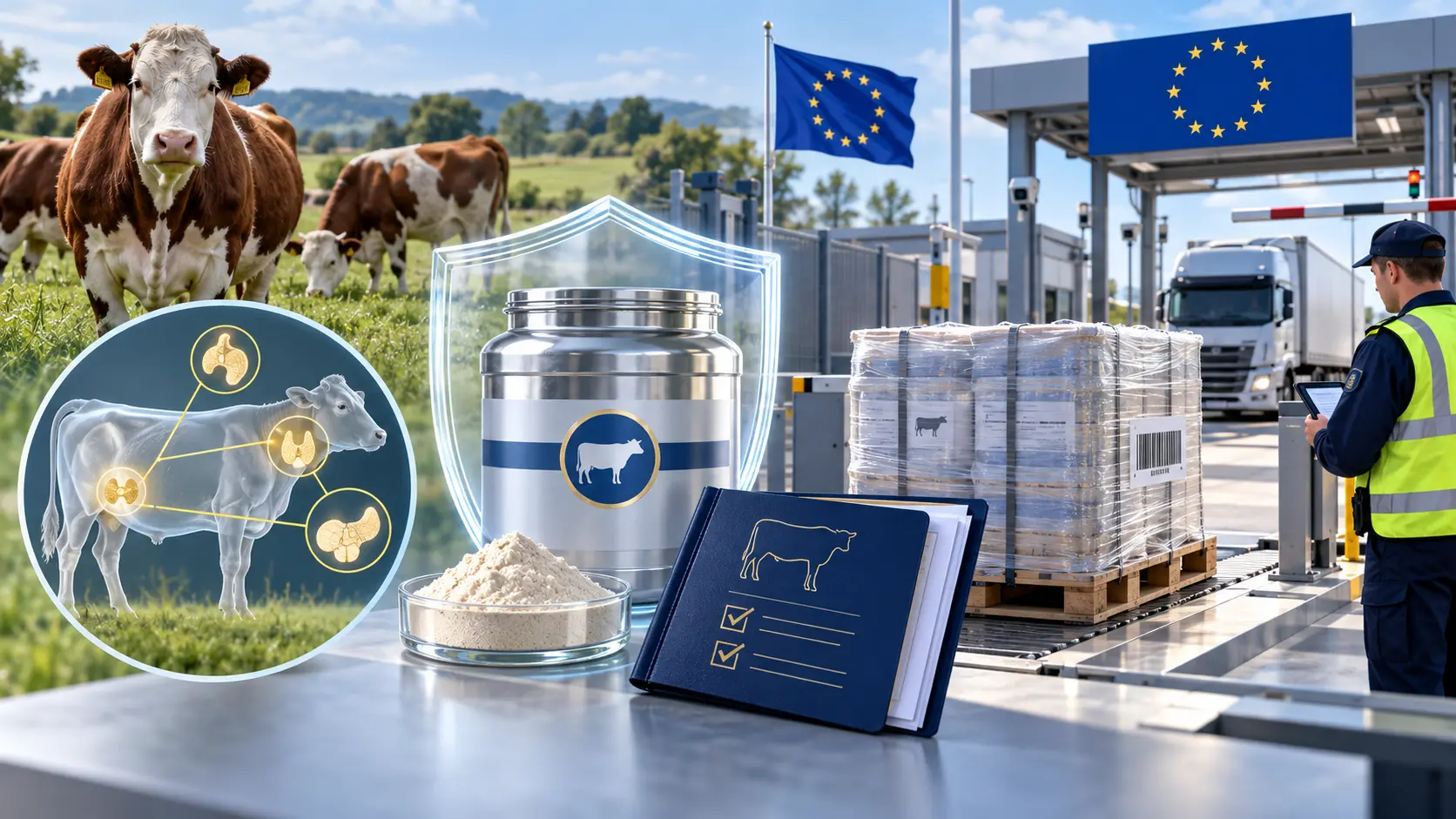
Regulation (EC) No 999/2001 controls transmissible spongiform encephalopathies. It covers BSE in cattle, scrapie in sheep and goats, and related risk-management measures.
The Regulation identifies specified risk material through Annex V. The list can depend on species, tissue, animal age, and country or region risk status. Buyers should check the current consolidated text instead of copying an old SRM list into a specification.
Most commercial organ powders do not carry one automatic legal answer. A bovine liver, adrenal, or beef kidney ingredient still needs source and segregation records. A pituitary material needs close review because collection inside the skull can create contact and control issues, even when a buyer cannot point to a blanket pituitary ban.
| Source species | Main issue | Procurement action |
|---|---|---|
| Bovine | BSE status, Annex V SRM, animal age, origin, and cross-contamination | Verify the exact tissue and current rules; reject generic “all bovine organs are allowed” statements |
| Ovine and caprine | Scrapie and small-ruminant SRM rules | Check tissue, origin, age or dentition criteria, and segregation |
| Porcine | Food hygiene and animal-health entry rules | Review disease controls and import eligibility even though bovine BSE rules do not apply in the same way |
| Cervid | Chronic wasting disease and national sourcing restrictions | Treat deer and elk tissues as a separate risk review |
| Poultry and marine | Species identity, contaminants, hygiene, and import category | Match the commodity to the correct entry and allergen rules |
A useful TSE statement names the species, tissue, origin, legal basis, and lot. It also identifies the signer and issue date.
| Record | Buyer check |
|---|---|
| TSE or BSE declaration | Species, tissue, origin, regulation cited, date, signer, and lot linkage |
| SRM exclusion statement | Exact excluded tissues and cross-contamination controls |
| Slaughter or veterinary record | Eligible establishment, inspection status, source animal, and traceability |
| Country-risk evidence | Current legal listing rather than a marketing brochure |
| Process flow | Collection, segregation, temperature, drying, packing, and rework controls |
No routine finished-powder test can replace source control for prion risk. Procurement teams should manage TSE risk through tissue exclusion, legal sourcing, traceability, and processing-chain controls.
Importing Glandular Ingredients into the EU
The import route depends on the legal commodity, CN code, species, tissue, process, intended use, and product composition. Confirm the route before the supplier books freight.
An attractive price loses value when a consignment reaches the wrong Border Control Post or carries the wrong certificate. A free sample may also trigger controls if it contains regulated animal-origin material.
Country and establishment eligibility
The Commission states that relevant animals and animal-origin goods may enter only from listed non-EU countries. Where required, the goods must also come from a listed establishment.
Regulations (EU) 2021/404 and 2021/405 support country listing for animal-health and public-health purposes. The Commission’s establishment page links the current records in TRACES NT.
Do not treat country reputation as legal evidence. “New Zealand sourced” or “Argentinian grass-fed” may support a commercial story, but the importer still needs the correct legal listing and establishment status.
Certificates, TRACES, and CHED-P
Relevant consignments may need pre-notification, an official certificate, entry through a designated Border Control Post, and a Common Health Entry Document for Products. The importer processes the CHED-P through TRACES NT.
The exact certificate model depends on the commodity. Buyers should confirm it with the EU importer, customs broker, BCP, and competent authority before dispatch.
Bulk powder and finished capsules
Encapsulation does not erase animal origin. A capsule with glandular powder and excipients may fall under rules for products of animal origin or composite products, depending on its composition and processing.
Do not assume a finished retail pack avoids veterinary border controls. Classify the product before the supplier prints labels or books the shipment.
| Import document | Purpose |
|---|---|
| Product description and intended-use statement | Supports the legal commodity classification |
| HS or CN code rationale | Aligns customs and regulatory treatment |
| Country and establishment listing | Confirms source eligibility for the relevant commodity |
| Official certificate or attestation | Supports legal entry where the model requires it |
| TRACES pre-notification and CHED-P | Supports border-control processing where applicable |
| Invoice, packing list, lot list, and transport record | Links the file to the physical consignment |
| Specification and batch COA | Supports identity and quality; it does not replace entry documents |
| TSE, SRM, species, and origin declarations | Supports disease and tissue controls |
| Novel Food status file | Supports lawful food use after customs release |
Common failures include the wrong code, an unlisted establishment, a mismatched certificate, late TRACES notice, inconsistent tissue names, broken lot links, and unresolved Novel Food status.
Food Hygiene, HACCP, Traceability, and Recall Readiness
Regulation (EC) No 852/2004 sets general food-hygiene rules. Regulation (EC) No 853/2004 adds rules for foods of animal origin.
The factory should control the material from tissue collection through packing. For glandular powders, delays before freezing or drying can increase microbial and enzymatic change.
| Control point | Evidence to review |
|---|---|
| Tissue collection | Approved source, animal fitness, tissue identity, and intended food use |
| Segregation | Species, tissue, allergen, SRM, and ABP separation |
| Time and temperature | Collection-to-freezing time, cold chain, thaw control, and process holds |
| Drying or extraction | Validated temperature, pressure, time, solvents, yield, and in-process limits |
| Cleaning | Sanitation procedure, verification results, and changeover controls |
| Batch release | Specification, sampling plan, methods, deviations, and approval authority |
| Traceability | Supplier lot, production lot, packaging lot, customer, and destination |
| Recall readiness | Retained sample, contact tree, mock recall, and recovery target |
Regulation (EC) No 178/2002 places safety, traceability, withdrawal, and recall duties on food business operators. A supplier’s quality system should support one-step-back and one-step-forward traceability.
“GMP” alone tells a buyer little. Ask which standard, issuing body, facility, products, and operations the certificate covers.
Glandular Ingredient Specifications, Testing, and COAs

A COA reports results against a specification. It does not prove Novel Food status, food-chain legality, import eligibility, or claim compliance.
The buyer should approve the specification before ordering. The document should define test method, unit, limit, sampling plan, and change-control process.
| Test or control | Why it matters | Procurement note |
|---|---|---|
| Species identity | Detects substitution and cross-species contamination | Choose a validated method that works on processed tissue |
| Tissue identity | Confirms the declared gland or organ | DNA can confirm species but may not identify the exact tissue |
| Microbiology | Controls pathogens and hygiene indicators | Set limits for the ingredient and intended finished product |
| Heavy metals | Controls lead, cadmium, mercury, and arsenic risks | Map the material to the applicable food category and risk profile |
| Veterinary drug residues | Addresses source-animal treatment | Select analytes by species, origin, and husbandry risk |
| Environmental contaminants | Addresses dioxins, PCBs, pesticides, and source exposure | Build a risk-based panel rather than using one generic screen |
| Hormones and bioactive markers | Supports safety and medicinal-boundary review | Give thyroid, adrenal, pituitary, ovarian, and orchic tissues added scrutiny |
| Moisture and water activity | Predicts stability and microbial growth | Set release and shelf-life limits |
| Protein, fat, ash, and markers | Controls composition and batch consistency | Link methods to the commercial specification |
| Residual solvents | Controls extracted or defatted materials | Match analytes to the manufacturing process |
| Stability and packaging | Supports shelf life | Study moisture, oxidation, temperature, and closure performance |
Regulation (EU) 2023/915 sets maximum levels for certain contaminants in food. It does not create one universal limit table for every glandular powder.
The operator must identify the applicable category. It must also apply the general duty not to place unsafe food on the market.
Product-Specific Safety Risks in Glandular Formulations
Formulators should turn tissue hazards into release limits, serving levels, target-population decisions, and label controls. One testing package will not fit every organ.
| Ingredient | Risk to evaluate | Product-development response |
|---|---|---|
| Bovine liver powder | Preformed vitamin A and environmental contaminants | Model daily vitamin A exposure and define a contaminant panel |
| Beef kidney powder | Cadmium, purines, and source-animal exposure | Set cadmium limits, review serving size, and track source region |
| Thyroid powder | T3, T4, drug interaction, and medicinal status | Set analyte-specific limits, use a suitable validated method, and obtain a boundary review |
| Adrenal powder | Corticosteroids and medicine-like claims | Define a steroid panel and restrict unsupported stress or disease claims |
| Orchic or ovarian material | Sex steroids and anti-doping risk | Review steroid exposure, target users, and sports positioning |
| Pancreas powder | Enzyme activity and pharmacological presentation | Measure relevant activity and assess dose and claims |
| Placenta or peptide fraction | Novelty, hormones, growth factors, and pathogens | Seek early status advice and expand characterisation |
Kang et al. found measurable T3 or T4 in several thyroid-support supplements sold in the United States. That study does not prove that all EU thyroid products contain hormones. It does support batch testing and analyte-specific limits.
EU Labeling Rules for Glandular Supplements
Directive 2002/46/EC works with Regulation (EU) No 1169/2011. The label must identify the product and give consumers the required food information.
| Label element | Practical requirement |
|---|---|
| Product name | Use “food supplement” as required by national implementation |
| Characterising substances | State the category or nature of the substances that characterise the product |
| Daily portion | Give the recommended daily intake |
| Dose warning | Tell users not to exceed the stated daily dose |
| Diet statement | State that food supplements do not replace a varied diet |
| Child warning | Tell users to keep the product away from young children |
| Ingredient list | Name ingredients in descending order and declare relevant additives and excipients |
| Amounts | State relevant substance amounts per recommended daily portion |
| Responsible operator | Give the name and address of the responsible food business operator |
| Storage and use | Add conditions or instructions when consumers need them for safe use |
Use clear source names such as “freeze-dried bovine kidney powder” or “porcine pancreas powder.” EU law does not create one blanket species-label rule for every glandular product. Clear naming still supports safety, dietary screening, traceability, and recall control.
Apply allergen rules by source. Milk-derived colostrum triggers milk allergen requirements. Fish or mollusk materials can trigger their listed allergens. Bovine liver and beef kidney do not appear as separate allergens in the EU list.
Origin statements need care. The label must state origin when omission would mislead consumers. Primary-ingredient rules may also apply when the label promotes one origin, but the main ingredient comes from another.
Health Claims and the Food-Medicine Boundary
US structure/function claim practice does not transfer to the EU. Even a mild phrase can create a health claim or medicinal presentation.
Health and nutrition claims
Regulation (EC) No 1924/2006 governs nutrition and health claims. The EU Register lists authorised and non-authorised health claims.
A brand cannot assume that “supports adrenal function” or “thyroid support” works because the language sounds gentle. It must identify the claimed substance, authorised wording, conditions of use, and permitted flexibility.
An organ powder may supply an authorised nutrient, such as iron or vitamin B12. The finished product may use a related authorised claim only when it meets every condition and the wording does not imply a gland-specific treatment.
Disease claims
Food information cannot claim to prevent, treat, or cure human disease. Claims such as “treats hypothyroidism,” “corrects adrenal fatigue,” or “restores pancreatic insufficiency” create clear risk.
The restriction covers labels, websites, brochures, marketplace listings, advertisements, and brand-controlled testimonials.
Medicinal products by presentation or function
Directive 2001/83/EC defines medicinal products by presentation and function. Treatment claims can satisfy the presentation test. A significant pharmacological, immunological, or metabolic action can satisfy the function test.
| Feature | Lower food-risk signal | Higher medicinal-risk signal |
|---|---|---|
| Composition | Whole food-style organ powder with controlled composition | Isolated or standardised active hormone or potent fraction |
| Dose | Food-like intake supported by safety data | Dose designed to produce a pharmacological effect |
| Claims | Factual identity and an authorised claim | Disease, clinical, or prescription-comparison language |
| Presentation | Food supplement format and food label | Medical protocol, symptom diagnosis, or therapeutic promise |
| Thyroid or adrenal actives | Defined analytes and controlled limits | Intentional or undeclared T3, T4, corticosteroids, or related actives |
Article 2(2) contains a rule for products that meet both medicinal and other product definitions. The Court clarified in Hecht-Pharma that authorities must first establish the medicinal-product definition. Mere uncertainty does not remove that test.
Online sales, marketplaces, and influencers
EU distance-selling rules require most mandatory information for a prepacked food before the customer completes an online purchase. Date marking can follow at delivery, but the full particulars must accompany the product.
Audit retailer, distributor, affiliate, and influencer copy. A compliant package cannot protect a brand from an illegal product-page claim.
Voluntary sourcing and certification claims
Claims such as “grass-fed,” “pasture-raised,” “New Zealand origin,” “hormone-free,” “BSE-free,” “organic,” Halal, and Kosher need evidence. Define the claim, scope, verification method, certificate owner, and chain of custody.
Regulation (EU) 2018/848 controls organic production and labeling. A farm practice statement does not automatically support an organic claim on the finished supplement.
Member State Notification and Market Access
Article 10 of Directive 2002/46/EC allows Member States to request notification when an operator places a supplement on their market. No single EU notification covers all 27 Member States.
The operator should create one launch file for each country. It should cover ingredient status, dose, label language, claims, notification, responsible party, and medicinal boundary.
| Market | Route to verify | Launch focus |
|---|---|---|
| Germany | BVL notification framework and state-level enforcement | German label, notification, other substances, and medicine boundary |
| France | Current government supplement declaration portal | Ingredient acceptability, French label, dose, declaration, and claims |
| Italy | Ministry of Health electronic notification and national register | Paid label notification, Italian text, other substances, and changes |
| Belgium | FPS Public Health FOODSUP | Composition, notification dossier, label, and national substance rules |
| Netherlands | NVWA requirements | Ingredient status, safety, claims, language, and applicable procedures |
| Ireland | FSAI requirements | Novel Food status, importer duties, food supplement rules, and enforcement |
Great Britain follows a separate post-Brexit regime. Northern Ireland may require a different analysis from Great Britain. Switzerland also follows its own rules.
Supplier Due Diligence Before a Bulk Order
Do not start with price. Start with legal identity and source-chain eligibility.
The strongest supplier file links every record to the same species, organ, process, lot, and intended use. Conflicting product names across the invoice, COA, certificate, and TSE declaration create border and audit risk.
| Due-diligence item | Minimum evidence | Red flag |
|---|---|---|
| Legal identity | Species, organ, tissue, process, physical form, and intended use | Generic “organ extract” description |
| Novel Food status | Reasoned memorandum with evidence or an exact Union-list match | “Natural means non-novel” |
| Human-food-chain status | Collection and processing records for human consumption | ABP documents offered as proof of food grade |
| Country and establishment eligibility | Current listing for the exact commodity and establishment | Supplier cites only the country’s reputation |
| TSE and SRM control | Lot-linked origin, tissue, and SRM exclusion records | One undated “BSE-free” certificate for all products |
| Manufacturing controls | Process flow, HACCP, site approval, traceability, and change control | A GMP logo without scope or issuing body |
| Specification and COA | Signed specification, methods, limits, and representative batch results | Identical values copied across many batches |
| Hormone profile | Defined analytes, methods, limits, and batch data for sensitive tissues | “Hormone-free” without a test panel or quantification limit |
| Import pack | CN-code rationale, certificate route, BCP, TRACES, and CHED plan | Supplier ships before the importer confirms the route |
| Member State plan | Label, dose, claim, notification, and medicine review by country | One unsupported “EU compliant” statement |
Ask the supplier to disclose process changes before production. A new slaughterhouse, country, species, extraction solvent, drying method, or subcontractor can change the regulatory and safety file.
An evaluation sample supports identity testing, formulation, and stability work. It does not prove that the later commercial lot will use the same legal source chain. Link sample approval to a locked specification and change-control agreement.
Common Compliance Failures
Most failures start before laboratory testing. The buyer chooses the wrong status route, accepts vague source documents, or ships before the importer confirms entry conditions.
| Failure | Prevention |
|---|---|
| Using organ consumption history for a modern extract | Match evidence to the exact material, process, form, and use |
| Treating the Novel Food Catalogue as an authorisation | Use it for screening and seek an Article 4 consultation when doubt remains |
| Calling EFSA the approving authority | Separate EFSA risk assessment from Commission authorisation |
| Buying ABP-grade input for a human supplement | Confirm human-food-chain intent before contracting |
| Accepting a blanket BSE-free statement | Check species, tissue, age, origin, SRM controls, and lot linkage |
| Shipping before classification | Confirm code, certificate, BCP, TRACES, and CHED route first |
| Copying US claims into EU marketing | Review every claim under Regulation 1924/2006 and medicinal law |
| Using one label across all EU countries | Review language, notification, dose, and national rules by market |
| Relying on the COA alone | Audit legal status, source chain, methods, records, and change control |
Enforcement, Withdrawal, Recall, and Post-Market Control
Articles 18 and 19 of Regulation 178/2002 govern traceability and operator action. An operator who believes a food may fail safety requirements must act, inform the competent authority when required, and support withdrawal or recall.
Authorities can reject a consignment at the border, suspend sales, order withdrawal, issue fines, or require destruction or re-dispatch. Online marketplaces can also remove a listing after an authority notice.
RASFF circulates information about serious food and feed risks. The Administrative Assistance and Cooperation Network supports cross-border action on other non-compliance and suspected fraud.
| Post-market control | Practical system |
|---|---|
| Complaint intake | Record product, batch, serving, timing, symptoms, medication, and contact details |
| Escalation | Define triggers for suspected hormone exposure, allergy, contamination, or wrong labeling |
| Trace exercise | Run mock recalls and measure the time needed to identify customers and stock |
| Authority monitoring | Review RASFF, national notices, Union-list updates, and claim decisions |
| Annual legal review | Recheck Novel Food status, conditions of use, labels, and target-country rules |
| Change control | Require supplier approval for source, process, specification, and site changes |
Regulatory Position in 2026
The EU did not create one new glandular supplement law in 2026. The date marks the review point for this guide.
EFSA’s updated scientific and administrative Novel Food guidance applies to relevant applications from 1 February 2025. EFSA updated its Novel Food application procedure page in May 2026.
The Commission continues to update the Union list, import controls, country and establishment listings, and certificate rules. Its 2026 food-safety campaign also highlighted import controls.
Do not publish predictions as law. No verified source supports a blanket 2026 ban on glandular extracts, a glandular-specific endocrine-testing mandate, or a fixed digital ABP traceability deadline.
Recheck these sources on the publication and shipment dates:
| Source | What to confirm |
|---|---|
| EUR-Lex consolidated legislation | Current amendments, annexes, and dates of application |
| Novel Food Status Catalogue | Current screening position |
| Novel Food Union list | Identity, specifications, uses, levels, and label conditions |
| TRACES NT | Eligible country and establishment |
| EU Register of health claims | Claim status and conditions of use |
| National authority portal | Notification, ingredient, label, dose, and fee requirements |
How Unicorns Biotechnology Supports EU-Focused Sourcing
Unicorns Biotechnology supplies animal-derived ingredients to supplement brands, contract manufacturers, formulators, importers, and distributors. Buyers can request technical records for the species, organ, process, and batch under review.
The available package may include specifications, batch COAs, test-method details, manufacturing flowcharts, source and origin records, TSE or BSE statements, SRM declarations, and samples. Confirm the exact document scope for each ingredient and destination before ordering.
For example, an EU buyer reviewing bovine liver powder or beef kidney powder may need tissue identity, human-food-chain evidence, heavy-metals data, microbiology, origin, process controls, and proposed import records. Thyroid or adrenal material needs additional hormone and medicinal-boundary review.
Unicorns Biotechnology cannot replace the legal duties of the EU importer or responsible food business operator. It can support their review with ingredient data and batch documents.
Request an EU technical documentation pack or evaluation sample for your glandular ingredient project.
Final Takeaway
EU glandular supplement compliance starts with identity. Define the species, tissue, process, composition, dose, claims, origin, and target market.
Next, document Novel Food status and human-food-chain eligibility. Then verify TSE controls, import conditions, testing, labeling, claims, national notification, and the medicinal-product boundary.
A low price or clean COA cannot fix the wrong legal classification. The strongest purchase file connects the exact ingredient, batch, source, safety data, and market route.
Frequently Asked Questions
Are glandular supplements legal in the European Union?
They can be. The EU does not impose one blanket ban or blanket authorisation. Legality depends on food status, Novel Food status, safety, food-chain eligibility, TSE controls, import route, claims, and Member State rules.
Are bovine liver capsules a Novel Food in the EU?
The operator must assess the exact ingredient and use. Fresh liver has a long food history, but that history may not cover a concentrated extract, new process, or different supplement form.
Is beef kidney powder a Novel Food in Europe?
Do not rely only on the culinary history of beef kidney. Compare the powder’s species, tissue, process, composition, form, intake, and EU consumption history with the proposed product.
Is bovine adrenal powder a Novel Food?
The answer requires product-specific evidence. Extraction, concentration, composition, serving level, and pre-1997 EU consumption can change the status.
Does EFSA approve glandular supplements?
No. EFSA performs scientific risk assessment. The European Commission manages Novel Food authorisation and the Union list. Member States enforce food law and national requirements.
What is the EU Novel Food cutoff date?
The cutoff date is 15 May 1997. The operator must support significant human consumption in the EU before that date.
Does the Novel Food Status Catalogue have legal force?
No. The Catalogue provides non-binding orientation. The operator still carries responsibility and may need an Article 4 consultation.
Can an animal ingredient use the traditional-food route?
It may qualify when it meets the legal definition and has at least 25 years of safe food use in a third country. Traditional medicinal use alone may not meet the test.
Can Category 3 animal by-product material enter a human food supplement?
Do not assume so. Category 3 describes material in the animal by-product chain. “Low risk” does not mean food grade or authorise human supplement use.
Which bovine tissues count as specified risk material?
Check the current Annex V to Regulation 999/2001. The answer can depend on species, tissue, animal age, and country or region risk status.
Is bovine pituitary automatically specified risk material?
Do not make that blanket claim. Review Annex V, origin, animal age where relevant, collection method, and contact with SRM. Also review Novel Food and medicinal status.
Do porcine glandular powders face BSE rules?
Porcine materials do not face bovine BSE rules in the same way. They still require food-chain, hygiene, animal-health, import, Novel Food, safety, label, and national review.
Can an importer bring bovine glandular powder into the EU?
Potentially. The importer must confirm commodity classification, eligible country and establishment, certificate, BCP, TRACES, CHED, TSE controls, and lawful food status.
Do bulk glandular powders require CHED-P?
Many consignments of animal-origin products require BCP controls and CHED-P. The exact answer depends on the legal commodity and current entry rules.
Does every EU country require food supplement notification?
No single EU notification covers all markets. Member States can require national notification and supporting documents.
Can mutual recognition bypass Novel Food authorisation?
No. Mutual recognition does not override harmonised Novel Food requirements, food-safety duties, or medicinal-product law.
Can a glandular supplement claim to support adrenal or thyroid function?
Not by default. The brand must check Regulation 1924/2006, the EU Register, food-information rules, and the medicinal-product boundary.
Can a thyroid glandular supplement contain T3 or T4?
Active thyroid hormones raise safety and medicinal-product concerns. Set analyte-specific limits, test representative lots, and obtain specialist advice before launch.
How long does an EFSA Novel Food assessment take?
EFSA receives nine months after a valid application under the statutory process. Requests for information and later Commission steps can extend the practical timeline.
Must an online product page show label information?
Most mandatory information for prepacked food must appear before the buyer completes the purchase. Date marking can follow at delivery, when all mandatory particulars must accompany the product.
Can a brand rely on a supplier’s “EU compliant” statement?
No. The importer and responsible food business operator must verify status, safety, food-chain eligibility, import records, label, claims, target-country notification, and change control.
Is a BSE-free certificate enough?
No. It does not replace SRM controls, source eligibility, traceability, Novel Food review, food-chain status, or import certification.
What documents should a glandular ingredient buyer request?
Request the specification, batch COA, methods, process flow, food-chain records, establishment details, origin, species traceability, TSE and SRM documents, Novel Food analysis, stability data, and import plan.
References
DOIs appear where the publisher assigned them. EU legislation and most European Commission pages do not carry DOIs, so these references use clean official URLs.
- Court of Justice of the European Union. (2009). Hecht-Pharma GmbH v. Staatliches Gewerbeaufsichtsamt Lüneburg (Case C-140/07). https://eur-lex.europa.eu/legal-content/EN/TXT/?uri=CELEX:62007CJ0140
- EFSA Panel on Biological Hazards. (2010). Scientific opinion on BSE/TSE infectivity in small ruminant tissues. EFSA Journal, 8(12), 1875. https://doi.org/10.2903/j.efsa.2010.1875
- EFSA Panel on Nutrition, Novel Foods and Food Allergens, Turck, D., Bohn, T., Castenmiller, J., de Henauw, S., Hirsch-Ernst, K. I., Maciuk, A., Mangelsdorf, I., McArdle, H. J., Naska, A., Pentieva, K., Siani, A., Thies, F., Tsabouri, S., Vinceti, M., Aguilera Gómez, M., Cubadda, F., Frenzel, T., Heinonen, M., … Knutsen, H. K. (2024). Guidance on the scientific requirements for an application for authorisation of a Novel Food in the context of Regulation (EU) 2015/2283. EFSA Journal, 22(9), e8961. https://doi.org/10.2903/j.efsa.2024.8961
- European Commission. (n.d.). Consultation process on Novel Food status. https://food.ec.europa.eu/food-safety/novel-food/consultation-process-novel-food-status_en
- European Commission. (n.d.). Distance selling. https://food.ec.europa.eu/food-safety/labelling-and-nutrition/food-information-consumers-legislation/distance-selling_en
- European Commission. (n.d.). EU Register of nutrition and health claims. https://food.ec.europa.eu/food-safety/labelling-and-nutrition/nutrition-and-health-claims/eu-register-health-claims_en
- European Commission. (n.d.). Food supplements. https://food.ec.europa.eu/food-safety/labelling-and-nutrition/food-supplements_en
- European Commission. (n.d.). Import controls of food and feed: Questions and answers. https://food.ec.europa.eu/horizontal-topics/official-controls-and-enforcement/import-controls-food-and-feed-qas_en
- European Commission. (n.d.). Non-EU countries authorised establishments. https://food.ec.europa.eu/food-safety/biological-safety/food-hygiene/non-eu-countries-authorised-establishments_en
- European Commission. (n.d.). Novel Food. https://food.ec.europa.eu/food-safety/novel-food_en
- European Commission. (n.d.). Novel Food Status Catalogue. https://food.ec.europa.eu/food-safety/novel-food/novel-food-status-catalogue_en
- European Commission. (n.d.). Rapid Alert System for Food and Feed. https://food.ec.europa.eu/food-safety/rasff_en
- European Commission. (n.d.). TRACES. https://food.ec.europa.eu/horizontal-topics/traces_en
- European Commission. (n.d.). Union list of Novel Foods. https://food.ec.europa.eu/food-safety/novel-food/authorisations/union-list-novel-foods_en
- European Commission. (2011). Commission Regulation (EU) No 142/2011 implementing Regulation (EC) No 1069/2009. Official Journal of the European Union, L 54, 1–254. https://eur-lex.europa.eu/eli/reg/2011/142/oj/eng
- European Commission. (2017). Commission Implementing Regulation (EU) 2017/2470 establishing the Union list of Novel Foods. Official Journal of the European Union, L 351, 72–201. https://eur-lex.europa.eu/eli/reg_impl/2017/2470/oj/eng
- European Commission. (2018). Commission Implementing Regulation (EU) 2018/456 on the procedural steps of the consultation process for determining Novel Food status. Official Journal of the European Union, L 77, 6–13. https://eur-lex.europa.eu/eli/reg_impl/2018/456/oj/eng
- European Commission. (2023). Commission Regulation (EU) 2023/915 on maximum levels for certain contaminants in food. Official Journal of the European Union, L 119, 103–157. https://eur-lex.europa.eu/eli/reg/2023/915/oj/eng
- European Food Safety Authority. (2024). Administrative guidance for the preparation of Novel Food applications in the context of Article 10 of Regulation (EU) 2015/2283. EFSA Supporting Publications, 21(10), EN-9041. https://doi.org/10.2903/sp.efsa.2024.EN-9041
- European Parliament and Council of the European Union. (2001). Directive 2001/83/EC on the Community code relating to medicinal products for human use. Official Journal of the European Communities, L 311, 67–128. https://eur-lex.europa.eu/eli/dir/2001/83/oj/eng
- European Parliament and Council of the European Union. (2001). Regulation (EC) No 999/2001 laying down rules for the prevention, control and eradication of certain transmissible spongiform encephalopathies. Official Journal of the European Communities, L 147, 1–40. https://eur-lex.europa.eu/eli/reg/2001/999/oj/eng
- European Parliament and Council of the European Union. (2002). Directive 2002/46/EC on the approximation of the laws of the Member States relating to food supplements. Official Journal of the European Communities, L 183, 51–57. https://eur-lex.europa.eu/eli/dir/2002/46/oj/eng
- European Parliament and Council of the European Union. (2002). Regulation (EC) No 178/2002 laying down the general principles and requirements of food law. Official Journal of the European Communities, L 31, 1–24. https://eur-lex.europa.eu/eli/reg/2002/178/oj/eng
- European Parliament and Council of the European Union. (2004). Regulation (EC) No 852/2004 on the hygiene of foodstuffs. Official Journal of the European Union, L 139, 1–54. https://eur-lex.europa.eu/eli/reg/2004/852/oj/eng
- European Parliament and Council of the European Union. (2004). Regulation (EC) No 853/2004 laying down specific hygiene rules for food of animal origin. Official Journal of the European Union, L 139, 55–205. https://eur-lex.europa.eu/eli/reg/2004/853/oj/eng
- European Parliament and Council of the European Union. (2006). Regulation (EC) No 1924/2006 on nutrition and health claims made on foods. Official Journal of the European Union, L 404, 9–25. https://eur-lex.europa.eu/eli/reg/2006/1924/oj/eng
- European Parliament and Council of the European Union. (2009). Regulation (EC) No 1069/2009 laying down health rules for animal by-products and derived products not intended for human consumption. Official Journal of the European Union, L 300, 1–33. https://eur-lex.europa.eu/eli/reg/2009/1069/oj/eng
- European Parliament and Council of the European Union. (2011). Regulation (EU) No 1169/2011 on the provision of food information to consumers. Official Journal of the European Union, L 304, 18–63. https://eur-lex.europa.eu/eli/reg/2011/1169/oj/eng
- European Parliament and Council of the European Union. (2015). Regulation (EU) 2015/2283 on Novel Foods. Official Journal of the European Union, L 327, 1–22. https://eur-lex.europa.eu/eli/reg/2015/2283/oj/eng
- European Parliament and Council of the European Union. (2017). Regulation (EU) 2017/625 on official controls and other official activities. Official Journal of the European Union, L 95, 1–142. https://eur-lex.europa.eu/eli/reg/2017/625/oj/eng
- European Parliament and Council of the European Union. (2018). Regulation (EU) 2018/848 on organic production and labeling of organic products. Official Journal of the European Union, L 150, 1–92. https://eur-lex.europa.eu/eli/reg/2018/848/oj/eng
- European Parliament and Council of the European Union. (2019). Regulation (EU) 2019/515 on the mutual recognition of goods lawfully marketed in another Member State. Official Journal of the European Union, L 91, 1–18. https://eur-lex.europa.eu/eli/reg/2019/515/oj/eng
- European Parliament and Council of the European Union. (2019). Regulation (EU) 2019/1381 on the transparency and sustainability of EU risk assessment in the food chain. Official Journal of the European Union, L 231, 1–28. https://eur-lex.europa.eu/eli/reg/2019/1381/oj/eng
- Federal Office of Consumer Protection and Food Safety. (n.d.). Nahrungsergänzungsmittel. https://www.bvl.bund.de/DE/Arbeitsbereiche/01_Lebensmittel/03_Verbraucher/04_NEM/NEM_node.html
- FPS Public Health. (2026). FOODSUP. https://www.health.belgium.be/en/tools/foodsup
- French Directorate-General for Competition Policy, Consumer Affairs and Fraud Control. (n.d.). Téléicare: La téléprocédure. https://www.economie.gouv.fr/dgccrf/teleicare-teleprocedure
- Italian Ministry of Health. (2025). Nuova notifica di integratore alimentare. https://www.salute.gov.it/new/it/servizi-online/apinf-ia-fsnn/nuova-notifica-di-integratore-alimentare
- Kang, G. Y., Parks, J. R., Fileta, B., Chang, A., Abdel-Rahim, M. M., Burch, H. B., & Bernet, V. J. (2013). Thyroxine and triiodothyronine content in commercially available thyroid health supplements. Thyroid, 23(10), 1233–1237. https://doi.org/10.1089/thy.2012.0521