
Beef liver supplements place dried bovine liver into capsules, tablets, or powder blends. They appeal to consumers who want organ-meat nutrients without the taste, preparation, or storage needs of fresh liver.
Demand now extends beyond ancestral nutrition. Supplement brands use grass-fed beef liver in whole-food multivitamins, iron nutrition products, women’s formulas, energy support blends, and beef organ complexes.
Yet two products with similar labels may differ in origin, drying methods, serving sizes, and nutrient levels. Procurement managers must assess the ingredients behind the label, not just the marketing story.
This guide explains the potential benefits, nutrition, dosage, safety, processing, testing, and quality standards behind bovine liver supplements. It also shows brands how to evaluate bulk bovine liver powder and private-label liver capsules.
This article provides general information for product development and sourcing. It does not provide medical advice.
Beef Liver Supplements at a Glance
| Question | Short answer |
|---|---|
| What are beef liver supplements? | Manufacturers dry bovine liver, mill it into powder, and package it in capsules, tablets, or blends. |
| What nutrients may they contain? | Bovine liver may provide vitamin A, vitamin B12, heme iron, copper, folate, riboflavin, choline, protein, and amino acids. |
| Do all products contain the same nutrient levels? | No. Animal diet, tissue handling, defatting, drying, serving size, and batch variation affect composition. |
| What forms appear on the market? | Whole liver powder, freeze-dried powder, desiccated liver, defatted liver, liver extract, and liver peptide powder. |
| Do beef liver supplements have a standard dosage? | No. Brands must set servings from the ingredient specification, nutrient assay, target user, and finished formula. |
| What creates the main safety concern? | Preformed vitamin A requires close control. Iron and copper may also matter for some users. |
| Does grass-fed mean higher quality? | Not by itself. The supplier must support the claim and provide quality, safety, and traceability records. |
| What should buyers request? | Specification, COA, origin records, process flow, BSE/TSE statement, test methods, stability data, and change-control terms. |
What Are Beef Liver Supplements?
Beef liver supplements contain bovine liver tissue in a measured dose form. Manufacturers often use capsules because the shell masks the natural color, aroma, and taste.
“Beef liver supplement” describes the finished consumer product. “Bovine liver powder” describes the bulk ingredient that a brand or contract manufacturer uses to make that product.
These terms often appear together:
- Beef liver capsules
- Beef liver pills
- Bovine liver supplements
- Grass-fed beef liver
- Freeze-dried beef liver
- Desiccated liver
- Beef organ supplements
- Liver glandular supplements
The word “glandular” often covers a broad group of animal tissue supplements. The liver functions as an organ rather than an endocrine gland, but many brands still place liver products in the glandular category.
Readers can learn more in our guide to glandular supplements.
Whole Liver Powder, Extract and Peptides Are Different Ingredients
Product developers should define the ingredient before they compare prices or nutrient claims.
| Ingredient form | Production approach | Composition | Common applications |
|---|---|---|---|
| Whole bovine liver powder | Dry and mill the complete cleaned tissue | Broad whole-tissue matrix | Capsules, tablets, organ blends and powders |
| Freeze-dried bovine liver | Freeze the tissue and remove water under vacuum | Whole-tissue composition with low-temperature processing | Premium grass-fed liver capsules |
| Desiccated liver | Dry liver through a stated or unstated method | Depends on the actual process | Capsules and tablets |
| Defatted liver powder | Remove part of the natural fat before drying or milling | Lower fat than whole liver powder | Tablets, capsules and nutritional formulas |
| Bovine liver extract | Separate or concentrate soluble liver components | More selective than whole tissue | Specialty formulations |
| Bovine liver peptide powder | Use enzymes to break liver proteins into shorter peptides | Hydrolyzed protein and peptide fraction | Drinks, sachets, powders and peptide blends |
“Desiccated” only means dried. It does not tell the buyer whether the supplier used freeze-drying, vacuum drying, tray drying, or another method.
A brand should never use “freeze-dried” unless its supplier can document that process. It should also avoid treating whole liver powder, liver extract, and liver peptides as equivalent ingredients.
Beef Liver Supplement Nutrition
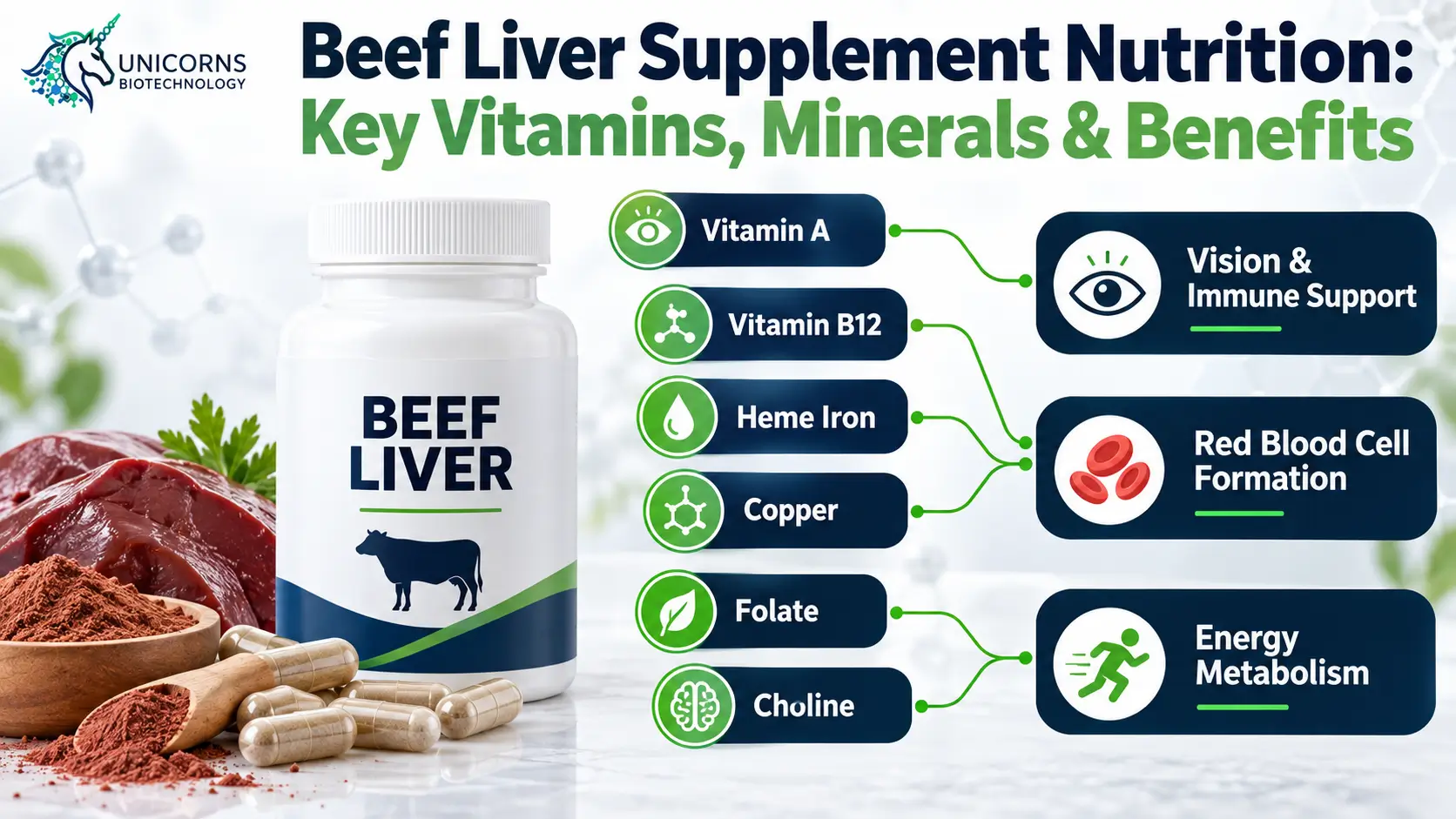
Fresh beef liver contains protein and a concentrated range of vitamins and minerals. Research on United States beef offal confirms that liver stands apart from most muscle meats for several micronutrients. doi.org
However, fresh-food values do not establish the composition of a finished capsule. Drying removes water and concentrates solids. Defatting, extraction, blending, and serving size can change the final nutrient delivery.
Key Nutrients in Bovine Liver
| Nutrient or component | Normal nutritional role | Buyer consideration |
|---|---|---|
| Vitamin A as retinol | Supports normal vision, immune function and cell differentiation | Control total preformed vitamin A per serving |
| Vitamin B12 | Supports red blood cell formation, neurological function and DNA synthesis | Verify content when the label makes a B12 declaration |
| Heme iron | Contributes to hemoglobin and oxygen transport | Test iron instead of assuming a level from fresh liver |
| Copper | Supports iron metabolism, energy production and connective tissue synthesis | Control intake when the formula contains other copper sources |
| Folate | Supports DNA synthesis and normal cell division | Confirm batch content before making a label claim |
| Riboflavin | Supports energy metabolism | Include it in the assay when the finished product declares vitamin B2 |
| Choline | Supports cell membranes, lipid transport and neurotransmitter synthesis | Test the finished ingredient when choline drives product positioning |
| Protein | Supplies amino acids and supports general nutrition | Select a suitable protein method and specification |
| Purines | Form part of the natural tissue matrix | Consider them when positioning the product for sensitive users |
NIH identifies vitamin B12 as a nutrient that supports healthy red blood cell formation, DNA synthesis, and normal nervous-system function. Copper also supports iron metabolism and energy production. Health Professional Fact Sheet
These nutrient functions do not prove that every beef liver supplement produces a clinical benefit. The serving must deliver a meaningful amount, and the label must support any declared level.
Do Beef Liver Capsules Contain Heme Iron?
Whole bovine liver naturally contains iron. Some of that iron occurs in heme-associated forms because liver contains blood, heme proteins, and iron-storage compounds.
The amount in a dried powder can vary. Blood removal, washing, defatting, drying, and raw-material variation all affect the result.
A brand should not market a beef liver supplement as an iron supplement without analytical data. It must also meet the applicable labeling threshold before claiming iron content.
The NIH explains that iron supports hemoglobin, oxygen transport, muscle metabolism, and connective tissue. It also warns that high supplemental iron intake can cause adverse effects. Health Professional Fact Sheet
Does Beef Liver Provide Vitamin B12?
Bovine liver ranks among the most concentrated food sources of vitamin B12. Yet the finished capsule dose may contain only a small amount of dried tissue compared with a normal food serving.
A formulator should test vitamin B12 when it supports the product concept. The specification should identify the method, unit, limit, and expected variation across shelf life.
Vitamin A Needs the Closest Control
Beef liver contains preformed vitamin A. This form differs from beta-carotene because the body does not need to convert it before use.
The NIH sets the adult tolerable upper intake level for preformed vitamin A at 3,000 mcg retinol activity equivalents per day. That limit covers intake from foods, drinks, and supplements. Health Professional Fact Sheet
Brands should calculate total exposure from the full formula. A customer may also take a multivitamin, cod liver oil, or another organ product that supplies retinol.
Potential Beef Liver Supplement Benefits
Beef liver supplement benefits come mainly from the nutrients in the tissue. Brands should distinguish known nutrient functions from claims about the complete finished product.
Direct controlled research on commercial desiccated beef liver capsules remains sparse. Much of the current benefit story comes from beef liver composition, established nutrient functions, and traditional food use rather than trials on specific finished products.
Vitamin B12 and Normal Energy Metabolism
Vitamin B12 helps the body form red blood cells and supports neurological function. Low vitamin B12 status can contribute to fatigue, anemia, and neurological symptoms.
A beef liver supplement may supply vitamin B12. It should not claim to eliminate fatigue unless evidence supports that claim in the intended population and at the proposed serving.
Consumers with pernicious anemia, gastrointestinal disorders, or certain medication-related absorption problems may need clinical treatment. Food-bound vitamin B12 may not correct these conditions.
Heme Iron and Red Blood Cell Formation
Iron supports hemoglobin, which transports oxygen from the lungs to tissues. This link explains why many brands position beef liver supplements around energy and women’s nutrition.
However, a brand cannot assume that every bovine liver powder supplies the same iron level. It must test the ingredient and finished product before declaring iron content.
Beef liver capsules should not claim to treat iron-deficiency anemia. That statement would create a disease claim and may delay proper diagnosis and treatment.
Vitamin A, Vision and Immune Function
Vitamin A supports normal vision, immune function, reproduction, and cell development. Bovine liver supplies vitamin A mainly in preformed form.
The same concentration that creates nutritional value also creates a safety limit. Brands should avoid language that encourages consumers to combine several high-retinol products.
Copper and Iron Metabolism
Copper acts as a cofactor for enzymes involved in iron metabolism, energy production, connective tissue formation, and neurotransmitter synthesis.
Beef liver may provide a large amount relative to its serving weight. Brands should review copper across the full formula, especially when they combine liver with mineral premixes.
Choline and Normal Lipid Metabolism
Liver contains choline, which supports cell membranes, lipid transport, and acetylcholine production. Choline also contributes to normal liver function.
This does not mean bovine liver capsules “detox the liver.” The source organ does not determine the target effect in the human body.
Protein and Amino Acids
Whole liver powder contains protein and amino acids. Yet a few grams of liver powder cannot replace a full dietary protein serving.
Brands should position protein as part of the whole-food matrix unless the finished serving meets the legal threshold for a protein claim.
What the Evidence Does and Does Not Show
Bovine liver provides established nutrients. Research supports the normal physiological roles of vitamin A, vitamin B12, iron, copper, folate, riboflavin, and choline.
That evidence does not automatically prove broad claims for a whole beef liver supplement.
| Claim area | Evidence position |
|---|---|
| Provides tested nutrients | Support with batch or finished-product analysis |
| Supports normal nutrient intake | Reasonable when the product supplies meaningful amounts |
| Treats anemia | Disease claim; do not use for a dietary supplement |
| Raises energy in all users | Direct product evidence remains limited |
| Balances hormones | Too broad without product-specific clinical evidence |
| Improves fertility | Requires strong product-specific human evidence |
| Detoxifies the body | Vague and difficult to substantiate |
| Repairs the liver | Implies a treatment effect and creates regulatory risk |
| Replaces a multivitamin | Depends on the tested nutrient profile and serving |
| Acts as “nature’s multivitamin” | Common marketing language, but it can imply more than the data show |
The FTC requires competent and reliable scientific evidence for health and safety claims. It reviews the full message, including labels, websites, social posts, testimonials, influencers, and trade-show materials. Federal Trade Commission
Beef Liver Supplements vs Fresh Beef Liver
Consumers often choose capsules because they dislike liver’s taste or texture. Capsules also offer easier storage and portion control.
The two forms remain different products.
| Factor | Fresh beef liver | Beef liver supplement |
|---|---|---|
| Water content | High | Low |
| Serving size | Usually measured in tens of grams | Usually measured in capsules or grams of powder |
| Preparation | Requires refrigeration and cooking | Ready to use |
| Taste and aroma | Strong | Capsule shell reduces sensory exposure |
| Nutrient information | Food databases provide representative values | Supplier or finished-product testing should establish values |
| Batch consistency | Natural variation | Manufacturer can set specifications, but variation remains |
| Formulation | Food ingredient | Capsule, tablet, powder or blend |
| Label framework | Conventional food | Dietary supplement when marketed in supplement form |
A brand should not convert fresh-liver nutrition data into capsule claims with a simple weight ratio. Water loss, fat removal, blood removal, processing yield, and test methods can change the relationship.
Fresh-Liver Equivalence Claims
Some labels state that a dried serving equals a certain amount of fresh liver. Such a claim needs manufacturing records.
The supplier should document:
| Required input | Why it matters |
|---|---|
| Starting fresh-tissue weight | Establishes the raw-material basis |
| Final dry-powder yield | Shows the actual concentration after water removal |
| Losses during cleaning | Accounts for removed blood, fat and connective tissue |
| Drying loss | Shows how much water the process removed |
| Batch mass balance | Links fresh input to released powder |
| Nutrient comparison | Confirms that the ratio reflects more than weight alone |
Do not calculate fresh equivalence from moisture assumptions alone. Use production data from the actual ingredient.
Beef Liver Supplement Dosage
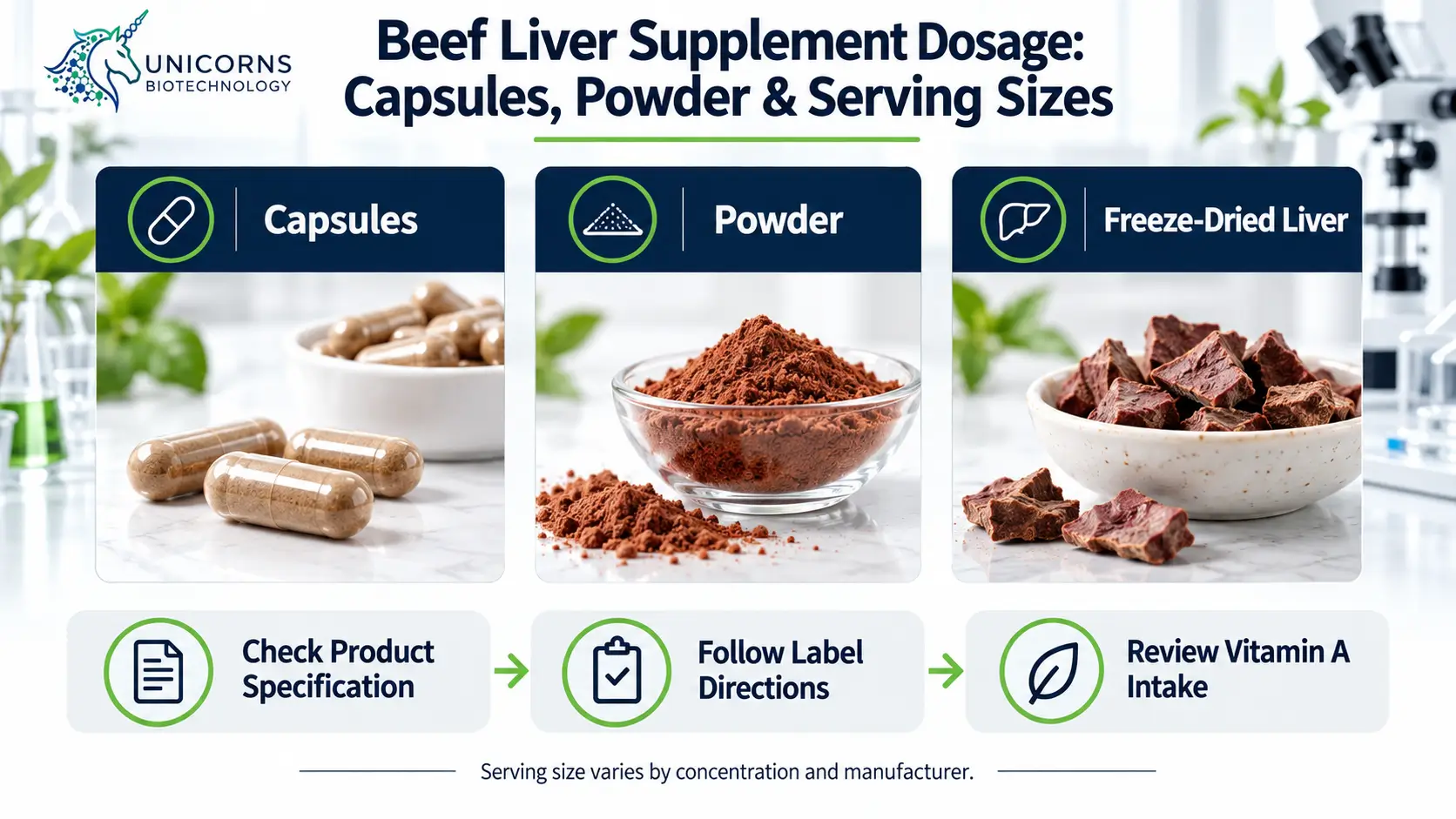
No universal clinical dosage exists for desiccated beef liver supplements. Retail products vary in capsule weight, daily servings, processing, and nutrient levels.
A label may recommend several capsules per day. That capsule count reflects the brand’s formulation and capsule size, not an industry-wide standard.
Formulators Should Start With the Nutrient Assay
A formulator should set the daily serving through four steps:
| Step | Decision |
|---|---|
| 1. Define the ingredient | Whole liver powder, defatted liver, extract or peptide |
| 2. Review composition | Vitamin A, iron, copper, vitamin B12, protein and other relevant markers |
| 3. Model total intake | Add nutrients from every ingredient and likely consumer supplement stacks |
| 4. Set the serving | Balance safety, label claims, capsule count, cost and consumer use |
Capsule capacity also affects the serving. A light, low-density powder may require more capsules than a dense mineral ingredient at the same weight.
Consumer Use
Follow the finished product label and avoid combining several liver or retinol products without professional advice.
People with medical conditions, high iron stores, copper disorders, pregnancy, or medication use should consult a qualified healthcare professional.
Beef Liver Supplement Side Effects and Safety
The main risks come from dose, nutrient concentration, existing health conditions, and product quality.
A “whole-food” label does not remove these risks.
Preformed Vitamin A
High long-term intake of preformed vitamin A can cause toxicity. Symptoms may include headache, nausea, dizziness, skin changes, bone effects, and liver abnormalities.
The NIH bases its preformed vitamin A upper limit partly on liver abnormalities and teratogenic effects. Brands should center retinol exposure in their safety review. Health Professional Fact Sheet
Pregnancy
Pregnant people need vitamin A, but excessive preformed vitamin A can harm fetal development. NIH advises against high-dose preformed vitamin A supplements during pregnancy. ods.od.nih.gov
A beef liver product should not target pregnancy without a qualified safety review. The review should cover the tested retinol level, serving size, prenatal vitamins, diet, and national guidance.
Iron
People with iron deficiency may need diagnosis and a controlled treatment plan. A whole liver supplement does not provide a fixed therapeutic iron dose.
People with iron-overload conditions should avoid adding iron-rich products without medical guidance.
Copper
Copper supports normal physiology, but excessive intake can cause adverse effects. People with copper metabolism disorders need added caution.
A product that combines bovine liver with a copper-containing mineral premix may increase total exposure. The formulator should calculate the complete daily amount.
Digestive Effects and Tolerance
Some users may experience nausea, stomach discomfort, constipation, or a metallic taste. Taking the product with food may improve tolerance, but brands should avoid making universal instructions without product data.
Large capsule servings may also reduce adherence. Product developers should balance target dose against capsule count.
Gout and Purine Sensitivity
The liver contains purines. People with gout or high uric acid may need to limit organ meats and organ-based supplements.
The finished label should direct sensitive users to seek professional advice.
Medication and Supplement Stacking
Consumers may combine beef liver capsules with multivitamins, prenatal products, iron supplements, cod liver oil, or other organ blends.
This stacking can raise total vitamin A, iron, and copper intake. Brands should account for common use patterns in warnings and consumer education.
Grass-Fed Beef Liver Supplements
“Grass-fed beef liver” carries strong commercial value. It signals animal husbandry, origin, and ancestral nutrition.
However, the term does not prove purity, nutrient content, or safety.
A supplier should define:
| Claim | Evidence needed |
|---|---|
| Grass-fed | Farm records or an audited sourcing standard |
| Grass-finished | Evidence that cattle did not receive grain during the finishing period |
| Pasture-raised | Defined access and husbandry criteria |
| Regeneratively raised | Named standard, scope and verification body |
| Hormone-free | Legal and analytical basis for the exact claim |
| Antibiotic-free | Treatment records and claim definition |
| Organic | Valid certification covering the source and supply chain |
| New Zealand origin | Origin and establishment records |
| Argentinian origin | Origin and establishment records |
| Traceable | Lot-level links from raw tissue through finished powder |
Country of origin can support a product story. It does not replace a supplier audit, contaminant testing, or BSE/TSE controls.
Freeze-Dried vs Desiccated Beef Liver
Freeze-drying and desiccation do not describe two equal categories.
Desiccation means moisture removal. Freeze-drying represents one specific desiccation method.
| Factor | Freeze-drying | Other drying methods |
|---|---|---|
| Process | Freezes tissue and removes ice under vacuum | Uses heated air, vacuum heat, atomization or another system |
| Heat exposure | Generally low | Depends on the method |
| Powder structure | Often porous after milling | Varies |
| Cost | Higher | Often lower |
| Throughput | Lower than many continuous systems | Can support larger output |
| Oxidation risk | Low during drying, but porous powder still needs protection | Depends on temperature, oxygen and time |
| Marketing value | Strong in premium organ supplements | Depends on process transparency |
| Required evidence | Freeze-dryer records and process flow | Exact method, temperatures, time and validation |
Freeze-drying does not guarantee nutrient retention. The supplier should support any retention claim with before-and-after data or a finished-product assay.
Spray drying may suit liquid liver extracts or hydrolyzed liver peptides. It does not fit every whole-tissue product.
Defatted vs Non-Defatted Bovine Liver Powder
Whole liver contains natural lipids. A supplier may remove part of that fat to improve stability, powder flow, or tablet performance.
Defatting changes composition. It may also change levels of fat-soluble nutrients.
| Factor | Non-defatted liver powder | Defatted liver powder |
|---|---|---|
| Fat content | Retains more natural liver fat | Contains less fat |
| Whole-tissue positioning | Stronger | More processed |
| Oxidation | May require stronger oxygen control | Often lower lipid oxidation risk |
| Flowability | Can create flow challenges | May flow more consistently |
| Nutrient profile | Reflects more of the whole tissue | Requires new analytical characterization |
| Label description | Whole liver powder | Defatted liver powder |
The supplier should disclose the solvent or physical method used for defatting. It should also test residual solvents when the process uses them.
How Manufacturers Produce Beef Liver Supplements
A controlled manufacturing process starts at tissue collection. Testing cannot correct poor raw-material control.
1. Source and Collect the Liver
The supplier collects liver from eligible cattle at an approved slaughter or food-processing establishment. It identifies the species, tissue, country, and lot.
The supplier must keep prohibited cattle materials out of the process. Although liver does not normally fall within specified risk material, the operation still needs segregation and traceability controls.
2. Trim, Clean and Chill
Operators remove unsuitable tissue, visible contamination, and unwanted material. They control time and temperature to limit microbial growth and enzymatic change.
The specification should state whether the process removes blood, connective tissue, bile ducts, and external fat.
3. Freeze or Prepare the Tissue
Freeze-drying freezes the liver before loading it into the chamber. Other processes may mince, homogenize, cook, extract, or hydrolyze the tissue.
The process selected at this stage determines whether the final ingredient remains whole liver powder or becomes an extract or peptide product.
4. Remove Moisture
The manufacturer controls drying time, pressure, inlet temperature, outlet temperature, product temperature, and final moisture according to the method.
It should validate the process against microbiological, moisture, composition, and stability targets.
5. Mill and Sieve
The dried material enters a mill-and-sieve system. Particle-size control supports capsule filling, blending, and tablet compression.
Heat from milling can affect lipid-rich animal powders. The manufacturer should control mill temperature and exposure time.
6. Blend and Release the Batch
Blending improves uniformity across the production lot. Quality personnel review the processing record, test results, deviations, and packaging status before release.
7. Package the Powder
The manufacturer packs bovine liver powder in food-grade bags, drums, or cartons. Oxygen and moisture barriers support shelf life.
Nitrogen flushing, oxygen absorbers, desiccants, and opaque packaging may help when stability studies support their use.
Quality Specifications for Bulk Bovine Liver Powder
A strong specification defines identity, composition, purity, safety, and physical performance.
| Specification item | What the buyer should check |
|---|---|
| Product identity | Bovine species and liver tissue |
| Ingredient form | Whole, freeze-dried, defatted, extracted or hydrolyzed |
| Country of origin | Country of cattle, slaughter and processing |
| Appearance | Expected color and acceptable variation |
| Aroma | Normal liver odor and rejection criteria |
| Particle size | Sieve method and passing percentage |
| Moisture or loss on drying | Method, limit and release result |
| Water activity | Stability and microbiological control |
| Protein | Method and basis of calculation |
| Fat | Relevant for whole and defatted grades |
| Ash | Mineral and process consistency |
| Vitamin A | Required when retinol exposure or claims matter |
| Vitamin B12 | Required when the label declares B12 |
| Iron and copper | Required for claims and intake calculations |
| Heavy metals | Lead, arsenic, cadmium and mercury |
| Microbiology | Total count, yeast, mould, E. coli and Salmonella |
| Veterinary residues | Risk-based panel linked to source country |
| Species identity | Validated method suitable for processed tissue |
| Shelf life | Real-time or justified accelerated stability data |
A specification should state the test method, unit, limit, and sampling approach. “Pass” without a defined method or acceptance limit gives the buyer little value.
How to Read a Beef Liver Powder COA
A Certificate of Analysis reports batch results against an approved specification. It should identify the tested lot and release date.
| COA field | Buyer expectation |
|---|---|
| Product name | Matches the specification, invoice and label |
| Batch number | Links to manufacturing and shipment records |
| Manufacturing date | Matches the batch record |
| Retest or expiry date | Matches the stability program |
| Test item | Uses clear analyte names |
| Specification | States numerical limits where possible |
| Result | Reports actual values rather than repeating limits |
| Method | Identifies the method or controlled reference |
| Laboratory | States whether the supplier or external laboratory performed the test |
| Approval | Includes authorised quality review |
A COA does not prove every claim. It also does not replace supplier qualification, identity testing, origin records, or BSE documentation.
Under 21 CFR 111.75, a dietary supplement manufacturer must conduct an appropriate identity test for each dietary ingredient. The rule also sets conditions for relying on a supplier’s COA for other specifications. ecfr.gov
Recommended Testing for Beef Liver Supplements
Testing should follow risk. Whole liver powder needs a different panel from a purified liver peptide.
Identity and Authenticity
Species testing can confirm bovine origin. DNA methods may work, but strong heat, hydrolysis, or extraction can reduce usable genetic material.
Species identity does not prove tissue identity. The buyer should combine testing with source records, collection controls, and process traceability.
Nutrient Testing
Test the nutrients that drive the formula, label, serving, and safety assessment. These may include vitamin A, vitamin B12, iron, copper, folate, choline, protein, and fat.
Do not assume a fixed value from a public food database.
Microbiological Testing
The test panel should include pathogens and hygiene indicators that fit the ingredient and target market.
A typical panel may cover total aerobic microbial count, yeast, mould, Escherichia coli, and Salmonella. Buyers should set limits from applicable law, customer requirements, and finished-product risk.
Heavy Metals and Environmental Contaminants
Beef liver participates in animal metabolism and storage. A risk assessment should cover lead, cadmium, mercury, and arsenic.
The supplier should also review pesticides, dioxins, PCBs, and veterinary drug residues when the source and market require them.
Stability Testing
Stability studies should monitor more than microbiology. Lipid oxidation, odor, color, moisture, nutrient change, and packaging performance can affect shelf life.
The study should use the intended commercial packaging.
BSE/TSE Controls for Bovine Liver Ingredients
Bovine liver does not normally appear on the prohibited cattle-material list. Still, the supplier must prove source eligibility and prevent cross-contamination.
A useful BSE/TSE file should cover:
- Cattle origin
- Slaughter establishment
- Animal inspection status
- Tissue identity
- Specified risk material exclusion
- Collection controls
- Transport and segregation
- Batch traceability
- Applicable legal basis
FDA rules prohibit certain cattle materials in human food and dietary supplements. FDA has cited ingredient companies that failed to maintain records supporting their BSE controls. fda.gov
A generic “BSE-free” statement cannot replace source and tissue records.
Current Good Manufacturing Practices
In the United States, 21 CFR Part 111 applies to dietary supplement manufacturing, packaging, labeling, and holding operations.
The regulation requires specifications for identity, purity, strength, composition, and contaminant limits. It also requires production records, quality-control review, and finished-batch verification. fda.gov
A raw-material supplier may follow a food or ingredient quality system rather than operate as a finished-supplement manufacturer. The finished-product company still carries its own Part 111 duties.
Buyers should ask which standard covers each site and operation.
How to Evaluate Grass-Fed Beef Liver Supplement Quality
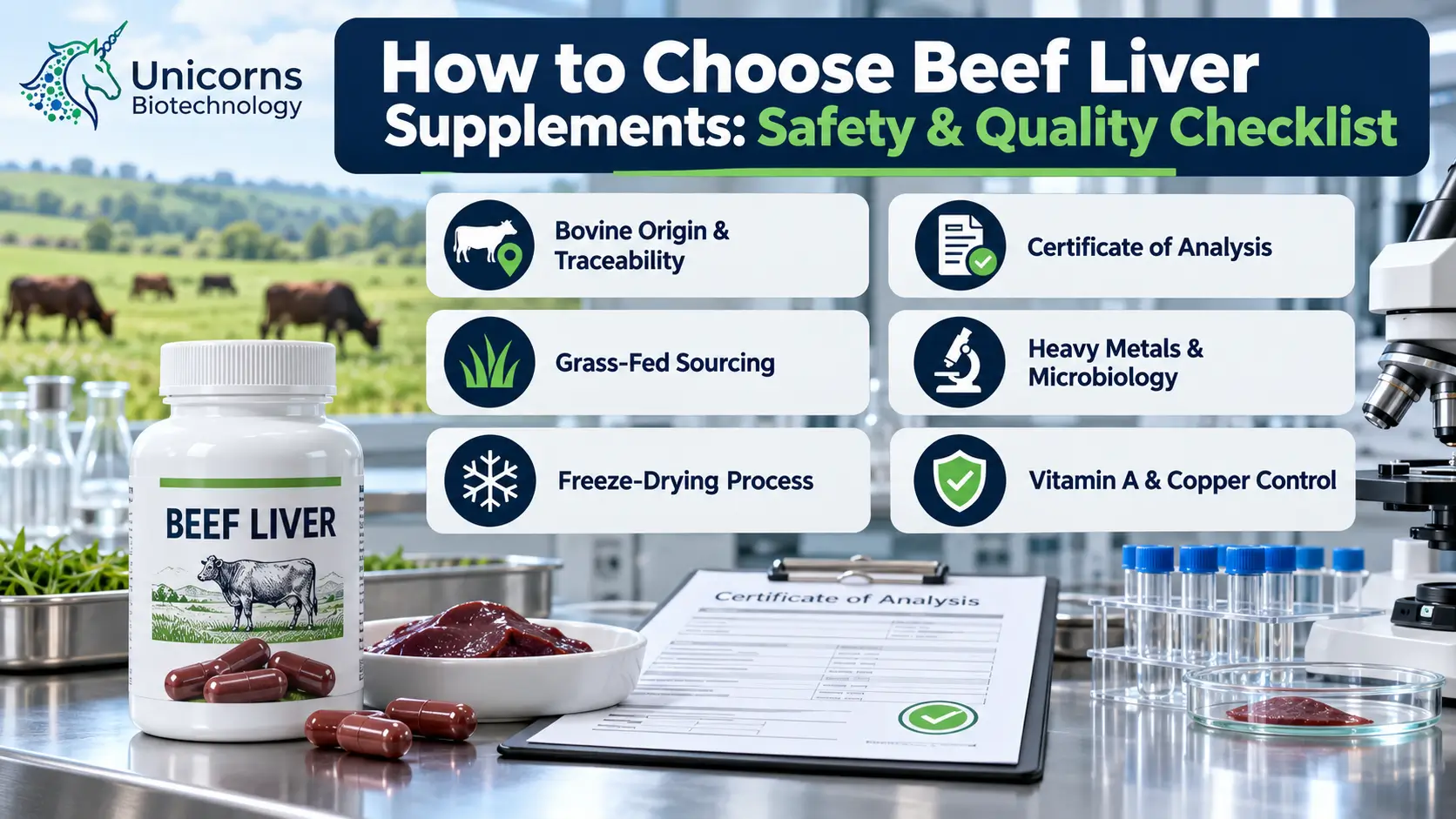
Consumers often focus on grass-fed origin. Procurement teams need a wider view.
| Evaluation point | Strong evidence | Red flag |
|---|---|---|
| Source | Named country and traceable establishment | “Global source” without details |
| Grass-fed claim | Defined standard and supporting records | Marketing statement only |
| Drying method | Process flow and batch records | “Low temperature” without parameters |
| Ingredient identity | Bovine species and liver tissue records | Generic “beef organ” |
| Nutrient profile | Batch or representative analytical data | Fresh-liver values copied onto powder |
| Vitamin A control | Tested result and serving-level calculation | No retinol data |
| Microbiology | Defined methods, limits and results | “Tested” without a report |
| Heavy metals | Numerical results and laboratory details | “Heavy-metal free” without detection limits |
| BSE/TSE | Source, tissue and legal documentation | One generic certificate for all bovine materials |
| COA | Lot-linked actual results | Identical results across many lots |
| Traceability | Raw source through customer shipment | Missing links between documents |
| Change control | Written notification requirement | Supplier changes origin without approval |
Third-party testing adds value only when the laboratory tests the right analytes with suitable methods. A laboratory logo alone does not prove quality.
Beef Liver Capsules, Powder or Tablets
The best dosage form depends on serving weight, sensory profile, consumer preference, and manufacturing cost.
| Dosage form | Advantages | Challenges |
|---|---|---|
| Capsules | Mask taste and allow simple formulas | High serving weight may require many capsules |
| Tablets | Can reduce unit count | Compression may need excipients and strong process control |
| Loose powder | Offers flexible serving size | Strong taste, aroma and limited water solubility |
| Sachets | Support measured powder servings | Need flavor masking and moisture control |
| Multi-organ capsules | Create broader organ positioning | Each organ may appear at a low individual dose |
| Soft chews | Support consumer convenience | Require flavor, stability and process development |
Whole bovine liver powder does not dissolve like a purified peptide. It may create sediment, cloudiness, and a strong animal aroma in drinks.
For soluble beverage systems, formulators may prefer liver peptides or selected extracts. Those ingredients require separate specifications and regulatory review.
Beef Liver Supplements vs Beef Organ Complexes
A single-organ supplement and a multi-organ complex serve different product concepts.
| Factor | Beef liver supplement | Beef organ complex |
|---|---|---|
| Main ingredient | Bovine liver | Liver plus heart, kidney, spleen or other organs |
| Consumer message | Concentrated liver nutrition | Nose-to-tail or broad organ nutrition |
| Specification | One organ source | Multiple ingredient specifications |
| Serving allocation | Full serving supports one tissue | Formula divides the serving across organs |
| Safety review | Focus on liver nutrients | Review every organ and cumulative exposure |
| Traceability | One tissue stream | Multiple tissue streams |
| Testing | Liver-specific | Species and tissue controls for each ingredient |
A multi-organ formula should not include more organs only to lengthen the label. Each component should have a defined purpose and meaningful serving.
Brands planning a broader range can review our private-label organ supplement guide.
Labeling and Marketing Beef Liver Supplements in the United States
The FDA does not approve dietary supplements before sale the same way it approves drugs. The manufacturer and distributor carry responsibility for safety, labeling, and compliance.
The finished label should include a Supplement Facts panel, serving size, ingredient declaration, net quantity, responsible company, and required statements.
Nutrient Claims
A brand may declare vitamin A, vitamin B12, iron, copper, or another nutrient when it has adequate data and follows the applicable labeling rules.
Generic food-composition data cannot replace finished-product analysis when processing and batch variation may change the declared value.
Structure and Function Claims
FDA allows qualified structure/function claims such as statements about normal nutrient functions. The company must possess substantiation and submit the required notification when the law requires it.
The claim must also carry the required disclaimer. FDA explains that structure/function claims may describe how a nutrient affects normal body structure or function. fda.gov
Disease Claims
A beef liver supplement should not claim to:
- Treat anemia
- Cure chronic fatigue
- Reverse liver disease
- Treat infertility
- Correct hypothyroidism
- Prevent birth defects
- Treat depression
- Repair damaged organs
Such claims can cause the FDA to treat the product as an unapproved drug.
Advertising
FTC standards cover websites, social media, Amazon listings, brochures, influencers, testimonials, and trade-show claims.
A label disclaimer cannot correct a misleading advertisement. Brands should review the full message that a reasonable consumer would take from the marketing.
Questions Procurement Teams Should Ask Suppliers
Start a supplier review before the buyer approves a sample.
| Question | Why it matters |
|---|---|
| Which cattle species and tissue do you use? | Confirms legal and technical identity |
| Where do the cattle, slaughterhouse, and processing plant operate? | Establishes origin and import eligibility |
| Does the liver remain in the human food chain? | Separates food-grade tissue from animal by-product material |
| What does “grass-fed” mean in your supply chain? | Tests claim strength |
| Which drying method do you use? | Defines the ingredient and process risk |
| Do you remove fat, blood, or connective tissue? | Explains composition differences |
| Which tests appear on every batch COA? | Shows release controls |
| Do you test vitamin A, B12, iron, and copper? | Supports safety and label development |
| How do you verify species and tissue identity? | Reduces substitution risk |
| Can you provide BSE/TSE and SRM records? | Supports bovine compliance |
| Which laboratory performs the tests? | Clarifies independence and method capability |
| Can we audit the manufacturing site? | Supports supplier qualification |
| How do you control process changes? | Protects the approved specification |
| What packaging supports the stated shelf life? | Reduces oxidation and moisture risk |
| Can you provide retained samples and complaint support? | Supports investigations and recalls |
Common Sourcing Mistakes
Using Fresh-Liver Nutrition Data for a Powder
Fresh and dried liver do not share the same moisture basis. Processing can also remove tissue components.
Use batch data or a justified specification.
Choosing a Supplier From Price Alone
A lower price can hide undocumented origin, inconsistent drying, high microbial counts, weak traceability, or missing BSE records.
Compare the full landed and compliance cost.
Accepting “Third-Party Tested” Without the Report
Ask for the laboratory name, method, sample identity, detection limit, date, and batch number.
A badge cannot replace a test report.
Treating Freeze-Drying as Proof of Quality
Freeze-drying describes one production step. It does not confirm species, nutrient content, microbiology, heavy metals, or traceability.
Evaluate the complete process.
Ignoring Vitamin A During Formulation
A formula may combine beef liver with cod liver oil, retinyl palmitate, or a vitamin premix.
Calculate preformed vitamin A from every source.
Making Claims From the Source Organ
Eating liver does not mean a supplement “supports liver detoxification.” The product needs evidence for the actual claim.
How Unicorns Biotechnology Supports Beef Liver Supplement Projects
Unicorns Biotechnology supplies bulk bovine liver powder and other animal-derived ingredients to supplement brands, contract manufacturers, distributors, and private-label companies.
Buyers can request specifications, batch COAs, process information, origin records, BSE/TSE statements, microbiological results, heavy-metal data, and samples for evaluation. Document availability and test scope depend on the agreed product and destination market.
Our bovine liver ingredients can support:
| Product concept | Ingredient option |
|---|---|
| Single-ingredient beef liver capsules | Whole freeze-dried bovine liver powder |
| Grass-fed organ supplement | Documented grass-fed bovine liver grade |
| Beef organ complex | Liver with heart, kidney, spleen or other bovine organs |
| Women’s organ formula | Liver-based blend with controlled iron, copper and vitamin A |
| Whole-food nutrient powder | Fine bovine liver powder for dry blends |
| Liver peptide product | Hydrolyzed bovine liver peptide powder |
| Private-label capsules | Custom formula, capsule and packaging project |
Review our bulk bovine liver powder and private-label organ supplement services for commercial projects.
Contact Unicorns Biotechnology to request a bovine liver powder specification, batch COA, third-party test report, sample, or bulk quotation.
Frequently Asked Questions
What are beef liver supplements?
Beef liver supplements contain dried bovine liver in capsules, tablets, powders, or blends. Products may use whole liver powder, freeze-dried liver, defatted liver, extract, or hydrolyzed liver peptides.
What are the main beef liver supplement benefits?
The main nutritional value comes from vitamin A, vitamin B12, heme iron, copper, folate, riboflavin, choline, protein, and other tissue components. Actual levels depend on the ingredient and serving.
Are beef liver supplements the same as eating fresh liver?
No. Drying removes water and changes the serving basis. Processing, defatting, extraction, capsule weight, and batch variation also affect the comparison.
How much beef liver supplement should someone take?
No universal dose applies to every product. Follow the finished label and consider vitamin A, iron, copper, diet, medications, and other supplements.
Can someone take beef liver capsules every day?
Daily use depends on the product’s nutrient profile, serving size, and the user’s total diet and supplement intake. Preformed vitamin A needs close attention.
Are beef liver supplements high in vitamin A?
They can be. Whole bovine liver naturally contains preformed vitamin A. Brands should test the ingredient and calculate the amount per daily serving.
Do beef liver supplements contain iron?
Whole bovine liver powder can contain iron, including heme-associated iron. The brand should test the product before declaring the amount or making an iron claim.
Are beef liver supplements safe during pregnancy?
Pregnant people should seek professional guidance. Excessive preformed vitamin A can harm fetal development, and prenatal supplements may already supply vitamin A and iron.
What does desiccated beef liver mean?
Desiccated beef liver means dried liver. The term does not identify the drying method. Buyers should ask whether the supplier used freeze-drying, vacuum drying, spray drying, or another process.
Is freeze-dried beef liver better?
Freeze-drying uses low processing temperatures and supports premium positioning. It does not guarantee superior nutrition or safety without analytical data.
Does grass-fed beef liver contain more nutrients?
The answer depends on the nutrient, source population, and production system. A grass-fed claim alone does not prove a higher nutrient level in the finished powder.
What should a beef liver supplement COA include?
The COA should identify the product and batch. It should report relevant physical, compositional, microbiological, contaminant, and nutrient results against an approved specification.
Is third-party testing required?
The finished manufacturer must meet applicable identity and quality requirements. Independent testing can strengthen verification, but the laboratory must use suitable methods and test the actual batch.
Are bovine liver supplements FDA approved?
No. FDA does not preapprove dietary supplements like prescription drugs. Manufacturers remain responsible for safety, labeling, claims, and current Good Manufacturing Practices.
Can beef liver supplements treat anemia?
Brands should not make that claim. Anemia has several causes and needs proper diagnosis. Beef liver products do not provide a fixed therapeutic iron dose.
What is the difference between beef liver supplements and liver support supplements?
Beef liver supplements contain bovine liver tissue. Liver support supplements often contain botanicals, amino acids, antioxidants, or other ingredients marketed for normal liver function.
What is the difference between beef liver powder and bovine liver peptides?
Whole bovine liver powder retains a broad tissue matrix. Bovine liver peptides come from enzymatic protein hydrolysis and contain shorter peptide fractions.
How should brands choose a bovine liver powder supplier?
Brands should review source identity, food-chain status, process controls, nutrient data, COAs, test methods, BSE/TSE documentation, traceability, stability, audit access, and change control.
Final Takeaway
Beef liver supplements attract consumers because they deliver bovine liver in a convenient format. Their value depends on the actual ingredient, nutrient profile, serving size, and quality system.
For brands, vitamin A control deserves the closest attention. Iron, copper, microbiology, contaminants, BSE records, and species identity also matter.
A strong supplier connects every claim to evidence. It links the source cattle, liver tissue, manufacturing process, specification, batch COA, packaging, and finished-product serving.
References
DOIs appear where publishers assigned them. Government guidance pages do not carry DOIs, so these references use clean official URLs.
- Dinh, T. T. N., Thompson, L. D., Galyean, M. L., Brooks, J. C., Patterson, K. Y., Phillips, K. M., & Miller, M. F. (2024). Nutrient analysis of raw United States beef offal items. Nutrients, 16(18), 3104. https://doi.org/10.3390/nu16183104
- Federal Trade Commission. (2022). Health products compliance guidance. https://www.ftc.gov/business-guidance/resources/health-products-compliance-guidance
- National Institutes of Health, Office of Dietary Supplements. (2025). Copper: Fact sheet for health professionals. https://ods.od.nih.gov/factsheets/Copper-HealthProfessional/
- National Institutes of Health, Office of Dietary Supplements. (2025). Iron: Fact sheet for health professionals. https://ods.od.nih.gov/factsheets/Iron-HealthProfessional/
- National Institutes of Health, Office of Dietary Supplements. (2025). Vitamin A and carotenoids: Fact sheet for health professionals. https://ods.od.nih.gov/factsheets/VitaminA-HealthProfessional/
- National Institutes of Health, Office of Dietary Supplements. (2025). Vitamin B12: Fact sheet for health professionals. https://ods.od.nih.gov/factsheets/VitaminB12-HealthProfessional/
- National Institutes of Health, Office of Dietary Supplements. (n.d.). Choline: Fact sheet for health professionals. https://ods.od.nih.gov/factsheets/Choline-HealthProfessional/
- U.S. Department of Agriculture, Agricultural Research Service. (n.d.). FoodData Central. https://fdc.nal.usda.gov/
- U.S. Food and Drug Administration. (2007). Final rule for current Good Manufacturing Practices for dietary supplements. https://www.fda.gov/food/dietary-supplements-guidance-documents-regulatory-information/backgrounder-final-rule-current-good-manufacturing-practices-cgmps-dietary-supplements
- U.S. Food and Drug Administration. (2024). Current Good Manufacturing Practices for food and dietary supplements. https://www.fda.gov/food/guidance-regulation-food-and-dietary-supplements/current-good-manufacturing-practices-cgmps-food-and-dietary-supplements
- U.S. Food and Drug Administration. (2024). Questions and answers on dietary supplements. https://www.fda.gov/food/information-consumers-using-dietary-supplements/questions-and-answers-dietary-supplements
- U.S. Food and Drug Administration. (2024). Structure/function claims. https://www.fda.gov/food/nutrition-food-labeling-and-critical-foods/structurefunction-claims
- U.S. Government Publishing Office. (2026). 21 CFR Part 111: Current Good Manufacturing Practice in manufacturing, packaging, labeling, or holding operations for dietary supplements. https://www.ecfr.gov/current/title-21/chapter-I/subchapter-B/part-111
- U.S. Government Publishing Office. (2026). 21 CFR 111.75: Requirements for determining whether specifications are met. https://www.ecfr.gov/current/title-21/chapter-I/subchapter-B/part-111/subpart-E/section-111.75
- U.S. Government Publishing Office. (2026). 21 CFR 189.5: Prohibited cattle materials. https://www.ecfr.gov/current/title-21/chapter-I/subchapter-B/part-189/subpart-B/section-189.5