
Bulk Freeze-Dried Royal Jelly Powder Manufacturer in China
Home >> Bulk Ingredients >> Other Animal Glandular Powders >> Wholesale Freeze-Dried Royal Jelly Powder Factory in China
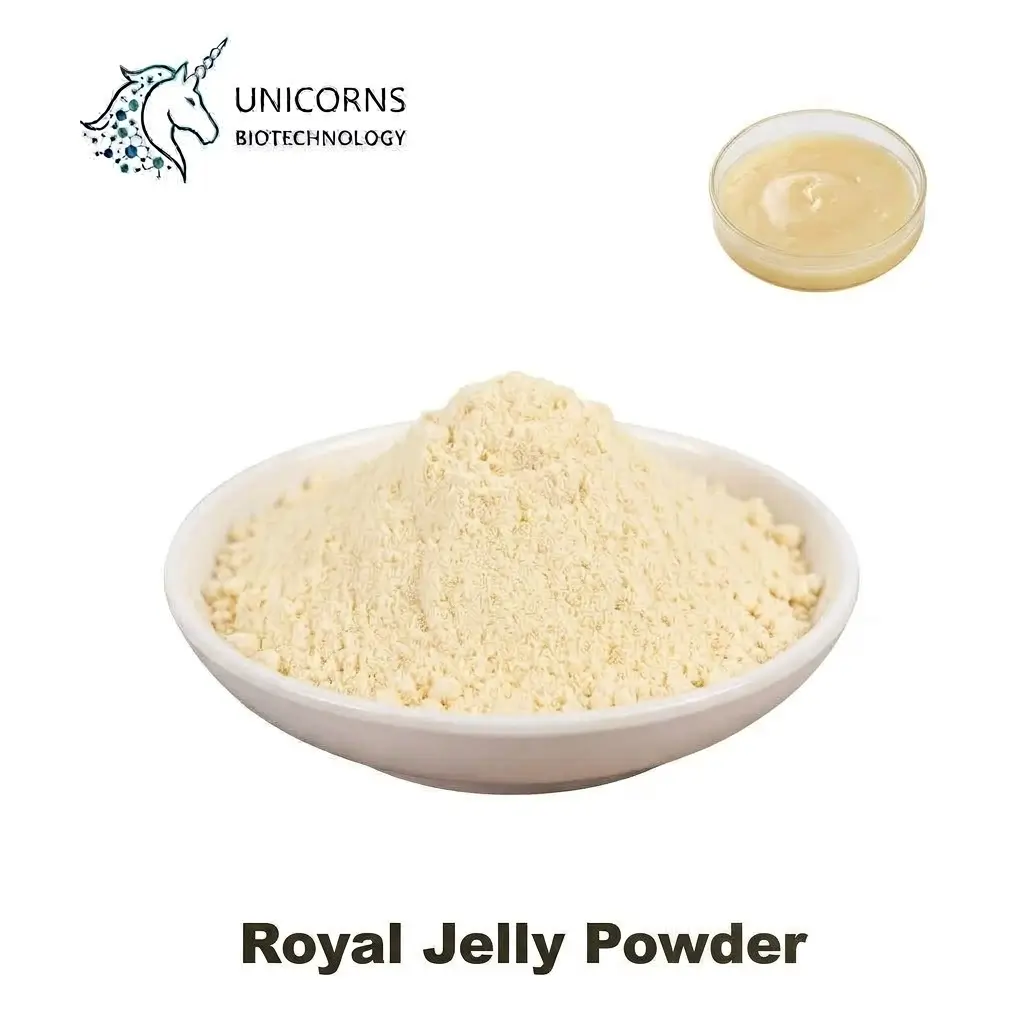
Buck Royal Jelly Powder 4% 10-HDA
| Product Name | Wholesale Royal Jelly Powder |
| Other Names | Royal Jelly Freeze-Dried Powder, Lyophilized Royal Jelly Powder, Bee Royal Jelly Powder, Royal Jelly Powder Bulk, 10-H2DA, 10-hydroxy-2-decenoic acid, queen bee acid, golden food, royal jelly extract, fresh royal jelly |
| Source | Apis Mellifera |
| Appearance | White-Yellowish Powder |
| Applications | Supplements, capsules, tablets, functional foods, powder blends, cosmetics |
| Manufacturing Capability | 600 tons annually |
| OEM services | Custom formulation, capsules, tablets, blends, contract manufacturing, softgels |
| Bulk Packaging | 20kg Vacuum Sealed Foil Bags, 25kg/drum, or custom bulk packaging |
Henan Unicorns Biotechnology Co., Ltd. is a wholesale Freeze-Dried Royal Jelly Powder manufacturer and supplier in China. We supply bulk Royal Jelly Powder standardized to ≥4% 10-HDA for dietary supplement brands, functional food manufacturers, nutraceutical companies, cosmetic formulators, ingredient distributors, contract manufacturers, and research companies. Our standard material comes from Apis mellifera royal jelly and is processed by freeze-drying to improve stability, handling, and formulation performance.
Our factory supports annual production and export capacity of up to 600 tons of Royal Jelly Powder per year. Available services include custom 10-HDA assay, particle size, moisture control, bulk packaging, private-label packing, batch-specific COA, third-party testing, and specification matching for different markets.
In addition to bulk Freeze-Dried Royal Jelly Powder, Unicorns Biotechnology supplies related bee-derived and animal-derived ingredients, including glandular powders, animal peptide powders, bile extracts, bile acids, cholesterol derivatives, and other specialty animal-origin raw materials for supplement, food, pharmaceutical, and cosmetic applications.
What Is Royal Jelly Powder?
Royal jelly is a creamy secretion that young worker honeybees produce from their hypopharyngeal and mandibular glands. Bees use it to feed larvae, while the queen continues to consume royal jelly throughout her life. Royal Jelly Biological Action a…
Fresh royal jelly contains large amounts of water. This makes cold-chain storage and industrial handling harder.
Royal Jelly Powder solves this problem by removing most of the water through freeze-drying, also called lyophilization. The process converts fresh royal jelly into a low-moisture powder that works better in commercial formulations.
ISO is also developing a dedicated standard for lyophilized royal jelly. The current draft defines it as a material produced from fresh royal jelly through vacuum freeze-drying, followed by steps such as crushing and sieving.
What Is 10-HDA in Royal Jelly Powder?
10-HDA, or 10-hydroxy-2-decenoic acid, is one of the most important chemical markers in royal jelly.
You may also see it written as 10-H2DA, particularly in technical documents and COAs. It belongs to the characteristic medium-chain fatty acids found in royal jelly.
Research commonly uses 10-HDA to evaluate royal jelly identity, quality, and authenticity. One major review describes it as a key quality and freshness marker. Royal Jelly Biological Action a… Another review identifies 10-HDA and major royal jelly proteins as key characteristic compounds of royal jelly. Royal Jelly Biological Action a…
The scientific literature also reports that lyophilized royal jelly normally contains a higher percentage of 10-HDA than fresh royal jelly because freeze-drying removes water. One review lists >3.5% 10-HDA for lyophilized royal jelly, compared with >1.4% for fresh material. Royal Jelly Biological Action a…
Why B2B buyers specify 10-HDA
A defined 10-HDA level gives buyers a practical parameter for comparing royal jelly raw materials.
For bulk sourcing, ask for:
| Purchasing Point | What to Check |
|---|---|
| 10-HDA content | Defined assay, such as ≥4.0% |
| Test method | Validated analytical method |
| Moisture | Low and controlled |
| Protein | Defined minimum |
| Identity | Apis mellifera royal jelly |
| Contaminants | Heavy metals and microbiology |
| Residues | Chloramphenicol and nitrofuran screening |
| Batch documents | COA and specification sheet |
ISO 12824:2016 establishes production, sanitary, organoleptic, chemical, storage, packaging, and transport requirements for royal jelly.
Royal Jelly Powder Composition
Royal jelly contains proteins, carbohydrates, lipids, amino acids, minerals, vitamins, polyphenols, and several characteristic bioactive components.
Its best-known components include:
10-HDA, major royal jelly proteins (MRJP1–MRJP9), royalactin, apisin, apisimin, royalisin, defensin-1, jelleins, amino acids, B vitamins, minerals, flavonoids, and phenolic compounds. Royal Jelly Biological Action a…
Major royal jelly proteins make up much of the protein fraction. The literature identifies MRJP1, also called royalactin in some contexts, as one of the best-known royal jelly proteins. ijms-20-04662
Freeze-drying changes the percentages because it removes water. A 2024 review gives the following general ranges:
| Component | Fresh Royal Jelly | Lyophilized Royal Jelly |
|---|---|---|
| Water | 60–70% | <5% |
| Protein | 9–18% | 27–41% |
| Lipids | 3–8% | 8–19% |
| 10-HDA | >1.4% | >3.5% |
| Ash | 0.8–3.0% | 2–5% |
These are literature ranges, not the specification for every commercial batch. Buyers should use the actual COA when approving material.
Freeze-Dried Royal Jelly Powder vs Fresh Royal Jelly
Fresh royal jelly and lyophilized royal jelly come from the same bee-derived material. Their physical properties differ.
| Feature | Fresh Royal Jelly | Freeze-Dried Royal Jelly Powder |
|---|---|---|
| Form | Creamy or viscous | Free-flowing powder |
| Water content | High | Low |
| Storage | Requires stricter temperature control | Easier to handle |
| Transportation | More difficult | Better suited to bulk shipment |
| Formulation | Harder to dose into dry formats | Easy to blend |
| Capsules/tablets | Less practical | Well suited |
| Standardization | More difficult | Easy to define by assay |
| 10-HDA concentration | Lower on wet-weight basis | Higher on dry-weight basis |
Fresh royal jelly remains sensitive to heat, oxygen, and light. Research reports degradation of sensitive components during unsuitable storage. Lyophilization is one method used to reduce this problem. pharmaceuticals-15-00907
For a supplement factory, this is the practical advantage: freeze-dried Royal Jelly Powder can move through weighing, blending, encapsulation, tableting, and packing lines more easily than fresh royal jelly.
Why Use Freeze-Dried Royal Jelly Powder?
Freeze-drying removes water at low temperature under vacuum rather than using high-temperature drying.
That matters because royal jelly contains heat-sensitive proteins, lipids, and other compounds. The process produces a dry ingredient while reducing the handling problems linked with fresh royal jelly.
For formulators, the main advantages are simple:
| Advantage | B2B Value |
|---|---|
| Low moisture | Better storage and handling |
| Powder form | Easy weighing and blending |
| Defined 10-HDA | Easier raw-material qualification |
| High protein content | Supports composition-based formulation |
| Longer commercial usability | Easier inventory management |
| Reduced cold-chain burden | Easier export and transport |
| Uniform particle size | Better production consistency |
Scientific reviews also distinguish lyophilized royal jelly from fresh royal jelly and report <5% water in typical lyophilized material.
Royal Jelly Powder Benefits and Research
Royal Jelly Powder contains a complex mix of proteins, peptides, fatty acids, amino acids, carbohydrates, vitamins, minerals, and polyphenols. Key royal jelly components include 10-hydroxy-2-decenoic acid (10-HDA), major royal jelly proteins (MRJPs), royalactin, apisin, apisimin, royalisin, defensin-1, and jelleins. Royal Jelly Biological Action a…
Researchers have studied royal jelly and its isolated components in antioxidant, immune, inflammatory, metabolic, skin, and healthy-aging pathways. Most findings come from cell, animal, and limited human studies, so finished-product claims should always follow the regulations of the target market. Royal Jelly Biological Action a…
Energy and Nutrition Formulations
Royal jelly naturally provides proteins, amino acids, lipids, carbohydrates, B vitamins, and minerals. This broad nutrient profile supports its use in general nutrition, wellness, and vitality formulations.
Freeze-Dried Royal Jelly Powder works well in capsules, tablets, sachets, powdered supplements, and functional food products. Its low-moisture powder form also makes weighing, blending, and commercial manufacturing easier than fresh royal jelly.
Immune Support Formulations
Royal jelly contains MRJPs, antimicrobial peptides, fatty acids, and other bioactive compounds that researchers have studied for immune-related activity. MRJP1, MRJP2, MRJP3, royalisin, apisimin, and jelleins have received particular attention in laboratory research. Royal Jelly Biological Action a…
These findings make Royal Jelly Powder relevant to immune-support supplement development. Brand owners should base final product claims on formulation data, dosage, and local regulatory requirements.
Healthy Aging Formulations
Royal jelly often appears in healthy-aging research because of its distinctive proteins, lipids, and 10-HDA content.
Studies in cell and animal models have examined royal jelly, 10-HDA, and MRJPs in pathways linked with oxidative stress, insulin/IGF signaling, mTOR, EGFR, cellular senescence, and stress resistance. Human evidence remains more limited, so Royal Jelly Powder should be positioned as a research-supported nutritional ingredient rather than a treatment for aging-related conditions. ijms-20-04662
Skin and Beauty Formulations
Royal jelly has a long history of use in beauty and cosmetic products. Researchers have studied 10-HDA and other royal jelly components in relation to fibroblast activity, collagen-related pathways, oxidative stress, and skin function.
A 2022 study evaluated royal jelly components in a controlled-release system for skin applications and focused on 10-HDA stability, fibroblast-related activity, and delivery into skin layers. pharmaceuticals-15-00907
These properties make Freeze-Dried Royal Jelly Powder relevant to beauty-from-within supplements, skin nutrition products, and selected cosmetic formulations.
Cholesterol Powder Manufacturing Process
Unicorns Biotechnology manufactures Freeze-Dried Royal Jelly Powder from qualified fresh royal jelly. Our process focuses on low-temperature dehydration, particle-size control, 10-HDA retention, and batch-specific quality testing.
Fresh Royal Jelly → Raw Material Inspection → Freezing → Vacuum Freeze-Drying → Milling → Sieving → Quality Testing → Packaging
1. Raw Material Inspection
We inspect each batch of fresh royal jelly before production. Our quality team checks the source, appearance, odor, basic composition, and raw-material documents before releasing it for processing.
The raw material comes from Apis mellifera royal jelly and forms the basis of our freeze-dried powder specification. Freeze-Dried Royal Jelly Powder…
2. Freezing
We freeze the qualified royal jelly before lyophilization. This step prepares the water inside the royal jelly for removal under vacuum and reduces the need for high-temperature drying.
Royal jelly contains heat-sensitive proteins, lipids, and characteristic fatty acids such as 10-HDA, so temperature control matters throughout processing.
3. Vacuum Freeze-Drying
We remove moisture from the frozen royal jelly through vacuum freeze-drying, also called lyophilization. Under reduced pressure, frozen water leaves the material through sublimation.
This process converts fresh royal jelly into a low-moisture dry material while limiting the heat exposure associated with conventional drying methods. Scientific literature also identifies lyophilization as a method used to improve the handling and stability of royal jelly. pharmaceuticals-15-00907
4. Milling and Sieving
After freeze-drying, we mill the dried royal jelly into a uniform powder and control the final particle size through sieving.
Our standard Royal Jelly Powder specification requires 100% through 120 mesh, which supports more consistent blending in capsules, tablets, sachets, powdered supplements, and other dry formulations. Freeze-Dried Royal Jelly Powder…
5. Batch Quality Testing
Our quality team tests the finished Freeze-Dried Royal Jelly Powder before release. Key parameters include 10-HDA, protein, moisture, total sugar, lipids, microbiology, heavy metals, and selected veterinary drug residues.
Our standard specification includes:
| Quality Parameter | Specification |
|---|---|
| 10-HDA / 10-H2DA | ≥4.0% |
| Protein | ≥33.0% |
| Moisture | ≤5.0% |
| Particle Size | 100% through 120 mesh |
| Total Sugar | ≤45.0% |
| Total Lipids | 8.0–15.0% |
Freeze-Dried Royal Jelly Powder…
We also test microbiological limits, heavy metals, chloramphenicol, and nitrofuran metabolites according to the product specification. Freeze-Dried Royal Jelly Powder…
6. Packaging and Batch Release
After the batch passes quality control, we pack the Royal Jelly Powder in sealed, moisture-resistant packaging for storage and export.
Each commercial batch can ship with a Certificate of Analysis (COA) and supporting specification documents. Buyers can also request third-party testing and packaging options for their target market.
Main Applications of Royal Jelly Powder
Freeze-Dried Royal Jelly Powder serves as a versatile bee-derived ingredient for dietary supplements, functional foods, nutrition powders, beauty-from-within products, and cosmetics. Manufacturers use it in royal jelly capsules, tablets, sachets, powdered drinks, royal jelly face cream, royal jelly shampoo, royal jelly skin products, serums, masks, and other personal care formulations. Its natural proteins, peptides, lipids, 10-HDA, vitamins, minerals, and other royal jelly components support a wide range of wellness and beauty product concepts.
Dietary Supplements
Functional Foods and Nutrition Products
Beauty and Skin Supplements
Cosmetics and Personal Care
Where to Buy Bulk Royal Jelly Powder in China
Unicorns Biotechnology supplies bulk Freeze-Dried Royal Jelly Powder from China for supplement manufacturers, functional food brands, distributors, formulators, and contract manufacturers.
Our standard commercial material provides ≥4% 10-HDA, ≥33% protein, low moisture, controlled particle size, microbiological testing, heavy-metal testing, and residue screening.
For B2B buyers comparing Royal Jelly Powder manufacturers, suppliers, wholesale prices, cost, MOQ, or custom specifications, price should follow technical qualification. A low Royal Jelly Powder price means little if the material does not meet your 10-HDA, residue, microbiology, or documentation requirements.
Send us your target 10-HDA level, annual volume, application, packaging requirement, and destination country. We can recommend the right specification for your project.
Frequently Asked Questions (FAQs)
Buyers often ask about the source, 10-HDA content, protein level, freeze-drying process, applications, storage, testing, and bulk supply of Royal Jelly Powder. The following FAQs cover the main technical and purchasing questions for supplement manufacturers, functional food brands, cosmetic formulators, ingredient distributors, and contract manufacturers sourcing Freeze-Dried Royal Jelly Powder in bulk.
What Is Freeze-Dried Royal Jelly Powder?
Freeze-Dried Royal Jelly Powder is fresh royal jelly processed by lyophilization to remove most of its water. The process converts fresh royal jelly into a low-moisture powder that works well in capsules, tablets, sachets, nutrition blends, and other commercial formulations.
Unicorns Biotechnology supplies Royal Jelly Powder made from Apis mellifera royal jelly with a standard specification of ≥4% 10-HDA.
Is Royal Jelly Powder the Same as Lyophilized Royal Jelly Powder?
Yes. Lyophilized Royal Jelly Powder and Freeze-Dried Royal Jelly Powder describe the same drying technology.
“Lyophilized” is the technical term, while “freeze-dried” is more common in commercial ingredient sourcing.
What Is 10-HDA in Royal Jelly Powder?
10-HDA, or 10-hydroxy-2-decenoic acid, is a characteristic fatty acid found in royal jelly. Buyers commonly use it as a quality and identity marker when comparing Royal Jelly Powder specifications.
Scientific literature identifies 10-HDA as one of the main characteristic compounds of royal jelly and an important quality marker.
How Much 10-HDA Does Royal Jelly Powder Contain?
Unicorns Biotechnology’s standard Freeze-Dried Royal Jelly Powder contains ≥4.0% 10-HDA. The referenced production batch tested at 4.03%.
The COA uses the term 10-H2DA, which refers to 10-hydroxy-2-decenoic acid in the product specification.
What Is Royal Jelly Powder Made From?
Royal Jelly Powder comes from fresh royal jelly produced by worker honeybees. It naturally contains proteins, amino acids, fatty acids, carbohydrates, vitamins, minerals, polyphenols, and characteristic royal jelly compounds such as 10-HDA and major royal jelly proteins.
Freeze-drying removes water while converting the fresh material into a powder suitable for industrial formulation.
What Is the Source of Unicorns Royal Jelly Powder?
Unicorns Biotechnology uses Apis mellifera royal jelly as the source material for its Freeze-Dried Royal Jelly Powder.
What Is the Difference Between Fresh Royal Jelly and Freeze-Dried Royal Jelly Powder?
Fresh royal jelly contains much more water and needs stricter temperature control. Freeze-Dried Royal Jelly Powder contains much less moisture and offers easier storage, transportation, weighing, blending, and formulation.
Scientific literature reports that lyophilized royal jelly generally contains less than 5% water and higher concentrations of protein and 10-HDA on a weight basis than fresh royal jelly.
Is Royal Jelly Powder Soluble in Water?
Unicorns Royal Jelly Powder is slightly soluble in water.
Formulators should not treat it as a fully water-soluble extract. Beverage and liquid-product developers should evaluate dispersion, sedimentation, taste, and stability during formulation trials.
How Is Freeze-Dried Royal Jelly Powder Manufactured?
Unicorns Biotechnology manufactures Royal Jelly Powder through a controlled process:
Fresh Royal Jelly → Raw Material Inspection → Freezing → Vacuum Freeze-Drying → Milling → Sieving → Quality Testing → Packaging
Vacuum freeze-drying removes frozen water through sublimation. After drying, Unicorns mills and sieves the material to achieve a uniform powder before batch testing and release.
What Are the Main Applications of Royal Jelly Powder?
Manufacturers use Royal Jelly Powder in dietary supplements, royal jelly capsules, tablets, sachets, functional foods, nutrition powders, beauty-from-within supplements, royal jelly face cream, royal jelly skin products, royal jelly shampoo, serums, masks, and other cosmetic formulations.
Its powder form and defined 10-HDA specification make it suitable for both nutritional and personal-care product development.
Can I Get a Free Royal Jelly Powder Sample?
Yes. Unicorns Biotechnology provides free Royal Jelly Powder samples for qualified B2B buyers to evaluate appearance, formulation performance, and specification compatibility before commercial purchasing.
Buyers can provide their application, target 10-HDA level, expected annual quantity, and destination market when requesting a sample.
What Testing Documents Are Available for Bulk Royal Jelly Powder?
Unicorns Biotechnology can provide a batch-specific Certificate of Analysis (COA) and product specification documents for bulk Royal Jelly Powder orders. Third-party laboratory testing can also support customer qualification requirements.
The current specification covers 10-HDA, protein, moisture, particle size, sugars, lipids, microbiology, heavy metals, chloramphenicol, and nitrofuran metabolites.
Can Unicorns Biotechnology customize the particle size?
Yes. Standard 80-mesh powder and custom particle sizes are available according to downstream blending, feed, pharmaceutical, or formulation requirements.