
Bulk Rabbit Meat Powder Supplier in China
Home >> Bulk Ingredients >> Other Animal Glandular Powders >> Wholesale Rabbit Meat Powder Factory in China
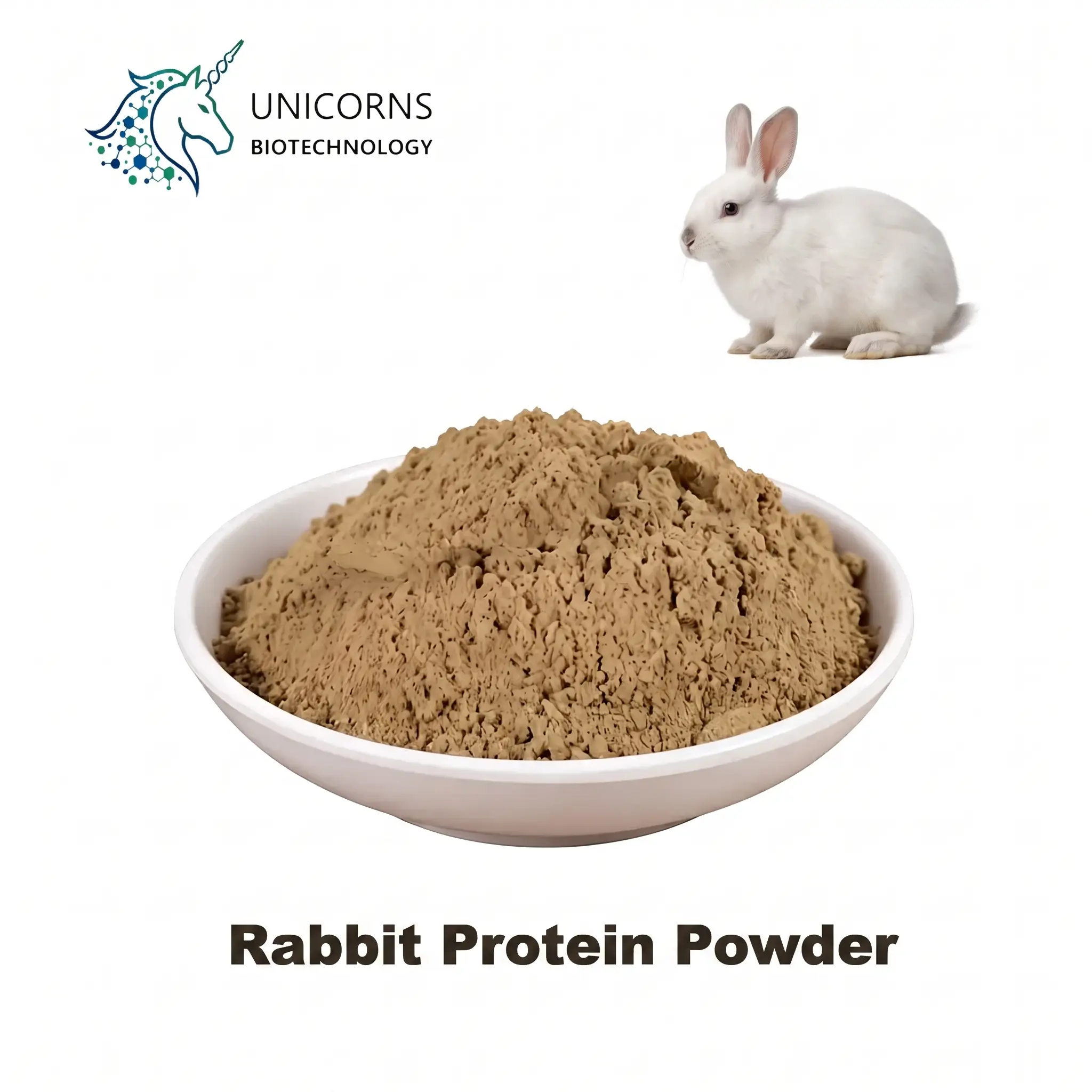
Buck Rabbit Protein Powder
| Product Name | Rabbit Meat Protein Powder |
| Other Names | Rabbit Meat Powder, Freeze-Dried Rabbit Meat Powder, Rabbit meat powder for sale, Rabbit Meal Raw Materials |
| Appearance | Yellow to yellowish brown fine powder |
| Benefits | For use in pet food and feed as an ingredient |
| Applications | Pet Food, Specialty Pet Nutrition |
| Documents Available | COA, Specification, MSDS, Allergen Statement, Non-GMO Statement |
| Manufacturing Capability | 600 tons annually |
| OEM services | Custom formulation, capsules, tablets, blends, contract manufacturing, softgels |
| Bulk Packaging | 1000kg/bag, or custom bulk packaging |
Unicorns Biotechnology supplies bulk Rabbit Meat Powder for pet food manufacturers, animal nutrition companies, pet treat producers, and ingredient distributors.
Our rabbit-derived protein powder contains at least 50% crude protein and meets a minimum 85% pepsin digestibility specification. This animal protein ingredient offers an alternative to conventional chicken, beef, and pork ingredients in dry pet food, wet pet food, meat-based treats, and specialty nutrition formulations.
The powder uses rabbit-derived materials remaining after edible meat processing. Its standard grade has defined limits for crude fat, ash, moisture, microbiological quality, and lipid oxidation. A natural antioxidant preparation containing vitamin E supports product stability during storage.
Based in Zhengzhou, Henan Province, China, Unicorns Biotechnology supports international buyers with technical specifications, bulk sourcing, sample inquiries, and wholesale quotation services.
What Is Rabbit Meat Powder?
Rabbit Meat Powder is a dried, ground animal-derived ingredient used as a protein source in pet food and animal feed manufacturing. It provides rabbit-derived proteins, fats, and minerals in a convenient powder or granular form for industrial processing.
Commercial rabbit meat powders vary in raw-material composition. Some contain only skeletal muscle, while others include additional rabbit tissues from meat processing.
Our reference grade uses remaining rabbit-derived material from edible meat segmentation. Its technical specification identifies the ingredient as Rabbit Meal. Occasional bone particles may appear under microscopic examination.
The material is yellow to yellowish brown, with a characteristic rabbit-derived aroma and a powdery to granular texture.
Rabbit Meat Powder Ingredient Identity
| Property | Description |
|---|---|
| Product name | Rabbit Meat Powder |
| Supplier technical designation | Rabbit Meal |
| Related names | Rabbit Protein Powder, Rabbit Meat Protein Powder, Rabbit Protein Meal |
| Animal source | Rabbit |
| Common domestic rabbit species | Oryctolagus cuniculus |
| Raw material | Rabbit-derived materials remaining after edible meat processing |
| Country of origin | China |
| Product code | 1000VE |
| Grade | Pet food and feed ingredient |
| Physical form | Powdery to granular |
| Color | Yellow to yellowish brown |
| Odor | Characteristic rabbit meal odor |
| Crude protein | ≥50% |
| Pepsin digestibility | ≥85% |
| Standard packaging | 1,000 kg big bag |
| Shelf life | 180 days |
| Main applications | Dog food, cat food, pet treats, and animal nutrition |
Rabbit Meat Powder is a complex biological ingredient. Unlike a purified amino acid or protein isolate, it does not have one molecular formula, molecular weight, or CAS number.
Rabbit Meat Powder vs. Rabbit Protein Powder
Rabbit Meat Powder describes the animal-derived material and its physical form. Rabbit Protein Powder is a broader term that may refer to ground rabbit material, concentrated protein, or hydrolyzed rabbit protein.
These materials can differ in processing, tissue composition, protein concentration, and digestibility.
For pet food manufacturing, buyers should compare the ingredient statement, crude protein content, amino acid profile, ash level, and processing information before choosing a grade.
Our standard product is a rabbit-derived protein powder with ≥50% crude protein. It is not a purified rabbit protein isolate.
Rabbit Meat Powder Chemical Composition and Energy Value
Rabbit meat contains animal proteins, essential amino acids, lipids, minerals, and vitamins. Its chemical composition makes it relevant to pet nutrition and animal protein ingredient development.
Fresh rabbit muscle generally contains around 19–23% protein, although the amount varies by muscle cut. Drying removes moisture and increases the concentration of protein and other solids per unit weight.
Commercial Rabbit Meat Powder has a different composition from fresh muscle because it may contain different rabbit tissues and undergoes additional processing.
Proximate Chemical Composition of Rabbit Meat
Dalle Zotte and Szendrő (2011) reviewed the nutritional characteristics of rabbit meat, including protein, water, fat, ash, and energy values.
Their findings show clear differences between rabbit loin, hind legs, and forelegs.
| Component per 100 g | Loin | Hind Legs | Forelegs |
|---|---|---|---|
| Water | 74.6 g | 73.8 g | 69.5 g |
| Protein | 22.4 g | 21.7 g | 18.6 g |
| Fat | 1.8 g | 3.4 g | 8.8 g |
| Ash | 1.2 g | 1.2 g | Not reported |
| Energy | 603 kJ | 658 kJ | 899 kJ |
Source: Dalle Zotte and Szendrő (2011), Table 1. Values describe fresh rabbit meat portions rather than the finished commercial powder.
Rabbit loin generally contains more protein and less fat than the forelegs. Fat content also influences the energy value of different rabbit meat cuts.
These differences highlight why animal protein ingredients require product-specific nutritional analysis.
Rabbit Meat Protein and Essential Amino Acids
Rabbit meat provides essential amino acids needed for normal growth, protein synthesis, tissue repair, and metabolic functions.
Research identifies lysine, leucine, isoleucine, valine, threonine, methionine, phenylalanine, and histidine among the amino acids in rabbit muscle protein.
| Amino Acid | Nutritional Function |
|---|---|
| Lysine | Protein synthesis and tissue growth |
| Leucine | Muscle protein metabolism |
| Isoleucine | Protein synthesis and energy metabolism |
| Valine | Tissue maintenance and metabolic function |
| Threonine | Protein synthesis and intestinal protein structures |
| Methionine | Sulfur amino acid metabolism |
| Phenylalanine | Precursor for tyrosine and other compounds |
| Histidine | Protein synthesis and histamine precursor |
| Arginine | Nitrogen metabolism and protein synthesis |
Gál et al. (2022) examined rabbit meat amino acid profiles and found that carcass parts and animal-related factors influence nutrient composition.
For pet food manufacturers, the amino acid profile of finished Rabbit Meat Powder is more important than fresh muscle averages. Complete diets must provide essential amino acids in suitable amounts for the target animal and life stage.
Fatty Acid Composition of Rabbit Meat
Rabbit meat contains saturated, monounsaturated, and polyunsaturated fatty acids.
Scientific research reports that unsaturated fatty acids account for around 60% of total fatty acids in rabbit muscle. The actual proportion varies with diet, tissue type, and production conditions.
| Fatty Acid | Chemical Designation | Classification |
|---|---|---|
| Palmitic acid | C16:0 | Saturated fatty acid |
| Stearic acid | C18:0 | Saturated fatty acid |
| Oleic acid | C18:1 n-9 | Monounsaturated fatty acid |
| Linoleic acid | C18:2 n-6 | Omega-6 polyunsaturated fatty acid |
| Alpha-linolenic acid | C18:3 n-3 | Omega-3 polyunsaturated fatty acid |
| Arachidonic acid | C20:4 n-6 | Long-chain polyunsaturated fatty acid |
Linoleic acid and alpha-linolenic acid contribute to the fatty acid profile of rabbit muscle. Their concentrations depend partly on the animal’s diet.
Commercial Rabbit Meat Powder may have different fatty acid proportions because of its tissue composition and processing method.
Manufacturers should use the finished ingredient’s fatty acid analysis when formulating diets with defined essential fatty acid requirements.
Vitamins and Minerals in Rabbit Meat
Rabbit meat naturally contains phosphorus, potassium, iron, zinc, selenium, and B vitamins. These nutrients participate in normal animal metabolism, tissue development, and enzyme activity.
| Nutrient | Role in Animal Nutrition |
|---|---|
| Phosphorus | Bone mineralization and energy metabolism |
| Potassium | Cellular function and electrolyte balance |
| Iron | Hemoglobin formation and oxygen transport |
| Zinc | Enzyme activity and tissue maintenance |
| Selenium | Antioxidant enzyme systems |
| Vitamin B3 (Niacin) | Energy metabolism |
| Vitamin B6 | Amino acid metabolism |
| Vitamin B12 | Normal cellular and nervous system function |
The scientific literature describes these nutrients in fresh rabbit tissues. It does not establish their exact concentrations in our commercial powder.
Rabbit Meat Powder may also contain minerals associated with bone-derived material. This makes calcium, phosphorus, and total ash important quality parameters for pet food formulation.
Energy Value of Rabbit Meat and Rabbit Meat Powder
Rabbit meat provides energy through its protein and fat content. Published research reports approximately 603–899 kJ per 100 g of fresh rabbit meat, depending on the muscle cut.
This corresponds to approximately 144–215 kcal per 100 g.
Rabbit Meat Powder contains less water than fresh meat, but its final energy value also depends on its fat, protein, and mineral composition.
The product’s exact energy value has not been established by the reference specification.
Pet food manufacturers should distinguish between gross energy (GE) and metabolizable energy (ME). Metabolizable energy helps determine the usable dietary energy supplied to dogs and cats.
Formulators should calculate or measure energy values using appropriate methods and the actual finished ingredient analysis.
Rabbit Meat Powder Technical Specifications
Unicorns Biotechnology supplies Rabbit Meat Powder with defined nutritional, physical, and safety specifications for pet food and feed manufacturing.
Our standard product contains at least 50% crude protein, while crude fat does not exceed 19%, crude ash does not exceed 13%, and moisture remains at or below 10%.
The specification also requires a minimum 85% pepsin digestibility. Quality parameters cover synthetic antioxidant residues, peroxide value, hexanal, histamine, Salmonella, and total plate count.
Rabbit Meat Powder Product Specifications
| Parameter | Specification |
|---|---|
| Product name | Rabbit Meat Powder |
| Supplier product designation | Rabbit Meal |
| Product code | 1000VE |
| Country of origin | China |
| Raw material | Rabbit-derived material remaining after edible meat processing |
| Appearance | Powdery to granular |
| Color | Yellow to yellowish brown |
| Odor | Characteristic, without abnormal or foul odors |
| Crude protein | ≥50% — GB/T 6432 |
| Crude fat | ≤19% — GB/T 6433 |
| Crude ash | ≤13% — GB/T 6438 |
| Moisture | ≤10% — GB/T 6435 |
| Pepsin digestibility | ≥85% — GB/T 17811 |
| BHA/BHT | ≤10 mg/kg — GB/T 17814 |
| Ethoxyquin | ≤5 mg/kg — GB/T 17814 |
| Peroxide value | ≤10 meq/kg — GB 5009.227 |
| Hexanal | ≤5.5 mg/kg — SN/T 3626 |
| Histamine | ≤100 mg/kg — GB/T 23884 |
| Salmonella | Not detected |
| Total plate count | ≤2 × 10⁶ CFU/g |
| Natural antioxidant addition | 0.2% |
| Antioxidant preparation | Vitamin E ≥155,000 mg/kg in the preparation |
| GMO declaration | Non-GMO |
| Packaging | 1,000 kg big bag |
| Shelf life | 180 days |
| Intended use | Pet food and feed ingredient |
Specifications are based on product code 1000VE, Version 01, revised September 1, 2026. These values are acceptance limits rather than individual batch results.
Understanding the 50% Crude Protein Specification
Crude protein measures estimated protein content based on nitrogen analysis.
A specification of ≥50% crude protein means the ingredient must meet that minimum under the stated analytical method.
However, crude protein does not directly establish the concentration of each essential amino acid or the amount of protein absorbed during digestion.
Two rabbit-derived powders with similar crude protein values may have different amino acid profiles, fat levels, ash content, and digestibility.
For reliable pet food formulation, manufacturers should evaluate protein content alongside amino acid analysis and other nutritional data.
Rabbit Meat Powder Protein Digestibility
Protein digestibility is an important consideration when evaluating animal-derived ingredients for pet nutrition.
Our Rabbit Meat Powder grade requires at least 85% pepsin digestibility, tested according to GB/T 17811.
Pepsin is a digestive enzyme that breaks down proteins under acidic conditions. Laboratory pepsin digestibility tests evaluate protein digestion under standardized test conditions.
This parameter helps buyers assess processing quality and compare ingredients tested using the same method.
However, laboratory pepsin digestibility does not equal in-vivo protein digestibility in dogs or cats. Actual digestibility depends on the animal species, ingredient characteristics, processing conditions, and finished diet.
Pet food manufacturers should therefore combine laboratory results with appropriate formulation and feeding evaluation.
Benefits of Rabbit Meat Powder in Pet Food Formulations
Rabbit Meat Powder offers several practical advantages for pet food manufacturers developing alternative animal protein products.
Its concentrated protein content, measurable digestibility specification, and distinct rabbit source make it relevant to specialty dog food, cat food, pet treats, and animal nutrition formulations.
1. Concentrated Animal Protein Source
Rabbit Meat Powder contains at least 50% crude protein, making it a concentrated rabbit-derived protein ingredient compared with fresh rabbit meat.
Protein supplies amino acids needed for normal growth, muscle maintenance, and tissue repair in animals.
The powder format also supports ingredient handling and dry blending in commercial pet food manufacturing.
Manufacturers should evaluate the complete amino acid profile when balancing essential nutrients in finished formulations.
2. Alternative Protein for Specialty Pet Foods
Rabbit is less common than chicken, beef, and pork in many conventional pet food formulas.
This makes rabbit-derived ingredients relevant to brands seeking distinctive animal protein sources for specialty product lines.
Rabbit may serve as a novel protein for an individual pet that has not consumed it previously.
However, no protein source is universally hypoallergenic. Manufacturers developing veterinary elimination diets must assess dietary history, species identity, and potential cross-contact.
3. Defined Laboratory Digestibility Specification
The minimum 85% pepsin digestibility specification gives technical buyers a measurable quality parameter.
Laboratory digestibility testing can help identify differences between processed animal protein ingredients.
For manufacturers, this provides additional information beyond crude protein percentage alone.
The result should be evaluated alongside amino acid composition, mineral content, and processing characteristics. It should not be interpreted as a guaranteed digestibility percentage in living dogs or cats.
4. Specialty Ingredient Positioning and Flavor
Rabbit Meat Powder provides a characteristic animal-derived aroma and a recognizable rabbit protein source.
Manufacturers can evaluate it for differentiated pet food recipes, animal protein blends, and meat-based treats.
Its aroma may contribute to the sensory characteristics of finished products. However, palatability depends on the complete formulation and the preferences of the target animal.
Brands should verify product acceptance through suitable palatability or feeding trials rather than assume a specific performance improvement.
Rabbit Meat Powder Manufacturing Process
Rabbit Meat Powder manufacturing involves preparing rabbit-derived raw materials, reducing moisture, processing the material into powder, and evaluating the finished ingredient against defined quality specifications.
The goal is to produce a concentrated animal protein ingredient with suitable physical characteristics, nutrient composition, and storage stability.
The following describes common industry processing stages. Individual production methods depend on the manufacturing facility and the product grade.
1. Rabbit Raw Material Selection
Manufacturing begins with rabbit-derived raw materials collected during edible meat processing.
Raw-material evaluation helps establish animal identity, source records, freshness, and suitability for animal-feed applications.
Our reference product uses remaining material from edible rabbit meat segmentation.
The composition may include different rabbit tissues and occasional bone particles. The exact tissue composition should be established through raw-material specifications and traceability documentation.
2. Thermal Processing and Moisture Reduction
Conventional animal protein meal production often uses controlled heating and moisture removal.
These operations reduce water content and help prepare the material for further processing.
Processing conditions can influence protein characteristics, moisture, fat oxidation, and digestibility.
Temperature, treatment time, and equipment must be selected according to the manufacturing process and feed safety requirements.
The exact operating parameters for product 1000VE require confirmation from the production facility.
3. Grinding and Powder Preparation
After moisture reduction, conventional processing uses grinding and particle-size adjustment to produce a powder or granular ingredient.
Particle size influences ingredient handling, mixing, and compatibility with pet food manufacturing equipment.
Our finished Rabbit Meat Powder specification describes a yellow to yellowish-brown material with a powdery to granular texture.
Under microscopic examination, fibrous material and occasional bone particles may be visible.
4. Antioxidant Addition
The reference Rabbit Meat Powder formulation includes 0.2% natural antioxidant preparation.
The preparation has a specified vitamin E concentration of at least 155,000 mg/kg.
Antioxidant management helps control oxidation in animal-derived ingredients that contain fat.
Finished-product quality evaluation also includes peroxide value and hexanal testing, which provide information about lipid oxidation.
5. Finished Product Testing and Packaging
Quality testing covers crude protein, fat, ash, moisture, pepsin digestibility, microbiological parameters, and selected chemical residues.
The product specification also includes limits for histamine, peroxide value, hexanal, BHA/BHT, and ethoxyquin.
The documented standard packaging is a 1,000 kg big bag.
Proper storage and transport help protect the ingredient from moisture, contamination, and conditions that may reduce quality.
Applications of Rabbit Meat Powder in Pet Food and Animal Nutrition
Rabbit Meat Powder serves as an alternative animal protein ingredient for dry dog food, cat food, wet pet food, pet treats, powdered meal toppers, and specialty pet nutrition products.
Its minimum 50% crude protein and defined pepsin digestibility support commercial ingredient evaluation. Manufacturers should also assess amino acid balance, fat, ash, mineral content, processing compatibility, and feed-market requirements when developing finished formulas.
Dry Dog Food and Cat Food Formulations
Wet Pet Food and Meat-Based Recipes
Pet Treats, Snacks, and Meal Toppers
Limited-Ingredient and Specialty Pet Nutrition
Rabbit Meat Powder vs. Rabbit Meal and Hydrolyzed Rabbit Protein
Rabbit-derived ingredients can differ significantly in source composition, processing, protein concentration, and nutritional characteristics.
Manufacturers should select the appropriate material according to the intended product, technical requirements, and local ingredient labeling rules.
| Feature | Rabbit Meat Powder | Rabbit Meal | Hydrolyzed Rabbit Protein |
|---|---|---|---|
| Commercial description | Dried rabbit-derived powder | Processed rabbit-derived meal | Protein ingredient modified through hydrolysis |
| Animal source | Rabbit | Rabbit | Rabbit |
| Raw-material composition | Depends on the declared product | Depends on the applicable meal definition | Depends on the protein source |
| Protein structure | Primarily processed animal proteins | Primarily processed animal proteins | Smaller proteins and peptides |
| Bone content | Depends on grade | Depends on grade and ingredient definition | Depends on source and processing |
| Main specifications | Protein, fat, ash, moisture, digestibility | Protein, fat, ash, moisture, digestibility | Protein, degree of hydrolysis, peptide profile |
| Common applications | Pet food, treats, animal nutrition | Pet food and feed | Specialized protein formulations |
| Key purchasing concern | Exact tissue composition and product identity | Applicable feed ingredient definition | Hydrolysis method and peptide characteristics |
The product supplied under reference code 1000VE is a rabbit-derived powder identified as Rabbit Meal in its technical specification.
It should not be represented as a purified protein isolate, a hydrolyzed peptide product, or a boneless muscle-only ingredient.
Rabbit Meat Powder Quality Control and Feed Safety
Quality control helps ensure that Rabbit Meat Powder meets the nutritional and safety requirements of pet food manufacturers.
Animal-derived ingredients require particular attention to species identity, raw-material traceability, microbial quality, oxidation, and chemical contaminants.
Protein, Fat, Moisture, and Ash Testing
Routine proximate analysis provides a foundation for ingredient qualification.
Crude protein indicates estimated protein concentration. Crude fat contributes to energy density and affects oxidation stability.
Moisture influences storage performance, while ash represents total inorganic mineral residue.
Our reference grade specifies ≥50% crude protein, ≤19% crude fat, ≤13% ash, and ≤10% moisture.
Lipid Oxidation and Antioxidant Testing
Animal-derived powders containing fat can undergo oxidation during processing and storage.
Oxidation may affect aroma, nutritional quality, and shelf life.
The reference specification includes the following controls:
| Parameter | Specification | Purpose |
|---|---|---|
| Peroxide value | ≤10 meq/kg | Monitors primary lipid oxidation |
| Hexanal | ≤5.5 mg/kg | Monitors an indicator of lipid oxidation |
| BHA/BHT | ≤10 mg/kg | Limits specified synthetic antioxidants |
| Ethoxyquin | ≤5 mg/kg | Limits ethoxyquin residue |
| Natural antioxidant preparation | 0.2% addition | Supports oxidation control |
Manufacturers should evaluate these parameters alongside product odor, packaging integrity, storage history, and current batch results.
Microbiological and Chemical Safety
The reference Rabbit Meat Powder specification requires Salmonella to be not detected and total plate count to remain at or below 2 × 10⁶ CFU/g.
It also includes a histamine limit of 100 mg/kg.
These are supplier specification limits, not guarantees that every destination market will accept the ingredient.
Buyers should compare the parameters with their own quality standards and applicable pet food regulations.
Additional testing may be necessary for heavy metals, veterinary drug residues, species authenticity, and other contaminants.
Animal Source Traceability and Allergen Considerations
Species identity and raw-material traceability matter when sourcing specialty animal proteins.
Rabbit Meat Powder manufacturers and distributors should maintain appropriate records for animal origin, raw-material handling, processing, and batch identification.
The reference specification declares no listed allergens. However, rabbit proteins can still trigger reactions in susceptible animals.
Pet food manufacturers should not interpret an allergen declaration as proof that rabbit protein is universally hypoallergenic or free from cross-contact risks.
Where to Buy Bulk Rabbit Meat Powder in China?
If you are looking for a Rabbit Meat Powder supplier in China, Unicorns Biotechnology can help with your bulk ingredient sourcing requirements.
Our standard rabbit-derived powder contains at least 50% crude protein and meets a minimum 85% pepsin digestibility specification. It is intended for pet food and feed manufacturing, with 1,000 kg big-bag packaging.
We support inquiries from pet food manufacturers, animal nutrition companies, contract manufacturers, pet treat brands, and ingredient distributors.
For an accurate wholesale quotation, please share your required quantity, destination country, intended application, target protein level, and any special testing or documentation requirements.
Our team can discuss available specifications, sampling arrangements, bulk pricing, and shipment options.
Frequently Asked Questions (FAQs)
Choosing a bulk Rabbit Meat Powder supplier requires careful evaluation of ingredient composition, protein quality, manufacturing, safety, and regulatory requirements.
Pet food manufacturers and ingredient distributors often need detailed technical information before approving a new animal protein source.
The following questions address common sourcing and formulation concerns.
Frequently Asked Questions (FAQs)
What is Rabbit Meat Powder made from?
Rabbit Meat Powder is a dried animal-derived ingredient produced from rabbit tissues for pet food and feed manufacturing.
Our reference grade uses rabbit-derived material remaining after edible meat processing. Its specification describes a powdery to granular product that may contain occasional bone particles.
The material is not documented as 100% boneless muscle meat. Buyers should review its raw-material composition and ingredient declaration before approving it for commercial use.
Is Rabbit Meat Powder the same as Rabbit Meal?
Not always. Rabbit Meat Powder is a descriptive commercial term, while Rabbit Meal may represent a specific processed animal protein ingredient category.
The correct regulatory definition depends on the source tissues, manufacturing process, and destination market.
Our reference product is commercially described as Rabbit Meat Powder, but its supplier specification identifies it as Rabbit Meal.
Manufacturers should verify the compliant ingredient name for finished pet food labeling.
What is the protein content of Rabbit Meat Powder?
Our standard Rabbit Meat Powder grade contains at least 50% crude protein, tested according to GB/T 6432.
This is a minimum acceptance specification rather than an exact batch test result.
Protein content may vary within the specification because of raw-material and processing differences.
Pet food manufacturers should also consider amino acid composition, ash content, fat, and digestibility when comparing protein ingredients.
What does 85% pepsin digestibility mean?
Pepsin digestibility measures protein digestion under defined laboratory conditions.
Our Rabbit Meat Powder specification requires at least 85% pepsin digestibility according to GB/T 17811.
This parameter helps evaluate protein processing quality, but it does not directly measure the percentage of protein absorbed by dogs or cats.
Actual digestion depends on the target animal, ingredient composition, and finished food.
Can Rabbit Meat Powder be used in dog food and cat food?
Rabbit Meat Powder is intended for pet food and feed applications, including evaluation in commercial dog and cat food formulations.
Possible applications include dry kibble, wet foods, animal protein blends, and meat-based treats.
Manufacturers must balance amino acids, fatty acids, minerals, and other nutrients according to the intended species and life stage.
They should also verify ingredient eligibility and labeling requirements in the target market.
Is Rabbit Meat Powder a novel protein for pets?
Rabbit can be considered a novel protein for an individual pet that has not previously consumed rabbit-derived ingredients.
However, the term depends on dietary history and the composition of the complete product.
Rabbit protein is not automatically hypoallergenic.
Manufacturers developing veterinary elimination diets should assess cross-contact controls, source identity, and other formulation requirements before making related claims.
What is the difference between Rabbit Meat Powder and Chicken Meal?
Both materials can supply animal-derived protein, but they originate from different species.
Their crude protein, fat, ash, amino acid profiles, and digestibility values depend on the commercial grades.
Rabbit Meat Powder provides an alternative animal source for specialty product development.
Manufacturers should compare the actual specifications and purchasing costs of both ingredients rather than assume one source always provides superior nutrition.
What is the energy value of Rabbit Meat Powder?
The reference specification does not provide an exact energy value for the commercial powder.
Research reports approximately 603–899 kJ per 100 g for different fresh rabbit meat cuts.
Those values cannot be directly applied to processed rabbit-derived powder.
Manufacturers should determine the powder’s gross energy or metabolizable energy using appropriate nutritional analyses and calculation methods.
Does Rabbit Meat Powder contain added antioxidants?
Yes. The reference formulation contains 0.2% natural antioxidant preparation.
The preparation has a specified vitamin E concentration of at least 155,000 mg/kg. This value describes the added preparation, not the finished powder.
The specification also limits peroxide value, hexanal, BHA/BHT, and ethoxyquin.
These parameters support evaluation of product stability and chemical quality.
How is Rabbit Meat Powder tested for quality?
The product specification includes crude protein, crude fat, ash, moisture, pepsin digestibility, peroxide value, hexanal, histamine, and microbiological parameters.
Several tests reference established GB/T or related analytical methods.
Buyers should request the current batch certificate of analysis and compare its results with their own incoming-material requirements.
Additional testing may be required depending on the destination country and finished-product application.
What are the packaging and shelf-life specifications?
The documented standard packaging is a 1,000 kg big bag.
The reference shelf life is 180 days under the specified storage conditions.
Keep Rabbit Meat Powder away from direct sunlight, rain, and hazardous materials.
Manufacturers should inspect each shipment and confirm its remaining shelf life, batch identity, and packaging integrity before using it in production.
How can I request a Rabbit Meat Powder sample and wholesale quotation?
Contact Unicorns Biotechnology with your intended application, required order quantity, destination country, and target nutritional specifications.
Our team can discuss the available product grade, packaging, technical documentation, commercial terms, and sampling arrangements.
If your project requires specific amino acid, mineral, microbiological, or regulatory documentation, include those requirements in your inquiry.
This helps us evaluate the appropriate sourcing solution for your manufacturing needs.