
Bulk Bovine Muscle Peptide Powder Manufacturer in China
Home >> Bulk Ingredients >> Glandular Extracts >> Wholesale Bovine Muscle Peptide Powder Factory
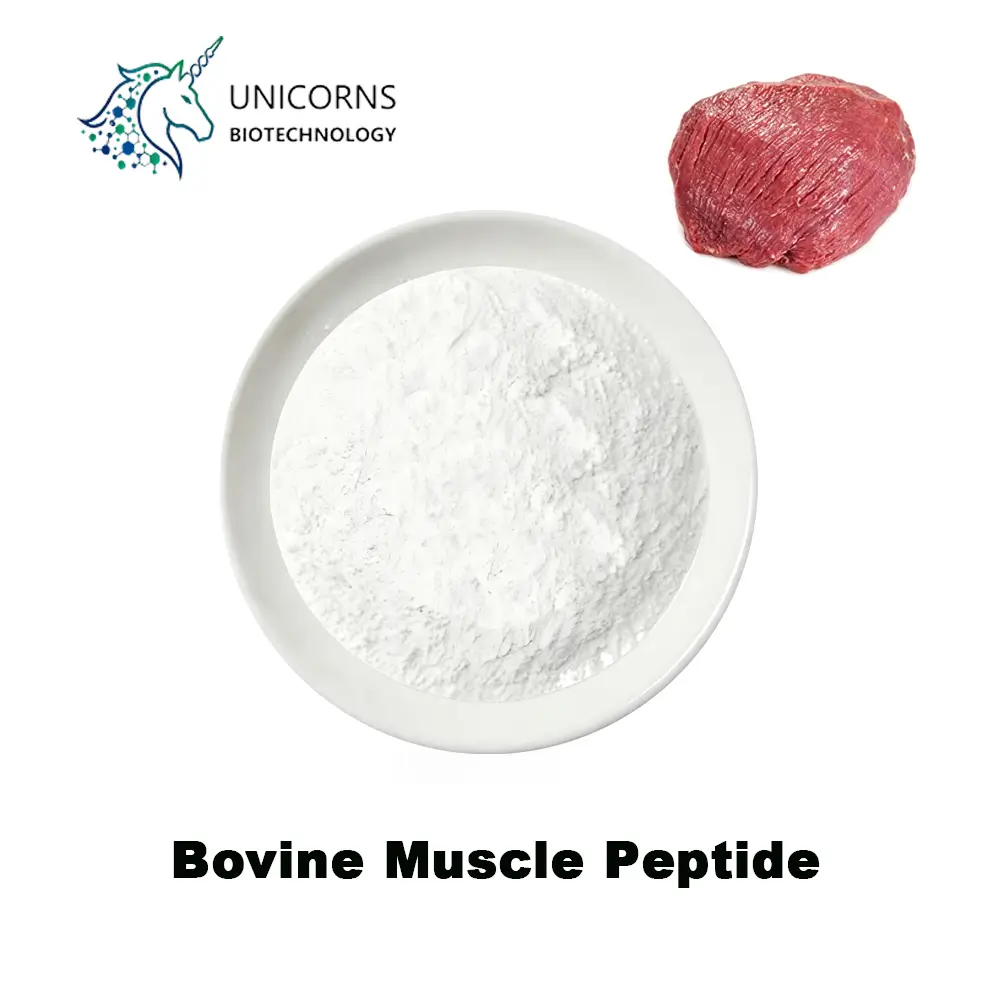
Wholesale Bovine Muscle Peptide Powder Supplier
| Product Name | Bovine Muscle Peptide Powder |
| Other Names | Hydrolyzed Beef Muscle Protein (HBMP), Hydrolyzed Bovine Protein, Beef Muscle Peptides, Bovine Muscle Peptides, Hydrolyzed Beef Protein Isolate, Bovine Muscle Hydrolysate, Beef Hydrolysate Powder, Enzymatic Bovine Muscle Powder, Bovine Muscle Extract Powder |
| Appearance | White To Light Yellow |
| Country of Origin | China |
| Applications | supplements |
| Documents Available | COA, Specification, MSDS, Allergen Statement, Non-GMO Statement |
| Manufacturing Capability | 600 tons annually |
| OEM services | Custom formulation, capsules, tablets, blends, contract manufacturing, softgels |
| Bulk Packaging | 1kg, 5kg, 10kg aluminum foil vacuum bag; or 20kg, 25kg Fiber Drum |
Henan Unicorns Biotechnology Co., Ltd. is a leading wholesale Bovine Muscle Peptide Powder manufacturer in China, supplying hydrolyzed bovine muscle protein ingredients to supplement brands, ingredient distributors, nutrition companies, contract manufacturers, functional food developers and private-label businesses.
Our factory has an annual manufacturing capability of 600 tons. The standard grade provides at least 75% protein and 65% peptides on a dry basis, with at least 85% of the measured peptide molecular-weight distribution below 500 Da. It is suitable for capsules, tablets, powder blends, sachets and customized nutritional formulas.
Unicorns Biotechnology also offers OEM formulation, private labels, custom specifications, particle-size options and export packaging. Buyers can source related glandular extracts and derivatives, including Bovine Liver Peptide Powder, Bovine Spleen Peptide Powder, Bovine Heart Peptide Powder and Bovine Eye Peptide Powder for single-ingredient and multi-organ product development.
What Is Bovine Muscle Peptide?
Bovine Muscle Peptide is an animal-derived protein hydrolysate made from fresh bovine muscle tissue. Low-temperature homogenization and degreasing prepare the tissue, after which protease-directed enzymatic digestion breaks larger muscle proteins into smaller peptide chains and amino-acid-containing fractions.
The finished material is a white to light-yellow powder standardized by total protein, peptide content and molecular-weight distribution. This processing makes it different from ordinary bovine muscle powder, which is generally produced by drying and milling tissue without a defined hydrolysis step.
Other Names for Bovine Muscle Peptide Powder
Other names for Bovine Muscle Peptide Powder include Bovine Muscle Peptides, Hydrolyzed Bovine Muscle Protein, Bovine Muscle Protein Hydrolysate, Beef Muscle Peptide Powder, Beef Muscle Protein Hydrolysate, Hydrolyzed Beef Protein Powder, Small-Molecule Bovine Muscle Peptides and Enzymatically Hydrolyzed Bovine Muscle.
The terms beef protein isolate and hydrolyzed beef protein are related but not automatically identical. Commercial beef proteins can differ in raw-material source, collagen content, protein purity and degree of hydrolysis. Buyers should compare the raw-material declaration, amino acid profile, hydroxyproline level, peptide assay and molecular-weight distribution rather than relying on the product name alone.
CAS Number, Formula and Molecular Weight
| Identity Item | Description |
| CAS Number | No single universal CAS number for this bovine-muscle-derived peptide mixture |
| Molecular Formula | No single molecular formula |
| Molecular Weight | A distribution of many peptides rather than one fixed value |
| Commercial Size Specification | ≥85.0% of the measured peptide distribution below 500 Da |
| Food Source | Fresh bovine muscle tissue, a natural animal-derived protein source |
| Production Route | Low-temperature homogenization, degreasing and protease-directed enzymatic digestion |
Because this product is a complex food-protein hydrolysate, a collagen CAS number, fixed chemical formula or single exact molecular weight should not be used to identify it.
Unicorns Biotechnology supplies wholesale bulk Bovine Muscle Peptide Powder and can customize packaging, particle size, peptide specifications, OEM formats and private labels according to the confirmed order specification.
Solubility, Particle Size and Formulation Behavior
The supplied grade is described as water-soluble at pH 5.4-6.0, although trace white peptide particles may precipitate. It is reported to remain stable from pH 4.0 to 9.0 and to withstand 100°C for 30 minutes or 121°C for 20 minutes under the stated test conditions.
The current product data sheet does not specify a mesh size. An 80-mesh or other customized particle-size requirement can be discussed, but it should be confirmed in the purchase specification and verified for the supplied batch.
Protein and Peptide Composition
The functional composition of Bovine Muscle Peptide Powder is defined primarily by its hydrolyzed protein fraction. Muscle proteins normally include myofibrillar, sarcoplasmic and connective-tissue proteins. After protease digestion, the finished powder contains a complex mixture of short peptides, longer residual protein fragments and free amino acids.
The supplied product data sheet does not identify or quantify individual peptide sequences, essential amino acids, branched-chain amino acids, collagen, vitamins or minerals. These components should not be presented as standardized active ingredients without additional testing.
| Composition Category | Specification | Formulation Significance |
| Protein | ≥75.0% on a dry basis | Concentrated source of bovine-muscle-derived protein material |
| Peptides | ≥65.0% on a dry basis | Hydrolyzed protein fraction consisting of shorter peptide chains |
| Peptides Below 500 Da | ≥85.0% of the measured peptide distribution | Defines the small-molecular-weight profile of the peptide fraction |
| Moisture | ≤7.0% | Supports dry-powder stability when protected from humidity |
| Ash | ≤9.0% | Controls the total inorganic residue under the stated test method |
| Individual Amino Acids | Not specified | A batch amino acid profile is required before making quantitative EAA, BCAA or leucine claims |
| Collagen or Hydroxyproline | Not specified | Testing is needed if formulators want to distinguish muscle protein from collagen-rich material analytically |
Protein and peptide percentages are overlapping analytical measurements and must not be added together. Peptides are part of the total protein-derived material, so ≥75% protein plus ≥65% peptides does not mean the powder contains 140% active ingredients.
Bovine Muscle Peptide Powder Specifications
Unicorns Biotechnology’s standard Bovine Muscle Peptide Powder is controlled through sensory, composition, molecular-weight, moisture, ash, heavy-metal and microbiological requirements.
The grade contains ≥75.0% protein and ≥65.0% peptides on a dry basis, with ≥85.0% of the measured peptide distribution below 500 Da. Moisture is limited to ≤7.0% and ash to ≤9.0%.
Heavy-metal limits include arsenic ≤1.0 ppm, cadmium ≤0.1 ppm, mercury ≤0.1 ppm, lead ≤0.7 ppm and chromium ≤2.0 ppm.
The supplied product data sheet does not state a residual-solvent limit or confirm the use of organic extraction solvents. Buyers requiring solvent control should request a process-specific residual-solvent declaration or third-party report.
Batch COA, specification, MSDS, origin documents and agreed third-party testing support quality review for supplement manufacturers and ingredient distributors.
| Test Item | Specification | Test Method |
| Color | White to light yellow | Sensory examination |
| Odor and Taste | Characteristic; no abnormal taste | Sensory examination |
| Physical State | Free-flowing powder; no visible foreign impurities | Visual examination |
| Protein | ≥75.0%, dry basis | GB 5009.5 |
| Peptides | ≥65.0%, dry basis | GB/T 22729 |
| Peptide Distribution Below 500 Da | ≥85.0% | GB/T 22729 |
| Moisture | ≤7.0% | GB 5009.3 |
| Ash | ≤9.0% | GB 5009.4 |
| Water Solubility | Soluble at pH 5.4-6.0; trace white peptide particles may precipitate | Product-specific test |
| Stability | pH 4.0-9.0; 100°C for 30 minutes; 121°C for 20 minutes | Product-specific test |
| Arsenic | ≤1.0 ppm | GB 5009.11 |
| Cadmium | ≤0.1 ppm | GB 5009.15 |
| Mercury | ≤0.1 ppm | GB 5009.17 |
| Lead | ≤0.7 ppm | GB 5009.12 |
| Chromium | ≤2.0 ppm | GB 5009.123 |
| Total Plate Count | ≤10,000 CFU/g | GB 4789.2 |
| Yeast and Mold | ≤100 CFU/g | Confirm method on batch COA |
| Staphylococcus aureus | Negative | Confirm method on batch COA |
| E. coli | Negative | Confirm method on batch COA |
| Residual Solvents | Not stated in supplied product data sheet | Process declaration or agreed third-party method |
Packaging uses two inner layers of food-grade polyethylene bags with an outer fiber drum or corrugated carton. Net weight, palletization and export marks can be customized by contract.
International buyers should approve the final specification, test methods, certificate package and destination-market compliance requirements before commercial production.
Bovine Muscle Peptide vs Bovine Collagen Peptides
Bovine Muscle Peptide Powder is not the same as Bovine Collagen Peptides Powder. Both ingredients come from cattle and both undergo hydrolysis, but they use different starting tissues and parent proteins.
Muscle peptide powder is derived from bovine muscle tissue and contains peptides released from mixed muscle proteins. Bovine collagen peptides are normally produced from collagen-rich hide, bone, tendon or connective tissue and have a collagen-characteristic amino acid pattern.
| Feature | Bovine Muscle Peptide Powder | Bovine Collagen Peptides Powder |
| Primary Raw Material | Fresh bovine muscle tissue | Bovine hide, bone, tendon or other collagen-rich tissue |
| Parent Proteins | Mixed muscle proteins, including myofibrillar and sarcoplasmic proteins | Collagen |
| Key Quality Markers | Protein, peptide content and molecular-weight distribution | Protein, collagen peptides, molecular weight and often hydroxyproline |
| Characteristic Amino Acids | Requires a product-specific amino acid profile | Typically rich in glycine, proline and hydroxyproline |
| Current Standard | Protein ≥75%; peptides ≥65%; ≥85% below 500 Da | Supplier and grade dependent |
| Typical Product Concepts | Peptide nutrition, protein blends, capsules, tablets and functional powders | Beauty, skin, joint, bone and connective-tissue formulas |
| Interchangeable | No | No |
A bovine muscle hydrolysate may contain some peptides originating from the connective tissue naturally present in muscle, but this does not make it a collagen peptide ingredient.
Buyers who need stronger analytical differentiation can request an amino acid profile, hydroxyproline result, collagen-content test and complete raw-material declaration.
Bovine Muscle Peptide Powder vs Bovine Muscle Powder
These products can start with similar bovine muscle material, but their processing and quality specifications are different.
Bovine Muscle Peptide Powder undergoes directed enzymatic hydrolysis and is standardized by peptide content and molecular-weight distribution. Conventional Bovine Muscle Powder is generally dried and milled muscle tissue and normally retains a greater proportion of intact proteins without a defined peptide assay.
| Feature | Bovine Muscle Peptide Powder | Bovine Muscle Powder |
| Main Process | Homogenization, degreasing and protease digestion | Drying and milling |
| Protein Form | Short peptides plus residual protein fragments | Mostly intact muscle proteins |
| Peptide Specification | ≥65.0% | Usually not standardized |
| Molecular-Weight Control | ≥85.0% of peptide distribution below 500 Da | Usually not tested |
| Solubility | Water-soluble grade at stated pH | Typically more limited and product dependent |
| Best Selection When | Defined hydrolysis, solubility and small-peptide profile matter | A minimally processed whole-muscle concept is preferred |
Nutritional and Formulation Benefits
The strongest supportable benefits of this ingredient come from its measured protein and peptide composition, small-molecular-weight profile and formulation behavior.
The supplied documents do not include human clinical studies on this exact grade or identify a standardized bioactive peptide sequence. It should therefore be marketed as a concentrated bovine-muscle-derived protein hydrolysate, not as a treatment for muscle loss, injury or disease.
Concentrated Protein and Peptide Nutrition
With ≥75% protein and ≥65% peptides on a dry basis, the powder provides a concentrated animal-derived protein hydrolysate for formulas requiring bovine muscle peptides. It can contribute protein-derived amino acids to the diet.
Any finished-product protein or muscle-maintenance claim must meet the composition, serving-size and labeling rules of the destination market.
Defined Small-Molecular-Weight Peptide Profile
At least 85% of the measured peptide molecular-weight distribution is below 500 Da. This is a meaningful quality marker for buyers comparing hydrolysis levels and peptide grades.
The pre-hydrolyzed format reduces average chain length compared with intact muscle proteins, but it does not by itself prove superior clinical absorption or a unique physiological effect.
Water-Soluble Formulation Option
The powder is specified as soluble in water at pH 5.4-6.0, with the possibility of trace white peptide particles. This supports use in powder blends, sachets and selected beverage systems where conventional whole-muscle powder may disperse poorly.
Product developers should still perform bench testing for clarity, flavor, sedimentation and compatibility with the complete formula.
Processing Stability for Product Development
The source specification reports stability across pH 4.0-9.0 and resistance to the stated heat treatments. These properties can be useful during formulation screening for foods and powdered nutrition products.
Finished-product stability must nevertheless be verified in the actual matrix, packaging and shelf-life conditions rather than inferred from the ingredient test alone.
How Bovine Muscle Peptide Powder Is Manufactured
Bovine Muscle Peptide Powder is produced through a controlled protein-hydrolysis process rather than simple high-temperature drying.
According to the supplied product data sheet, fresh muscle tissue from cattle raised in the Xilin Gol grassland region of Inner Mongolia undergoes low-temperature homogenization, degreasing and protease-directed enzyme digestion.
Process control is intended to reduce larger proteins into a standardized peptide fraction while managing sensory quality and powder performance. The finished powder is released against protein, peptide, molecular-weight, moisture, ash, heavy-metal and microbiological requirements.
| Step | Manufacturing Stage | Purpose |
| 1 | Raw-Material Selection | Fresh, healthy bovine muscle is selected under the agreed source and traceability requirements. |
| 2 | Low-Temperature Homogenization | Muscle tissue is homogenized under controlled conditions to create a consistent material for processing. |
| 3 | Degreasing | Excess fat is reduced to improve the protein-rich substrate and downstream powder characteristics. |
| 4 | Protease-Directed Digestion | Selected protease treatment breaks larger muscle proteins into shorter peptide fractions. |
| 5 | Powder Preparation | The hydrolyzed material is processed into a white to light-yellow, free-flowing powder. |
| 6 | Quality Release | Each commercial batch is reviewed against agreed composition, contaminant, microbiological and documentation requirements. |
Bovine Muscle Peptide Powder Applications
Bulk Bovine Muscle Peptide Powder can be used in dietary supplements, functional nutrition products and customized animal-derived ingredient formulas where a defined protein hydrolysate is required.
The standard grade is suitable for dry blending and selected water-dispersible systems. Application approval, serving level, sensory performance and label wording must be evaluated for the destination market and finished formulation.
Capsules and Tablets
Powdered Beverages and Sachets
Sports and Active-Nutrition Blends
Multi-Ingredient and Private-Label Formulas
Where to Buy Bulk Bovine Muscle Peptide Powder
Henan Unicorns Biotechnology Co., Ltd. supplies bulk Bovine Muscle Peptide Powder from China for supplement manufacturers, nutrition brands, ingredient distributors, contract manufacturers and private-label companies.
Our factory offers high-quality bovine-derived peptide ingredients at wholesale prices, supported by a 600-ton annual manufacturing capability, batch documentation, flexible packaging and OEM production for capsules, tablets, powder blends and sachets.
| Unicorns Biotechnology Advantage | Buyer Benefit |
| China Manufacturer and Supplier | Direct factory supply for commercial bulk orders |
| Annual Manufacturing Capability | 600 tons |
| Standardized Composition | Protein ≥75%; peptides ≥65%; ≥85% of peptide distribution below 500 Da |
| Raw-Material Source | Fresh bovine muscle tissue from cattle raised in the Xilin Gol grassland region, according to the supplied product data sheet |
| OEM Services | Capsules, tablets, sachets, powder blends and private-label products |
| Custom Options | Particle size, blend design, packaging, testing plan and order specification |
| Quality Documents | COA, specification, MSDS, flow chart, origin statement and supporting declarations according to order requirements |
| Third-Party Testing | Available according to buyer requirements and agreed test scope |
| Free Sample | Available to qualified commercial buyers; shipping terms can be confirmed with sales |
| Certificate Review | GMP, Halal, Kosher and destination-market certificate requirements should be confirmed for the selected grade and production site before order |
Contact Unicorns Biotechnology to request a free sample, current wholesale price, batch COA, technical specification, third-party testing options and an OEM quotation.
Please provide the destination market, annual demand, target format, packaging requirement and required certificates so our team can prepare an accurate bulk Bovine Muscle Peptide Powder proposal.
Frequently Asked Questions (FAQs)
The following frequently asked questions explain the main differences between Cholesterol Powder and Cholestyramine Powder, available source options, grade selection, assay levels, applications, packaging, testing, and regulatory documents. They are designed to help pharmaceutical manufacturers, aquaculture feed producers, ingredient distributors, and formulation companies select the right cholesterol grade for vitamin D3 production, steroid intermediates, artificial bezoar, feed premixes, and other industrial uses.
Is Bovine Muscle Peptide the same as Bovine Collagen Peptide?
No. Bovine Muscle Peptide Powder is derived from bovine muscle tissue and contains peptides from mixed muscle proteins. Bovine collagen peptides are derived from collagen-rich hide, bone, tendon or connective tissue.
Their parent proteins, amino acid patterns, quality markers and common applications are different.
Does Bovine Muscle Peptide Powder contain collagen peptides?
Bovine muscle naturally includes some connective tissue, so a muscle hydrolysate may contain a limited collagen-derived fraction.
It should not be described as a collagen peptide ingredient unless collagen is intentionally standardized and verified. An amino acid profile and hydroxyproline test can help buyers assess collagen contribution.
How is it different from ordinary Bovine Muscle Powder?
Ordinary Bovine Muscle Powder is generally produced by drying and milling muscle tissue. Bovine Muscle Peptide Powder undergoes protease-directed enzymatic digestion and is standardized by peptide content and molecular-weight distribution.
The current grade contains ≥65% peptides and ≥85% of the measured peptide distribution below 500 Da.
Is Bovine Muscle Peptide Powder the same as beef protein isolate?
Not necessarily. Beef protein isolate is a broad commercial term and may use different beef-derived raw materials or purification processes.
Compare the raw-material declaration, protein and peptide assays, amino acid profile, hydroxyproline, collagen content and molecular-weight distribution before treating two products as equivalent.
What does ≥85% below 500 Da mean?
It means that at least 85% of the measured peptide molecular-weight distribution falls below 500 daltons under the stated analytical method.
It does not mean every component in the powder is below 500 Da, and it should not be presented as the product’s single molecular weight.
What are the standard protein and peptide contents?
The supplied standard specifies protein at ≥75.0% and peptides at ≥65.0%, both on a dry basis.
These values overlap because peptides are protein-derived components and should not be added together.
Does the product have a CAS number or molecular formula?
There is no single universally applicable CAS number, molecular formula or exact molecular weight for this mixture of bovine-muscle-derived peptides.
Use the biological source, manufacturing process, composition assays and molecular-weight distribution to identify the ingredient.
Is Bovine Muscle Peptide Powder water-soluble?
The supplied grade is described as soluble in water at pH 5.4-6.0. Trace white peptide particles may precipitate, so beverage formulators should conduct bench tests for clarity, sedimentation, flavor and compatibility in the complete product.
Can Unicorns Biotechnology provide an 80-mesh grade?
Yes. We can customize An 80-mesh or other mesh sizes requirement according to your requirement.
What documents are available for export orders?
Depending on the order and destination market, Unicorns Biotechnology can provide a COA, product specification, MSDS, manufacturing flow chart, origin statement and agreed supporting declarations.
Third-party testing and additional documentation can be arranged according to buyer requirements.
What OEM services are available?
Unicorns Biotechnology supports OEM capsules, tablets, sachets, powder blends and private-label products.
Custom peptide specifications, particle size, blend composition, serving format, packaging and testing plans can be discussed based on project volume and regulatory requirements.
What documents are available?
Available documents may include a batch-specific COA, SDS or MSDS, specification sheet, manufacturing flow chart, origin statement, allergen statement, non-GMO statement, TSE/BSE statement, residual solvent report, heavy metal report, microbiological report, and third-party test report.