
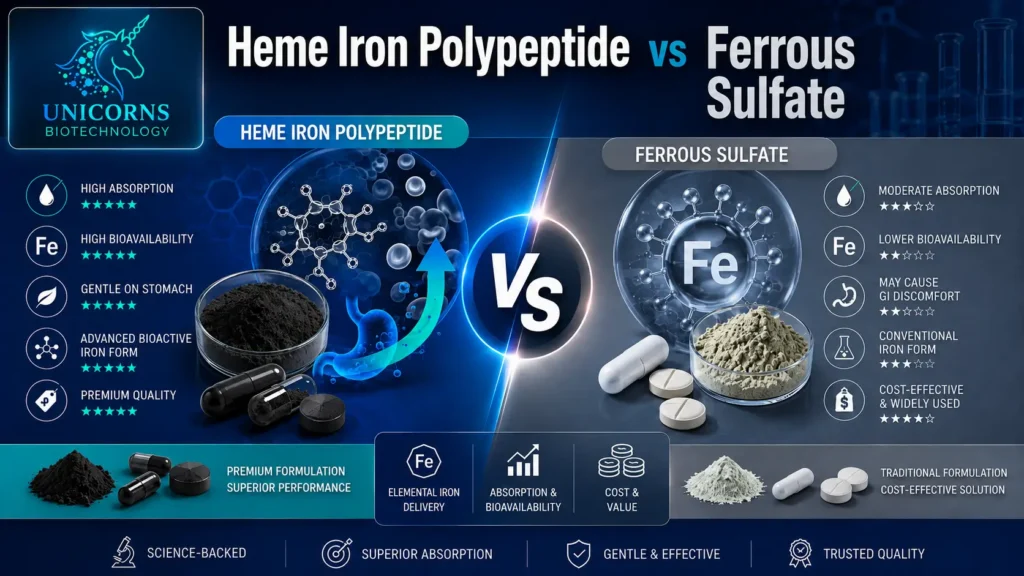
Heme iron polypeptide vs ferrous sulfate is an important comparison for consumers, clinicians, supplement brands, formulators, and ingredient buyers choosing an oral iron source. Both provide elemental iron, but they differ substantially in raw material source, molecular form, intestinal handling, dietary compatibility, clinical evidence, gastrointestinal tolerability, cost, and finished-product positioning.
Ferrous sulfate is an established, widely available, and economical non-heme iron salt. Heme Iron Polypeptide, commonly abbreviated as HIP, is an animal-derived ingredient produced from hemoglobin and is often selected for premium heme iron supplements. Current evidence does not establish either form as universally better. Ferrous sulfate has stronger conventional treatment evidence, while HIP may offer advantages for selected formulations and users, particularly where an animal-derived heme iron source, lower exposure to unbound ionic iron, or different product positioning is desired.
Heme Iron Polypeptide vs Ferrous Sulfate at a Glance
| Comparison | Heme Iron Polypeptide | Ferrous Sulfate |
|---|---|---|
| Iron category | Heme-associated iron | Non-heme ferrous iron salt |
| Source | Usually bovine or porcine hemoglobin | Manufactured inorganic mineral salt |
| Iron form | Iron retained within a heme-peptide matrix | Ferrous ions, Fe²⁺, released after dissolution |
| Absorption | Uses heme-related pathways that remain incompletely understood | Primarily absorbed through non-heme iron transport mechanisms |
| Effect of food | Generally less affected by some common dietary inhibitors | More readily affected by phytates, polyphenols, tea, coffee, and calcium |
| Clinical evidence | Promising but comparatively limited | Extensive clinical history and broader supporting evidence |
| Hemoglobin response | Can improve hemoglobin, but superiority is unproven | Established effectiveness for iron-deficiency anemia |
| Digestive tolerance | May be better tolerated by some users | Nausea, constipation, abdominal discomfort, and dark stool are common |
| Elemental iron | Depends on the HIP specification | Depends on the chemical and hydration form |
| Cost | Higher | Low |
| Dietary positioning | Animal-derived, not vegan | Generally compatible with vegetarian formulas |
| Common market position | Premium heme iron supplements | Conventional and cost-sensitive iron products |
The comparison must always be based on the amount of elemental iron, not simply the number of milligrams of each raw material.
What Is Heme Iron Polypeptide?
Heme Iron Polypeptide is a hemoglobin-derived iron ingredient containing heme-associated iron within a matrix of peptides and amino acids. Commercial HIP is generally produced from bovine or porcine hemoglobin through separation, controlled enzymatic hydrolysis, filtration, concentration, drying, milling, and standardization.
The hydrolysis stage is important because isolated heme can aggregate under acidic gastrointestinal conditions. The surrounding peptides may help keep heme more dispersed or soluble, although the exact behavior depends on the manufacturing process and finished-product formulation.
Unicorns Biotechnology supplies bulk Heme Iron Polypeptide Powder from bovine or porcine sources, with customizable iron content from 2% to 8% for capsules, tablets, gummies, sachets, and private-label formulas.
HIP Is Not the Same as Blood Powder
HIP should not be confused with dried whole blood, hemoglobin powder, or an organ powder.
- HIP is a processed and standardized heme-peptide ingredient.
- Hemoglobin powder is primarily a concentrated blood protein.
- Whole blood powder retains a wider range of blood components.
- Spleen and liver powders are whole-organ ingredients with naturally variable nutrient profiles.
Brands evaluating natural animal-origin iron materials may also compare HIP with bovine blood powder, porcine blood powder, or bovine spleen powder. These materials are not interchangeable and should be selected according to the formula concept, tested iron content, target market, and regulatory requirements.
What Is Ferrous Sulfate?
Ferrous sulfate is an inorganic iron salt that supplies iron in the ferrous, Fe²⁺, state. It has a long history of use in oral iron tablets, capsules, syrups, and drops and is frequently used as the reference treatment in clinical iron studies.
Its main advantages include:
- Extensive clinical experience
- Broad global availability
- Low raw-material cost
- Established manufacturing standards
- High elemental iron concentration
- Familiarity among healthcare professionals and formulators
Ferrous sulfate may be supplied in different hydration states, including anhydrous, monohydrate, and heptahydrate forms. These materials do not contain the same percentage of elemental iron. Buyers should therefore verify the exact chemical form and assay rather than assuming that all ferrous sulfate ingredients provide an identical iron concentration.
How Are Heme Iron Polypeptide and Ferrous Sulfate Absorbed?
Ferrous Sulfate Absorption
After ingestion, ferrous sulfate dissolves and releases Fe²⁺ ions. These ions are absorbed mainly in the duodenum through non-heme iron transport mechanisms, including divalent metal transporter 1.
Once iron enters the intestinal cell, it may be temporarily stored in ferritin or exported into circulation through ferroportin. The hormone hepcidin regulates ferroportin and can reduce both intestinal iron absorption and the release of stored iron.
Non-heme iron absorption is influenced by:
- Existing iron status
- Inflammation
- Hepcidin concentration
- The amount of iron in each dose
- Recent iron supplementation
- Meal composition
- Gastric and intestinal conditions
- Other medicines or minerals
Heme Iron Polypeptide Absorption
Heme-associated iron appears to use intestinal uptake pathways that differ at least partly from those used by non-heme iron salts. Experimental evidence suggests that some heme may cross the intestinal cell membrane as an intact molecule before heme oxygenase releases the iron inside the cell.
However, the precise mechanism is not completely resolved. Several transporters and pathways have been proposed, and it is too definite to claim that HIP is absorbed through one confirmed “dedicated heme receptor.”
Heme iron may be less strongly suppressed by inflammation or hepcidin than non-heme iron in some experimental settings, but it is not proven to be completely independent of these regulatory systems.
Better Absorption Does Not Automatically Mean Better Clinical Results
One of the most commonly missed points in the Heme Iron Polypeptide versus ferrous sulfate comparison is the difference between bioavailability and clinical effectiveness.
A study can measure several different outcomes:
- Fractional iron absorption
- Total iron absorbed
- Short-term serum iron
- Transferrin saturation
- Soluble transferrin receptor
- Hemoglobin
- Ferritin
- Resolution of iron deficiency
- Resolution of iron-deficiency anemia
An ingredient may produce a higher short-term serum iron concentration without producing a greater long-term increase in hemoglobin. Likewise, hemoglobin may normalize before body iron stores, represented partly by ferritin, are fully replenished.
For this reason, claims that HIP is “better absorbed” should not automatically be converted into claims that it treats iron-deficiency anemia more effectively in every population.
What Does the Clinical Evidence Show?
2025 Randomized Trial in Anemic Gambian Infants
One of the most direct recent comparisons involved 208 anemic infants aged 6 to 12 months. Participants received 10 mg of elemental iron daily as either HIP or ferrous sulfate for 84 days.
Both treatments improved hemoglobin and ferritin. However, the trial found no statistically significant difference between the two groups for its primary endpoints:
- Hemoglobin concentration
- Unadjusted serum ferritin
The prevalence of anemia also declined by a similar amount in both groups.
HIP produced more favorable results for several secondary iron-status indicators:
- Higher serum iron
- Higher transferrin saturation
- Lower soluble transferrin receptor
- Lower unsaturated iron-binding capacity
- Higher inflammation-adjusted ferritin in a post hoc analysis
Adverse-event frequency was similar between the groups. The researchers concluded that HIP was not superior for the primary hemoglobin and ferritin endpoints, although the secondary findings justified further investigation.
An important study-design detail is that the ferrous sulfate product also contained whey protein, ascorbic acid, and an emulsifier. Product composition can therefore influence results, and findings from one finished supplement should not automatically be applied to every raw ferrous sulfate or HIP ingredient.
Systematic Review and Meta-Analysis
A systematic review and meta-analysis evaluated randomized studies comparing heme and non-heme iron across children, adolescents, pregnant women, women of reproductive age, and other non-hospitalized populations.
The analysis found a possible hemoglobin advantage for heme iron in children with anemia or low iron status and a possible reduction in total reported side effects. However, the certainty of the evidence was rated very low.
Several limitations affected the conclusions:
- Many trials were small.
- Heme iron was sometimes combined with non-heme iron.
- Doses and treatment periods varied.
- Different populations were studied.
- Not all products were pure HIP.
- Some studies measured different outcomes.
- A small number of studies had a large influence on pooled results.
The review therefore did not establish a universal clinical advantage for HIP over non-heme iron.
Evidence in Chronic Kidney Disease
In the HEMATOCRIT trial involving peritoneal dialysis patients, HIP did not demonstrate a clear advantage over conventional oral iron. Ferritin results favored the conventional treatment, while other iron-status outcomes were broadly comparable.
A separate study in patients with non-dialysis chronic kidney disease found that oral HIP maintained hemoglobin similarly to intravenous iron sucrose but was less effective at restoring iron stores measured through ferritin.
These findings apply to specialized kidney-disease populations and should not be generalized to healthy adults or routine supplement users.
Evidence After Roux-en-Y Gastric Bypass
A small randomized trial compared ferrous sulfate with HIP after Roux-en-Y gastric bypass surgery. Ferrous sulfate improved iron-status indicators, while the tested HIP product did not produce the same normalization during the study period.
The trial was small, but it shows why altered gastrointestinal anatomy must be considered separately. HIP should not automatically be assumed to work better in people with impaired absorption after bariatric surgery.
Which Is More Effective?
Based on current evidence:
- Ferrous sulfate has stronger and broader support as a conventional oral treatment.
- HIP can improve hemoglobin and iron status.
- HIP may favor certain secondary iron markers in some populations.
- HIP has not consistently produced a greater increase in hemoglobin or ferritin.
- Neither ingredient performs identically in every population.
- More independent, dose-equivalent HIP trials are needed.
Effectiveness also depends on whether the underlying cause of iron deficiency has been identified and addressed. Continued blood loss, inflammation, gastrointestinal disease, poor adherence, and deficiencies of folate or vitamin B12 can limit the response to either ingredient.
Food, Coffee, Tea, Calcium, and Stomach Acid
Ferrous Sulfate and Dietary Inhibitors
Non-heme iron is more readily influenced by other food components. Its absorption may be reduced by:
- Phytates in grains and legumes
- Polyphenols and tannins
- Tea and coffee
- High-calcium meals or supplements
- Some high-fiber foods
- Certain medicines
- Conditions that reduce gastric acidity
Vitamin C can support non-heme iron absorption by helping maintain iron in a soluble, reduced form, which is why ascorbic acid is commonly included in ferrous iron products.
Can HIP Be Taken with Food?
Heme iron is generally less affected by many common dietary inhibitors than non-heme iron. This creates a useful positioning advantage for products intended to be taken with meals.
However, HIP should not be described as completely unaffected by food, calcium, stomach acid, or gastrointestinal conditions. Direct product-specific evidence remains limited.
A practical comparison is:
- Ferrous sulfate may be better absorbed away from food, but food can improve digestive tolerance.
- HIP may offer greater meal flexibility, but users should follow the directions for the specific finished product.
- Medical treatment schedules should be determined by an appropriate healthcare professional.
Side Effects and Digestive Tolerance
Common Ferrous Sulfate Side Effects
Ferrous sulfate commonly causes:
- Nausea
- Abdominal discomfort
- Constipation
- Diarrhea
- Dyspepsia
- Vomiting
- Metallic taste
- Dark or black stool
A meta-analysis of 43 randomized trials involving 6,831 adults found that ferrous sulfate significantly increased gastrointestinal side effects compared with placebo and intravenous iron.
These effects may occur because only part of an oral iron dose is absorbed. The remaining iron can stay in the intestinal lumen, where it may contribute to local irritation, oxidative reactions, and changes in the intestinal environment.
Does HIP Cause Fewer Side Effects?
HIP may cause fewer digestive effects in some users because its iron remains associated with a heme-peptide matrix rather than being delivered entirely as soluble ionic iron. Some older studies and the recent meta-analysis reported lower total side-effect rates with heme iron.
However, the evidence is not conclusive:
- The pooled evidence was rated very low certainty.
- Sensitivity analyses did not always preserve the apparent advantage.
- Kidney-disease studies did not demonstrate a consistent difference.
- The 2025 pediatric trial reported similar adverse-event frequency.
The defensible conclusion is that HIP may be better tolerated by some users, but it should not be marketed as guaranteed to prevent constipation, nausea, or abdominal discomfort.
Ferrous Sulfate Tolerability Also Depends on the Dosing Strategy
Comparisons often assume that ferrous sulfate must be taken in large, divided doses every day. Newer research shows that dosing frequency can influence absorption and tolerability.
An oral ferrous iron dose can temporarily increase hepcidin, reducing absorption from another dose taken later the same day or on the following day. Studies in iron-depleted and iron-deficient women have found that single-dose or alternate-day schedules can improve fractional absorption and may reduce gastrointestinal complaints compared with consecutive daily dosing.
Long-term clinical results are not identical across all studies, so alternate-day treatment should not be treated as universally superior. It does show that the performance of ferrous sulfate depends on dose size and schedule, not only its chemical form.
Elemental Iron: The Most Important Calculation
HIP powder weight and ferrous sulfate weight cannot be compared directly. The relevant measurement is the amount of elemental iron supplied.
Calculation Formula
Required ingredient weight = Target elemental iron ÷ Iron percentage
For example, a formulation requiring 10 mg of elemental iron would need:
| HIP iron specification | HIP powder required for 10 mg iron | HIP powder required for 15 mg iron |
|---|---|---|
| 2% iron | 500 mg | 750 mg |
| 4% iron | 250 mg | 375 mg |
| 6% iron | 166.7 mg | 250 mg |
| 8% iron | 125 mg | 187.5 mg |
A 2% HIP powder may require substantially more capsule space than a higher-assay HIP material or ferrous sulfate. The choice therefore affects:
- Capsule size
- Number of capsules per serving
- Tablet weight
- Gummy dose capacity
- Cost per serving
- Excipient requirements
- Label declarations
- Manufacturing overage
- Finished-product testing
For B2B comparison, buyers should calculate cost per gram of elemental iron, not only the price per kilogram of raw material.
Cost and Availability
Ferrous sulfate is considerably less expensive because it is produced at very large scale through mature mineral-processing and chemical-manufacturing systems. It is standardized, widely distributed, and available in numerous pharmaceutical and food grades.
HIP normally costs more because production involves:
- Controlled animal-source raw materials
- Blood collection and fractionation
- Hemoglobin separation
- Enzymatic hydrolysis
- Purification and filtration
- Concentration and drying
- Microbiological controls
- Species traceability
- Iron standardization
- Veterinary and origin documentation
- Smaller production volumes
Its higher price may still be commercially appropriate for premium products where source differentiation, heme iron positioning, digestive-tolerance messaging, or lower elemental iron servings support a higher retail price.
Dietary, Religious, and Ethical Considerations
Heme Iron Polypeptide is animal-derived and is not suitable for vegan products. Depending on its source, it may also face market limitations:
Bovine HIP
Buyers may require:
- Bovine source declaration
- Country-of-origin information
- BSE/TSE documentation
- Veterinary health documentation
- Grass-fed declaration, when applicable
- Halal or Kosher certification support
Porcine HIP
Porcine HIP is unsuitable for halal or kosher products and may be unacceptable in markets or consumer groups that avoid pork-derived ingredients.
Ferrous sulfate is not inherently animal-derived, although buyers should still verify the excipients, processing aids, capsule shells, and finished-product manufacturing system.
Formulation Comparison for Supplement Brands
Capsules and Tablets
Ferrous sulfate offers a high elemental iron concentration and economical serving cost. However, it can present metallic taste, oxidation, reactivity, and digestive-tolerance challenges.
HIP can support premium heme iron capsules and tablets, but lower iron assays may require a larger fill weight. Formulators should evaluate:
- Bulk density
- Powder flow
- Particle size
- Compressibility
- Disintegration
- Moisture sensitivity
- Capsule fill capacity
- Tablet hardness
- Coating requirements
Gummies, Chewables, and Powder Blends
HIP can have a dark color and characteristic animal-derived flavor. Ferrous sulfate can create metallic notes and interact with flavors, colors, fats, and vitamins.
Development trials should evaluate:
- Taste masking
- Odor control
- Color consistency
- pH compatibility
- Iron stability
- Oxidative changes
- Shelf-life assay
- Packaging protection
- Consumer sensory acceptance
Brands planning finished heme iron capsules, tablets, gummies, or combination organ formulas can review the development options in the guide to private-label organ supplements.
Quality Control for Heme Iron Polypeptide
A HIP specification should provide more than a total iron result. Buyers should consider requesting:
- Bovine or porcine source identification
- Total iron assay
- Heme-associated iron testing, where available
- Protein or peptide characterization
- Moisture and ash
- Particle-size distribution
- Bulk density
- Solubility or dispersibility
- Heavy metals
- Microbiological limits
- Pathogen testing
- Veterinary-drug residues
- Species authentication
- BSE/TSE statement
- Allergen declaration
- Non-GMO statement
- Manufacturing flow chart
- Country-of-origin statement
- Batch COA
- Third-party laboratory report
Processing labels alone do not prove quality. Buyers should prioritize analytical results and batch consistency. The principles discussed in freeze drying vs spray drying for animal ingredients are also relevant when evaluating animal-derived powders and extracts.
Which Iron Ingredient Should You Choose?
| Product goal | More likely starting choice | Main reason |
|---|---|---|
| Economical conventional iron tablet | Ferrous sulfate | Low cost and established use |
| Clinically familiar oral iron treatment | Ferrous sulfate | Broader supporting evidence |
| Premium animal-derived iron supplement | HIP | Distinct heme iron positioning |
| Vegan or vegetarian supplement | Ferrous sulfate | HIP is animal-derived |
| Sensitive-stomach product concept | Consider HIP | Possible tolerability advantage |
| Small capsule with high elemental iron | Depends on assay | Ingredient weight must be calculated |
| Natural organ-based formula | HIP or tested whole-organ powder | Supports animal-origin positioning |
| Halal or Kosher formula | Source-dependent | Porcine HIP is unsuitable |
| Post-bariatric treatment | Clinician-directed | Direct evidence does not favor HIP |
| Chronic kidney disease | Specialist-directed | Evidence is population-specific |
| Pregnancy or pediatric products | Clinician-directed | Accurate dosing and medical supervision are essential |
Safety and Responsible Use
Iron supplementation should not begin solely because someone feels tired. Iron deficiency and its underlying cause should be properly evaluated.
Special caution is required for:
- Iron-overload disorders
- Chronic gastrointestinal bleeding
- Kidney disease
- Inflammatory disease
- Pregnancy
- Infants and children
- Post-bariatric surgery
- People taking medicines that interact with iron
Excessive iron intake can be harmful, and accidental ingestion can be especially dangerous for children. All finished iron products should carry appropriate warnings and be stored securely.
A raw-material supplier can provide ingredient specifications and formulation support, but it does not determine an individual patient’s therapeutic dose.
Final Verdict: Is Heme Iron Polypeptide Better Than Ferrous Sulfate?
Ferrous sulfate remains the more established, accessible, and cost-effective oral iron form. It has extensive clinical use and can effectively improve hemoglobin and replenish iron when appropriately dosed and tolerated.
HIP provides a differentiated heme-associated iron source from bovine or porcine hemoglobin. It may offer better meal flexibility and digestive tolerance for some users, and recent research has shown favorable results for several secondary iron-status markers. However, it has not consistently produced superior hemoglobin or ferritin outcomes.
For supplement brands, the better choice depends on the intended market:
- Choose ferrous sulfate for conventional, economical, and high-elemental-iron products.
- Consider HIP for premium animal-derived supplements, differentiated heme iron formulas, and products designed around source transparency or digestive tolerance.
- Compare products using elemental iron, finished serving size, clinical evidence, stability, documentation, and cost per serving.
Unicorns Biotechnology supplies bovine and porcine Heme Iron Polypeptide Powder with customizable iron content, bulk packaging, source documentation, quality testing, and OEM support. Buyers can also explore our complete range of animal-derived glandular extracts or contact Unicorns Biotechnology to request a sample, COA, specification, or quotation.
Frequently Asked Questions
Is Heme Iron Polypeptide absorbed better than ferrous sulfate?
Heme iron may be less affected by some dietary inhibitors and may use intestinal pathways that differ from non-heme iron. However, higher fractional absorption does not necessarily produce a greater increase in hemoglobin or ferritin. Direct clinical trials have not established that HIP is universally more effective than ferrous sulfate.
Does Heme Iron Polypeptide cause constipation?
HIP can still cause digestive symptoms, including constipation, nausea, or abdominal discomfort. Some studies suggest fewer total side effects than non-heme iron, but the evidence is uncertain. It should not be promoted as completely free from gastrointestinal effects.
Can Heme Iron Polypeptide be taken with food?
HIP is generally considered less sensitive to some meal-related inhibitors than ferrous sulfate. This may provide greater administration flexibility, but it is not proven to be entirely unaffected by food. Users should follow the directions of the finished product and their healthcare provider.
Is HIP vegan or vegetarian?
No. HIP is produced from animal hemoglobin, normally bovine or porcine. Ferrous sulfate is a mineral salt and can generally be used in vegetarian products, provided all excipients and processing aids are also suitable.
Is Heme Iron Polypeptide the same as elemental iron?
No. Elemental iron is the actual amount of iron delivered. HIP is the ingredient matrix carrying that iron. A 250 mg serving of 4% HIP provides approximately 10 mg of elemental iron.
Is HIP the same as bovine blood powder?
No. Bovine blood powder is a dried whole-blood or hemoglobin-rich ingredient. HIP undergoes additional hydrolysis and processing to create a standardized heme-peptide ingredient. Their composition, appearance, applications, and iron concentration can differ substantially.
Why is Heme Iron Polypeptide more expensive?
HIP requires controlled animal sourcing, blood fractionation, enzymatic hydrolysis, purification, drying, species documentation, microbiological controls, and iron standardization. Ferrous sulfate is manufactured at much larger scale through a simpler, mature chemical process.
Which is better for pregnancy supplements?
There is no universally superior form for pregnancy. The decision depends on laboratory-confirmed iron status, elemental iron dose, digestive tolerance, other nutrients in the formula, and professional medical guidance. Pregnancy products must also comply with local dosage and claim regulations.
Can HIP and ferrous sulfate be combined?
Technically, heme and non-heme iron can be combined in a finished formula, and some clinical studies have tested mixed products. The total elemental iron, safety, stability, labeling, and target population must be evaluated before commercialization.
What should buyers request from a HIP manufacturer?
Buyers should request the specification, COA, iron assay, source statement, manufacturing flow chart, microbiological results, heavy-metal testing, species documentation, BSE/TSE statement for bovine material, allergen statement, Non-GMO statement, and third-party testing when required.
References
- Bah, M., Verhoef, H., Okoh, E., Bah, A., Colley, A., Saidykhan, A., Prentice, A. M., & Cerami, C. (2025). Heme iron compared with ferrous iron salts to treat iron deficiency anemia in Gambian children: A randomized controlled trial. The American Journal of Clinical Nutrition, 122(4), 997–1005. https://doi.org/10.1016/j.ajcnut.2025.07.037
- Gallo Ruelas, M., Alvarado-Gamarra, G., Aramburu, A., Dolores-Maldonado, G., Cueva, K., Rojas-Limache, G., Diaz-Parra, C. P., & Lanata, C. F. (2025). A comparative analysis of heme vs non-heme iron administration: A systematic review and meta-analysis of randomized controlled trials. European Journal of Nutrition, 64, Article 51. https://doi.org/10.1007/s00394-024-03564-y
- Dutt, S., Hamza, I., & Bartnikas, T. B. (2022). Molecular mechanisms of iron and heme metabolism. Annual Review of Nutrition, 42, 311–335. https://doi.org/10.1146/annurev-nutr-062320-112625
- West, A. R., & Oates, P. S. (2008). Mechanisms of heme iron absorption: Current questions and controversies. World Journal of Gastroenterology, 14(26), 4101–4110. https://doi.org/10.3748/wjg.14.4101
- Barraclough, K. A., Brown, F., Hawley, C. M., Leary, D., Noble, E., Campbell, S. B., Isbel, N. M., Mudge, D. W., van Eps, C. L., & Johnson, D. W. (2012). A randomized controlled trial of oral heme iron polypeptide versus oral iron supplementation for the treatment of anaemia in peritoneal dialysis patients: HEMATOCRIT trial. Nephrology Dialysis Transplantation, 27(11), 4146–4153. https://doi.org/10.1093/ndt/gfs372
- Nagaraju, S. P., Cohn, A., Akbari, A., Davis, J. L., & Zimmerman, D. L. (2013). Heme iron polypeptide for the treatment of iron deficiency anemia in non-dialysis chronic kidney disease patients: A randomized controlled trial. BMC Nephrology, 14, Article 64. https://doi.org/10.1186/1471-2369-14-64
- Mischler, R. A., Armah, S. M., Craig, B. A., Rosen, A. D., Banerjee, A., Selzer, D. J., Choi, J. N., & Gletsu-Miller, N. (2018). Comparison of oral iron supplement formulations for normalization of iron status following Roux-en-Y gastric bypass surgery: A randomized trial. Obesity Surgery, 28(2), 369–377. https://doi.org/10.1007/s11695-017-2858-4
- Tolkien, Z., Stecher, L., Mander, A. P., Pereira, D. I. A., & Powell, J. J. (2015). Ferrous sulfate supplementation causes significant gastrointestinal side-effects in adults: A systematic review and meta-analysis. PLOS ONE, 10(2), e0117383. https://doi.org/10.1371/journal.pone.0117383
- Moretti, D., Goede, J. S., Zeder, C., Jiskra, M., Chatzinakou, V., Tjalsma, H., Melse-Boonstra, A., Brittenham, G., Swinkels, D. W., & Zimmermann, M. B. (2015). Oral iron supplements increase hepcidin and decrease iron absorption from daily or twice-daily doses in iron-depleted young women. Blood, 126(17), 1981–1989. https://doi.org/10.1182/blood-2015-05-642223
- Stoffel, N. U., Cercamondi, C. I., Brittenham, G., Zeder, C., Geurts-Moespot, A. J., Swinkels, D. W., Moretti, D., & Zimmermann, M. B. (2017). Iron absorption from oral iron supplements given on consecutive versus alternate days and as single morning doses versus twice-daily split dosing in iron-depleted women: Two open-label, randomized controlled trials. The Lancet Haematology, 4(11), e524–e533. https://doi.org/10.1016/S2352-3026(17)30182-5
- von Siebenthal, H. K., Gessler, S., Vallelian, F., Steinwendner, J., Kuenzi, U. M., Moretti, D., Zimmermann, M. B., & Stoffel, N. U. (2023). Alternate day versus consecutive day oral iron supplementation in iron-depleted women: A randomized double-blind placebo-controlled study. EClinicalMedicine, 65, 102286. https://doi.org/10.1016/j.eclinm.2023.102286
- Eskeland, B., Malterud, K., Ulvik, R. J., & Hunskaar, S. (1997). Iron supplementation in pregnancy: Is less enough? A randomized, placebo-controlled trial of low-dose iron supplementation with and without heme iron. Acta Obstetricia et Gynecologica Scandinavica, 76(9), 822–828. https://doi.org/10.3109/00016349709024359