
Bulk Porcine Spleen Peptide Powder Manufacturer in China
Home >> Bulk Ingredients >> Glandular Extracts >> Wholesale Porcine Spleen Peptide Powder
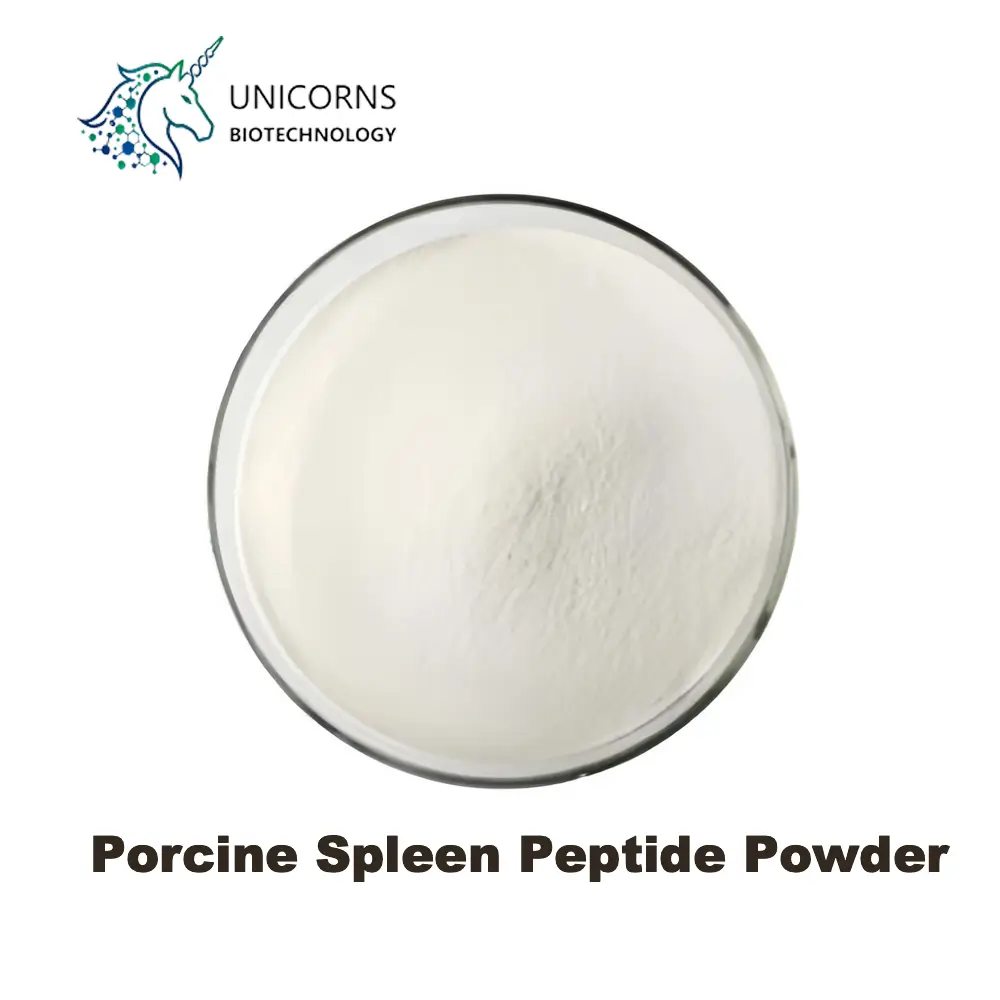
Bulk Pig Spleen Peptide Powder
| Product Name | Porcine Spleen Peptide Powder |
| Other Names | Porcine Splenic Hydrolysate, Hydrolyzed Porcine Spleen Powder, Porcine Spleen Hydrolysate, Enzymatic Porcine Spleen Peptide, Pig Spleen Peptide Powder, Porcine Spleen Extract Powder, Hydrolyzed Pork Spleen Protein, Sus scrofa Spleen Peptide, Spleen Peptide (Porcine Source), Pork Spleen Oligopeptide Powder, Small Molecular Porcine Spleen Peptide, Low Molecular Weight Spleen Peptide, Porcine Spleen Bioactive Peptide |
| Appearance | White To Light Yellow |
| Country of Origin | China |
| Applications | supplements |
| Documents Available | COA, Specification, MSDS, Allergen Statement, Non-GMO Statement |
| Manufacturing Capability | 600 tons annually |
| OEM services | Custom formulation, capsules, tablets, blends, contract manufacturing, softgels |
| Bulk Packaging | 1kg, 5kg, 10kg aluminum foil vacuum bag; or 20kg, 25kg Fiber Drum |
Unicorns Biotechnology is a wholesale Porcine Spleen Peptide Powder manufacturer and supplier in China. We supply bulk ingredients to supplement brands, nutrition companies, ingredient distributors, contract manufacturers, functional food producers, and private label businesses.
Our factory produces up to 600 tons of glandular extracts and animal-derived peptide ingredients each year. Buyers can order standard bulk powder or request custom peptide content, particle size, packaging, capsules, tablets, sachets, and finished private label products. We also supply porcine glandular powders, bovine spleen powder, porcine liver peptides, organ protein hydrolysates, and other glandular extracts and derivatives.
What Is Porcine Spleen Peptide Powder?
Porcine Spleen Peptide Powder is a hydrolyzed animal protein ingredient made from fresh, healthy pig spleen tissue. The spleen is cleaned, homogenized, defatted, and treated with selected proteases. This process breaks larger proteins into shorter peptide chains that are easier to disperse and digest.
The standard grade contains at least 65% peptides and 75% protein on a dry basis. At least 85% of its peptides have a relative molecular weight below 500 Da. The finished ingredient is normally a white to light-yellow, free-flowing powder with a mild characteristic taste.
Other Names
Common commercial names include:
Porcine spleen peptides, pork spleen peptide powder, swine spleen peptide powder, porcine spleen hydrolysate, hydrolyzed pork spleen powder, porcine spleen protein hydrolysate, spleen oligopeptide powder, and pork organ peptide powder.
CAS Number and Molecular Information
Porcine spleen peptide powder is a natural mixture rather than a single chemical compound. It does not have one fixed CAS number, molecular formula, or molecular weight. Its main components are short peptide chains and amino acids produced from porcine spleen proteins.
The peptide fraction is mainly standardized by total peptide content and molecular weight distribution. Custom 80-mesh powder can be supplied for capsule, tablet, drink-mix, and sachet manufacturing.
Solubility and Stability
The powder disperses in water and normally produces a light-colored solution. Trace white peptide particles may remain at approximately pH 5.4 to 6.0. The ingredient is stable between pH 4.0 and 9.0. It can withstand heating at 100°C for 30 minutes or 121°C for 20 minutes under the conditions stated in the product specification.
Unicorns Biotechnology can adjust peptide content, protein level, particle size, bulk density, flavor profile, and packaging for different formulations.
Key Peptide and Nutrient Profile
Porcine spleen peptide powder is standardized mainly by its peptide and protein content. The balance consists of moisture, mineral ash, free amino acids, and minor nutrients naturally present in spleen tissue.
Small-Molecule Peptides
The main active fraction consists of oligopeptides formed through controlled enzymatic hydrolysis. The standard export grade contains at least 65% peptides, with at least 85% of the peptide fraction below 500 Da.
These short chains require less digestive breakdown than intact spleen protein. This makes them suitable for drink powders, capsules, and nutrition formulas designed for rapid dispersion and easy digestion.
Protein and Amino Acids
Total protein is standardized at not less than 75% on a dry basis. A separate food-grade profile can be produced with protein at or above 80%, depending on the agreed specification.
The protein hydrolysate supplies a range of amino acids and short peptide chains. The exact amino acid profile can be tested for product development or label support.
Naturally Occurring Micronutrients
Porcine spleen tissue may contain iron, vitamin B12, minerals, and other minor nutrients. These components are not automatically standardized in every batch. Buyers planning iron, vitamin, or mineral claims should request batch-specific testing before preparing finished-product labels.
Porcine Spleen Peptide Powder Specifications
Unicorns Biotechnology supplies a high-peptide export grade with protein ≥75%, peptides ≥65%, and at least 85% of peptides below 500 Da. Moisture is controlled at ≤7.0%, while ash is limited to ≤9.0%.
A separate profile based on the Q/BCKZ 0128S-2024 solid beverage standard can use protein ≥80%, oligopeptides ≥55%, moisture ≤5.0%, and lead ≤0.9 mg/kg. The standard also sets microbiological limits for total plate count, coliforms, mold, and Salmonella.
The production process is water-based and uses food-grade protease rather than routine organic solvent extraction. Residual solvent testing can still be arranged when required. Each shipment can include a batch COA, SDS or MSDS, manufacturing flow chart, country-of-origin statement, allergen statement, porcine-origin declaration, and third-party laboratory report.
Typical Export Specification
| Test Item | Specification |
|---|---|
| Product source | Fresh, healthy porcine spleen |
| Appearance | White to light-yellow powder |
| Odor and taste | Characteristic, without abnormal odor or taste |
| Physical form | Free-flowing powder without visible foreign matter |
| Protein, dry basis | ≥75.0% |
| Total peptides, dry basis | ≥65.0% |
| Peptides below 500 Da | ≥85.0% of peptide fraction |
| Moisture | ≤7.0% |
| Ash | ≤9.0% |
| Water solubility | Soluble or readily dispersible, with possible trace peptide sediment |
| Typical dispersion pH | 5.4 to 6.0 |
| pH stability | Stable from pH 4.0 to 9.0 |
| Heat stability | 100°C for 30 minutes or 121°C for 20 minutes |
| Particle size | 80 mesh or customized |
| Standard packaging | 25 kg fiber drum with food-grade inner bags |
| Shelf life | 24 months under proper storage |
Optional Food-Grade Quality Limits
| Test Item | Q/BCKZ 0128S-2024 Reference |
|---|---|
| Protein, dry basis | ≥80 g/100 g |
| Oligopeptides, dry basis | ≥55 g/100 g |
| Moisture | ≤5.0 g/100 g |
| Lead, as Pb | ≤0.9 mg/kg |
| Salmonella | Not detected in 25 g |
| Total plate count | m = 10,000, M = 50,000 CFU/g |
| Coliforms | m = 10, M = 100 CFU/g |
| Mold | ≤50 CFU/g |
Protein can be tested according to GB 5009.5, moisture by GB 5009.3, lead by GB 5009.12, and oligopeptides by GB/T 22492 Appendix B. Microbiological testing follows the relevant GB 4789 methods.
Porcine Spleen Peptide vs Bovine Spleen Peptide
Porcine and bovine spleen peptides are both animal-derived protein hydrolysates, but they come from different species. Their peptide profiles, taste, color, sourcing costs, and regulatory acceptance may differ.
| Comparison | Porcine Spleen Peptide | Bovine Spleen Peptide |
|---|---|---|
| Raw material | Pig spleen | Cattle spleen |
| Common positioning | Daily nutrition and immune-support formulas | Bovine glandular and organ supplement formulas |
| Peptide profile | Depends on enzyme process and molecular weight target | Depends on enzyme process and molecular weight target |
| Religious suitability | Not suitable for Halal or Kosher products | May qualify when sourcing and certification meet requirements |
| BSE and TSE concern | Lower relevance for porcine species | Requires clear bovine origin and TSE/BSE documentation |
| Selection basis | Species preference, specification, cost, and market rules | Species preference, specification, certification, and market rules |
There is no universal basis for claiming that one species is always more active than the other. Buyers should compare peptide content, molecular weight distribution, source traceability, microbiological quality, and finished-product requirements.
Potential Benefits and Formulation Value
Porcine spleen peptide powder is mainly used as an easily dispersed source of animal-derived peptides and protein. Finished-product benefits depend on the complete formula, serving size, clinical support, and permitted claims in the target market.
Easily Digested Peptide Nutrition
Enzymatic hydrolysis breaks intact spleen proteins into shorter chains. These peptides require less digestive processing than whole organ powder and may be more suitable for users who prefer hydrolyzed protein ingredients.
Immune-Nutrition Formulations
Spleen-derived ingredients are commonly used in products positioned for immune nutrition and general resistance support. The ingredient can be combined with colostrum, thymus peptides, zinc, vitamin C, beta-glucans, or amino acids.
Any immune-related claim should be based on the finished formula and local regulatory requirements. The raw material should not be presented as a treatment for infection or immune disease.
Recovery and Nutritional Support
The powder provides protein, peptides, and amino acids in a concentrated form. It can be used in nutrition products aimed at adults with increased protein needs, limited appetite, or recovery-related dietary requirements.
Use in medical foods, hospital nutrition, or post-surgery formulas requires local approval and review by qualified healthcare professionals.
Antioxidant and Cellular Nutrition Research
Some animal protein hydrolysates contain peptide sequences studied for antioxidant activity. The level of activity depends on the enzyme, peptide sequence, molecular weight distribution, and laboratory method.
Buyers developing antioxidant products can request peptide profiling, amino acid testing, or application-specific laboratory analysis.
Porcine Spleen Peptide Manufacturing Process
Production starts with inspected, fresh porcine spleen. The tissue is trimmed to remove membranes and unwanted material, washed, crushed, and mixed with purified water to form a uniform slurry.
The slurry undergoes low-temperature homogenization and controlled degreasing. Selected food-grade proteases are then added under controlled pH, temperature, and time conditions. After hydrolysis, the enzymes are inactivated and the liquid is filtered to remove insoluble material.
The peptide solution is concentrated, dried, milled, sieved, and blended. Each batch is then tested for protein, peptide content, molecular weight distribution, moisture, ash, heavy metals, and microbiological quality before packing. This general sequence follows the process described in the attached enterprise standard: crushing, membrane removal, slurrying, enzymatic hydrolysis, filtration, concentration, drying, milling, blending, and packaging.
Porcine Spleen Peptide Powder Applications
Its high protein content, small peptide size, and water dispersibility allow it to fit several human and animal nutrition formats. Formulators should consider taste masking, porcine-origin labeling, dosage, and local regulatory status during product development.
Dietary Supplement Capsules and Tablets
Functional Foods and Solid Drinks
Special Nutrition and Recovery Formulas
Pet Food and Animal Nutrition
Where to Buy Bulk Porcine Spleen Peptide Powder
Henan Unicorns Biotechnology Co., Ltd. supplies high-quality Porcine Spleen Peptide Powder directly from China for wholesale and contract manufacturing projects. We support supplement brands, animal extract distributors, functional food companies, and private label businesses with standard and custom grades.
| Factory Advantage | Buyer Benefit |
|---|---|
| Direct China factory supply | Stable bulk pricing and shorter sourcing channels |
| 600-ton annual production capability | Support for pilot orders and regular container shipments |
| Standardized peptide content | Peptides ≥65% and protein ≥75% available |
| Molecular weight control | ≥85% of peptides below 500 Da |
| Batch quality documents | COA, SDS/MSDS, flow chart, origin statement, and test reports |
| Third-party testing | Heavy metals, microbiology, protein, peptides, and custom tests |
| OEM manufacturing | Capsules, tablets, sachets, blends, and private labels |
| Custom specifications | Peptide level, protein content, particle size, flavor, and packaging |
| Bulk packaging | Standard 25 kg drums and customized pack sizes |
| Clear species declaration | Fully identified porcine origin for regulatory and label review |
| Religious status | Porcine material is not suitable for Halal or Kosher products |
Contact Unicorns Biotechnology for a free sample, current wholesale price, minimum order quantity, batch-specific COA, and third-party test report. Please provide your target peptide content, annual volume, destination market, packaging format, and finished-product application when requesting a quotation.