
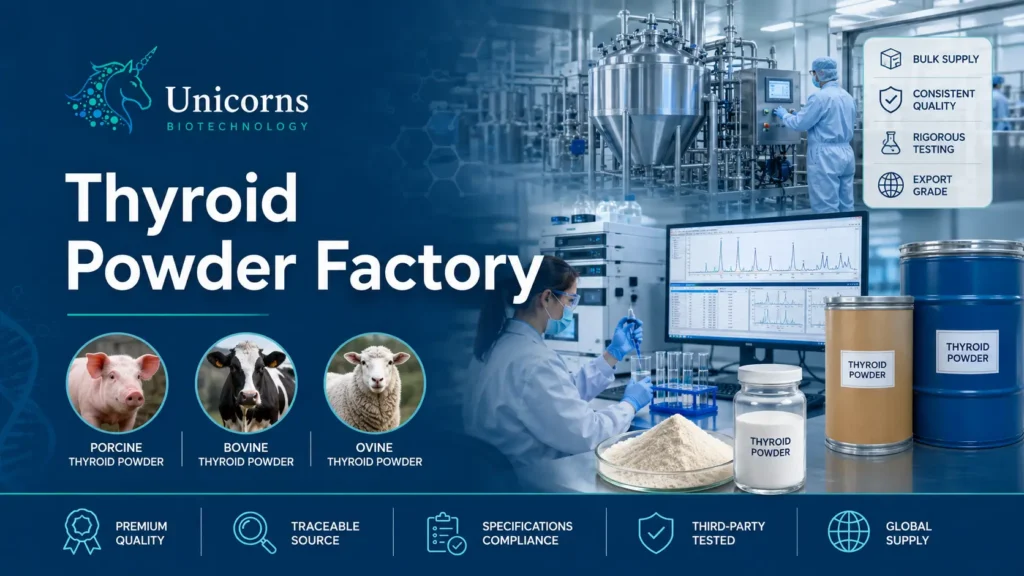
Choosing a Thyroid Powder Factory involves more than comparing price and particle size. When sourcing bulk thyroid powder for sale, professional buyers must evaluate the raw material’s origin, manufacturing controls, and analytical methods. Because animal-derived thyroid tissue may naturally contain T3, T4, iodine-containing compounds, proteins, and other glandular components, professional buyers must evaluate raw-material origin, manufacturing controls, analytical methods, batch consistency, documentation, and intended-use compliance before placing a bulk order.
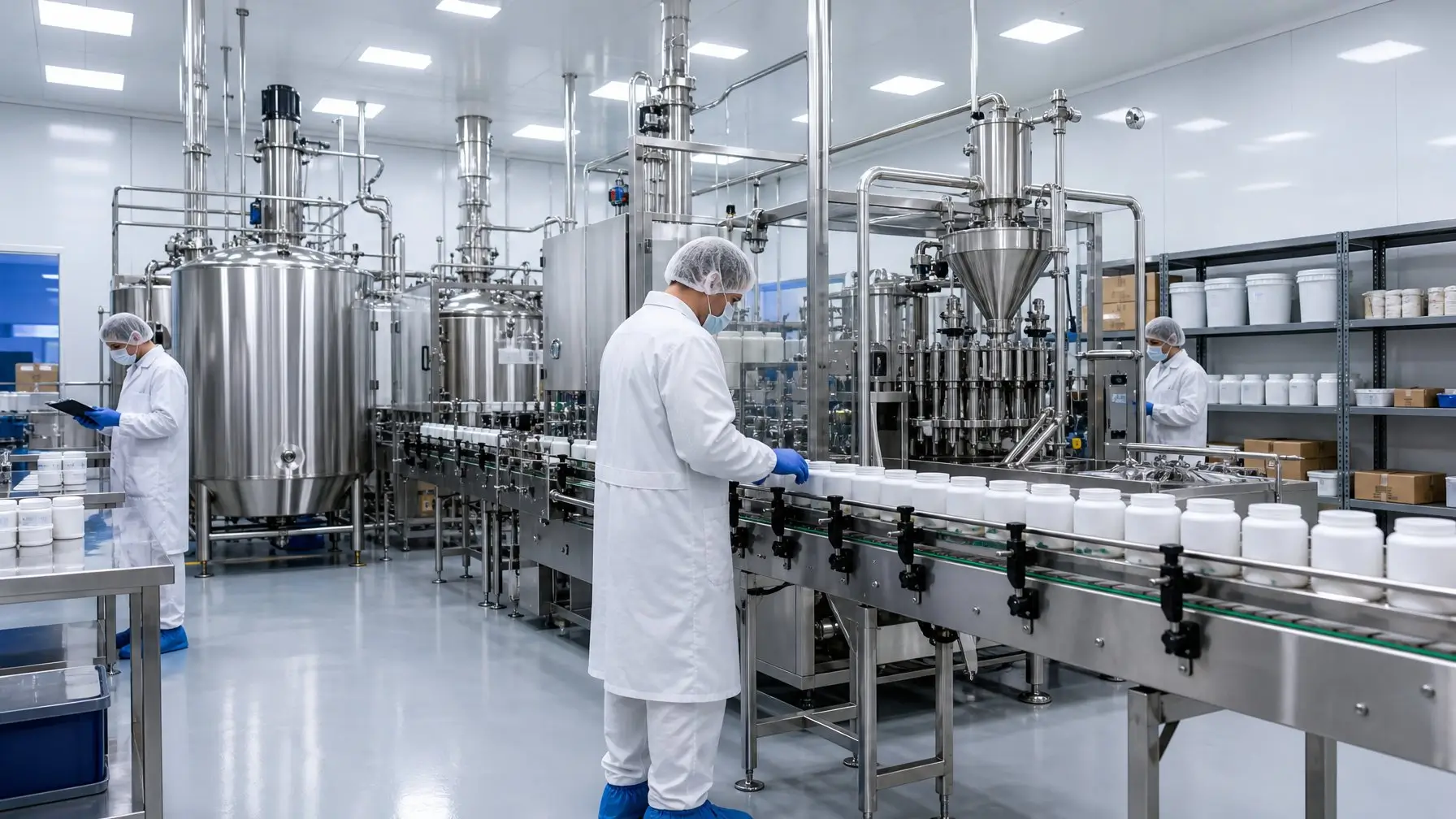
The difference between a reliable thyroid powder manufacturer and a marginal one often shows up not in the first sample, but in the tenth production batch. Porcine, bovine, and ovine sources each carry distinct sourcing, testing, and documentation requirements. Hormone assays demand validated methods and batch-specific data. Particle size, drying method, species segregation, and traceability controls all shape whether the material you receive will meet your specification consistently at commercial scale.
This guide covers what a thyroid powder factory actually produces, how to compare animal sources, what manufacturing controls matter, which specifications and analytical tests to prioritize, how to qualify a supplier, and what commercial terms to expect. Whether you are a formulator sourcing bulk porcine thyroid powder, a distributor evaluating a new origin, or a quality manager building a supplier file, the goal is to give you a practical framework for every stage of the sourcing process. Unicorns Biotechnology, a GMP-compliant animal glandular powder manufacturer with factory production in Henan, China, has supplied over 5,000 tons of animal-derived powders to global buyers and offers the kind of traceable, batch-tested supply this guide describes. If you are ready to request specifications, samples, or a quotation, reach out to Unicorns Biotechnology directly.
What A Factory May Actually Produce
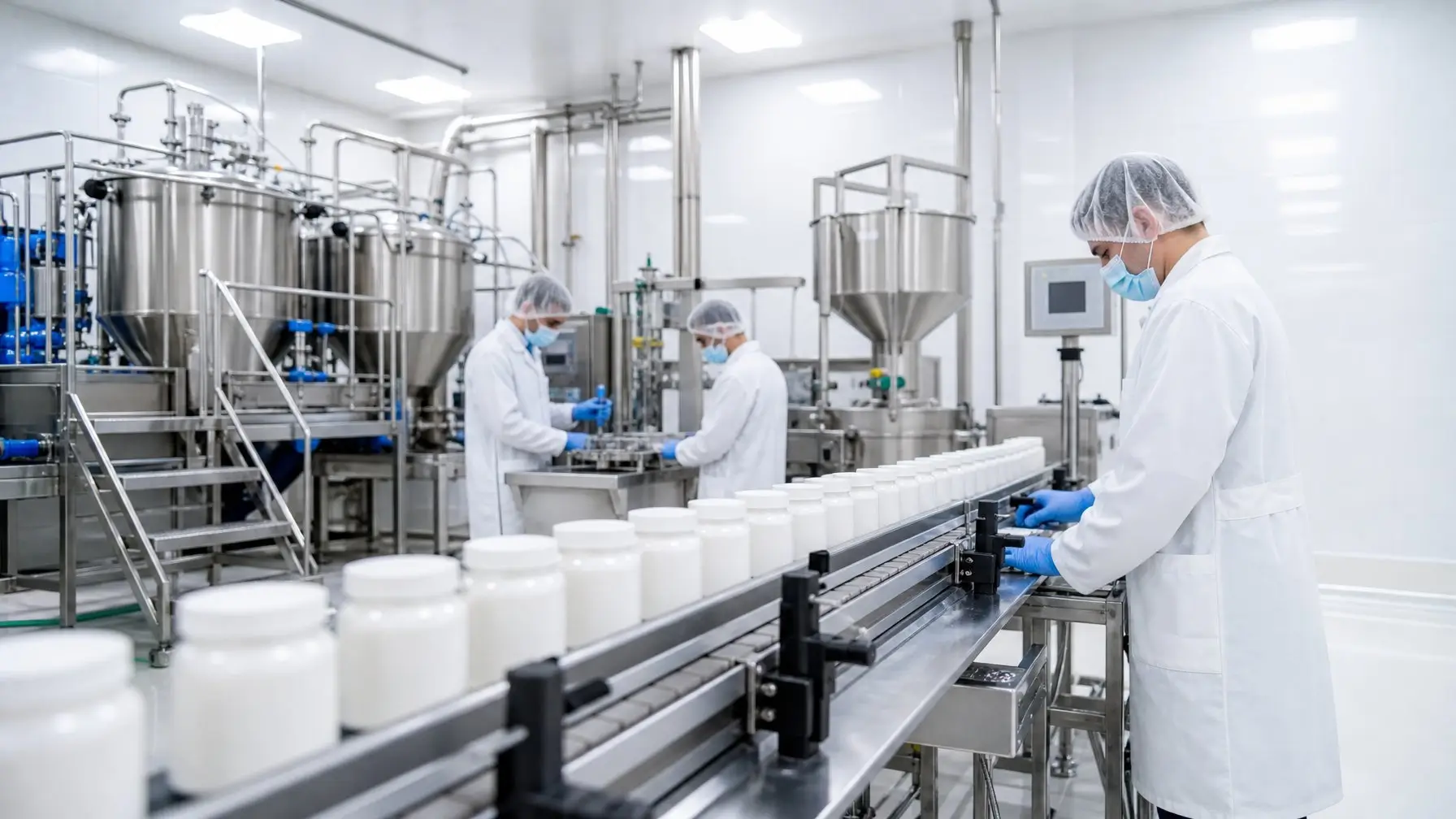
The general term “thyroid powder” can refer to materially different products: whole dried gland tissue, processed concentrates with altered composition, or hormone-standardized materials requiring validated potency assays and regulatory controls. Knowing which product form your factory actually manufactures determines every downstream specification, test, and compliance decision.
Whole Thyroid Gland Powder
Whole thyroid gland powder is cleaned, dried, and milled animal thyroid tissue with minimal compositional alteration beyond moisture removal and particle-size reduction. The gland is separated from surrounding connective tissue and fat, then processed into a fine powder.
Formats you may encounter include freeze-dried thyroid powder, spray-dried thyroid powder, defatted thyroid powder, non-defatted whole-gland powder, and custom-milled thyroid tissue. Each format carries different cost, flowability, fat content, and stability characteristics.
Freeze-dried material generally preserves tissue structure through low-temperature dehydration. Spray-dried powder supports scalable, cost-effective production with good flowability. Defatted versions reduce oxidation risk and improve shelf stability.
The critical point: no drying or milling method guarantees a fixed hormone concentration. Final T3, T4, and iodine content must always be confirmed by batch-specific testing.
Thyroid Concentrates And Extracts
Processed thyroid concentrates and extracts differ from whole-gland powder in several measurable ways. Hormone concentration, protein content, water dispersibility, carrier content, extraction method, and intended application may all be altered during manufacturing.
An extract may use solvent-based or enzymatic processing to concentrate specific fractions. A concentrate may involve blending or dilution to achieve a target assay. These concentrates are frequently used in metabolic support products and fat burner formulations. Buyers should request precise processing descriptions and confirm whether the material has been standardized to a defined T3/T4 specification.
The distinction matters for downstream formulation, labeling claims, and regulatory classification.
Standardized Desiccated Thyroid Materials
Ordinary whole-gland thyroid powder is not automatically equivalent to pharmaceutical-grade natural desiccated thyroid (NDT) or a finished prescription medicine. Standardized desiccated thyroid material requires defined T3 and T4 potency per unit weight, validated analytical methods, dose uniformity testing, stability data, and the full regulatory controls applicable to its intended market.
For buyers in the US market, USP-grade desiccated thyroid specifies T3 and T4 content per grain, with acceptance ranges and validated HPLC assay methods. Meeting these requirements demands a level of process control and documentation well beyond standard food-grade or supplement-grade glandular powder production.
| Product Form | Main Characteristic | Typical Buyer Requirement |
|---|---|---|
| Whole-gland powder | Dried and milled thyroid tissue | Species identity, microbiology, and general composition |
| Freeze-dried powder | Low-temperature dehydration | Tissue preservation and premium processing |
| Spray-dried powder | Scalable powder production | Cost, flowability, and commercial volume |
| Thyroid concentrate | More processed or concentrated material | Defined processing and composition |
| Hormone-standardized material | Controlled T3 and T4 potency | Validated assays, uniformity, and regulatory compliance |
Choosing The Right Animal Source
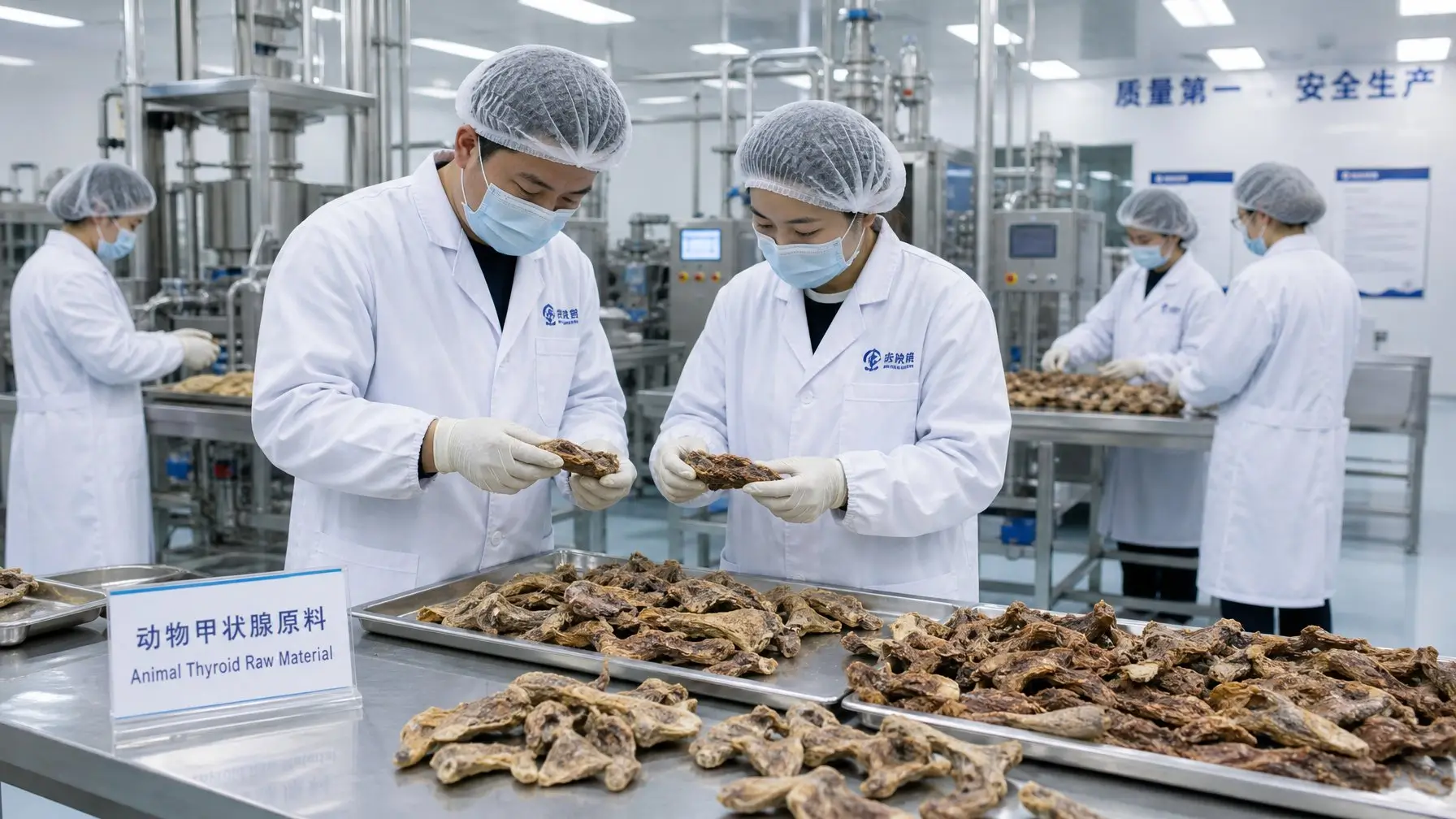
Porcine thyroid material remains the most commercially familiar source for desiccated thyroid products, while bovine and ovine sources serve specialized pharmaceutical, supplement, research, and biochemical applications. Each species carries distinct documentation, testing, and market-access requirements that directly affect your sourcing decision.
Porcine Thyroid Materials
Most animal-derived thyroid products used historically and commercially have been porcine-derived. Porcine thyroid powder is available in both whole-tissue grades and assay-controlled grades with defined T3 and T4 content.
Buyers sourcing porcine material should confirm porcine-origin declarations for regulatory and customer compliance. Halal and kosher market restrictions apply; porcine-derived ingredients are excluded from both certification systems, which limits the end markets you can serve. T3, T4, and iodine testing requirements remain standard for any grade intended for supplement or pharmaceutical use.
Porcine thyroid glands are typically collected from government-certified slaughterhouses under veterinary authority supervision. Species identity testing, microbiological controls, and fat content should be confirmed per batch.
Bovine Thyroid Materials
Bovine thyroid powder serves buyers who need a non-porcine animal source or who are formulating bovine-specific glandular products. Grass-fed sourcing can be specified where verifiable supply chains exist, though buyers should request documentation rather than relying on verbal claims.
BSE and TSE documentation is mandatory for bovine thyroid materials entering most regulated markets. You should confirm the country of origin, review tissue classification under specified-risk-material regulations, and obtain formal BSE/TSE declarations from the manufacturer. Species identity testing via PCR or DNA analysis helps detect substitution or cross-species contamination.
Ovine Thyroid Materials
Sheep thyroid powder occupies a more specialized position. Ovine thyroid materials are commonly used in research, biochemical extraction, and niche glandular supplement formulations.
Grass-fed ovine sources may be available depending on origin country and seasonal supply. Custom T3, T4, and iodine assays should be specified at the time of quotation. Buyers should understand that whole ovine thyroid powder is not equivalent to standardized NDT without validated potency controls and applicable regulatory oversight.
Species identity testing is particularly important for ovine materials to differentiate from bovine or caprine tissue, which can share overlapping supply chains.
| Factor | Porcine | Bovine | Ovine |
|---|---|---|---|
| Animal source | Pig | Cattle | Sheep |
| Commercial familiarity | High for desiccated thyroid materials | Specialized | Specialized |
| Main documentation concern | Species and origin declaration | BSE/TSE and origin | Species identity and origin |
| Religious-market consideration | Restricted in halal and kosher markets | Certification dependent | Certification dependent |
| Custom testing | T3, T4, iodine, and identity | T3, T4, iodine, identity, and BSE/TSE | T3, T4, iodine, and identity |
How Manufacturing Controls Shape Product Quality
Every step in the thyroid powder production process directly affects final composition, batch consistency, microbial quality, and shelf stability. Lot control at the raw-gland stage, cold-chain discipline, drying-method selection, milling precision, blending protocols, and packaging design each contribute measurable quality outcomes that determine whether your commercial batches match your approved sample.
Raw Gland Sourcing And Lot Control
Thyroid glands should be collected from approved slaughterhouses or animal-processing facilities that operate under the supervision of a permanent veterinary authority. Healthy-animal documentation and veterinary inspection records form the foundation of your traceability chain.
Species separation at the collection stage prevents cross-species contamination. Cold-chain control from gland collection through transport to the factory is essential to preserve tissue integrity. Each incoming raw-material lot requires identification by species, collection facility, country of origin, and collection date.
Unicorns Biotechnology sources raw glandulars from government-certified slaughterhouses under the official veterinary authority of China, with lot-level traceability from the animal source through finished powder.
Cleaning, Trimming, And Tissue Preparation
Before drying, the raw thyroid gland undergoes cleaning to remove connective tissue, excess fat, blood residues, unwanted surrounding tissue, and foreign matter. Thorough trimming affects the final fat content, protein ratio, and purity of the finished powder.
Inadequate cleaning leads to elevated ash, variable fat content, and potential microbial issues. Production records should document the cleaning and trimming steps for each batch.
Drying Methods And Their Commercial Tradeoffs
Three primary drying methods are used in thyroid powder manufacturing:
- Freeze drying (lyophilization): Preserves tissue structure through low-temperature dehydration. Higher cost, lower throughput, often preferred for premium or research-grade materials.
- Spray drying: Scalable, produces powder with good flowability and consistent particle characteristics. Cost-effective for commercial volume.
- Controlled dehydration: Conventional hot-air or vacuum drying at managed temperatures. Moderate cost with variable effects on sensitive tissue components.
No drying method automatically preserves a fixed hormone concentration. Final T3, T4, and iodine content must be confirmed by batch testing regardless of the method used.
Milling, Sieving, And Powder Uniformity
Standard thyroid powder is typically milled to 80-mesh size, with custom mesh options (60-mesh, 100-mesh, or finer) available based on your blending, capsule-filling, or extraction requirements.
Metal detection at the milling stage is a basic quality expectation. Particle-size uniformity affects bulk density, flowability, content uniformity in downstream dosage forms, and blending behavior. Request particle-size distribution data, not just a single sieve specification.
Blending, Standardization, And Batch Release
Where a defined potency is required, batches may need controlled blending based on validated T3 and T4 assay results. Blending protocols should be documented with pre-blend and post-blend assay data.
Batch release should follow a defined testing protocol that covers identity, T3, T4, total iodine, moisture, ash, heavy metals, microbiology, species verification, and veterinary residues, where required. The release should not occur until all results fall within the acceptance criteria.
Packaging, Storage, And Shipment Readiness
Packaging protects thyroid powder from moisture, oxygen, light, and contamination during storage and transit. Standard options include vacuum-sealed aluminum foil bags, fiber drums with inner PE liners, and 25 kg drums with moisture-proof construction.
Nitrogen-flushed packaging reduces oxidation risk for sensitive materials. Controlled storage at specified temperature and humidity conditions supports shelf-life claims. Each package should carry batch number, production date, retest or expiry date, and storage instructions.
A useful process flow to reference:
Animal source qualification → Gland collection → Cold transport → Cleaning and trimming → Drying → Milling → Sieving → Testing → Blending or standardization → Packaging → Batch release
Critical Specifications And Analytical Testing
The specification sheet is the single most important technical document in your supplier evaluation. Core test items should cover species identity, physical properties, composition, hormone content, contaminants, and microbiology, with acceptance criteria calibrated to your intended use and regulatory framework.
Core Specification Items Buyers Should Compare
| Test Item | Why Buyers Should Check It |
|---|---|
| Animal species | Confirms porcine, bovine, or ovine origin |
| Appearance | Supports incoming-material identification |
| Particle size | Affects blending, filling, and further processing |
| Moisture / loss on drying | Influences stability and microbial risk |
| Ash | Indicates inorganic content and batch consistency |
| Protein | Supports composition comparison |
| Fat | Affects oxidation, flow, and stability |
| T3 assay | Measures a biologically active thyroid component |
| T4 assay | Measures a principal thyroid component |
| Total iodine | Helps evaluate natural compositional variation |
| Thyroglobulin | May be relevant for research or identity purposes |
| Heavy metals (Pb, As, Cd, Hg) | Supports regulatory and customer limits |
| Total plate count | Indicates general microbial quality |
| Yeast and mold | Supports shelf-life evaluation |
| E. coli | Hygiene-related indicator |
| Salmonella | Important pathogen requirement |
| Species identity | Helps detect substitution or cross-species contamination |
| Veterinary residues | May be requested for controlled markets |
| Water activity | Supports stability and microbial assessment |
| Bulk density | Important for packaging and dosage-form manufacturing |
The specification should reflect the intended use. A general whole-tissue ingredient, a research-grade material, and a hormone-standardized pharmaceutical raw material should not share identical acceptance criteria.
Why T3 And T4 Assays Matter
Thyroid tissue naturally contains active hormone components, primarily liothyronine (T3) and levothyroxine (T4). Concentrations vary with animal source, tissue quality, season, processing method, and batch.
A defined potency should never be claimed without batch-specific testing. Buyers requiring potency control need validated analytical methods with documented accuracy, precision, and recovery data. Finished-product manufacturers remain responsible for dose accuracy and regulatory compliance in their target market.
For reference, USP-grade desiccated thyroid specifies T3 at 8.1–9.9 mcg/grain and T4 at 34.2–41.8 mcg/grain, with results expressed on a defined basis.
Questions To Ask About The Test Method
Before accepting any T3/T4 data on a COA, verify the analytical foundation behind the numbers:
- Is the method HPLC, LC-MS, or another validated technique?
- Are certified reference standards used for T3 and T4?
- Is the result reported on an as-is or dry basis?
- What are the detection and quantification limits?
- Is the method validated for the animal thyroid tissue matrix specifically?
- Can a chromatogram be supplied with each batch COA?
- Is each commercial batch tested, or are results extrapolated from a representative batch?
- Can an independent laboratory confirm the result?
These questions separate suppliers who actually perform validated testing from those who copy generic data onto batch paperwork.
When Total Iodine Testing Becomes Important
Iodine content in thyroid tissue varies naturally across batches, species, and seasons. Total iodine testing becomes important when your application involves finished-product labeling, formula development with iodine targets, batch-to-batch consistency requirements, or regulatory review that considers iodine content.
Both organic and inorganic iodine fractions may be relevant depending on the application. Confirm with your factory whether iodine is measured and whether the method distinguishes inorganic iodides from total organic iodine.
Supplier Qualification, Documentation, And Audit Readiness
Qualifying a thyroid powder factory requires documented evidence of traceability from animal source through batch release, species segregation controls, BSE/TSE risk management for bovine and ovine materials, and a change-control system that triggers buyer notification before any material change takes effect.
Traceability, Segregation, And Change Control
Your thyroid powder manufacturer should trace each batch through the raw thyroid tissue lot, animal source, collection facility, production batch, testing records, packaging materials, and shipment records. Full farm-to-factory traceability is the standard expectation for animal-derived ingredients entering regulated supply chains.
Species segregation requires documented physical and procedural controls: separate storage, dedicated or validated-clean production equipment, and line-clearance records. For buyers specifying porcine-free or non-porcine thyroid powder, these controls are non-negotiable.
The supplier should notify you in advance about any changes to animal source, slaughterhouse or tissue supplier, manufacturing site, drying method, analytical method, specification, packaging, or subcontracted laboratory. A formal change-control policy should be part of your quality agreement.
BSE And TSE Risk Review
BSE and TSE risk management is especially important for bovine and ovine thyroid materials. You should confirm:
- Country of origin and its BSE risk classification
- Animal health controls at the source
- Tissue classification under specified-risk-material regulations
- Formal BSE/TSE declarations from the manufacturer
- Supplier records documenting compliance
- Import-market requirements for the destination country
For porcine materials, BSE/TSE risk is generally not a concern, but buyers should still maintain origin documentation.
Documents To Request Before Approval
A practical checklist for your supplier file:
- Recent batch-specific COA (minimum three batches)
- Product specification sheet
- Technical data sheet (TDS)
- SDS or MSDS
- Manufacturing flow chart
- Animal-origin statement
- Country-of-origin statement
- BSE/TSE declaration (bovine and ovine)
- Non-GMO statement
- Non-irradiation statement
- Allergen statement
- Antibiotic or veterinary-residue statement
- Species identity report (PCR or DNA)
- T3 and T4 test report with chromatograms
- Total iodine report
- Microbiology report
- Heavy-metal report
- Stability or shelf-life data
- Packaging specification
- Certification copies (GMP, HACCP, ISO, Halal, Kosher as applicable)
- Third-party laboratory report
- Change-control policy
Understand the difference between document types. A standard document describes general product characteristics. A batch-specific report provides data from a defined production lot. A supplier declaration is a statement of compliance signed by the manufacturer. An independently tested result comes from a third-party laboratory with no commercial interest in the outcome.
How To Audit A Potential Supply Partner
Use a structured buyer checklist rather than relying on general impressions:
- Is the company a direct manufacturer or a trader listed on Alibaba?
- Which animal sources are processed on site?
- Can each source be physically and procedurally segregated?
- Where are the thyroid glands collected?
- Is full batch traceability available and documented?
- Which drying methods are performed in-house?
- Can T3, T4, and iodine be tested for every batch?
- Are the analytical methods validated for animal thyroid tissue?
- Can the factory provide three recent COAs with chromatograms?
- Can species identity be independently confirmed?
- What are the annual capacity and normal lead time?
- Are pilot and commercial batches produced by the same process and equipment?
- Can the facility support a customer audit (on-site or remote)?
- Is there a documented change-control and deviation-management system?
- Can the supplier support your intended market legally and technically?
On-site audits, remote document audits, supplier questionnaires, batch-record reviews, laboratory reviews, and corrective-and-preventive-action (CAPA) procedures should all be part of your qualification program.
Commercial Supply Terms And Working With Unicorns Biotechnology
Practical supply terms determine whether a thyroid powder factory can actually support your commercial requirements beyond the sample stage. MOQ flexibility, pilot-batch capability, packaging options, annual capacity, and RFQ responsiveness all affect time-to-market and ongoing supply continuity.
MOQ, Samples, Pilot Orders, And Commercial Batches
Unicorns Biotechnology supports the full procurement pathway:
- Free samples: Available for initial laboratory evaluation, typically shipped in 1 kg aluminum foil bags.
- Trial/pilot orders: Small commercial quantities for production trials and sample qualification, typically 5–20 kg.
- Commercial batches: Standard bulk production runs at quantities defined by your annual demand and specification.
Request retention samples from each approved batch for your own incoming-inspection reference. Confirm that pilot batches and commercial batches follow the same manufacturing process, equipment, and release specification to ensure sample-to-bulk consistency.
Packaging Options, Lead Times, And Annual Supply
Standard packaging options include 1 kg foil bags, 5 kg cartons, 10 kg cartons, 20 kg cartons, and 25 kg drums or cartons with inner food-grade PE liners. Vacuum-sealed and nitrogen-flushed packaging is available for moisture- and oxidation-sensitive materials. Palletized packaging supports large-volume shipments.
Lead times depend on species, grade, custom testing, and order volume. Request specific timelines during the quotation stage. Unicorns Biotechnology has exported over 5,000 tons of animal-derived powders and maintains production capacity for annual supply agreements, safety stock, and reserved capacity arrangements.
RFQ Inputs, Pricing Variables, And Custom Manufacturing
When requesting a bulk quotation, provide the following information for an accurate response:
- Product species (porcine, bovine, or ovine)
- Intended use and target market
- Required assays (T3, T4, iodine, identity, etc.)
- Specification or acceptance criteria
- Order quantity and annual demand estimate
- Particle size (standard 80-mesh or custom)
- Packaging preference
- Required documents and certifications
- Delivery destination and preferred Incoterm
Pricing variables include animal source, drying method (freeze-dried vs. spray-dried), custom testing scope, particle size, packaging format, and order volume. Custom thyroid powder manufacturing, including private-label and OEM support, is available based on buyer specifications.
Why Unicorns Biotechnology Fits Bulk Buyer Requirements
Unicorns Biotechnology operates as a direct thyroid powder manufacturer with GMP-compliant factory production in Henan, China. The company processes porcine and sheep thyroid materials, with bovine glandular sourcing capability across its broader product range.
Key capabilities for bulk buyers:
- Freeze-dried and spray-dried processing options
- Custom mesh sizes for downstream formulation needs
- T3, T4, and iodine testing
- Species identity testing (PCR/DNA)
- Heavy-metal and microbiological controls
- Batch-specific COA, SDS, TDS, and full technical document packages
- Third-party testing support
- Export-ready documentation including animal-origin, BSE/TSE, non-GMO, and allergen statements
- Raw materials sourced from government-certified slaughterhouses under permanent veterinary authority control
- Stated BSE-free, pesticide-free, antibiotic-free, and GMO-free glandular ingredients
Whether you need a laboratory sample, a pilot batch for qualification, or a long-term annual supply agreement, Unicorns Biotechnology is structured to support each stage of your procurement process. Along with other providers like Pioneer Biotech, we help buyers navigate the complexities of glandular sourcing.
Frequently Asked Questions
These questions address the most common technical and commercial concerns raised by procurement managers, formulators, and quality teams evaluating a thyroid powder factory for bulk supply.
What is the difference between thyroid powder and thyroid extract?
Thyroid powder is the whole dried and milled thyroid gland with minimal processing beyond cleaning, drying, and particle-size reduction. Thyroid extract typically involves additional processing steps such as solvent extraction or concentration that alter the composition, hormone concentration, or protein profile. The two are not interchangeable in a specification.
Which source is better: bovine, porcine or sheep thyroid powder?
No single source is universally “better.” Porcine thyroid powder is the most commercially established for desiccated thyroid applications. Bovine material suits non-porcine requirements but requires BSE/TSE documentation. Sheep thyroid powder serves niche research, biochemical, and specialty supplement markets. Your choice depends on regulatory requirements, end-market restrictions, and formulation goals.
Is thyroid powder the same as natural desiccated thyroid?
Not automatically. Natural desiccated thyroid (NDT) in the pharmaceutical sense requires defined T3 and T4 potency per unit weight, validated analytical methods, dose uniformity, stability data, and regulatory approval for its intended market. General whole-gland thyroid powder is a raw material that may or may not meet those requirements.
What specifications should a thyroid powder factory provide?
At minimum: species identity, appearance, particle size, moisture, ash, protein, fat, T3 assay, T4 assay, total iodine, heavy metals, microbiology (total plate count, yeast and mold, E. coli, Salmonella), and species verification. Additional tests for veterinary residues, water activity, and bulk density should be included based on intended use.
Should every thyroid powder batch be tested for T3 and T4?
Yes, if potency is relevant to your application. T3 and T4 concentrations vary naturally between batches due to differences in animal source, tissue quality, season, and processing conditions. Batch-specific assay data using a validated HPLC or LC-MS method is the only reliable way to confirm content.
How is animal species identity verified?
Species identity is typically verified by PCR (polymerase chain reaction) or DNA-based testing that can distinguish porcine, bovine, ovine, and other animal tissues. This testing detects substitution and cross-species contamination. Request species identity reports from both the manufacturer and, where possible, an independent third-party laboratory.
What BSE/TSE documents are needed for bovine and sheep thyroid powder?
Bovine and ovine thyroid materials require a formal BSE/TSE declaration from the manufacturer, documentation of the country of origin and its BSE risk classification, animal health controls at the source, tissue classification under specified-risk-material rules, and compliance with the import requirements of your destination market.
Can thyroid powder particle size and packaging be customized?
Yes. Standard production is typically 80-mesh powder, with custom sizes such as 60-mesh or 100-mesh available. Packaging can be customized from 1 kg foil bags to 25 kg drums, with options for vacuum sealing, nitrogen flushing, and palletized shipments based on order volume and stability requirements.
How do buyers verify batch-to-batch consistency?
Request COAs from at least three recent production batches and compare T3, T4, iodine, moisture, ash, microbiology, particle size, and appearance data across lots. Consistent results within defined acceptance ranges indicate process control. Retention samples from each qualified batch provide a physical reference for future comparison.
What information is needed to request a bulk quotation?
Provide the product species (porcine, bovine, or ovine), intended use, target market, required assays, specification or acceptance criteria, order quantity and annual demand, particle size, packaging preference, required documents, and delivery destination with preferred Incoterm. Complete information enables an accurate and responsive quotation.
Why is desiccated thyroid often not recommended by clinicians?
Some clinicians prefer synthetic levothyroxine (T4) because it allows precise, consistent dosing and has well-characterized pharmacokinetics. Desiccated thyroid contains both T3 and T4 in ratios that may not match every patient’s physiological needs, and natural batch-to-batch variability in older or poorly standardized products has raised consistency concerns in clinical settings. This is a clinical and regulatory matter separate from the raw-material manufacturing question.
What are the most common side effects of natural desiccated thyroid supplements?
Reported side effects in clinical literature include heart palpitations, tremor, headache, insomnia, and symptoms of excess thyroid hormone if dosing is not properly managed. Side-effect profiles relate to finished-product dosing and clinical supervision. As a raw-material buyer, your responsibility is to ensure the material meets defined specifications so that finished-product manufacturers can control dosing accurately.
Where can I buy natural desiccated thyroid safely and legally?
For finished pharmaceutical products, natural desiccated thyroid requires a prescription in the United States and most regulated markets. For bulk raw materials, buyers should source from qualified manufacturers with documented traceability, batch-specific COAs, species identity testing, and export-ready documentation. Unicorns Biotechnology supplies bulk thyroid powder raw materials to B2B buyers, not finished consumer products.
How does desiccated thyroid compare to levothyroxine for hypothyroidism treatment?
Desiccated thyroid provides both T3 and T4, while levothyroxine is a synthetic T4-only medication. Clinical selection between the two is a medical decision outside the scope of raw-material manufacturing. From a manufacturing perspective, the key difference is that desiccated thyroid raw materials require T3 and T4 assays, species verification, and tighter compositional controls than a single synthetic API.
Why do some doctors avoid prescribing Armour Thyroid?
Armour Thyroid is a branded porcine-derived desiccated thyroid product. Some physicians prefer synthetic alternatives due to concerns about T3/T4 ratio variability, dosing precision, and the availability of extensive clinical trial data for synthetic levothyroxine. These are clinical prescribing decisions. For bulk material suppliers, the relevant takeaway is that consistent hormone content, validated testing, and batch uniformity are essential quality expectations.
Is Synthroid made from pig thyroid, and how is it manufactured?
No. Synthroid (levothyroxine sodium) is a synthetic thyroid hormone manufactured through chemical synthesis, not derived from animal thyroid tissue. It contains only T4. Desiccated thyroid products, by contrast, are animal-derived and contain both T3 and T4. These are fundamentally different manufacturing processes and product categories.