
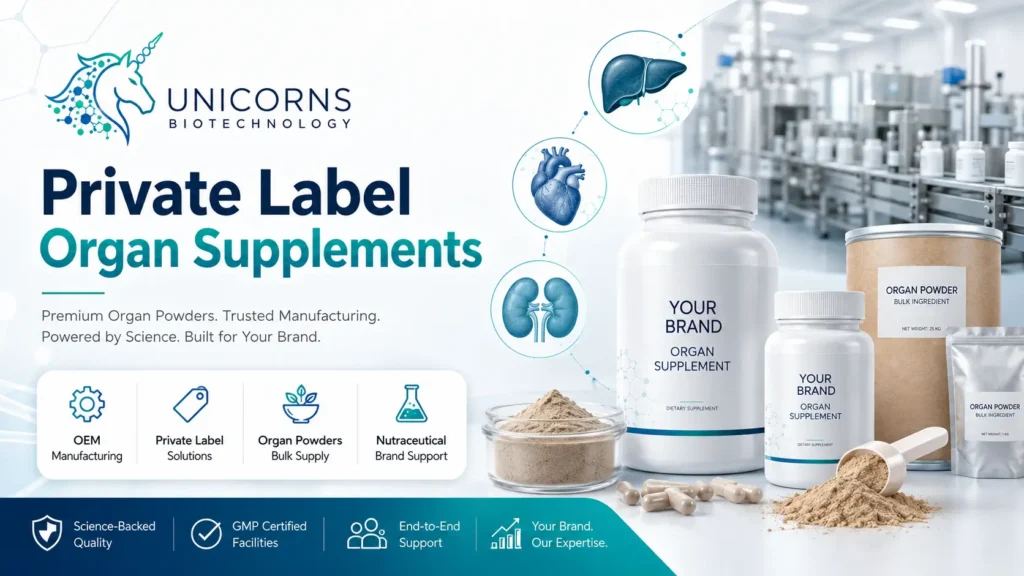
Launching private label organ supplements involves far more than purchasing beef liver powder and placing a logo on a bottle. A commercially viable product requires the right animal species, verified organ identity, suitable processing method, realistic serving size, manufacturing-compatible powder, compliant packaging, quality testing, export documentation, and a supply partner capable of supporting repeat orders.
For startup founders, established dietary supplement brands, purchasing managers, product developers, contract manufacturers, CDMOs, ingredient distributors, and importers, the central question is not simply where to buy organ powder. The real question is how to turn a bulk animal-derived ingredient into a differentiated, testable, scalable, and market-ready nutraceutical product.
Unicorns Biotechnology supports this process through bulk organ powder supply, custom organ blends, specification development, capsule and tablet manufacturing, private label packaging, quality documentation, third-party testing support, and international shipment coordination. As a specialized animal-derived ingredient manufacturer in China, Unicorns Biotechnology supplies bovine, porcine, sheep, deer, poultry, equine, and other glandular ingredients for global B2B buyers.
This guide explains how private label organ supplement manufacturing works, which raw materials and processing methods are available, what specifications buyers should evaluate, and how Unicorns Biotechnology can help move a product from concept to commercial production.
What Are Private Label Organ Supplements?
Private label organ supplements are finished nutraceutical products manufactured for sale under another company’s brand. The brand owner controls the product name, positioning, packaging, sales channel, and customer relationship, while a private label manufacturer or contract manufacturing partner manages some or all of the ingredient sourcing, formulation, production, testing, and packaging.
Common finished products include:
- Beef liver capsules
- Bovine heart capsules
- Bovine kidney supplements
- Bovine spleen and heme iron formulas
- Adrenal glandular supplements
- Pancreas glandular formulas
- Multi-organ capsules
- Nose-to-tail nutrition blends
- Powder jars and sachets
- Practitioner-focused glandular formulas
- Pet organ nutrition products
Private label organ powders can be manufactured as simple single-ingredient products or as complex formulas combining several organs, animal species, nutrients, peptides, minerals, or complementary ingredients.
Private Label vs. White Label Organ Supplements
White label and private label are often used interchangeably, but they can refer to different development models.
A white label organ supplement normally uses an existing formula and standard product format. The buyer adds its brand, label, and packaging with limited changes. This model can reduce product development time and may suit startups testing market demand.
A private label organ supplement may involve greater customization, such as:
- A proprietary organ blend
- Custom organ ratios
- A selected animal species
- Freeze-dried or spray-dried material
- Defatted or non-defatted powder
- Custom capsule count
- Branded packaging
- Additional nutrients or functional ingredients
- Buyer-specific quality standards
- Target-market testing requirements
The correct model depends on the brand’s budget, desired differentiation, target launch date, sales channel, and projected order volume.
OEM, ODM and Contract Manufacturing
An OEM organ supplement project is manufactured according to specifications supplied or approved by the buyer.
An ODM project may involve more product-development assistance from the manufacturer, including formula concepts, ingredient selection, dosage-form recommendations, and packaging options.
Contract manufacturing normally refers to producing a buyer-owned formula or finished product under a manufacturing agreement.
Unicorns Biotechnology can also operate as a bulk organ powder supplier for contract manufacturers and CDMOs that already have encapsulation, tableting, blending, or packaging capabilities. These buyers may purchase only the raw glandular powders, custom particle sizes, or pre-blended organ formulas rather than a finished private label product.
Who Buys Private Label Organ Supplements?
Different B2B buyers approach organ supplement manufacturing with different priorities.
Startup Founders and New Nutraceutical Brands
A startup founder may have a strong product concept but limited experience with raw material specifications, capsule filling, packaging procurement, quality control, or regulatory documentation.
These buyers typically need support with:
- Choosing a commercially practical first product
- Selecting single-organ or multi-organ formulas
- Determining a realistic serving size
- Understanding MOQ requirements
- Calculating capsule count
- Reviewing packaging options
- Preparing product samples
- Estimating manufacturing and landed costs
- Organizing technical documents
- Planning a first commercial production run
For a new brand, the best initial product is not always the formula with the most ingredients. A focused beef liver product or well-designed multi-organ blend may be easier to communicate, manufacture, and scale.
Purchasing Managers at Established Supplement Companies
Purchasing managers usually focus on supply-chain reliability and supplier qualification.
Their evaluation may cover:
- Animal species and tissue identity
- Raw material traceability
- Country of origin
- Drying method
- Batch consistency
- Specification limits
- Test methods
- Heavy metal and microbiological results
- BSE or TSE documentation
- Packaging and shelf life
- MOQ and lead time
- Change-notification procedures
- Forecast-based supply
- International shipping documents
- Pricing stability
For this buyer, receiving an attractive sample is not enough. The supplier must be able to support recurring purchase orders, documentation reviews, third-party testing, and scale-up.
Product Developers and R&D Teams
Product managers and formulators need organ powders that perform properly in the selected dosage form.
They may evaluate:
- Bulk density
- Tapped density
- Particle size
- Powder flow
- Moisture
- Fat content
- Blend uniformity
- Capsule fill weight
- Tablet compressibility
- Odor
- Color
- Dispersibility
- Excipient requirements
- Stability
A formula that looks promising on paper may become impractical if it requires too many capsules per serving or produces an unstable, poorly flowing blend.
Contract Manufacturers and CDMOs
Contract manufacturers may not need finished private label services. Instead, they may need a qualified source of bulk glandular powders for a client formula.
Important requirements include:
- Manufacturing-scale packaging
- Approved raw material specifications
- Consistent particle size
- Acceptable bulk density
- Organ and species identity
- Batch-specific COAs
- Allergen and non-GMO statements
- BSE or TSE declarations
- Third-party laboratory testing
- Vendor qualification support
- Reliable reorder supply
Unicorns Biotechnology can supply individual organ powders or discuss custom premixes that reduce weighing and blending complexity at the finished-product facility.
Ingredient Distributors and Importers
Distributors generally prioritize portfolio breadth, factory pricing, neutral packaging, export documents, sample support, and recurring supply.
They may require several products in one shipment, such as bovine liver, heart, kidney, spleen, pancreas, adrenal, thyroid, bone marrow, and porcine glandular powders.
The broad selection of bovine glandular powders, porcine glandular powders, sheep glandular powders, and deer glandular powders allows distributors to develop a more complete animal-derived ingredient portfolio.
Why Choose Private Label Manufacturing Instead of In-House Production?
Building an in-house supplement manufacturing operation requires substantially more than purchasing a capsule-filling machine.
A company may need:
- Qualified premises
- Controlled production areas
- Blending equipment
- Capsule or tablet equipment
- Packaging machinery
- Dust-control systems
- Calibrated testing equipment
- Sanitation procedures
- Raw material quarantine areas
- Finished-product storage
- Quality-control personnel
- Production and batch records
- Supplier qualification systems
- Stability and retention-sample programs
- Complaint and recall procedures
- Regulatory and labeling expertise
Private label organ supplement manufacturing can reduce the initial capital investment and allow a brand to focus on product positioning, customer acquisition, sales, and distribution.
Potential advantages include:
- Faster product development
- Lower equipment investment
- Access to experienced production personnel
- Established quality systems
- Existing packaging resources
- Easier scale-up
- Reduced raw material sourcing complexity
- Access to formulation and testing support
- More predictable production planning
However, private label manufacturing does not remove the brand owner’s responsibilities. The buyer should still review the final formula, specifications, label, claims, testing plan, commercial agreement, and target-market requirements.
How to Position a Private Label Organ Supplement
Product positioning should be decided before the final formula is approved. The brand story influences the organ type, animal species, processing method, serving size, packaging, certifications, and target price.
Common market positions include:
Whole-Food Nutrition
This positioning emphasizes the natural nutritional matrix of whole organ powders rather than isolated synthetic nutrients.
Suitable products may include:
- Beef liver capsules
- Bovine spleen powder
- Beef heart powder
- Multi-organ capsules
- Bone marrow blends
Ancestral and Nose-to-Tail Nutrition
Nose-to-tail formulas often combine several bovine organs and are marketed to consumers interested in traditional diets, carnivore nutrition, paleo lifestyles, or animal-based foods.
A typical product concept may combine liver, heart, kidney, spleen, pancreas, lung, and bone marrow. The exact ratio should be selected according to the target serving size, desired positioning, ingredient density, and commercial cost.
Premium Freeze-Dried Organ Supplements
Freeze-dried organ powders are frequently selected for premium products because the low-temperature, vacuum-based process minimizes prolonged high-temperature exposure.
Freeze-drying is not automatically superior for every product. Buyers should compare the entire manufacturing process, finished-powder specifications, nutrient testing, flow behavior, cost, and intended application. The detailed freeze drying vs. spray drying guide for animal ingredients explains the technical and commercial differences.
Organ-Specific Products
Single-organ supplements can provide a simpler message and make it easier to create a series of related products.
Examples include:
- Beef liver
- Beef heart
- Bovine kidney
- Bovine spleen
- Bovine adrenal
- Bovine pancreas
- Bovine thyroid
- Bovine thymus
- Bovine bone marrow
Practitioner-Grade Glandular Formulas
Practitioner-oriented products may use specialized glandular tissues, more detailed technical documentation, narrower positioning, and carefully controlled specifications.
Endocrine tissues such as thyroid and adrenal require particularly careful evaluation. The biological function of an organ in an animal does not automatically prove a corresponding effect in humans. Active compounds, safety considerations, product claims, and regulatory status should be reviewed for the intended sales market.
For a broader technical discussion, see Bovine Glandulars Explained.
Clean-Label Organ Supplements
A clean-label organ supplement may be positioned around:
- One clearly identified animal species
- A clearly identified organ
- No unnecessary fillers
- No artificial colors
- No artificial flavors
- No preservatives
- No undeclared drying carriers
- Transparent capsule-shell ingredients
- Traceable raw material sourcing
- Batch-specific testing
The term “clean label” is not a substitute for a specification. Buyers should confirm exactly what is and is not present in the raw material and finished product.
Types of Organ Powders for Private Label Product Development
Organ supplement brands can select from common nutritional organs, specialized glandular tissues, reproductive tissues, connective tissues, or custom animal-derived blends.
Bovine Organ Powders
Bovine ingredients have strong recognition in the glandular supplement and ancestral nutrition markets.
Unicorns Biotechnology’s bovine portfolio includes liver, heart, kidney, spleen, pancreas, lung, thyroid, adrenal, thymus, bone marrow, trachea, prostate, ovary, uterus, placenta, orchic tissue, mammary tissue, stomach, intestine, blood, and other cattle-derived materials.
Bovine Liver Powder
Bovine Liver Powder is often selected as a first product because beef liver is widely recognized by consumers and works in single-organ capsules, multi-organ blends, tablets, and powder formulas.
As a whole organ powder, it contains a natural matrix of proteins, peptides, vitamins, minerals, and liver tissue components. Exact nutritional values should be confirmed through batch-specific testing rather than assumed from generic food-composition data.
Bovine Heart Powder
Bovine Heart Powder can be used in single-organ capsules, sports nutrition concepts, whole-food formulas, or multi-organ blends.
When developing heart powder products, buyers should confirm moisture, fat content, particle size, powder density, microbiological limits, heavy metals, and any nutrient markers intended for label use.
Bovine Kidney Powder
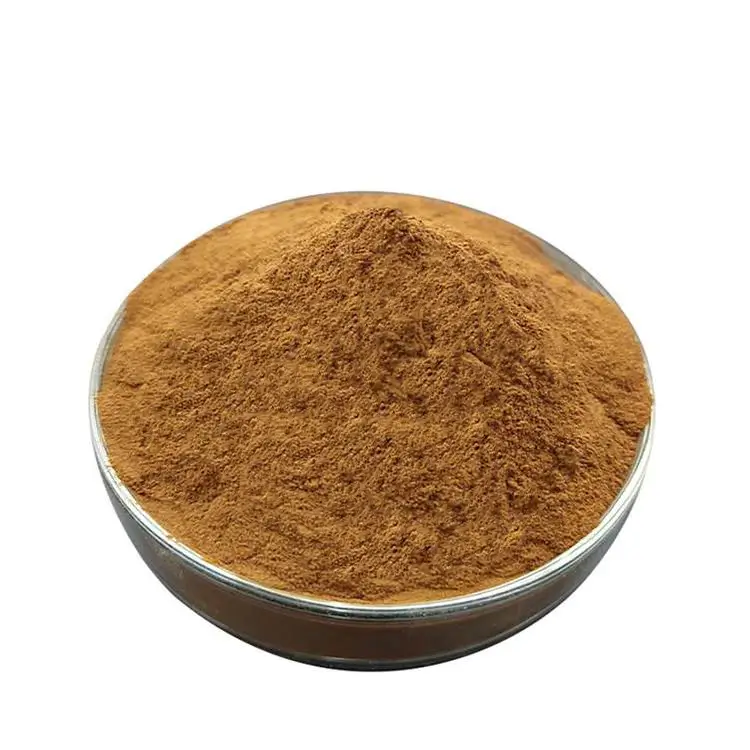
Bovine Kidney Powder may be used alone or blended with liver, heart, spleen, pancreas, and other bovine organs.
Product positioning should remain based on permitted nutritional or structure-function language. The source organ’s function in cattle should not be presented as proof that the finished supplement treats a human kidney disorder.
Bovine Spleen Powder
Bovine Spleen Powder is frequently considered for whole-food iron, women’s nutrition, and multi-organ formulas.
Brands planning to make statements about iron, vitamin B12, peptides, or trace minerals should request the relevant analytical testing. Organ identity alone does not establish a guaranteed nutrient level.
Bovine Pancreas Powder
Bovine Pancreas Powder is available for glandular capsules, tablets, custom blends, and specialized digestive-product concepts.
Whole pancreas powder should be distinguished from standardized pancreatin or isolated enzyme preparations. If enzyme activity is part of the product specification or marketing, appropriate activity assays and stability controls are required.
Bovine Adrenal Powder
Bovine Adrenal Powder can be supplied for single-ingredient glandular supplements or combined with other organ powders and complementary nutrients.
Because adrenal tissue may require market-specific safety and regulatory review, buyers should evaluate the processing method, composition, intended claim language, and destination-country requirements before finalizing the product.
Bovine Bone Marrow Powder
Bovine Bone Marrow Powder can be developed as a single ingredient, part of a nose-to-tail blend, or combined with collagen, cartilage, bone matrix, or other animal-derived materials.
The buyer should define whether the desired material is pure marrow, marrow with bone matrix, a cartilage-containing blend, an extract, or a hydrolyzed peptide product. These are not interchangeable ingredients.
Porcine Organ Powders
Porcine tissues may offer different technical, economic, or formulation advantages compared with bovine materials.
Available porcine products may include:
- Porcine liver powder
- Porcine heart powder
- Porcine kidney powder
- Porcine spleen powder
- Porcine pancreas powder
- Porcine thyroid powder
- Porcine thymus powder
- Porcine stomach powder
- Porcine intestine powder
- Porcine bone marrow powder
- Porcine gastric mucin powder
- Porcine blood and plasma ingredients
- Porcine reproductive tissue powders
Species choice can affect consumer acceptance, religious suitability, import requirements, product positioning, and raw material cost. Porcine ingredients should be clearly declared and should not be substituted for bovine materials without buyer approval.
Sheep, Deer, Poultry and Other Animal Sources
Ovine, cervine, poultry, equine, and other animal-derived powders may support specialized formulas or region-specific product concepts.
Before selecting a less common species, buyers should assess:
- Raw material availability
- Batch consistency
- Species verification
- Consumer familiarity
- Target-market acceptability
- Religious restrictions
- Import requirements
- Documentation
- Minimum production quantity
- Long-term supply continuity
Specialty species may create stronger differentiation, but they can also increase sourcing and regulatory complexity.
Single-Organ vs. Multi-Organ Supplements
The choice between a single-organ formula and a multi-organ supplement has implications for brand positioning, serving size, manufacturing, testing, cost, and consumer understanding.
Advantages of Single-Organ Products
Single-organ supplements offer:
- A clear ingredient story
- Simpler labels
- Easier raw material qualification
- More serving-weight space for one organ
- Easier product-line expansion
- More straightforward cost calculations
- Fewer blend-uniformity concerns
A brand may begin with beef liver capsules and later expand into heart, kidney, spleen, pancreas, adrenal, and bone marrow products.
Advantages of Multi-Organ Formulas
Multi-organ products can offer:
- Broader nose-to-tail positioning
- Strong product differentiation
- Several organ ingredients in one SKU
- A more comprehensive ancestral-nutrition concept
- Greater potential for proprietary ratios
- Increased perceived value
However, multi-organ formulas are more complex. Each additional ingredient affects:
- Blend uniformity
- Raw material qualification
- Powder density
- Capsule fill
- Serving size
- Testing
- Label space
- Cost
- Supply-chain risk
Selecting Organ Ratios
There is no universal ideal organ ratio.
A formula should be based on:
- Product positioning
- Intended serving size
- Capsule size
- Capsule count
- Powder density
- Ingredient availability
- Target cost
- Label simplicity
- Market expectations
- Claims strategy
- Manufacturing feasibility
Before confirming the Supplement Facts panel, a pilot blend should be evaluated for density, flow, capsule fill, color, odor, and uniformity.
Selecting the Animal Species and Raw Material Source
Animal species and organ identity are fundamental quality attributes.
A serious specification should identify:
- Species
- Organ or tissue
- Country of origin
- Processing location
- Raw material collection controls
- Slaughterhouse status
- Veterinary supervision
- Traceability method
- Drying method
- Defatted or non-defatted status
- Added carriers or excipients
- Microbiological controls
- BSE or TSE status where relevant
Unicorns Biotechnology states that its raw glandular materials are sourced from government-certified slaughterhouses under the control of official veterinary authorities in China. The company also describes BSE-free, pesticide-free, antibiotic-free, and non-GMO documentation for its glandular ingredients. These statements should still be confirmed against the current specification, applicable certificate, and selected production batch before being used on a finished-product label.
Grass-Fed and Pasture-Raised Claims
Grass-fed, pasture-raised, regenerative, hormone-free, antibiotic-free, and similar sourcing claims can strengthen premium positioning, but they require evidence.
Buyers should ask:
- What does the supplier mean by grass-fed?
- Is the claim farm-specific or regional?
- Is documentation available for each batch?
- Is the animal exclusively grass-fed or only partially grass-fed?
- Does the documentation cover the exact raw material?
- Can the claim be used legally in the destination market?
Do not treat a general supplier statement as automatic authorization to print a sourcing claim on every finished-product label.
Ethical and Sustainable Sourcing
Organ supplement brands may position their products around fuller utilization of animal materials that would otherwise be underused.
A responsible sourcing review may include:
- Slaughterhouse approval
- Veterinary inspection
- Species traceability
- Animal welfare policies
- By-product utilization
- Environmental controls
- Waste handling
- Energy use
- Packaging materials
- Supplier-code compliance
Sustainability claims should be specific, measurable, and supported by supply-chain evidence.
Freeze-Dried, Spray-Dried, Desiccated or Hydrolyzed?
The processing method affects powder characteristics, cost, stability, composition, and formulation performance.
Freeze-Dried Organ Powder
Freeze-drying, also called lyophilization, freezes the material and removes water by sublimation under vacuum.
Potential advantages include:
- Lower product temperatures during water removal
- Premium market positioning
- Suitability for certain whole-organ tissues
- Porous powder structure
- Potentially reduced thermal damage to selected sensitive components
Commercial considerations include:
- Longer processing cycles
- Higher production cost
- Lower bulk density
- Larger packaging volume
- Potentially less predictable powder flow
- Additional milling after drying
Spray-Dried Organ Powder
Spray-drying converts a liquid feed, extract, slurry, or hydrolysate into powder through atomization and rapid evaporation.
Potential advantages include:
- Continuous high-volume processing
- More uniform particles
- Higher bulk density
- Better flow in many applications
- Lower manufacturing cost at scale
- Suitability for extracts and protein hydrolysates
Buyers should ask what occurred before spray-drying. Extraction, filtration, hydrolysis, fat removal, concentration, and carrier addition may change the composition more than the drying stage alone.
Desiccated Organ Powder
“Desiccated” broadly means dried, but it does not explain how the ingredient was dried.
A buyer should clarify whether the material is:
- Freeze-dried
- Spray-dried
- Air-dried
- Vacuum-dried
- Drum-dried
- Low-temperature dehydrated
- Extracted before drying
- Defatted before drying
The processing flowchart is more informative than the word “desiccated” alone.
Hydrolyzed Organ Peptides
Hydrolysis breaks organ proteins into smaller peptides.
Hydrolyzed products may offer:
- Improved dispersibility
- Different solubility characteristics
- Suitability for sachets or powdered beverages
- Specialized peptide positioning
- Potentially easier formulation in certain applications
However, whole organ powder and hydrolyzed organ peptide powder are different products. Buyers should evaluate:
- Degree of hydrolysis
- Molecular-weight distribution
- Protein content
- Peptide content
- Enzyme used
- Residual enzyme controls
- Filtration
- Carrier content
- Flavor and odor
- Microbiological limits
- Target application
Defatted vs. Non-Defatted Organ Powders
Fat content affects organ powder stability, sensory properties, flow, capsule filling, and nutritional positioning.
Non-Defatted Organ Powder
A non-defatted powder retains more of the organ’s naturally occurring lipid fraction.
Possible advantages include:
- Whole-organ positioning
- Retention of naturally occurring lipids
- Less processing
- Broader tissue matrix
Possible challenges include:
- Stronger odor
- Higher oxidation sensitivity
- Reduced flow
- Greater variability
- Shorter shelf-life risk if not properly controlled
- More demanding packaging requirements
Defatted Organ Powder
A defatted powder has some lipid material removed.
Possible advantages include:
- Improved flow in some formulations
- Better oxidative stability
- Reduced odor
- Easier blending
- More predictable capsule production
Possible disadvantages include:
- Changed nutritional composition
- Additional processing
- Potential solvent concerns, depending on the process
- Weaker whole-organ positioning
Buyers should ask how the material was defatted, whether solvents were used, what the final fat specification is, and whether oxidation markers are monitored.
Neither option is universally better. The right choice depends on the intended formula, label position, manufacturing method, shelf life, and target cost.
Is the Powder 100% Organ Material?
A product called organ powder may contain more than organ tissue.
Depending on the manufacturing process, it may include:
- Maltodextrin
- Modified starch
- Gum arabic
- Silicon dioxide
- Anti-caking agents
- Flow agents
- Antioxidants
- Preservatives
- Processing aids
- Standardizing ingredients
- Capsule excipients
The buyer should distinguish among:
- Pure whole organ powder
- Organ powder with drying carrier
- Standardized organ blend
- Glandular extract
- Organ protein hydrolysate
- Organ peptide powder
- Finished manufacturing premix
A carrier may be technically necessary for some spray-dried extracts, but it should be declared and included in the specification.
For clean-label private label glandular supplements, request written confirmation of all added ingredients and processing aids.
Specifications B2B Buyers Should Confirm
A robust organ powder specification should go beyond appearance and moisture.
Identity and Traceability
Confirm:
- Product name
- Scientific or common animal species
- Exact organ or tissue
- Country of origin
- Processing country
- Raw material source
- Lot numbering
- Traceability method
- BSE or TSE status where applicable
- GMO status
- Irradiation status
Physical Specifications
Important physical characteristics include:
- Appearance
- Color
- Odor
- Particle size
- Bulk density
- Tapped density
- Moisture or loss on drying
- Water activity
- Flowability
- Solubility or dispersibility
Chemical and Compositional Tests
Depending on the product, buyers may request:
- Protein
- Fat
- Ash
- Amino acid profile
- Iron
- Vitamin B12
- Vitamin A
- Mineral profile
- Peptide content
- Enzyme activity
- Oxidation markers
- Relevant organ-specific analytical markers
A claim should not be based solely on the expected composition of fresh organ meat. The finished powder should be tested using an appropriate analytical method.
Microbiological Specifications
Typical microbiological controls may include:
- Total aerobic microbial count
- Yeast and mold
- Coliforms
- Enterobacteriaceae
- Escherichia coli
- Salmonella
- Staphylococcus aureus
- Other market-specific organisms
Limits should reflect the destination market, dosage form, intended consumer, and buyer standard.
Contaminant Testing
A testing plan may include:
- Lead
- Arsenic
- Cadmium
- Mercury
- Pesticide residues
- Veterinary drug residues
- Residual solvents
- Mycotoxins where relevant
- Dioxins or PCBs where required
- Other destination-market contaminants
Testing every possible parameter on every batch may not be commercially necessary. A risk-based plan can combine supplier qualification, periodic testing, and batch-specific release tests.
Why Bulk Density and Particle Size Matter
Bulk density is one of the most overlooked factors in organ supplement formulation.
Two powders with the same weight can occupy very different volumes. A low-density freeze-dried powder may require a larger capsule, more capsules per serving, or a larger bottle than a denser spray-dried powder.
Bulk density can influence:
- Capsule size
- Fill weight
- Capsules per serving
- Bottle count
- Bottle size
- Packaging cost
- Shipping cost
- Consumer convenience
- Product margin
Particle size affects:
- Powder flow
- Dust generation
- Blend uniformity
- Segregation risk
- Encapsulation speed
- Tablet compression
- Mouthfeel
- Dispersibility
- Finished-product appearance
An ingredient should not be approved only because it passes chemical and microbiological specifications. It must also perform in the buyer’s manufacturing process.
For a multi-organ formula, the contract manufacturer should test the actual combined blend rather than assuming that each powder will behave the same way after mixing.
Finished Product Formats
Capsules
Capsules are the most common format for private label organ supplements because they reduce exposure to the characteristic taste and odor of organ powders.
Options may include:
- Gelatin capsules
- HPMC capsules
- Pullulan capsules
- Different capsule sizes
- Natural or opaque capsule colors
- Printed capsules
- Bottles or blister packs
A plant-derived capsule shell does not make an organ supplement vegetarian or vegan. Label language should remain clear.
Tablets
Tablets can provide higher production efficiency and compact packaging, but organ powders may not compress well without formulation support.
Tablet development may require:
- Binders
- Lubricants
- Flow agents
- Disintegrants
- Compression trials
- Hardness testing
- Friability testing
- Disintegration testing
- Coating
Brands seeking an additive-free product should evaluate whether tablet production is compatible with that claim.
Powder Blends and Sachets
Loose powders and sachets can deliver larger serving weights than capsules, but they expose consumers to the product’s flavor, odor, color, and dispersibility.
Powder formulas may require:
- Flavor masking
- Improved dispersibility
- Agglomeration
- Anti-caking controls
- Moisture-resistant packaging
- Serving scoops
- Sachet filling trials
Softgels and Other Formats
Softgel feasibility depends on fat content, suspension behavior, particle size, fill volume, and stability.
Gummies and beverages are not automatically suitable for whole organ powders. Strong taste, odor, color, solubility, heat exposure, water activity, and consumer acceptance should be evaluated before these formats are offered.
The Private Label Organ Supplement Development Process
Step 1: Define the Product Concept
The buyer should define:
- Target consumer
- Target market
- Sales channel
- Product position
- Animal species
- Single-organ or multi-organ concept
- Dosage form
- Target serving size
- Capsule count
- Packaging format
- Expected retail price
- Initial order quantity
- Target launch date
A clear product brief reduces formulation revisions and quotation delays.
Step 2: Select the Organ Powders
The buyer and supplier evaluate:
- Species
- Tissue identity
- Drying method
- Defatted or non-defatted status
- Carrier content
- Particle size
- Bulk density
- Documentation
- Availability
- Cost
Step 3: Develop or Review the Formula
Formula development should consider:
- Organ ratios
- Intended serving weight
- Capsule size
- Number of capsules per serving
- Added nutrients
- Excipients
- Sensory properties
- Stability
- Claims
- Cost per bottle
A startup may benefit from a simpler first formula. Established brands may prioritize differentiation and proprietary organ ratios.
Step 4: Review Samples and Documents
The buyer should evaluate both the material and its supporting documents.
Sample review may include:
- Color
- Odor
- Texture
- Particle size
- Flow
- Dispersibility
- Capsule-filling behavior
- Blend compatibility
Document review may include:
- COA
- Specification
- MSDS or SDS
- Process flowchart
- Animal-origin statement
- Allergen statement
- Non-GMO statement
- BSE or TSE statement
- Third-party laboratory results
Step 5: Confirm the Quotation and MOQ
The quotation should define:
- Ingredient or formula
- Quantity
- Dosage form
- Capsule material
- Units per bottle
- Bottle and closure
- Label
- Carton
- Testing
- Documents
- Incoterm
- Payment terms
- Production lead time
- Shipping destination
A price per kilogram alone does not show the complete cost of a finished private label product.
Step 6: Produce a Pilot Sample
A pilot or pre-production sample helps confirm:
- Formula appearance
- Capsule fill
- Capsule count
- Tablet dimensions
- Bottle fit
- Label dimensions
- Powder flow
- Odor
- Packaging presentation
The sample should represent the intended commercial formula as closely as possible.
Step 7: Approve the Label and Packaging
The buyer should verify:
- Product name
- Statement of identity
- Serving size
- Supplement Facts
- Ingredient list
- Allergen declarations
- Directions
- Warnings
- Net contents
- Responsible company information
- Lot coding
- Expiration coding
- Country-of-origin requirements
- Claims
- Barcode
- Final artwork
The manufacturer may provide technical information and packaging templates, but the brand owner should obtain appropriate regulatory review for the destination market.
Step 8: Commercial Manufacturing
A typical production flow may include:
- Raw material receiving
- Quarantine
- Document and identity review
- Weighing
- Blending
- Encapsulation, tableting, or powder filling
- In-process checks
- Bottle or sachet filling
- Labeling
- Lot coding
- Finished-product testing
- Quality release
- Export packing
The Unicorns Biotechnology animal glandular powder factory includes raw material preparation, controlled drying, milling, sieving, blending, microbial control, clean packaging, laboratory testing, and traceability systems.
Step 9: Finished-Product Testing and Release
The release plan may include:
- Identity
- Formula verification
- Fill weight
- Capsule count
- Tablet weight
- Microbiological testing
- Heavy metals
- Moisture
- Packaging inspection
- Label reconciliation
- Finished-product COA
Additional tests should be selected according to the formula, claims, and target market.
Step 10: Export and Delivery
International projects may require:
- Commercial invoice
- Packing list
- Certificate of origin
- COA
- Health or veterinary documentation where applicable
- Ingredient statements
- Customs classification
- Shipping marks
- Pallet documents
- Import permits
- Destination-country certificates
Import requirements for animal-derived materials can differ substantially from ordinary botanical powders. The buyer should confirm import eligibility before commercial production.
Quality Control for Animal-Derived Ingredients
Animal-derived ingredients require source-specific quality controls.
A supplier qualification program should cover:
- Approved slaughterhouse
- Veterinary supervision
- Animal species
- Exact tissue identity
- Raw material freshness
- Temperature controls
- Sanitation
- Cross-species contamination
- Cross-contact controls
- Drying conditions
- Microbial reduction
- Milling and sieving
- Packaging
- Warehousing
- Batch traceability
Species and Tissue Identity
A bovine kidney powder should be verified as bovine kidney, not merely accepted as an unspecified animal organ powder.
Depending on risk and product type, identity controls may involve:
- Supply-chain records
- Anatomical verification
- Microscopy
- Protein-based methods
- DNA methods
- Process records
- Supplier audits
BSE and TSE Risk
BSE and TSE controls are especially important for bovine-derived materials and certain tissues.
The sourcing country, animal health controls, slaughterhouse status, age of animal, tissue type, and intended market may affect acceptability.
High-risk tissues should not be treated the same as ordinary organs. Buyers should obtain product-specific documentation and destination-market advice.
Microbiological Control
Microbial risk can be influenced by:
- Raw material handling
- Processing delay
- Temperature
- Cleaning
- Drying
- Milling
- Environmental exposure
- Packaging
- Storage
A low-moisture powder is not automatically microbiologically safe. Each batch should be released against approved specifications.
Testing and Documents Buyers Should Request
A B2B buyer may request the following documents according to the product and market.
Product Documents
- Certificate of Analysis
- Product specification
- Technical Data Sheet
- SDS or MSDS
- Manufacturing flowchart
- Shelf-life statement
- Storage statement
- Packaging specification
- Sample label
- Finished-product COA
Source and Compliance Statements
- Animal-origin statement
- Country-of-origin statement
- BSE or TSE statement
- Non-GMO statement
- Allergen statement
- Irradiation statement
- Antibiotic statement
- Pesticide statement
- Hormone statement where applicable
- Carrier and excipient declaration
Factory and Quality Documents
- Business license
- Manufacturing license
- GMP documentation
- HACCP documentation
- ISO or food-safety certificates
- Halal certificate
- Kosher certificate
- FDA facility registration where applicable
- Audit reports where available
- Third-party laboratory reports
Certificate availability should be confirmed for the specific factory, product, process, and shipment. A certificate associated with one production line should not automatically be represented as covering every organ ingredient or finished dosage form.
Regulatory and Labeling Considerations
Organ supplement requirements differ by country, animal species, tissue type, dosage form, claim, and intended consumer.
United States
Dietary supplement manufacturers, packers, labelers, and holders serving the United States should evaluate the requirements of 21 CFR Part 111. FDA’s dietary supplement CGMP framework includes specifications, quality-control operations, master manufacturing records, batch records, packaging controls, traceability, and reserve-sample requirements.
FDA identifies five core statements for dietary supplement labels:
- Statement of identity
- Net quantity of contents
- Nutrition labeling or Supplement Facts
- Ingredient list
- Name and place of business of the manufacturer, packer, or distributor
Brands should also distinguish among health claims, nutrient-content claims, and structure-function claims. Disease-treatment claims can cause a supplement to be regulated as an unapproved drug.
European Union
Food supplement rules and animal-origin import controls should both be reviewed for products intended for the European Union.
Products of animal origin may be subject to animal health requirements, approved-country rules, official controls, and border checks.
The acceptability of a finished supplement should not be assumed only because the raw material can be sold in another country.
Other Markets
Canada, the United Kingdom, Australia, New Zealand, Southeast Asia, the Middle East, and other markets may apply different requirements to:
- Animal species
- Import certificates
- Glandular tissues
- Novel ingredients
- Product claims
- Label wording
- Religious certification
- Registration
- Testing
The target market should be identified before the formula and packaging are finalized.
From Ingredient Benefits to Compliant Claims
A source organ’s biological role in an animal does not prove that consuming the organ powder will reproduce the same function in humans.
Brands should distinguish among:
- Measured composition
- Traditional use
- General nutritional positioning
- Structure-function claims
- Nutrient-content claims
- Health claims
- Disease claims
| Proposed statement | Evidence needed | Relative risk |
|---|---|---|
| Made with bovine liver powder | Species and tissue documentation | Lower |
| Contains naturally occurring protein | Finished-product composition testing | Lower |
| Grass-fed bovine source | Supply-chain documentation | Medium |
| Provides a stated amount of iron | Validated finished-product assay | Medium |
| Supports normal energy metabolism | Ingredient and claim substantiation | Medium |
| Treats anemia, thyroid disease, or adrenal disease | Drug-level evidence and authorization | High or prohibited |
Claims should be reviewed against the laws of the market where the product will be sold.
Managing Taste, Odor and Capsule Count
Organ powders have characteristic sensory properties. These can affect reviews, repeat purchases, returns, and overall product success.
Common challenges include:
- Strong animal odor
- Dark or variable color
- Capsule aftertaste
- Bottle odor after opening
- High capsule count
- Powder clumping
- Fat oxidation
- Low bulk density
- Poor dispersibility
Potential solutions include:
- Selecting a suitable processing method
- Using capsules instead of loose powder
- Adjusting particle size
- Optimizing serving weight
- Using opaque capsules
- Selecting protective packaging
- Adding an induction seal
- Using a desiccant where suitable
- Conducting pilot sensory testing
- Evaluating the product after storage
- Controlling fat oxidation
A technically compliant product may still fail commercially if consumers find the odor unacceptable or must take an impractical number of capsules.
Calculating Commercial Viability and Unit Economics
A low raw material price does not always produce the lowest finished-product cost.
Unit economics should include:
- Organ powder cost
- Formula loss allowance
- Capsule shell
- Excipients
- Blending
- Encapsulation or tableting
- Bottle
- Closure
- Induction seal
- Desiccant
- Label
- Carton
- Testing
- Quality release
- Freight
- Customs duties
- Import fees
- Warehousing
- Fulfilment
- Distributor margin
- Retailer margin
- Promotional allowances
- Customer acquisition
- Returns
Why Density Changes Product Cost
A lower-density powder may require:
- A larger capsule
- More capsules per serving
- More capsules per bottle
- A larger bottle
- A larger carton
- Higher shipping volume
Therefore, a more expensive powder per kilogram could still produce a more economical finished product if it has better flow, higher density, and more efficient capsule filling.
Target Margin Planning
Before confirming production, the brand should estimate:
- Manufacturing cost per bottle
- Landed cost
- Wholesale price
- Distributor price
- Retail price
- Gross margin
- Marketing cost
- Net contribution
This calculation should be completed before investing in custom packaging or a large production batch.
MOQ, Lead Time and Scale-Up
MOQ depends on the type of project.
Different minimums may apply to:
- Bulk organ powder
- Custom powder blend
- Capsules
- Tablets
- Sachets
- Custom bottle colors
- Printed cartons
- Custom labels
- Proprietary formulas
- Third-party testing
A startup may reduce initial risk by using an existing bottle, standard capsule, digital labels, and a focused formula.
Lead-Time Components
Total lead time may include:
- Product brief review
- Formula development
- Raw material sourcing
- Sample production
- Testing
- Packaging procurement
- Commercial manufacturing
- Finished-product release
- Export booking
- International shipment
The stated manufacturing lead time should not be confused with the entire project timeline.
Scale-Up Planning
Brands should plan:
- Initial trial quantity
- Reorder point
- Safety stock
- Sales forecast
- Packaging inventory
- Raw material reservation
- Seasonal promotions
- Forecast sharing
- Production-capacity booking
- Alternative suppliers or materials
A successful launch can create a supply problem if the manufacturer was not informed of the expected scale.
Packaging and Sales-Channel Strategy
Packaging should be selected according to the product’s sales channel.
Direct-to-Consumer Brands
DTC products may prioritize:
- Premium appearance
- Brand storytelling
- Subscription-friendly bottle count
- Protective shipping packaging
- Consumer education
- Strong differentiation
Amazon and Online Marketplaces
Marketplace products may require:
- Durable packaging
- Barcode compliance
- Fulfilment-compatible dimensions
- Tamper evidence
- Competitive bottle count
- Clear claims
- Careful odor and capsule-count management
Retail Products
Retail buyers may expect:
- Strong shelf presentation
- Printed cartons
- Case-pack requirements
- Longer shelf life
- Retailer margin
- Display-ready packaging
- Defined product dimensions
Practitioner Products
Practitioner channels may value:
- Detailed ingredient identity
- Technical documentation
- Smaller specialized SKUs
- Professional packaging
- Conservative claims
- Educational materials
Distributor and Importer Products
International distribution may require:
- Multilingual labels
- Neutral outer cartons
- Pallet specifications
- Regional barcodes
- Importer information
- Market-specific warnings
- Local registration support
Formula Ownership, Confidentiality and Exclusivity
Before beginning a custom organ supplement project, both parties should understand who owns the formula and related intellectual property.
A manufacturing agreement may address:
- Formula ownership
- NDA terms
- Confidentiality
- Artwork ownership
- Testing-data ownership
- Trademark ownership
- Exclusivity
- Geographic restrictions
- Minimum volumes
- Packaging-tool ownership
- Formula-transfer conditions
- Use of similar formulas for other clients
A private label product is not automatically exclusive. Exclusivity should be defined in writing, together with the volume, territory, product, and duration.
Quality Agreements and Change Control
Long-term buyers may require a quality agreement in addition to a commercial contract.
A quality agreement can define:
- Approved specification
- Test methods
- Sampling
- Release responsibilities
- Out-of-specification handling
- Deviation reporting
- Complaint investigation
- Retention samples
- Recall responsibilities
- Record retention
- Audit rights
- Change notification
Changes that may require buyer approval include:
- Animal source
- Slaughterhouse
- Species
- Tissue
- Drying method
- Processing facility
- Carrier
- Excipient
- Particle size
- Packaging
- Test method
- Contract laboratory
- Specification
A COA confirms selected results for a batch. It does not replace a long-term quality system.
Supply Continuity and Risk Management
Purchasing managers should evaluate whether the supplier can support the product after launch.
Questions to ask include:
- Is the animal material available year-round?
- Are multiple approved sources available?
- Can raw material be reserved?
- How much forecast notice is required?
- Is safety stock available?
- What happens if one slaughterhouse becomes unavailable?
- Can the same drying method be maintained?
- Are packaging materials dual-sourced?
- Will the buyer receive change notifications?
- Can batch-to-batch sensory variation be controlled?
- Is an alternative specification available?
Specialty animal tissues may have less predictable availability than bovine liver or heart. Product-line planning should reflect this risk.
Building an Organ Supplement Product Line
A nutraceutical startup does not need to launch every possible organ product at once.
Phase 1: Launch a Hero Product
A first product may be:
- Beef liver capsules
- Five-organ bovine blend
- Nose-to-tail organ complex
- Beef liver powder
The hero product should have a clear story, manageable serving size, reliable supply, and practical manufacturing cost.
Phase 2: Add Organ-Specific Products
The brand can expand into:
- Heart
- Kidney
- Spleen
- Pancreas
- Adrenal
- Bone marrow
Using common bottle sizes, capsule types, and label dimensions can reduce packaging complexity.
Phase 3: Develop Specialized Formulas
Possible line extensions include:
- Men’s multi-organ formula
- Women’s organ nutrition formula
- Practitioner glandular complex
- Organ plus collagen blend
- Heme iron organ formula
- Hydrolyzed organ peptide blend
- Pet organ nutrition powder
Each extension should have a distinct purpose rather than repeating the same formula under a different name.
How Unicorns Biotechnology Supports Different Buyers
Support for Startup Brands
Unicorns Biotechnology can assist with:
- Organ powder selection
- Formula concepts
- Sample supply
- Custom blends
- Capsule and tablet options
- Packaging selection
- MOQ planning
- Quality documents
- Export support
Support for Established Supplement Brands
Established brands may require:
- Buyer-owned specifications
- Custom organ ratios
- Supplier qualification
- Third-party testing
- Product-line extensions
- Confidential formulas
- Repeat production
- Forecast-based supply
- Custom packaging
Support for Contract Manufacturers and CDMOs
Contract manufacturers can source:
- Bulk bovine organ powders
- Bulk porcine glandular powders
- Sheep and deer ingredients
- Custom particle sizes
- Pre-blended organ premixes
- Manufacturing-scale packaging
- Technical documents
- Batch-specific COAs
Support for Distributors and Importers
Distributor services may include:
- Broad product selection
- Factory-direct bulk supply
- Sample support
- Neutral packaging
- Consolidated shipments
- Export documentation
- Custom specifications
- Repeat-order planning
Why Choose Unicorns Biotechnology?
Specialized Animal-Derived Ingredient Manufacturing
Unicorns Biotechnology focuses on glandular powders, glandular extracts, animal peptide powders, bile-derived ingredients, cholesterol derivatives, and related animal-origin raw materials rather than treating organ powders as a minor product category.
Broad Organ Powder Portfolio
Available categories include bovine, porcine, sheep, deer, horse, chicken, duck, goose, and other animal-derived powders.
Factory-Based Processing
The company’s documented manufacturing capabilities include:
- Raw material preparation
- Controlled drying
- Milling
- Sieving
- Blending
- Microbial control
- Clean packaging
- Quality-control testing
- Batch traceability
Flexible Processing Options
Depending on the ingredient and project, buyers can discuss:
- Freeze-dried powders
- Spray-dried powders
- Desiccated materials
- Defatted or non-defatted powders
- Hydrolyzed organ peptides
- Custom mesh size
- Custom blends
Bulk and Finished-Product Services
Unicorns Biotechnology supports bulk ingredient supply as well as OEM and private label solutions, including custom formulation, blending, capsule filling, tablet production, bulk packaging, and finished branded packaging. These capabilities are described across its current bovine organ product pages.
Quality and Export Documents
Depending on the project, available documents may include:
- COA
- Specification
- MSDS
- Process flowchart
- Allergen statement
- Non-GMO statement
- Animal-origin statement
- BSE or TSE statement
- Third-party test report
- Packing list
- Commercial invoice
- Certificate of origin
Sample and Customization Support
Buyers can request samples, technical documents, custom particle size, bulk packaging, private label packaging, and project-specific testing before confirming commercial production.
How to Evaluate an Organ Supplement Manufacturer
Use the following checklist when comparing suppliers:
- Is the company a manufacturer or trader?
- Can it identify the exact animal species?
- Can it identify the exact organ or tissue?
- Is the raw material traceable?
- Is it sourced from an approved slaughterhouse?
- Is veterinary documentation available?
- Which drying method is used?
- Is the powder defatted or non-defatted?
- Are carriers or excipients added?
- Can particle size be customized?
- Is bulk density available?
- Are microbiological specifications defined?
- Are heavy metals controlled?
- Is BSE or TSE documentation available?
- Can third-party testing be arranged?
- Are samples representative of commercial production?
- Can the supplier provide bulk powder and finished products?
- Can it produce custom multi-organ blends?
- What are the MOQ and lead time?
- Can it support recurring orders?
- Will it provide change notifications?
- Can it sign an NDA?
- Who owns the custom formula?
- Can the facility be audited?
- What happens if a batch fails specification?
The lowest quoted price should not be the only selection criterion. Supplier transparency, product identity, manufacturing compatibility, documentation, and supply continuity directly affect the buyer’s commercial risk.
Information Needed for an Accurate Quotation
To receive a useful private label organ supplement quotation, provide:
- Company name
- Company website
- Target country
- Product concept
- Preferred animal species
- Required organs
- Single-organ or multi-organ formula
- Desired organ ratios
- Dosage form
- Serving size
- Capsule size
- Capsules per serving
- Units per bottle
- Packaging style
- Expected order quantity
- Required testing
- Required certificates
- Target wholesale cost
- Target launch date
- Delivery address or port
- Preferred Incoterm
The more complete the product brief, the more accurately the manufacturer can assess feasibility, MOQ, price, and lead time.
Frequently Asked Questions About Private Label Organ Supplements
What is the difference between bulk organ powder supply and private label manufacturing?
Bulk supply means the buyer purchases organ powder or a custom blend for manufacturing elsewhere. Private label manufacturing includes some or all of the finished-product steps, such as formulation, blending, encapsulation, tableting, packaging, labeling, testing, and export.
Can Unicorns Biotechnology manufacture single-organ supplements?
Yes. Single-organ products may include bovine liver, heart, kidney, spleen, pancreas, adrenal, thymus, thyroid, bone marrow, and other animal-derived powders. The available format and specification should be confirmed for each project.
Can Unicorns Biotechnology create a multi-organ formula?
Yes. Buyers can discuss custom combinations and ratios using bovine, porcine, sheep, deer, poultry, or other animal-derived ingredients. Formula feasibility depends on density, capsule size, serving weight, raw material availability, target cost, and regulatory requirements.
Are freeze-dried and spray-dried organ powders available?
Both methods are available for various products. The appropriate method depends on the raw material, desired product position, powder characteristics, order volume, and budget.
Does freeze-dried always mean better quality?
No. Freeze-drying reduces thermal exposure and can support premium whole-organ positioning, but finished-product quality also depends on raw material handling, pretreatment, milling, moisture, oxidation, microbial control, packaging, storage, and testing.
Are Unicorns Biotechnology organ powders 100% pure?
Pure organ powder options can be discussed, but buyers should confirm the specification for the selected product. Spray-dried extracts and hydrolysates may require carriers, while finished capsules or tablets may contain manufacturing excipients.
Can you supply defatted and non-defatted powders?
Availability depends on the specific organ and project. Buyers should specify the desired fat content, processing restrictions, oxidation limits, and label positioning.
What is the MOQ for bulk organ powder?
MOQ varies by product, processing method, packaging, specification, and stock availability. Standard bulk powders may have a different MOQ from custom blends or specially processed materials.
What is the MOQ for private label capsules?
The MOQ depends on the formula, capsule type, bottle, label, carton, testing, and customization level. Standard components usually allow more flexibility than custom packaging.
Can startup brands place a smaller first order?
Trial-order options may be available depending on the product and packaging. Using a standard bottle, standard capsule, and simpler formula can make a startup project more practical.
Can I request a sample?
Samples can be requested for technical evaluation. The buyer should confirm whether the sample comes from a current commercial batch and whether the commercial material will follow the same specification.
What documents are available?
Documents may include a COA, specification, MSDS, flowchart, animal-origin statement, allergen statement, non-GMO statement, BSE or TSE statement, and third-party testing. Availability should be confirmed for the selected product.
Can third-party testing be arranged?
Yes, testing can be discussed according to the buyer’s target market and required parameters. The parties should confirm the laboratory, methods, sample handling, cost, and acceptance criteria in advance.
Can particle size and bulk density be customized?
Particle size can be adjusted for many ingredients. Bulk density may be influenced by the drying method, milling, fat content, and particle morphology. A target should be confirmed through trial production.
Can organ powders be manufactured in HPMC capsules?
Yes, HPMC shells may be used if the formula is compatible. However, the finished product remains animal-derived and should not be labeled vegetarian or vegan.
Are tablets available?
Tablet production may be available, but feasibility depends on compressibility, dose, excipients, tablet size, disintegration, and stability.
Can you provide bottles, labels, and cartons?
Private label projects can include bottle packaging, label application, cartons, lot coding, and export packaging. The buyer should approve all artwork and legal label content before production.
Can contract manufacturers purchase only raw materials?
Yes. Contract manufacturers and CDMOs can purchase individual organ powders, custom specifications, bulk packaging, or pre-blended glandular formulas.
Can distributors purchase neutral-packaged products?
Neutral bulk packaging can be discussed for distributors and importers. Packaging format depends on the product, density, shipment size, and destination requirements.
What affects the wholesale price?
Price is influenced by species, organ availability, drying method, fat content, particle size, formula complexity, testing, packaging, quantity, certification requirements, and shipping terms.
How long does private label manufacturing take?
The timeline includes formula review, raw material confirmation, sampling, packaging procurement, commercial production, testing, quality release, and shipment. Custom packaging and specialized testing can extend the schedule.
Can you ship internationally?
Unicorns Biotechnology supports international B2B shipments. The buyer should confirm that the selected animal-derived ingredient and finished product are eligible for import into the destination market.
Can Unicorns Biotechnology sign an NDA?
Confidentiality agreements can be discussed for custom formulas, buyer-owned specifications, and private label projects.
Can I obtain exclusivity?
Product or geographic exclusivity may be negotiated, but it should be defined in a written agreement with clear volume, territory, product, and duration requirements.
What is the typical shelf life?
Shelf life depends on the organ, fat content, moisture, processing method, packaging, and storage. The confirmed shelf life should be based on product-specific stability information rather than a generic organ-powder assumption.
How should organ powders be stored?
Most powders require sealed packaging, protection from moisture, heat, sunlight, contamination, and strong odors. Product-specific storage instructions should be stated in the specification and on the finished label where necessary.
Build Your Organ Supplement Brand with Unicorns Biotechnology
A successful private label organ supplement begins with more than an attractive brand concept. It requires verified animal origin, clear tissue identity, appropriate processing, manufacturing-compatible powder, practical serving size, quality testing, compliant packaging, reliable documentation, and long-term supply planning.
Unicorns Biotechnology helps dietary supplement brands, startup founders, purchasing managers, contract manufacturers, CDMOs, ingredient distributors, and international importers source bulk glandular powders and develop finished organ supplement products.
Project support can include:
- Bovine, porcine, sheep, deer, poultry, and other organ powders
- Freeze-dried and spray-dried options
- Single-organ and multi-organ formulas
- Custom particle sizes
- Custom powder blends
- Capsule and tablet manufacturing
- Private label packaging
- Bulk wholesale supply
- Product samples
- COA and technical documents
- Third-party testing support
- Export packaging and international shipment coordination
To receive a tailored proposal, send Unicorns Biotechnology your preferred animal species, selected organs, target formula, dosage form, serving size, estimated order quantity, packaging requirements, destination market, required tests, and target launch date.
Contact Unicorns Biotechnology to request organ powder samples, product specifications, bulk wholesale pricing, or a private label manufacturing quotation.