
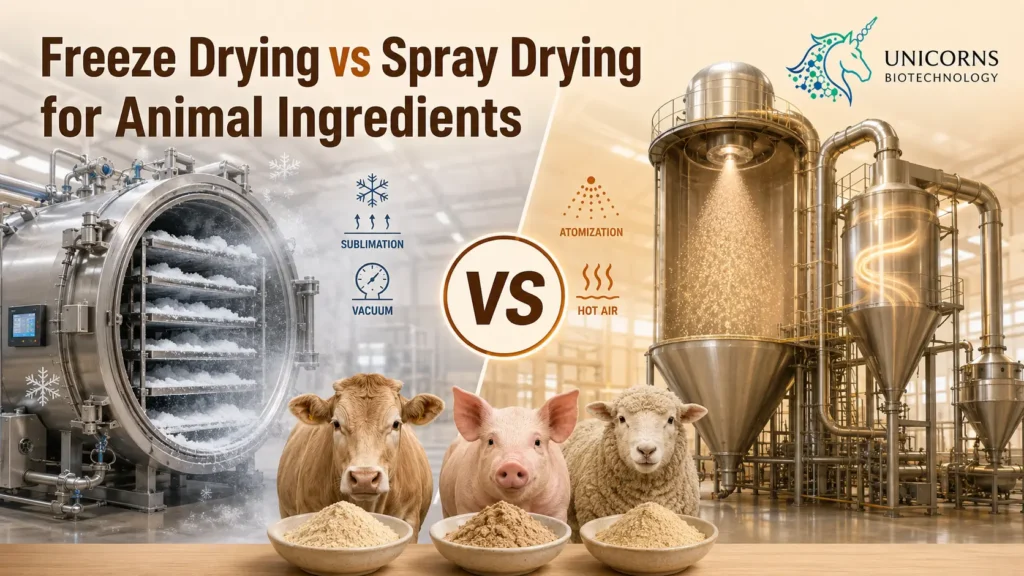
When you need to convert perishable animal tissues into stable, shippable powders, two drying technologies dominate the conversation: freeze drying vs spray drying. Both remove water and produce dry powders for large-scale powder production. These methods are pillars of industrial drying. In some specialized cases, manufacturers may spray freeze dry materials to combine the benefits of both drying technologies. This helps to optimize the processing time while preserving the structural integrity of the ingredient.
Yet they operate by different physical mechanisms and deliver powders with distinct functional profiles. The best method depends on your starting material and the dosage form you intend to supply. Selecting between a spray dryer vs freeze dryer often comes down to the sensitivity of heat-sensitive materials and other heat-sensitive products. Producers must also consider long-term scalability and the overall operational cost.
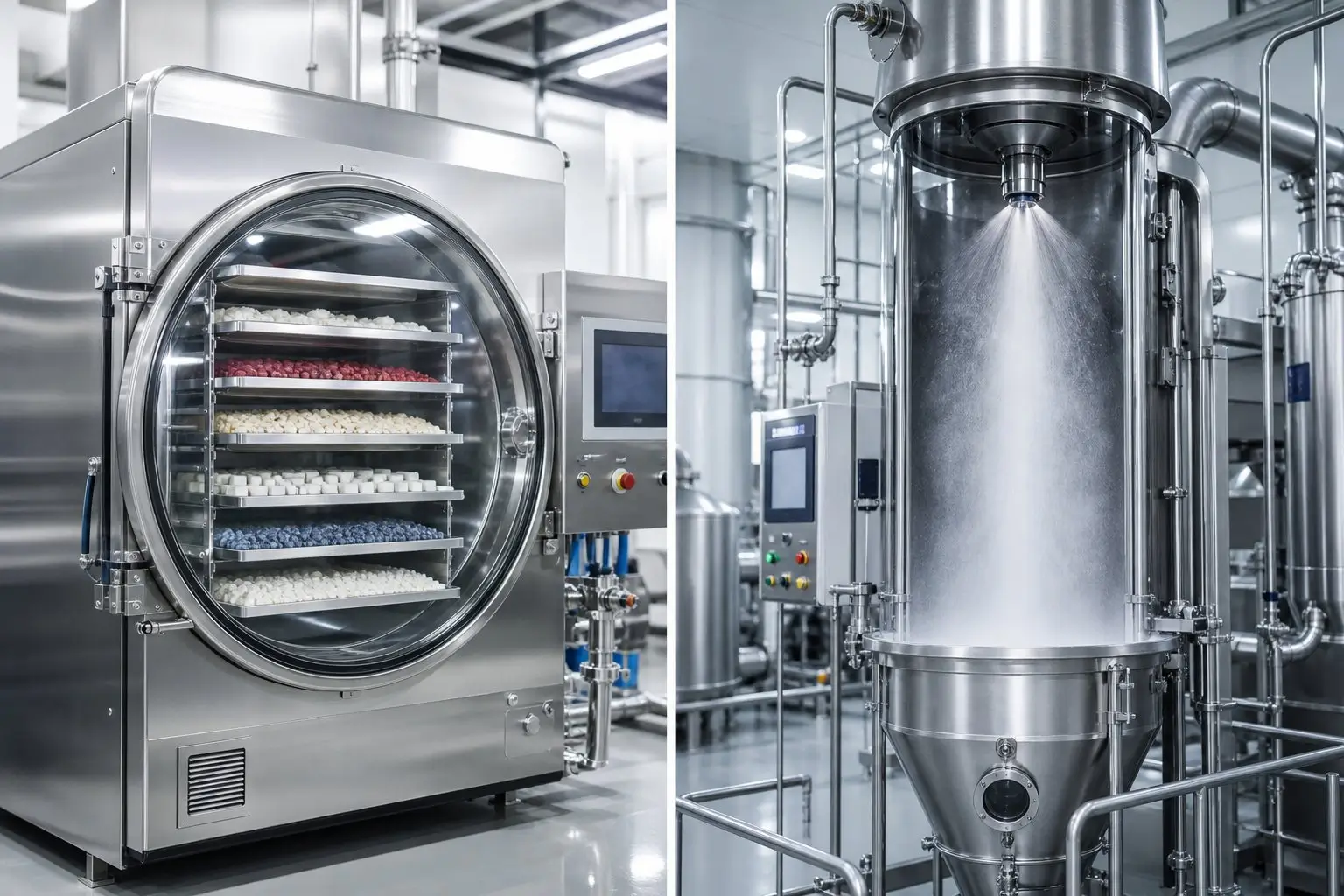
The freeze drying process removes frozen water through sublimation under vacuum. This makes it well suited to whole animal glandular powders and organ powders. It is also ideal for certain enzyme preparations and bioactive proteins.
Spray drying removes water rapidly from atomized liquid droplets. This is the standard choice for scalable production of liquid organ extracts, protein hydrolysates, and collagen peptides.
When evaluating spray drying vs freeze drying, it is important to note that neither process automatically guarantees superior nutrition. Finished-product testing is more reliable than the drying-method name alone.
Across these categories, the ingredient form matters as much as the drying step in industrial drying. A freeze-dried whole-organ powder and a spray-dried organ extract are not compositionally equivalent.
Extraction, hydrolysis, and concentration can introduce larger compositional differences than the drying method itself. These upstream steps define the final utility of the powder.
Unicorns Biotechnology manufactures bulk animal-derived ingredients, including glandular powders and animal peptide powders. We provide full traceability and export-ready documentation for global B2B buyers.
If you source these materials at commercial scale, reach out to Unicorns Biotechnology for specifications and COA documentation. We provide samples tailored to your specific product requirements.
Starting Material Comes Before Process Choice
The drying method matters less than what you feed into the dryer. A freeze-dried whole gland and a spray-dried glandular extract start from different material states.
They pass through different upstream processes and produce powders that differ in protein profile and fat content. These differences impact how high-value products are formulated for the end consumer.
Why Whole Tissue And Liquid Feed Are Not Equivalent Inputs
A bovine thyroid gland is a solid tissue with intact cellular architecture. A porcine liver extract is a filtered, concentrated liquid containing only the soluble fraction of the original organ.
When you dry these materials, the resulting powders are compositionally different before the dryer even starts. The upstream steps, not the drying step, created the gap.
Buyers who compare a freeze-dried whole-organ powder against a spray-dried organ extract are often making a sourcing error. They must account for the loss of insoluble fractions during extraction.
What Freeze Drying Can Process In Animal-Based Manufacturing
Freeze drying accepts a broad range of feed forms. You can load trays with sliced whole glands, minced organ tissue, tissue homogenates, or sensitive enzyme solutions.
This flexibility is a practical advantage when you need to retain the full tissue matrix. It preserves membrane-bound lipids and structural components that would be removed during filtration.
Low-temperature drying is the hallmark of this process. It protects delicate biological components from thermal degradation during the lengthy sublimation cycle.
What Spray Drying Usually Requires From A Feed System
Spray drying requires a pumpable liquid feed that can be atomized into fine droplets. This typically means liquid extracts, protein hydrolysates, or clarified suspensions.
A tissue homogenate can be spray-dried if it is sufficiently fluid. It is more accurate to say spray drying generally requires a pumpable feed than to say whole organs cannot be processed.
Feed-solids content and feed viscosity directly affect atomization quality. Too-high viscosity produces coarse particles that may not dry uniformly.
How Extraction, Hydrolysis, Filtration, And Carriers Change Composition
Before spray drying, you often extract, hydrolyze, filter, and concentrate the raw tissue. Extraction separates soluble from insoluble fractions, while hydrolysis breaks proteins into peptides.
Filtration removes particulates and lipids. Carrier addition, such as maltodextrin, dilutes the active fraction and changes the powder’s physical behavior.
When evaluating freeze-dried vs spray-dried animal ingredients, always compare the full process chain. The preparation steps are as critical as the final moisture removal.
How The Two Drying Systems Work
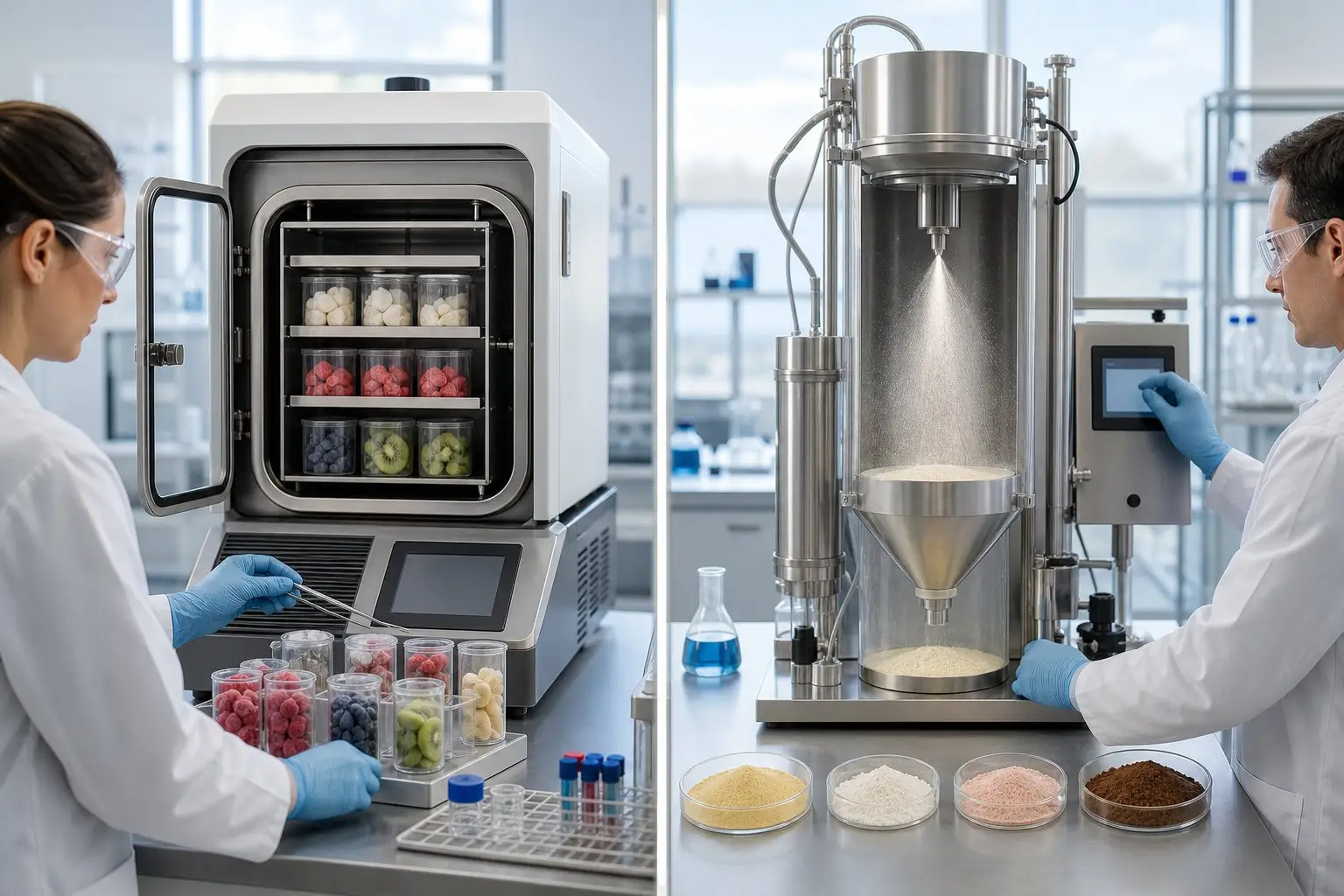
Freeze drying removes water by sublimation at low temperature and reduced pressure. Spray drying removes water by rapid evaporation from atomized droplets in hot gas.
The two drying technologies differ in heat exposure intensity, vacuum requirements, and residence time. Evaluating Freeze Drying vs Spray Drying reveals how the physical state of the material changes during moisture removal.
Freeze Drying As Lyophilization Under Vacuum
Freeze drying, also called lyophilization, follows a defined sequence. First, freezing locks water into ice crystals. The freezing rate controls the pore structure in the dried cake.
Primary drying applies a vacuum system, refrigeration systems, and gentle shelf heat. This allows ice to convert directly to vapor. The condenser collects this vapor while the refrigeration systems maintain the necessary low temperatures. During primary drying, the vapor moves toward the cold condenser, where it is frozen to prevent it from entering the vacuum pump. In some specialized setups, solvent recovery systems are integrated into the vacuum chain.
Secondary drying raises the temperature under continued vacuum to remove residual bound water. This step typically targets a final moisture level below 3%. This preservation method results in excellent rehydration properties, making it a preferred choice for ingredients that need to dissolve quickly.
A full cycle for animal tissue can take 24 to 72 hours. This longer processing time is a primary constraint of the batch-based lyophilization method. Researchers who spray freeze dry samples often do so to shorten the secondary drying phase.
Spray Drying Through Atomization And Rapid Evaporation
Spray drying is a continuous process. Liquid feed is atomized into droplets by a rotary atomizer or two-fluid nozzle. The operator must carefully control the feed rate. These droplets enter a drying chamber and contact a hot drying medium, usually air or nitrogen.
Modern spray drying equipment allows for rapid moisture removal. Moisture evaporates within seconds, and dried particles are separated from the exhaust air by a cyclone separator.
The residence time from atomization to powder collection is typically 5 to 30 seconds. This speed makes it ideal for high-volume, industrial-scale production. Continuous operation keeps the drying chamber at steady-state conditions.
Where Heat Exposure, Vacuum, And Residence Time Differ
| Parameter | Freeze Drying | Spray Drying |
|---|---|---|
| Water-removal mechanism | Sublimation under vacuum | Evaporation from atomized droplets |
| Product temperature during drying | Typically -40°C to +40°C | Droplet temperature typically 40–80°C |
| Processing time | Hours to days | Seconds to minutes |
| Production mode | Batch | Continuous |
| Vacuum required | Yes | No |
| Throughput | Lower | Higher |
Freeze drying exposes material to low temperatures for extended periods. Spray drying exposes material to high gas temperatures for very short periods.
Neither exposure is inherently benign. Both can alter sensitive biological materials in different ways depending on the specific sensitivity of the molecules.
Why Inlet Air Temperature Does Not Equal Product Temperature
A common misconception treats the spray dryer’s inlet temperature as the temperature experienced by the product. In practice, rapid evaporative cooling keeps the droplet surface temperature low.
The product’s actual thermal exposure depends on the outlet temperature and residence time. This is why spray drying can successfully process many heat-sensitive proteins without denaturation.
Side-By-Side Manufacturing And Quality Comparison
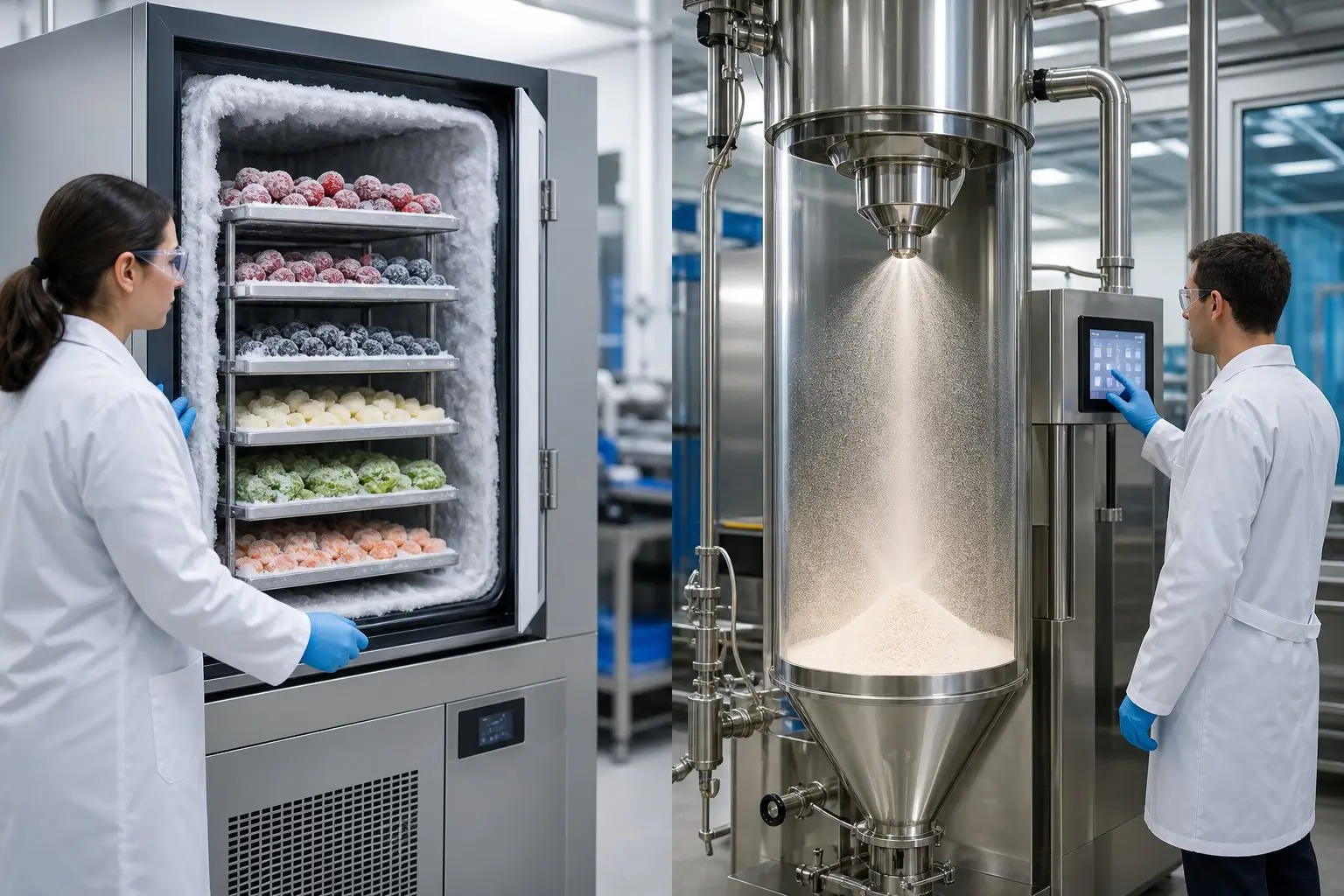
Freeze drying and spray drying diverge in production throughput and cost positioning. Analytical verification of the finished powder matters more than the name of the drying method.
Production Mode Throughput And Scale-Up Reality
Freeze drying is batch-based. Industrial freeze dryers can handle meaningful volumes, but throughput per unit of time is lower than spray drying.
Spray drying is continuous. Feed pumps in and powder comes out, allowing a single tower to process several tons of liquid feed per day.
For high-volume animal-derived ingredients like collagen peptides, spray drying is the standard choice. For premium whole glandular powders, freeze drying is commercially justified.
The higher energy consumption associated with freeze drying often dictates the price of the final ingredient. When comparing spray drying vs freeze drying, throughput is a key factor. Large-scale manufacturing usually favors the scalability and lower operational cost of spray drying systems. In contrast, the high equipment cost associated with an industrial freeze dryer often limits its use to smaller, premium batches. When planning a production facility, the initial equipment cost for a spray dryer is usually lower for a comparable volume of output.
Particle Structure Density And Flow Behavior
Freeze-dried material forms a porous, sponge-like cake that must be milled. The resulting particles are irregular in shape and relatively low in bulk density.
The powder morphology of spray-dried products is typically spherical or near-spherical, often resembling microspheres. These particles have higher bulk density and more predictable flow behaviors.
Spray drying allows for a controlled particle size distribution. This is a major advantage for large-scale powder production. This uniformity is advantageous for capsule filling and multi-ingredient blending. Many manufacturers use agglomeration techniques during the spray drying process to further improve the flowability and dissolution rate of the resulting powder.
| Property | Freeze-Dried Powder | Spray-Dried Powder |
|---|---|---|
| Particle shape | Irregular, angular | Spherical or near-spherical |
| Bulk density | Lower | Higher |
| Flowability | Often poorer | Often better |
| Packaging volume | Larger | Smaller |
| Rehydration | Often faster | Variable |
Cost Positioning Packaging Volume And Commercial Fit
Freeze drying costs more per kilogram due to longer cycles and high energy consumption. The porous powder also requires more packaging volume, increasing shipping costs.
Spray drying costs less at industrial scale. Continuous operation and denser particles reduce production and logistics expenses for bulk suppliers.
Premium positioning in dietary supplements can justify freeze-drying economics. For food ingredients and high-volume B2B supply, spray drying usually delivers better commercial ROI.
Why Analytical Verification Matters More Than Process Labels
Two powders labeled bovine liver powder can differ dramatically in protein and fat content. These differences occur regardless of whether they were freeze-dried or spray-dried.
Solubility and reconstitution are critical metrics for buyers to verify. The process name alone does not prove the final potency or functional bioactivity of the ingredient.
Always request a current COA and TDS. Compare specifications such as moisture, active markers, and particle size distribution to ensure the product meets your needs.
Process Parameters That Actually Change Results
Specific parameter choices create wide variation in powder quality within each drying method. Freezing rate and inlet temperature each influence protein integrity and particle behavior.
Controlling the glass transition temperature is also vital for powder stability. If the material exceeds this temperature during storage, it may cake or degrade.
Critical Freeze-Drying Variables For Tissue And Sensitive Materials
Freezing rate determines ice-crystal size. Rapid freezing creates smaller crystals, which can improve reconstitution but may increase surface area exposed to oxidation.
Product thickness on the tray directly controls drying time. The vacuum system must maintain specific pressure to ensure efficient primary drying. Thicker layers increase the risk of temperature gradients within the tissue during the process.
Chamber pressure must keep the product temperature below the collapse point. If the product warms too much, the porous structure collapses, reducing quality.
Milling temperature matters for lipid-rich materials like brain powder. Heat generated during milling can promote lipid oxidation and reduce shelf life.
Critical Spray-Drying Variables For Extracts Hydrolysates And Solutions
Feed-solids concentration affects energy efficiency and droplet size. Higher solids reduce energy consumption per kilogram but increase the feed viscosity.
Atomizer type controls the particle size distribution. Rotary atomizers produce broader distributions, while pressure nozzles offer tighter control over the final powder size.
Outlet temperature is the best indicator of actual particle thermal exposure. Shorter residence times reduce heat damage but require highly efficient moisture removal.
Powder recovery from the cyclone separator affects the overall yield. Sticky feeds and lipid-rich materials can reduce recovery rates significantly if parameters are not optimized.
How Feed Chemistry Influences Stability And Drying Behavior
The composition of your liquid feed changes drying behavior independently of dryer settings. High-protein feeds can form surface skins, trapping moisture inside particles.
High-fat feeds cause stickiness and wall deposition in spray dryers. High-salt feeds alter the glass transition temperature and can lead to caking behavior in storage.
Prior pasteurization or heat treatment reduces the remaining thermal budget. The degree of hydrolysis also influences viscosity and the final solubility of the peptide powder.
Post-Drying Milling Cooling And Recovery Effects
Milling of freeze-dried cakes generates heat and exposes surfaces to oxygen. Cryogenic milling reduces oxidation in lipid-rich materials by maintaining a cold environment.
Cooling after spray drying stabilizes the powder and reduces caking. Insufficient cooling can cause moisture migration inside sealed containers over time.
Sieving and blending after either process standardize particle size. These steps ensure lot uniformity but add handling stages where contamination risks must be managed.
Effects Across Animal-Derived Ingredient Categories
The impact of freeze drying vs spray drying varies by ingredient category. Whole glandular powders, enzyme preparations, and lipid-rich heat-sensitive materials each respond differently to sublimation.
In some pharmaceutical contexts, these methods are used for poorly soluble drugs and heat-sensitive drugs. The choice of drying can enhance the delivery and bioavailability of these compounds.
Whole Glandular And Organ Powders
For bovine thyroid or porcine liver powder, freeze drying is the standard choice. It preserves the full whole-tissue matrix and membrane-bound lipids.
The tissue is cleaned, frozen, and sublimation-dried. This follows the same preservation principles used for freeze-dried fruits to maintain cellular integrity. No carrier addition is required, so the powder can be positioned as a carrier-free, whole-organ ingredient.
Spray drying a whole-organ slurry is technically possible but difficult. The high fat content and fibrous tissue of most organs make atomization a significant challenge.
Organ Extracts Hydrolysates And Standardized Soluble Fractions
Spray drying is preferred when the target is a standardized organ extract. It produces uniform, free-flowing powders with controlled particle size and excellent dispersibility.
For collagen peptides and blood protein hydrolysates, spray drying is the dominant industrial method. These materials are already in solution, making them natural fits for atomization.
Freeze drying can also process these liquid feeds. It is sometimes chosen for high-value products where volatile aroma compounds must be maximally retained for the consumer.
Enzyme-Containing Ingredients And Activity Retention
Pancreatic enzymes and trypsin require careful drying to preserve activity. Functional activity must be verified through testing after the drying process is complete.
While we focus on animal tissues, these technologies also produce industrial catalysts. Maintaining the active site of these catalysts is paramount. Whether for digestion or industrial use, maintaining the active site of the molecule is paramount.
Freeze drying generally presents less thermal stress for high-activity enzymes. However, optimized spray drying can also preserve activity when outlet temperatures are strictly controlled.
Lipid-Rich Materials Palatants And Sensory-Driven Powders
Lipid-rich materials present oxidation challenges for both drying methods. Freeze drying reduces thermal oxidation, but the porous structure can accelerate oxidation after milling.
For pet food palatants, volatile aroma retention is a key quality driver. Freeze drying preserves the native profile, while spray drying can generate Maillard-derived flavor notes.
Neither method is universally superior for palatability. Decisions should be guided by species-specific trials and batch consistency data from the manufacturer.
Composition Stability And Functional Performance
Drying affects protein structure and lipid oxidation in ways that influence formulation. Protein denaturation and peptide molecular-weight distribution shift depending on the drying method.
Advanced applications like a dry powder inhaler require specific particle engineering. In such cases, the drying method must be chosen to meet strict aerodynamic requirements.
Proteins Peptides Enzymes And Bioactive Components
Proteins can undergo denaturation or aggregation during either drying method. Freeze drying involves ice-crystal formation, while spray drying involves brief thermal and shear stress.
For most animal-derived protein powders, both methods retain the amino acid profile. The differences appear in functional properties such as solubility and emulsification capacity.
Naturally occurring hormones in glandular powders require dedicated analytical testing. Drying does not replace the need for hormone assays or regulatory assessments of these materials.
Heat-sensitive vitamins may degrade during either process. Minerals are not destroyed by drying; their concentration simply rises as the water is removed from the tissue.
Lipids Oxidation Control And Packaging Dependence
Lipid oxidation is a primary threat in non-defatted glandular powders. Peroxide and anisidine values should be monitored to assess the stability of the final product.
Freeze-dried powders have a high surface area, increasing oxygen contact. Spray-dried powders may undergo brief thermal oxidation during the initial moisture removal.
Shelf life depends heavily on oxygen-barrier packaging and nitrogen flushing. Claiming freeze-dried ingredients last longer is not supported without product-specific stability data.
Carriers Excipients And Labeling Implications
Spray-dried animal-derived powders often contain carriers to reduce stickiness and improve yield. Maltodextrin and gum arabic are common choices for this purpose.
| Carrier/Aid | Purpose | Labeling Impact |
|---|---|---|
| Maltodextrin | Reduces stickiness, improves yield | Must be declared; dilutes active fraction |
| Gum arabic | Encapsulation, film-forming | Must be declared |
| Modified starch | Wall material, stability | Must be declared |
| Silicon dioxide | Flow aid | Must be declared in many markets |
Carriers improve formulation performance but dilute the active animal-derived component. For clean-label positioning, carrier-free freeze-dried powders are often the preferred choice.
Sensory Quality Solubility And Application Performance
Freeze-dried powders tend to retain a color closer to the native tissue. Spray-dried powders can undergo browning if the feed contains sugars or high levels of amino acids.
Solubility is more application-dependent than process-dependent. Reconstitution speed is influenced by particle porosity and the presence of any surfactants in the formulation. The porous structure of lyophilized powders typically leads to superior rehydration properties compared to denser particles.
For capsule filling, spray-dried powders with higher bulk density often perform better. They allow for a more consistent fill weight in high-speed automated equipment.
Buyer Decision Guide For Commercial Sourcing
Selecting the right drying technologies is only one part of a sourcing decision. Your product objective and supplier-evaluation discipline determine the final success of your formulation.
How To Match The Method To Product Objective And Dosage Form
| Product Objective | Suggested Starting Option |
|---|---|
| Whole-gland powder | Freeze drying |
| Whole-organ ancestral ingredient | Freeze drying |
| Standardized soluble organ extract | Spray drying |
| Protein hydrolysate | Usually spray drying |
| Carrier-free positioning | Often freeze drying |
| Instant drink or soluble sachet | Often spray drying |
What Documentation And Testing Bulk Buyers Should Request
For any animal-derived ingredient, request a COA with current batch data. This should include moisture, protein, fat, and microbiological limits to ensure safety.
Obtain a manufacturing flowchart showing the full process from tissue to powder. Request a complete carrier declaration and an Animal Origin Statement for traceability purposes.
Stability data and third-party testing reports provide additional confidence. These documents verify that the ingredient will remain potent throughout its intended shelf life.
Common Comparison Mistakes To Avoid In Supplier Evaluation
Avoid comparing a whole-organ powder with an extract as if drying were the only variable. Upstream filtration and concentration significantly alter the nutrient profile.
Do not assume freeze drying provides a validated microbial kill step. It does not replace the need for separate pathogen-reduction steps in animal tissue processing.
Finally, avoid selecting by process name alone. The COA data and application test results should drive your final purchasing decisions.
How Unicorns Biotechnology Supports Specification-Driven Bulk Purchasing
Unicorns Biotechnology manufactures bulk animal-derived ingredients at its GMP-compliant factory. We supply glandular powders and organ extracts from bovine, porcine, and ovine sources.
We provide full documentation, including MSDS and Animal Origin Statements. Third-party testing is supported upon request to ensure the highest quality standards are met.
Free samples and trial orders are available. This allows you to test our materials in your dosage form before committing to a commercial production specification.
Frequently Asked Questions
How do freeze-drying and spray-drying differ in process and end-product quality?
The freeze drying process uses sublimation under vacuum to remove moisture, preserving the porous structure. Spray drying uses atomization and hot air to produce denser, spherical particles.
Which method is better for preserving nutrients in foods?
Freeze drying is often better for heat-sensitive nutrients because it uses low-temperature drying. Spray drying is highly effective for stable extracts and high-volume industrial production.
Is spray drying generally cheaper than freeze drying?
Yes, spray drying typically has lower energy consumption and higher throughput. This makes it a more cost-effective choice for large-scale manufacturing of liquid extracts.
What is spray freeze drying technology?
The spray freeze drying process atomizes liquid into a cryogenic medium before lyophilization. This creates a highly porous structure with a very high surface area.
Using a specialized spray freeze dryer combines the benefits of both methods but is more complex and expensive to operate. The decision to spray freeze dry is frequently reserved for high-value biopharmaceuticals or specific laboratory applications.
What are the limitations of freeze drying?
Freeze drying involves long batch cycles and high capital costs. The resulting powder morphology can also lead to poor flowability in automated filling equipment.
Which method is better for animal protein hydrolysates?
Spray drying is the industrial standard for hydrolysates. It offers excellent efficiency, controlled particle size distribution, and good solubility for the final user.
References
- Ratti, C. (2001). Hot air and freeze-drying of high-value foods: A review. Journal of Food Engineering, 49(4), 311–319. https://doi.org/10.1016/S0260-8774(00)00228-4
- Gharsallaoui, A., Roudaut, G., Chambin, O., Voilley, A., & Saurel, R. (2007). Applications of spray-drying in microencapsulation of food ingredients: An overview. Food Research International, 40(9), 1107–1121. https://doi.org/10.1016/j.foodres.2007.07.004
- Ishwarya, S. P., Anandharamakrishnan, C., & Stapley, A. G. F. (2015). Spray-freeze-drying: A novel process for the drying of foods and bioproducts. Trends in Food Science & Technology, 41(2), 161–181. https://doi.org/10.1016/j.tifs.2014.10.008
- Anandharamakrishnan, C., & Ishwarya, S. P. (2015). Spray Drying Techniques for Food Ingredient Encapsulation. John Wiley & Sons. https://doi.org/10.1002/9781118863985
- Pikal, M. J. (2004). Mechanisms of protein stabilization during freeze-drying and storage. Freeze-Drying/Lyophilization of Pharmaceutical and Biological Products (2nd ed., pp. 63–107). Marcel Dekker. https://doi.org/10.1201/9780203021323.ch3
- Huang, S., et al. (2017). Spray drying of probiotics and other food-grade bacteria: A review. Trends in Food Science & Technology, 63, 1–17. https://doi.org/10.1016/j.tifs.2017.02.007
- U.S. Food and Drug Administration. (2017). GRAS Notice No. 669: Bovine Lactoferrin. https://www.fda.gov/food/gras-notice-inventory/gras-notice-669
- U.S. Food and Drug Administration. (2018). Hazard Analysis and Risk-Based Preventive Controls for Human Food. https://www.fda.gov/regulatory-information/search-fda-guidance-documents
- Fang, Z., & Bhandari, B. (2012). Comparing the efficiency of protein and maltodextrin on spray drying of bayberry juice. Food Research International, 48(2), 478–483. https://doi.org/10.1016/j.foodres.2012.05.025