
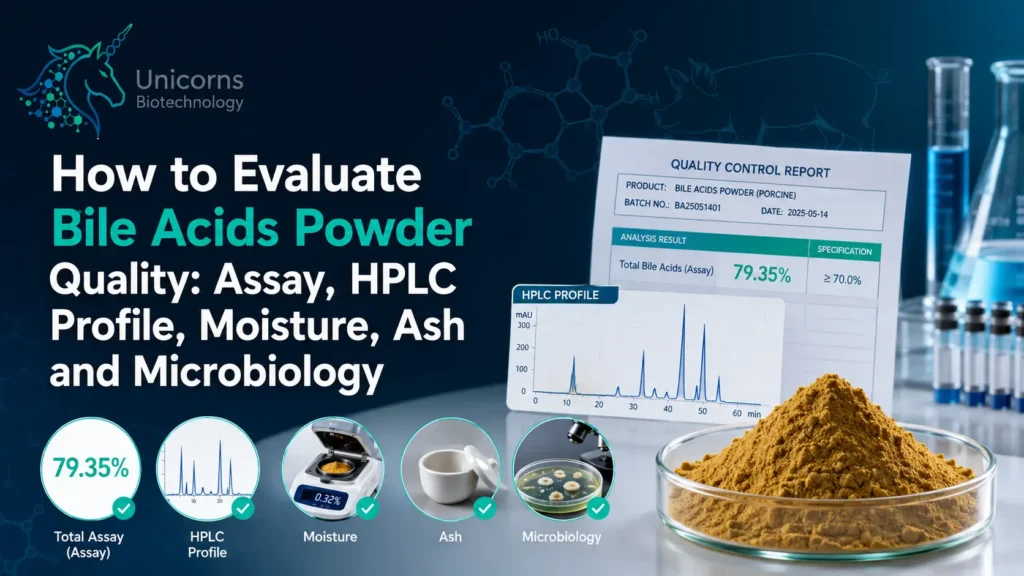
Bile acids powder quality depends on more than one assay result. Buyers must check identity, composition, physical purity, microbial safety, and batch consistency. A clean Certificate of Analysis helps, but it cannot answer every question.
Two powders may carry the same total bile acids claim. Yet they may contain different bile acids, moisture levels, carriers, or process residues. Those differences affect dosing, blending, feed performance, and cost.
This guide explains how procurement managers and QC teams should review bulk feed-grade bile acids powder. It focuses on porcine-origin material for animal nutrition, premixes, and compound feed.
B2B Bile Acids Powder Quality Evaluation Framework
Start with the intended application. Then define the required grade and test methods before requesting quotations.
The following framework covers the main purchasing risks.
| Quality area | Main buyer question | Evidence required |
|---|---|---|
| Product identity | Did the supplier provide the agreed porcine material? | Source statement, process description and analytical profile |
| Total assay | How much active bile acids content does the powder contain? | Result, method, units and assay basis |
| HPLC profile | Which bile acids make up the total assay? | Chromatogram, peak table and quantitative results |
| Moisture and ash | How much water and inorganic residue remain? | Loss on drying, ash results and test methods |
| Microbiology | Does the lot meet the agreed hygiene limits? | Counts, pathogen results and sample quantities |
| Contaminants | Does the material control metals and process residues? | Heavy metal and risk-based residue reports |
| Physical quality | Will the powder work in the buyer’s process? | Particle size, density, flow and dispersibility data |
| Consistency | Will bulk lots match the approved sample? | Multiple batch COAs and trend data |
A buyer should approve the complete quality package. One test result cannot replace this review.
Product Identity, Porcine Origin and Feed-Grade Bile Acids
Product identity comes first. A precise assay means little when the supplier tests the wrong material.
What exactly is bile acids powder?
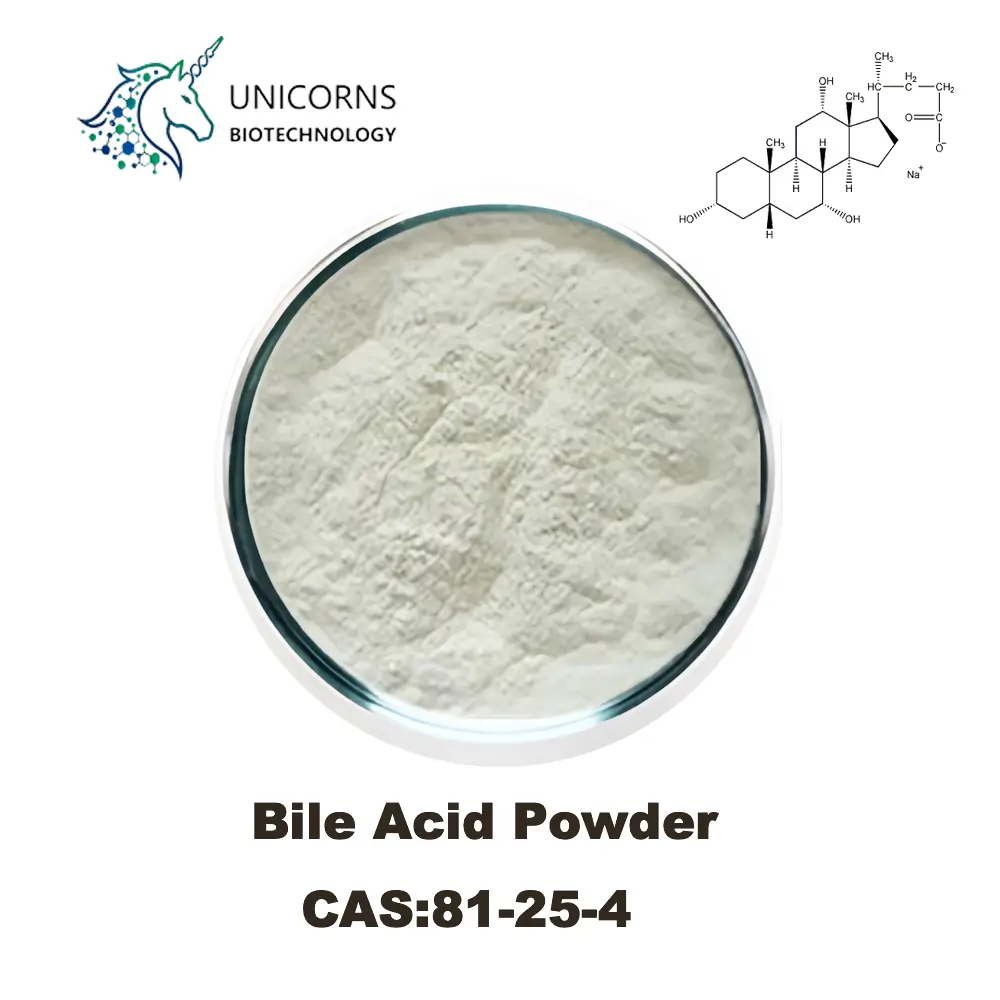
Bile acids powder contains a mixture of bile acids. It does not describe one purified chemical.
The mixture has no single molecular formula or universal CAS number. Each bile acid has its own chemical identity.
| Bile acid | Abbreviation | CAS number |
|---|---|---|
| Hyocholic acid | HCA | No widely used commercial CAS number |
| Hyodeoxycholic acid | HDCA | 83-49-8 |
| Chenodeoxycholic acid | CDCA | 474-25-9 |
| Cholic acid | CA | 81-25-4 |
| Deoxycholic acid | DCA | 83-44-3 |
The attached Unicorns specification identifies the product as porcine-origin Bile Acid Powder from China. It describes a brown-yellow fine powder with non-GMO status.
Is bile acids powder the same as porcine bile extract?
These product names often overlap in commercial listings. However, they may describe different materials.
| Product | Main feature | Common B2B use |
|---|---|---|
| Feed-grade bile acids powder | Standardized mixture of active bile acids | Feed additives and premixes |
| Porcine bile powder | Dried porcine bile with a broader natural composition | Research or further processing |
| Porcine bile extract | Processed extract with a supplier-defined concentration | Supplements, feed or intermediates |
| Ox bile extract | Bovine extract with a bovine bile profile | Digestive formulations |
| Bile salts | Sodium or potassium salts of bile acids | Water-dispersible formulations |
| Cholic acid | Purified single compound | Chemical synthesis |
| TUDCA | Purified taurine-conjugated UDCA | Pharmaceutical or supplement products |
Buyers should not approve these products as direct substitutes. Each material needs its own specification.
For a source comparison, review Porcine Bile vs Ox Bile. You can also compare conventional bile acids with bile salts.
How should buyers verify the animal source?
Request a signed porcine-origin statement. The document should identify the raw material, source country, and manufacturing site.
The supplier should also link the raw material lot to the finished batch. That link helps the QC team investigate complaints or deviations.
A chromatographic fingerprint can support the declared species. Yet processing changes the fingerprint. Buyers must compare the sample with a suitable processed reference.
PCR can support species testing when the sample still contains sufficient DNA. Purification, heating, and chemical treatment may damage that DNA. HPLC profiling often provides more useful evidence for processed bile acids.
Why does the manufacturing process affect the profile?
Manufacturers may use saponification, acidification, purification, decolorization, concentration, and drying. Each step can change the final profile.
Saponification can break conjugated bile acids into free bile acids. A raw porcine bile powder may show glycine-conjugated markers. A processed feed-grade powder may show HCA, HDCA, and CDCA.
Never compare a processed feed additive with the wrong reference fingerprint. Ask the supplier to define free acids, conjugated acids, and bile salts in its method.
Total Bile Acids Assay, Potency and Calculation Basis
The total assay drives dosing and cost calculations. It also creates many purchasing disputes.
What does “total bile acids assay” measure?
The phrase can describe several different measurements. The supplier must state the exact meaning.
| Assay term | What it may measure |
|---|---|
| Total bile acids | Overall response from a nonselective or group assay |
| Free bile acids | Unconjugated acids after extraction or processing |
| Bile acid salts | Sodium, potassium, or other salt forms |
| Marker assay | One selected bile acid |
| Sum of named acids | Combined HPLC results for listed compounds |
| Chromatographic purity | Relative area of target peaks |
| Overall powder purity | Active matter after water, ash, and other components |
A total bile acids claim does not prove the profile. It also does not prove overall powder purity.
Which test methods can measure total bile acids?
Laboratories may use titration, spectrophotometry, enzymatic analysis, or chromatography. Each method answers a different question.
Enzymatic methods often use 3α-hydroxysteroid dehydrogenase. The reaction creates a measurable signal from bile acids with a suitable 3α-hydroxyl group. The method measures total response but cannot identify each acid. Zhao et al.
Titration measures acidic functions but lacks compound selectivity. Spectrophotometry may face color or matrix interference. HPLC separates named acids but requires reference standards and good resolution.
The laboratory must validate its method for the powder matrix. A method for blood serum does not prove accuracy in a feed ingredient.
Is the assay reported on an as-is basis or dry basis?
An as-is result measures the received powder. A dry-basis result removes moisture from the calculation.
Use this formula when the method and specification allow the conversion:
Dry-basis assay = As-is assay × 100 ÷ (100 − moisture percentage)
Assume a sample contains 30% total bile acids and 10% moisture. Its dry-basis assay equals 33.33%.
Procurement teams should never treat dry-basis and as-is results as equal.
| Product | Declared assay | Assay basis | Moisture | Active content as received |
|---|---|---|---|---|
| Product A | 30% | As-is | 5% | 30% |
| Product B | 30% | Dry basis | 10% | 27% |
Both suppliers may quote “30% bile acids.” Product B contains less active content per kilogram delivered.
Which reference standard controls the assay result?
A sound method identifies the reference standard and its purity. The laboratory should correct calculations for that purity.
The method should also define the calibration range, extraction recovery, repeatability, and sample weight. Ask for measurement uncertainty when small differences could trigger a rejection.
Can carriers or moisture affect the product value?
Yes. Water, mineral salts, and declared carriers reduce the active content per kilogram delivered.
Some water-dispersible products need carriers. That does not make them poor products. The supplier must disclose the carrier and include it in the specification.
Undeclared dilution creates a different problem. Ash testing, microscopy, carbohydrate testing, and chromatographic mass balance can help investigate it.
Why can two 30% bile acids powders differ?
Total assay gives one number. It does not show which compounds create that number.
| Parameter | Product A | Product B |
|---|---|---|
| Total bile acids | 30% as-is | 30% dry basis |
| Moisture | 5% | 10% |
| Ash | 3% | 5% |
| HCA, HDCA and CDCA profile | Quantified | Not supplied |
| Unknown chromatographic peaks | Controlled | Not reported |
| Carrier | None declared | Not stated |
| Commercial risk | Lower | Higher |
Buyers should compare assay, profile, moisture, ash, and disclosure together.
HPLC Bile Acid Profile and Chromatographic Fingerprint
HPLC shows the composition behind the total assay. It helps confirm identity, consistency, and possible adulteration.
Research on commercial oxgall powders found similar total bile acid content but different individual profiles. That result shows why total assay alone cannot define a bile ingredient. Hu et al.
Which bile acids define feed-grade porcine bile acids powder?
China’s current feed-additive standard identifies HCA, HDCA, and CDCA as principal components of porcine feed-grade bile acids.
| Compound | Full name | QC role |
|---|---|---|
| HCA | Hyocholic acid | Supports porcine-origin profile assessment |
| HDCA | Hyodeoxycholic acid | Often forms a major part of processed porcine bile acids |
| CDCA | Chenodeoxycholic acid | Confirms composition and supports total profile analysis |
| CA | Cholic acid | May occur depending on source and process |
| DCA | Deoxycholic acid | May occur at a product-specific level |
One published preparation of porcine bile acids contained 7.88% HCA, 70.23% HDCA, and 18.01% CDCA. Those figures describe one research product. They do not set a universal commercial specification. Yang et al.
Each buyer should set ranges against an approved commercial grade.
Is total bile acids assay the same as HPLC purity?
No. Total assay measures an overall amount. HPLC separates compounds and measures their individual responses.
“HPLC 99%” also needs context. The number may describe area normalization rather than weight-based purity. It may exclude water, ash, or compounds that the detector cannot see.
Ask the supplier whether it reports relative peak areas or absolute concentrations.
Which HPLC detector works for bile acids?
Many bile acids absorb little ultraviolet light. A method may use low-wavelength UV detection, derivatization, ELSD, CAD, or mass spectrometry.
| Technique | Best use | Main buyer check |
|---|---|---|
| HPLC-UV | Routine testing under a validated method | Wavelength, sensitivity and interference |
| Derivatized HPLC-UV | Stronger UV response for selected acids | Reaction recovery and derivative stability |
| HPLC-ELSD | Compounds with weak UV absorption | Calibration response and detector settings |
| HPLC-CAD | Multi-component bile acid fingerprints | Peak separation and reference standards |
| LC-MS/MS | Identity confirmation and trace quantification | Ion transitions, internal standards and matrix effects |
A 2025 study used UHPLC-CAD to separate 17 bile acids across ten bile-derived materials. The researchers linked GHDCA and GCDCA with pig bile powder. They also showed that chromatographic profiles could distinguish animal sources. Wu et al.
That research covered bile-derived medicinal materials. Feed-grade processing may change conjugated compounds. Buyers should use a fingerprint that matches the finished process.
How should buyers read an HPLC chromatogram?
Start with the reference chromatogram. Match each sample peak against a qualified standard.
Then review retention time, resolution, symmetry, and baseline separation. Poor separation can merge two compounds into one peak.
The peak table should include each analyte, retention time, peak area, and result. It should also show unknown peaks.
System suitability proves that the instrument performed as intended during the test. It may cover repeatability, peak resolution, tailing, and standard response.
Does peak-area percentage equal absolute concentration?
Not always. Peak area measures detector response.
Different bile acids may produce different response factors. A 40% area does not always equal 40 grams per 100 grams.
Absolute quantification uses calibration standards. It reports results as percentages, milligrams per gram, or other mass-based units.
Relative profiling can still support batch comparison. It should not replace a mass-based assay when the purchase contract requires one.
Can HPLC detect adulteration or the wrong animal source?
A validated fingerprint can flag missing markers, abnormal ratios, or unexpected peaks. It can also expose changes in raw material or processing.
HPLC cannot prove every type of fraud. A skilled adulterator may add a single target compound to pass a simple marker test.
Combine total assay, multi-component profiling, ash, and traceability. Add LC-MS/MS or species testing when the risk justifies the cost.
What should a batch fingerprint specification contain?
A commercial fingerprint should set ranges for the main compounds. It should also control unknown peaks and total identified bile acids.
| Fingerprint control | Recommended requirement |
|---|---|
| Main bile acids | Individual limits for HCA, HDCA and CDCA |
| Relative ratios | Approved ranges based on qualified batches |
| Unknown peaks | Defined individual or total limit |
| Retention time | Tolerance against reference standards |
| Peak resolution | Method-specific system suitability limit |
| Repeatability | Replicate injection or preparation limit |
| Batch similarity | Approved internal fingerprint range |
Review several commercial batches before setting tight limits. Natural raw materials show some variation.
Moisture Content, Loss on Drying and Water Activity
Moisture affects assay, storage, handling, and microbial risk. It also changes the active content per kilogram.
Why does moisture affect bile acids powder quality?
Excess moisture can cause caking. It can also reduce flow through hoppers and dosing equipment.
Moisture may support microbial growth when the powder reaches a suitable water activity. It can also damage premix uniformity during storage.
Are loss on drying and water content the same?
No. Loss on drying measures the weight that a sample loses under set conditions. Water and other volatile matter may contribute to that loss.
Karl Fischer testing targets water. Water activity measures the water available for microbial growth and chemical reactions.
| Test | What it measures | Main use |
|---|---|---|
| Loss on drying | Water plus other volatile loss | Routine release specification |
| Karl Fischer | Water content | More selective moisture determination |
| Water activity | Available water | Microbial and stability risk |
The attached specification sets loss on drying at no more than 10.0%. It does not claim a universal moisture limit for every bile acids grade.
What test conditions should the method state?
The method should state sample weight, temperature, time, and endpoint. Different conditions can produce different results.
Compare supplier and third-party results only when both laboratories use compatible methods.
What is an acceptable moisture limit?
The agreed application controls the limit. Feed-grade powder may use a different limit than a pharmaceutical intermediate.
Unicorns Biotechnology currently sets loss on drying at ≤10.0% for its standard porcine-origin Bile Acid Powder. Buyers can request a tighter custom limit when their process needs it.
Ash Content and Residue on Ignition
Ash measures the inorganic residue that remains after combustion. It helps buyers monitor purification and carrier content.
Are ash and residue on ignition the same test?
The terms may describe related tests, but methods can differ. Total ash burns the organic matrix under defined conditions.
Residue on ignition may use a pharmacopeial procedure. Sulfated ash adds sulfuric acid before ignition. Acid-insoluble ash measures material that remains after acid treatment.
Always compare the method, not just the test name.
What does a high ash result indicate?
High ash may point to residual processing salts, mineral carriers, or incomplete purification. It may also indicate contamination.
Ash does not identify the residue. A legitimate salt-form product may carry more ash than a free-acid powder.
The attached Unicorns specification sets ash at no more than 5.0%.
Does high ash prove adulteration?
No. Ash provides a warning signal.
The supplier may declare a mineral carrier or salt conversion. In that case, the specification should explain the higher result.
Undeclared ash needs investigation. Ask for elemental testing and a process review.
Which tests can identify the residue?
ICP-MS or ICP-OES can measure individual elements. Ion chromatography can measure chloride or other ions.
Acid-insoluble ash may help detect soil or silicate contamination. The QC team should choose follow-up tests based on the manufacturing process.
Microbiological Limits and Feed Ingredient Safety
Animal-derived powders need sound hygiene controls. Drying lowers microbial risk, but it does not create a sterile product.
The attached specification cites current USP microbiological methods. It uses TAMC, TYMC, E. coli, and Salmonella limits.
Which microbiological tests belong on the COA?
| Parameter | Unicorns specification |
|---|---|
| Total Aerobic Microbial Count | ≤10,000 CFU/g |
| Total Combined Yeast and Mould Count | ≤100 CFU/g |
| Escherichia coli | Absence/g |
| Salmonellae | Absence/10 g |
The sample amount matters for pathogen testing. “Absence/g” and “absence/10 g” give more information than the word “negative.”
Does drying or GMP production make bile acids powder sterile?
No. Feed-grade bile acids powder remains a nonsterile ingredient unless the supplier validates and declares a sterile process.
GMP controls people, materials, equipment, records, and sanitation. It does not replace microbial testing.
Bile acids can inhibit some microorganisms. That property does not guarantee a pathogen-free powder.
What should buyers check behind a microbial result?
The report should identify the method, sample quantity, reporting unit, and detection limit. It should also name the laboratory and test date.
Ask whether the laboratory checked method suitability. The product itself may inhibit recovery and create a false low count.
Which additional microorganisms may require testing?
Destination rules or customer standards may require more tests. These can include Enterobacteriaceae, coliforms, Staphylococcus aureus, Bacillus cereus, or clostridia.
Use a risk assessment. Do not add a large panel without reviewing the source, process, and intended animal species.
How should a manufacturer control microbial risk?
The manufacturer should control raw material collection, processing time, drying, and warehouse humidity. It should also monitor equipment sanitation and packaging integrity.
Finished-lot testing confirms the result after production. Trend data helps the QC team spot rising counts before they cross a limit.
Heavy Metals, Residual Solvents and Other Contaminants
Heavy metals belong on every bulk ingredient specification. Animal source and processing also create other potential risks.
Which heavy metals should buyers check?
The attached specification sets these limits:
| Test | Specification |
|---|---|
| Total heavy metals | ≤10 ppm |
| Lead | ≤2 ppm |
| Arsenic | ≤2 ppm |
| Cadmium | ≤1 ppm |
| Mercury | ≤0.1 ppm |
Ask the laboratory to name the method. ICP-MS and ICP-OES report individual elements with better detail than an old total heavy metals test.
Should the report state total arsenic or inorganic arsenic?
Yes. Total arsenic and inorganic arsenic are not the same.
The purchase specification should name the required form. Destination regulations may set different limits.
When should buyers request residual solvent testing?
Review the manufacturing flowchart first. Then match the solvent panel to the process.
Do not request a generic panel that ignores the actual route. The supplier should disclose extraction and purification solvents.
Which other contaminants need risk-based testing?
| Risk | When to consider testing |
|---|---|
| Veterinary drug residues | When source-region or animal controls raise concern |
| Antibiotic residues | When the raw material program lacks strong controls |
| Pesticides | When feed or environmental exposure creates risk |
| Dioxins and PCBs | When destination rules or sourcing risk require them |
| Undeclared carriers | When mass balance, ash, or assay results look abnormal |
| Cleaning residues | When sanitation chemicals could contact the product |
| Cross-species material | When source claims affect market access |
A long testing panel cannot replace supplier controls. Use testing to confirm a sound risk program.
Physical Properties and Feed Formulation Performance
A powder can pass chemical tests and still fail in production. Formulators also need flow, density, and particle-size data.
Does powder appearance prove quality?
No. Appearance works as a quick identity check.
The attached specification describes a brown-yellow fine powder. A large color shift may signal a process change or storage problem.
Color cannot prove assay or species origin. The laboratory must confirm those properties.
Why do particle size and 80 mesh matter?
Particle size affects blending, dust, segregation, and dispersion. Large particles may separate from a fine premix.
The standard bulk Bile Acids Powder from Unicorns Biotechnology is specified at 80 mesh. The company can customize particle size for specific processes.
Mesh alone gives limited data. A particle-size distribution gives a clearer picture.
Which physical parameters should formulators request?
| Parameter | Process impact |
|---|---|
| Particle-size distribution | Mixing and segregation |
| Bulk density | Pack size and volumetric dosing |
| Tapped density | Compaction and transport behavior |
| Flowability | Hopper and feeder performance |
| Caking tendency | Warehouse and production handling |
| Hygroscopicity | Moisture uptake |
| Dispersibility | Distribution through liquid or dry systems |
| Solubility | Performance in true solution systems |
Run a small production trial before approving a new grade. Use the same carrier and equipment planned for commercial production.
Is water-dispersible powder the same as bile salts?
No. A manufacturer may improve dispersibility through carriers or formulation aids.
Bile salts contain ionic forms such as sodium or potassium salts. They often show greater water solubility than free bile acids.
Ask the supplier to disclose the formulation. That disclosure affects assay, ash, labeling, and price comparison.
Sampling Plan, Laboratory Testing and Chain of Custody
The best analytical method cannot repair poor sampling. A laboratory result only describes the material that reaches the laboratory.
Can one scoop represent a commercial batch?
Usually not. Powder can segregate during drying, transfer, packing, and transport.
The buyer should use a written sampling plan. It should define container selection and sampling locations.
How should buyers sample drums or bags?
Take increments from selected containers across the lot. Sample different depths when the packaging allows safe access.
Create a composite sample for overall release testing. Keep individual container samples when segregation risk matters.
Seal and label the samples. Record the lot, container numbers, date, sampler, and sampling method.
Should buyers test the approval sample or the shipped batch?
Test both. A sales sample may not represent the first commercial shipment.
Qualify the sample before placing the order. Then confirm the first delivered batch against the approved specification.
Keep a retained sample from each major lot. It can support future complaint or stability investigations.
When should buyers use a third-party laboratory?
Use independent testing during initial qualification and first shipment. Repeat it after major changes or unexpected results.
A routine requalification schedule also helps. Set the frequency against supply risk and purchase volume.
How should two laboratories handle conflicting results?
Compare sample identity first. Then compare test methods, basis, extraction, calibration, and reference standards.
Review measurement uncertainty and sample homogeneity. Do not reject a lot before completing that comparison.
Bile Acids Powder COA, Specification and Technical Dossier
A specification sets the rules. A COA reports the result from one batch.
Buyers often confuse these documents. That mistake weakens supply agreements.
What should a complete bile acids powder COA include?
| COA field | Required information |
|---|---|
| Product identity | Exact name, grade and porcine origin |
| Batch identity | Lot number and production date |
| Specification | Agreed acceptance limits |
| Result | Actual numerical result where possible |
| Method | Named method and revision |
| Unit | %, ppm, mg/kg or CFU/g |
| Calculation basis | As-is or dry basis |
| HPLC data | Named acids and quantitative results |
| Release approval | Authorized QC or QA signature |
| Dates | Manufacturing, testing and expiry dates |
| Traceability | Link to the manufacturing batch |
A COA should report the results of quantitative tests. Repeated use of “complies” hides useful trend data.
What is the difference between a COA, TDS and specification?
| Document | Main purpose |
|---|---|
| Product specification | Defines acceptance limits |
| Certificate of Analysis | Reports one batch’s results |
| Technical Data Sheet | Describes typical properties and use |
| Safety Data Sheet | Covers handling, storage and safety |
| HPLC report | Provides chromatographic evidence |
| Third-party report | Confirms selected results independently |
| Process flowchart | Shows key manufacturing steps |
| Traceability statement | Confirms raw material origin |
Request all relevant documents before approving a supplier.
Which HPLC data should a buyer request?
Request the sample chromatogram and reference chromatogram. Also request the peak table, integration report, and individual results.
The report should identify the method and detector. It should also state whether results use peak-area normalization or external calibration.
Which COA red flags suggest weak quality control?
| Red flag | Purchasing risk |
|---|---|
| No animal source | Wrong or mixed raw material |
| No assay method | Incomparable result |
| No assay basis | Hidden dry-basis or as-is difference |
| “HPLC 99%” without analytes | Misleading purity claim |
| Total assay without profile data | Unknown composition |
| Missing units | Unusable specification |
| One CAS number for the mixture | Poor product understanding |
| Identical results across every batch | Possible copied data |
| Every result says “complies” | No trend visibility |
| Trader COA without site details | Weak manufacturing traceability |
One red flag does not prove fraud. It does justify more questions.
GB 7300.1301-2025 Feed Additive Bile Acids Standard
China published GB 7300.1301-2025 on June 30, 2025. The mandatory standard took effect on July 1, 2026.
The standard carries the English title Feed Additives, Part 13: Others, Bile Acid. China’s Ministry of Agriculture and Rural Affairs manages the standard. Review the official GB 7300.1301-2025 record.
Which products fall within GB 7300.1301-2025?
The standard covers feed-additive bile acids derived from porcine bile. It addresses a finished ingredient for use in feed.
It does not turn every bile extract into the same product. Buyers should confirm grade, process, and intended use.
Which quality areas does the standard cover?
The standard addresses technical requirements, sampling, test methods, and inspection. It also covers labeling, packaging, transport, storage, and shelf life.
Buyers should name the current standard in purchase agreements for relevant Chinese feed-grade material.
Does Chinese-standard compliance guarantee import approval?
No. The destination country controls imports and local use.
The importer should check feed-additive registration, labeling, animal-origin documentation, and contaminant limits. Some markets also require veterinary health certificates or import permits.
When is a BSE or TSE statement relevant?
BSE and TSE controls focus on bovine and other susceptible ruminant materials. They do not form the main species risk for a porcine product.
Porcine buyers should prioritize a porcine-origin statement, traceability, and veterinary documentation. They should also review cross-species controls at the factory.
Shelf Life, Packaging and Stability
Shelf life needs data. A printed expiry date alone cannot prove stability.
What evidence supports a 24-month shelf life?
A stability program should track assay, moisture, microbiology, appearance, and caking. HPLC profiling can also track major composition changes.
The Unicorns Bile Acids Powder specification lists a 24-month shelf life. Buyers can request supporting storage conditions and stability data.
How does packaging protect the powder?
The inner liner blocks moisture and direct contact. The outer drum protects the liner during storage and transport.
Inspect seals, labels, and batch codes upon receipt. Record any damaged packaging before opening the lot.
What storage conditions should the supplier state?
The supplier should define temperature, humidity, light protection, and container closure. It should also explain handling after opening.
Warehouse staff should close partial containers after use. They should also avoid humid staging areas.
Supplier Audit, Batch Consistency and Change Control
A good sample proves that one sample passed. It does not prove long-term control of supply.
Is the seller a manufacturer or trading company?
Ask for the manufacturing address and production scope. Link the seller’s COA to the factory’s batch record.
A trader can supply a sound product. However, the buyer still needs manufacturing-site traceability.
You can use these seven glandular powder manufacturer checks when building a supplier audit.
How many batch COAs should procurement review?
Review at least three recent commercial batches when possible. Compare assay, moisture, ash, microbiology, and HPLC profile.
Look for stable trends rather than identical numbers. Natural materials should show controlled variation.
Which production controls should a supplier demonstrate?
| Control | Evidence |
|---|---|
| Raw material approval | Supplier qualification and incoming inspection |
| In-process testing | Batch records and test results |
| Cleaning | Procedures and verification records |
| Cross-contamination | Segregation and line-clearance controls |
| Instrument control | Calibration and maintenance records |
| Laboratory control | Methods, standards and training |
| Batch release | Authorized QA or QC review |
| Retained samples | Retention procedure and storage |
| Complaints | Investigation and response records |
| Recall | Written recall procedure |
A remote document review can start qualification. A site audit gives stronger evidence for high-volume contracts.
What do OOS and OOT mean?
An Out-of-Specification result exceeds an approved limit. An Out of Trend result stays within limits but shifts from normal performance.
Both results need investigation. The supplier should identify the cause and document corrective action.
CAPA means Corrective and Preventive Action. A sound CAPA removes the cause and lowers recurrence risk.
Which changes must the supplier report?
The supply agreement should require notice for major changes. These include animal source, source region, factory, process, carrier, method, specification, and packaging.
Also include contract laboratory changes. A new laboratory can change results due to differences in methods or calibration.
Cost per Active Kilogram and Procurement Value
Price per kilogram gives an incomplete comparison. Active content and quality risk drive the real cost.
How should buyers compare bile acids powder prices?
Use this basic formula:
Cost per active kilogram = Delivered price per kilogram ÷ Active fraction
Assume a powder costs US$12 per kilogram and contains 30% active bile acids.
US$12 ÷ 0.30 = US$40 per active kilogram
Run this calculation only after confirming the assay method and basis.
Why can the cheapest powder cost more?
A lower price may hide more moisture, ash, or carrier. It may also hide a weak profile or inconsistent batches.
Add third-party testing, rejected-lot risk, freight, and dose rate. Those costs can erase a small price advantage.
Can products with the same assay be used interchangeably?
Not without a technical review. Compare profile, moisture, physical properties, and formulation performance.
Run a premix or feed trial before changing commercial suppliers.
Seven-Step Bile Acids Powder Supplier Qualification Process
| Step | Buyer action | Required output |
|---|---|---|
| 1 | Define the application and requirements | User Requirement Specification |
| 2 | Review the supplier’s technical dossier | Approved document package |
| 3 | Compare recent batch COAs | Batch consistency assessment |
| 4 | Test a representative sample | Independent laboratory report |
| 5 | Run a feed or premix trial | Formulation approval |
| 6 | Confirm the first commercial batch | Shipment release |
| 7 | Monitor trends and supplier changes | Requalification record |
Do not skip the first commercial batch check. It connects sample approval with real supply.
Bile Acids Powder Quality Scorecard
A scorecard helps procurement, formulation, and QC teams make one decision.
| Evaluation area | Suggested weight |
|---|---|
| Product identity and porcine traceability | 15% |
| Total bile acids assay | 15% |
| HPLC profile and fingerprint | 20% |
| Moisture, ash and physical properties | 10% |
| Microbiology and contaminants | 15% |
| Batch consistency and change control | 10% |
| Regulatory documents | 10% |
| Capacity and delivery performance | 5% |
Adjust the weights for your market. A regulated importer may place more weight on documents and traceability.
Why Choose Unicorns Biotechnology for Bile Acids Powder?
Henan Unicorns Biotechnology is a leading manufacturer of bulk animal-derived ingredients in China. The company manufactures feed-grade porcine bile acids powder for feed mills, premix producers, distributors, and animal nutrition companies.
Unicorns Biotechnology has a product-specific annual manufacturing capacity of 600 tons for bile acids powder. This capacity supports bulk programs and planned supply contracts.
| Buyer requirement | Unicorns Biotechnology support |
|---|---|
| Product source | Porcine-origin feed-grade material |
| Standard documents | Specification, COA, TDS and SDS |
| Analytical support | Batch testing and HPLC profile support |
| Independent confirmation | Third-party testing upon request |
| Standard physical grade | Brown-yellow fine powder and 80 mesh |
| Customization | Assay, particle size and formulation options |
| Packaging | 25 kg drums and custom bulk packaging |
| Supply capacity | 600 tons per year for bile acids powder |
| Export support | Technical and shipment documents |
| Sample evaluation | Samples for qualified B2B projects |
Tell the technical team your target assay, profile, particle size, application, volume, and destination. Unicorns Biotechnology can then prepare a matching specification.
Contact Unicorns Biotechnology to request a quotation, a sample COA, an HPLC profile, a technical dossier, or an evaluation sample.
Frequently Asked Questions About Bile Acids Powder Quality
What is a good total bile acids assay?
No single assay fits every grade. A good assay meets the buyer’s formulation target and uses an agreed method.
Confirm whether the result covers total bile acids, free acids, or named compounds. Also confirm the dry or as-is basis.
Is total bile acids the same as HPLC purity?
No. Total bile acids measures overall concentration. HPLC purity often refers to the relative response of selected chromatographic peaks.
Ask for both the total assay and individual bile acid profile.
Which bile acids should porcine bile acids powder contain?
Processed feed-grade porcine bile acid powder should contain HCA, HDCA, and CDCA as the principal components. The exact ratios depend on the raw material and process.
CA, DCA, and other acids may also appear at product-specific levels.
Are HCA, HDCA and CDCA markers of porcine bile acids?
They support the identification of processed porcine bile acids. A reliable test should evaluate the full profile rather than one marker.
Processing changes free and conjugated bile acids. Use a reference fingerprint that matches the finished grade.
Can HPLC distinguish porcine bile from ox bile?
A validated multi-component fingerprint can support species differentiation. Porcine and bovine bile exhibit distinct chemical profiles.
HPLC cannot replace raw material traceability. Use both controls together.
Which method works best for bile acids, HPLC-UV, ELSD, CAD or LC-MS/MS?
The best method depends on the analytes and required sensitivity. A validated HPLC method may support routine release.
CAD and ELSD help with weak UV absorption. LC-MS/MS gives stronger identity confirmation and lower detection limits.
Why do two bile acids powders with the same assay differ?
They may use different methods, assay bases, animal sources, or carriers. They may also contain different bile acid ratios.
Compare the HPLC profile, moisture, ash, and physical properties.
Should buyers use a dry-basis or as-is assay?
Use the basis written in the purchase specification. An as-is assay reflects the delivered powder.
A dry-basis assay helps compare active solids. It does not show the active content in each delivered kilogram without moisture adjustment.
What is an acceptable moisture level for bile acids powder?
The product grade and application control the limit. Unicorns Biotechnology sets loss on drying at ≤10.0% for its standard feed-grade product.
Do not apply a universal 5% limit without checking the agreed specification.
Is loss on drying the same as water content?
No. Loss on drying may include water and other volatile matter.
Karl Fischer targets water. Water activity measures the water available for microbial growth.
What does high ash mean in bile acids powder?
High ash may indicate process salts, mineral carriers, or incomplete purification. It may also signal contamination.
Ash does not identify the residue. Use elemental or ion testing when the result looks abnormal.
Is ash the same as residue on ignition?
The terms may use different methods. Sulfated ash and total ash can produce different results.
The COA should name the method and acceptance limit.
Does bile acids powder need microbiological testing?
Yes. Animal-derived feed ingredients need microbial release controls.
A standard panel includes TAMC, TYMC, E. coli, and Salmonella. Destination rules may require more organisms.
Is feed-grade bile acids powder sterile?
No. A dry, GMP-controlled powder does not become sterile by default.
The supplier should control microbial risk and test the finished lot.
What should a bile acids powder COA include?
The COA should include product identity, porcine source, batch number, limits, results, units, methods, and assay basis. It should also carry authorized release approval.
Request the HPLC profile as a separate report when the COA lacks enough detail.
Can a COA alone qualify a supplier?
No. A COA reports one batch.
Supplier qualification also needs traceability, methods, several batch records, an independent test, and a commercial trial.
When should buyers request third-party testing?
Use third-party testing during initial qualification and first shipment. Repeat it after major changes or unusual results.
High-volume buyers should also set a periodic verification schedule.
Does bile acids powder need to comply with GB 7300.1301-2025?
Relevant feed-additive bile acids in China should meet the current mandatory standard. The standard took effect on July 1, 2026.
Importers must also meet destination-country rules.
Does porcine bile acids powder require a BSE or TSE statement?
Porcine material does not carry the same BSE risk as bovine material. Buyers may still request a statement to confirm cross-species controls.
A porcine-origin declaration and veterinary documentation provide more direct evidence.
How should buyers sample a bulk shipment?
Use a written, risk-based plan. Sample selected containers and several powder locations.
Seal retained samples and record the complete chain of custody.
How can buyers compare bile acids powder prices?
Compare delivered cost per active kilogram. Use comparable assays and calculation bases.
Then add testing, freight, dose rate, and rejected-lot risk.
Final Bile Acids Powder Approval Checklist
| Approval point | Confirmed |
|---|---|
| Intended grade and application | ☐ |
| Porcine-origin declaration | ☐ |
| Raw material traceability | ☐ |
| Total assay and test method | ☐ |
| Dry-basis or as-is statement | ☐ |
| HCA, HDCA and CDCA profile | ☐ |
| HPLC chromatogram and peak table | ☐ |
| Loss on drying | ☐ |
| Ash method and result | ☐ |
| TAMC and TYMC | ☐ |
| E. coli and Salmonella | ☐ |
| Heavy metals | ☐ |
| Risk-based residues | ☐ |
| Particle size and density | ☐ |
| Packaging and storage conditions | ☐ |
| Stability and shelf life | ☐ |
| Multiple batch consistency | ☐ |
| Third-party verification | ☐ |
| Regulatory documents | ☐ |
| Supplier change-control agreement | ☐ |
Summary
Good bile acids powder quality combines identity, potency, composition, purity, safety, and consistency. Total assay gives only one part of that picture.
Review the HPLC profile beside moisture, ash, microbiology, and contaminants. Then confirm the commercial batch through representative sampling.
A strong supplier should explain every test and calculation. It should also support the data with traceability, methods, and change control.
References
- Hu, P. L., Yuan, Y. H., Yue, T. L., & Guo, C. F. (2018). Bile acid patterns in commercially available oxgall powders used for the evaluation of the bile tolerance ability of potential probiotics. PLOS ONE, 13(3), e0192964. https://doi.org/10.1371/journal.pone.0192964
- Wu, H., Wang, X., He, F., Cheng, X., Jing, W., Wei, F., & Yin, T. (2025). Comprehensive analysis of bile-derived medicinal materials based on ultra-high-performance liquid chromatography coupled with charged aerosol detection and chemometrics. Analytical Science Advances, 6, e70040. https://doi.org/10.1002/ansa.70040
- Yang, B., Huang, S., Li, S., Feng, Z., Zhao, G., & Ma, Q. (2022). Safety evaluation of porcine bile acids in laying hens: Effects on laying performance, egg quality, blood parameters, organ indexes, and intestinal development. Frontiers in Veterinary Science, 9, 895831. https://doi.org/10.3389/fvets.2022.895831
- Zhao, X., Jiang, L., Fang, X., Guo, Z., Wang, X., Shi, B., Meng, Q., & Yu, Y. (2022). Bile acid detection techniques and bile acid-related diseases. Frontiers in Physiology, 13, 826740. https://doi.org/10.3389/fphys.2022.826740
- Standardization Administration of China. (2025). GB 7300.1301-2025: Feed additives, Part 13: Others, Bile acid. Official standard record