
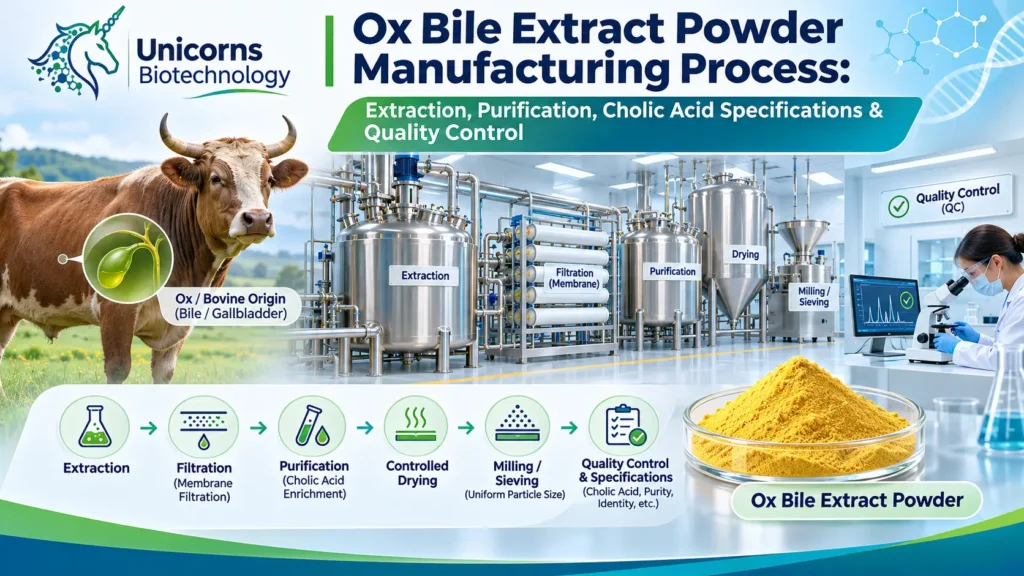
The ox bile extract powder manufacturing process converts bovine bile into a standardized ingredient for dietary supplements, digestive formulations, and pharmaceutical raw material applications. Key stages include raw bile collection, concentration, solvent-assisted extraction, alkaline treatment, purification, filtration, drying, and quality testing.
Unicorns Biotechnology manufactures bulk Ox Bile Extract Powder in China using an extraction and purification process designed to produce consistent cholic acid content. Our standard product contains at least 45% cholic acid, with 20%, 25%, 40%, and higher-content custom grades available, subject to production requirements and clients’ specification needs.
This guide explains how ox bile powder is manufactured, how processing methods affect bile-acid composition, and what supplement manufacturers and ingredient buyers should check when selecting a supplier.
What Is Ox Bile Extract Powder?
Ox Bile Extract Powder is an animal-derived ingredient manufactured from bovine bile. It is also known as bovine bile extract, ox bile powder, ox gall powder, dried ox gall, purified ox gall, or Fel Bovis.
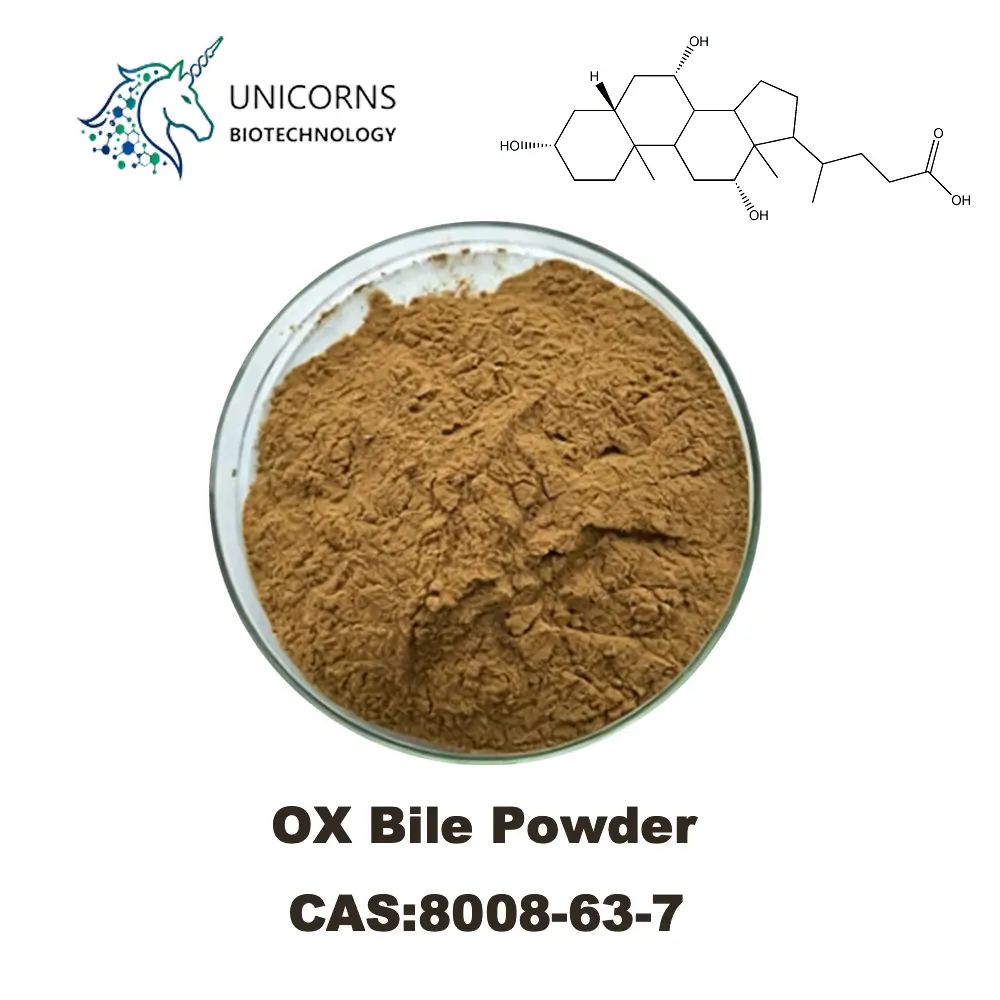
Bile is produced by the liver and stored in the gallbladder. It contains bile acids, bile salts, phospholipids, cholesterol, pigments, and other compounds.
Manufacturers process liquid bile into a dry powder to improve handling, storage, batch consistency, and use in finished formulations.
Cholic Acid and the Bile Acid Composition
Cholic acid is one of the primary bile acids found in bovine bile. It is widely used as a quality marker when manufacturing standardized ox bile extracts.
| Property | Cholic Acid |
|---|---|
| Chemical name | Cholic acid |
| CAS number | 81-25-4 |
| Molecular formula | C₂₄H₄₀O₅ |
| Molecular weight | 408.57 g/mol |
| Chemical class | Primary bile acid |
| Primary function | Contributes to fat emulsification and micelle formation through its bile salt forms |
Other bile acids found in bovine bile can include chenodeoxycholic acid, deoxycholic acid, glycocholic acid, and taurocholic acid.
Ox bile extract is a mixture, not a single purified compound. Its composition depends on the animal source, extraction process, chemical treatment, and purification method.
A specification of 45% cholic acid does not mean the remaining 55% is inactive material. It can contain other bile acids, bile salts, and residual constituents of the processed bile.
Ox Bile Extract Powder Manufacturing Process: Step by Step
Unicorns Biotechnology uses a manufacturing route based on concentrated bovine bile, solvent-assisted extraction, alkaline processing, activated-carbon purification, membrane filtration, and controlled drying.
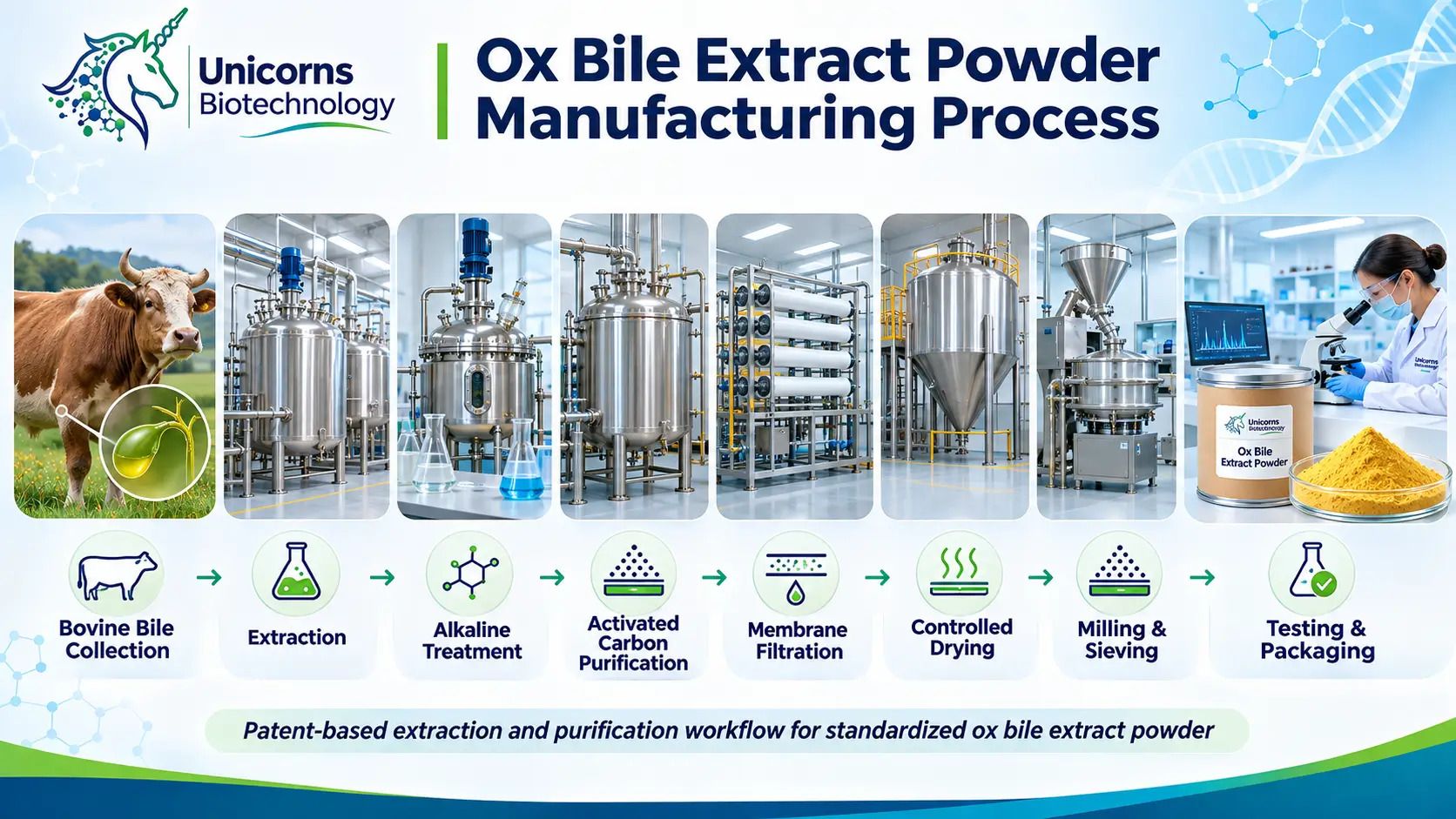
This approach is consistent with the manufacturing method described in Chinese invention patent CN106619725B, A Method for Preparing Ox Bile Powder, published in 2017 and granted in 2020.
1. Raw Bovine Bile Collection and Inspection
The process begins with collecting bovine bile from qualified cattle slaughterhouses.
Animal origin and source traceability are important because ox bile is an animal-derived raw material. Manufacturers must control risks related to animal health, contamination, and unwanted biological materials.
Unicorns Biotechnology sources bovine raw materials from qualified slaughterhouses under veterinary oversight.
The raw material inspection process covers source records, animal-origin documentation, appearance, storage conditions, and BSE/TSE risk controls.
Fresh liquid bile is filtered and concentrated into bovine bile paste, which provides a more manageable starting material for extraction.
2. Solvent-Assisted Extraction of Concentrated Bovine Bile
Concentrated bovine bile contains bile acids and other compounds that must be separated or refined to achieve the required product specification.
The manufacturing process uses purified water and methanol as extraction media.
The patented process describes combining concentrated bovine bile paste with methanol and purified water, followed by mixing and heating under reflux.
This stage improves contact between the extraction liquid and bile components and prepares the material for further purification.
Solvent selection and extraction conditions affect the resulting composition. The manufacturing process must therefore include suitable controls for solvent handling and removal.
3. Alkaline Treatment and Bile Acid Processing
After extraction, manufacturers introduce sodium hydroxide under controlled reaction conditions.
This alkaline treatment is an important difference between refined ox bile extract powder and simply dried bovine bile.
Depending on temperature, concentration, and reaction time, alkaline processing can hydrolyze conjugated bile acids. Glycine- and taurine-conjugated bile acids may be converted into less-conjugated or unconjugated forms.
This means the final composition may differ from the original bile-acid profile.
Manufacturers must control reaction conditions and verify the resulting composition using appropriate analytical methods.
For formulators, this distinction matters. Do not assume a standardized cholic acid extract has the same composition as non-hydrolyzed whole bile powder.
4. Activated Carbon Purification
The alkaline-treated material undergoes purification using activated carbon.
Activated carbon can adsorb selected impurities and colored compounds from the processing liquid. This helps refine the material before filtration and drying.
In the referenced patented process, activated carbon is added during a heated treatment stage.
The purification conditions must be controlled to limit unwanted losses and achieve consistent finished-product quality.
The resulting mixture is then cooled and prepared for membrane filtration.
5. Microporous Membrane Filtration
Filtration removes suspended particles, activated carbon, and other unwanted physical matter from the processed liquid.
The patent describes a microporous membrane with a pore size of 1.2 μm.
This filtration stage produces a cleaner processing liquid and reduces the amount of insoluble material entering the drying stage.
Membrane filtration is a physical separation step. It does not, by itself, remove dissolved residual solvents or all chemical impurities. Those require separate process controls or analytical verification.
6. Controlled Drying of Purified Ox Bile Extract
Drying converts the purified liquid into a solid material suitable for powder manufacturing.
The referenced patent uses microwave drying. Its disclosed conditions include a temperature of 120°C and a drying time of 200–260 minutes.
Industrial drying parameters must be validated for the equipment and material being processed.
The main objectives are to reduce moisture, produce stable dry material, and obtain consistent powder characteristics.
Drying also forms part of the overall solvent-removal strategy. Residual solvent levels must be assessed against the requirements of the intended application and destination market.
7. Pulverizing, Sieving, and Powder Standardization
After drying, the solid ox bile extract is pulverized into a fine powder.
Milling and screening help achieve the particle size needed for downstream applications.
Unicorns Biotechnology offers customizable particle sizes according to customer requirements.
The finished powder can then be blended to improve batch uniformity. The company checks cholic acid content and other quality parameters before releasing the material for packaging.
8. Quality Testing, Packaging, and Storage
Each finished production lot is evaluated against its approved specification.
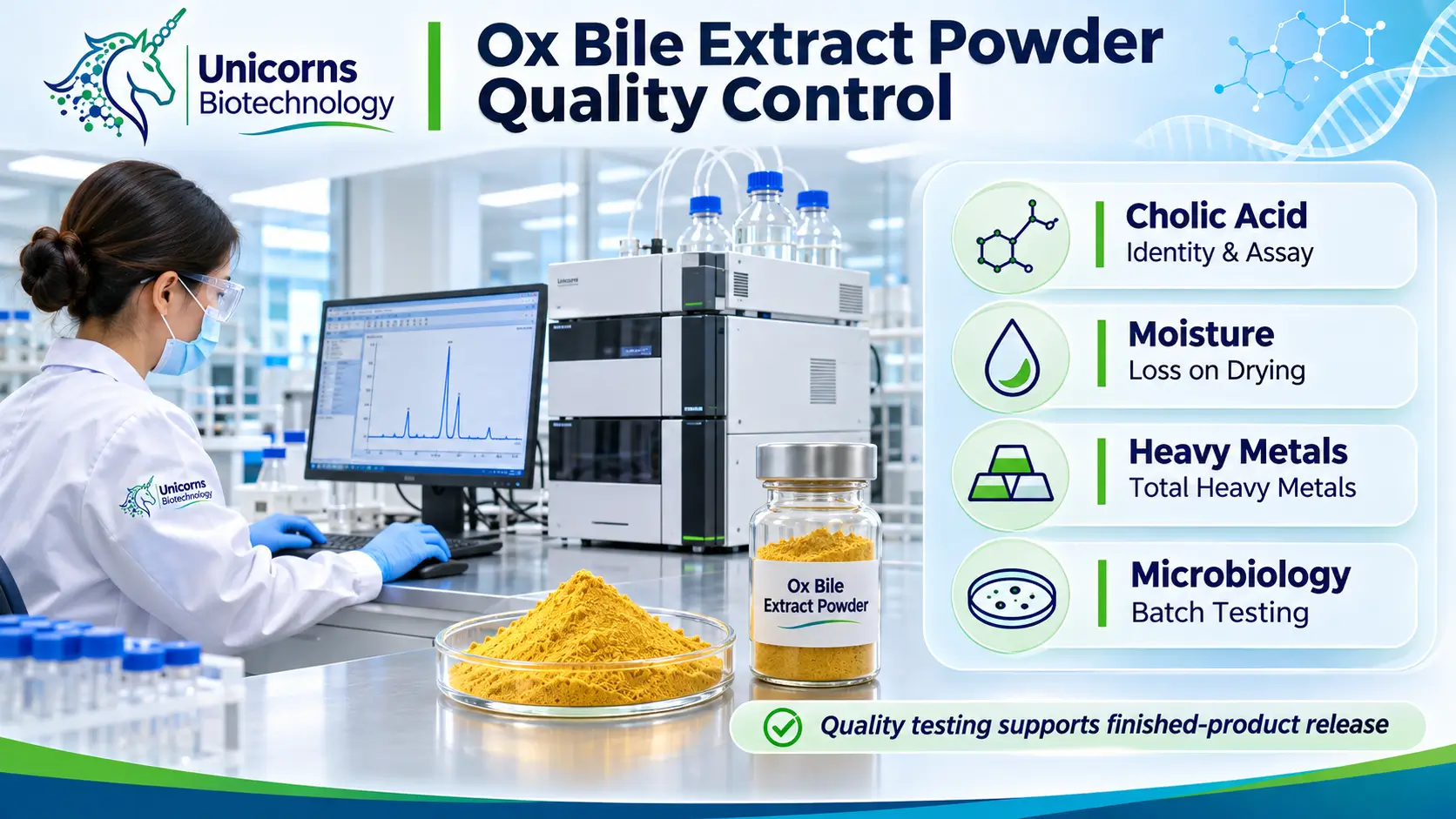
Quality checks include cholic acid content, identity, appearance, moisture, heavy metals, and microbiological limits.
Ox bile extract powder is hygroscopic, meaning it can absorb moisture from the air. Therefore, store finished powder in sealed, moisture-resistant packaging.
Bulk orders are commonly packed in 25 kg drums. Custom packaging is available for ingredient distributors, contract manufacturers, and OEM supplement projects.
Traditional Ox Bile Drying vs. Refined Extraction and Purification
Not all ox bile powders are manufactured in the same way.
Some products are made by filtering and drying liquid bovine bile. Others undergo further extraction, alkaline treatment, filtration, and purification to produce a standardized ingredient.
The process choice affects the final cholic acid content, the range of bile acids present, and the powder’s physical properties.
| Manufacturing feature | Traditional dried ox bile | Refined ox bile extract |
|---|---|---|
| Starting material | Liquid bovine bile | Concentrated bovine bile |
| Main processing | Filtration and drying | Extraction, chemical treatment, purification and drying |
| Solvent-assisted extraction | Not always required | Used in the referenced method |
| Alkaline treatment | Generally absent | Included in the referenced method |
| Purification | Limited or basic | Activated carbon and membrane filtration |
| Bile-acid profile | Closer to the original bile composition | May change during processing |
| Standardization | Depends on product grade | Targeted cholic acid specification |
| Main procurement focus | Whole-bile composition | Marker content and controlled quality |
An earlier Chinese patent, CN104257691A, reports cholic acid levels of 20–35% for traditional manufacturing methods and 40–45% for its more refined process.
The later patent CN106619725B reports 45–53% cholic acid and a manufacturing yield of 65–70% under its disclosed conditions.
These figures are results reported in the patents. They are not universal manufacturing yields or guarantees for every commercial production batch.
For buyers, the finished batch COA is more important than the manufacturing method alone.
Ox Bile Extract Powder Specifications: 20%, 25%, 40%, 45% and Custom Grades
Cholic acid content is a key factor used to distinguish commercial ox bile extract grades.
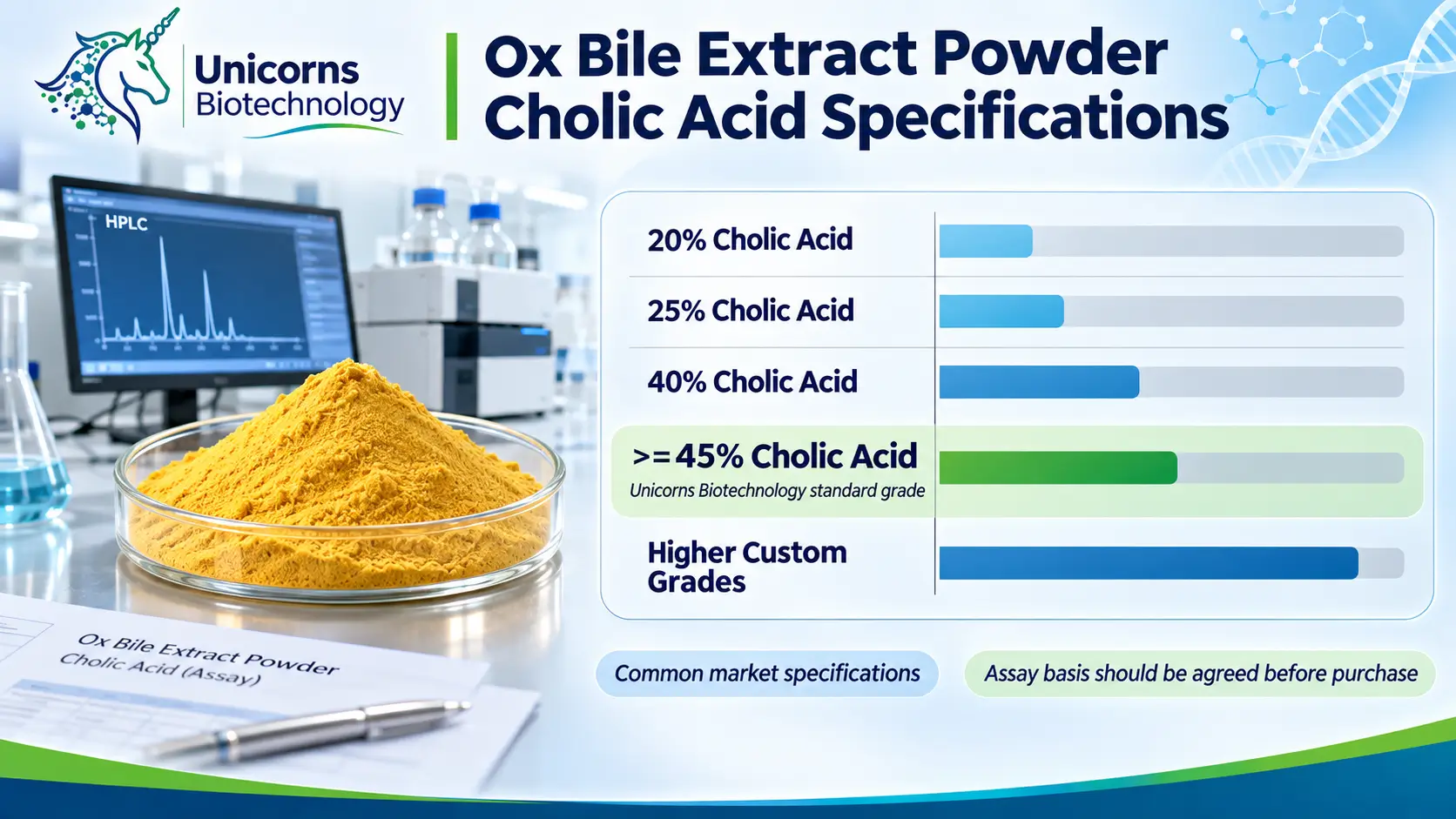
Different supplement manufacturers require different specifications depending on the target formulation, ingredient loading, analytical requirements, and production cost.
Unicorns Biotechnology’s primary commercial specification is cholic acid ≥45%. We also support evaluating other content levels for custom manufacturing projects.
| Grade | Cholic acid specification | Commercial use |
|---|---|---|
| Lower-content custom grade | 20% | Customized formulations with lower marker requirements |
| Lower-content commercial grade | 25% | Ingredient blends and selected formulation projects |
| Standardized grade | 40% | General-purpose standardized bile extract |
| Main Unicorns Biotechnology grade | ≥45% | Bulk supplements and standardized ingredient applications |
| High-content custom grade | 50% or higher | Specialized formulations requiring higher marker content |
Custom grades depend on raw material quality, processing conditions, analytical results, and production feasibility.
Do not treat cholic acid content and total bile acid content as interchangeable specifications.
For example, a material labeled 50% total bile acids may not contain 50% cholic acid. The same applies when comparing free cholic acid with cholic acid equivalents determined by a specified analytical procedure.
Buyers should define the target marker, test method, reporting basis, and acceptance limits before placing bulk orders.
Standard Quality Specifications of Unicorns Biotechnology Ox Bile Extract Powder
The following table summarizes the standard Ox Bile Extract specification supplied by Unicorns Biotechnology.
| Parameter | Specification |
|---|---|
| Product name | Ox Bile Extract Powder |
| Animal source | Bovine origin, grass-fed |
| Country of origin | China |
| Cholic acid | ≥45.0% |
| Identification | Positive |
| Appearance | Yellow powder |
| Taste | Characteristic bitter taste |
| Moisture / loss on drying | ≤5.0% |
| Particle size | Customizable |
| Total heavy metals | ≤10 ppm |
| Arsenic (As) | ≤1 ppm |
| Lead (Pb) | ≤1 ppm |
| Cadmium (Cd) | ≤1 ppm |
| Mercury (Hg) | ≤0.1 ppm |
| Total plate count | ≤1,000 CFU/g |
| Yeast and mold | ≤100 CFU/g |
| Escherichia coli | Negative |
| Salmonella | Negative |
| Staphylococcus | Negative |
| GMO status | Non-GMO |
| Packaging | 25 kg drum or custom packaging |
The product specification also identifies the ingredient as BSE-free, antibiotic-free, and non-irradiated. Buyers should request the relevant declarations and supporting documentation for their destination market.
Final batch acceptance should be based on an approved specification and the corresponding Certificate of Analysis.
Cholic Acid Testing and Quality Control
The cholic acid assay is a key part of standardized ox bile extract manufacturing.
Cholic acid is a defined compound with a molecular formula of C₂₄H₄₀O₅. Commercial ox bile extract, however, contains several related bile acids and their conjugated forms.
This creates an important analytical distinction.
Free Cholic Acid vs. Cholic Acid Equivalents
Free cholic acid refers to the unconjugated chemical compound.
Cholic acid equivalents can refer to the amount calculated through a specified analytical method that accounts for certain conjugated or related forms.
The Food Chemicals Codex describes ox bile extract as containing bile acids, chiefly glycocholic and taurocholic acids as sodium salts, equivalent to at least 45% cholic acid.
As a result, a label stating “45% cholic acid” should always be supported by a defined assay method.
Manufacturers may use chromatographic methods, such as HPLC, to determine selected bile acids. The sample preparation and calculation method must match the reported specification.
Residual Solvent Testing
Solvent-assisted manufacturing requires appropriate residual-solvent controls.
Because the referenced manufacturing method uses methanol, residual methanol is a relevant quality parameter.
The ICH Q3C(R9) guideline classifies methanol as a Class 2 residual solvent for pharmaceutical applications.
For supplement manufacturing, appropriate solvent limits and testing requirements depend on the intended market, ingredient use, and applicable regulatory framework.
Buyers should confirm whether the supplier’s COA or additional test report covers residual solvents before approving a batch.
Animal-Origin and Microbiological Controls
Bovine-derived ingredients require traceability and suitable animal health controls.
Relevant documentation may include animal-origin declarations, slaughterhouse records, BSE/TSE statements, and production batch traceability.
Microbiological testing helps verify that the finished powder meets the accepted limits for total aerobic count, yeast and mold, and specified microorganisms.
Unicorns Biotechnology supports technical documentation for bulk ox bile extract orders, subject to destination-market requirements and the agreed product specification.
Ox Bile Extract Powder Applications and Formulation Considerations
Manufacturers use standardized ox bile extract in several types of formulations.
Dietary Supplements and Digestive Formulations
Ox bile extract is used as an ingredient in digestive enzyme and bile salt supplement formulas.
Manufacturers may combine it with pancreatin, lipase, or other digestive ingredients, subject to the target market’s permitted uses and labeling rules.
Bile salts contribute to lipid emulsification and micelle formation, processes involved in the normal digestion and absorption of dietary fats.
Capsules and Tablets
Formulators can incorporate powdered ox bile extract into hard capsules, tablets, and blended supplement formulations.
Formulators must evaluate particle size, powder flow, moisture uptake, compatibility with other ingredients, and finished-product stability.
Animal Nutrition and Specialty Applications
Bile-derived ingredients are also used in selected animal nutrition and technical applications.
The correct product grade depends on the intended animal species, regional feed regulations, and required quality standard.
Ox bile extract should not automatically be substituted for concentrated feed-grade bile acids powder because their composition and specifications may differ.
OEM and Custom Manufacturing
Unicorns Biotechnology supports bulk ingredient supply and OEM development for animal-derived supplement products.
Projects may include ingredient sourcing, custom powder blending, capsules, tablets, and private-label packaging.
For custom ox bile formulations, manufacturers should confirm the target cholic acid content, particle size, moisture limit, packaging format, and applicable regulatory requirements before production.
Why Choose Unicorns Biotechnology as an Ox Bile Extract Powder Manufacturer in China?
Unicorns Biotechnology manufactures bovine-derived ingredients, glandular powders, bile extracts, and specialty biochemical raw materials in China.
Our main Ox Bile Extract Powder is standardized to at least 45% cholic acid. We can evaluate additional grades for customers who require different assay levels or formulation properties.
Our manufacturing and supply capabilities cover raw material sourcing, processing, quality control, bulk packaging, export support, and custom manufacturing projects.
We serve dietary supplement manufacturers, ingredient distributors, contract manufacturers, and formulation companies seeking a consistent source of bulk ox bile extract powder.
Buyers can request product specifications, batch COAs, animal-origin documents, samples, and quotations based on their purchasing requirements.
Frequently Asked Questions About Ox Bile Extract Powder Manufacturing
How is ox bile extract powder manufactured?
Ox bile extract powder is manufactured from bovine bile through collection, concentration, extraction, purification, filtration, drying, milling, and quality testing. Some refined manufacturing methods also include alkaline treatment to modify or standardize the bile-acid composition.
What is the difference between ox bile powder and ox bile extract powder?
Ox bile powder may describe simply dried bovine bile. Ox bile extract powder generally indicates additional extraction, purification, or standardization. However, suppliers don’t use the names consistently. Buyers should compare the actual specifications and processing methods.
What does 45% cholic acid mean in ox bile extract?
It means the product meets a minimum cholic acid assay of 45% under the specified method. Depending on the standard, the result may be expressed as free cholic acid or cholic acid equivalents. These figures should not be confused with total bile acid content.
Does the manufacturing process include hydrolysis?
Some processes do, while others do not. The method in patent CN106619725B includes sodium hydroxide treatment under reflux, which may hydrolyze conjugated bile acids. Products described as non-hydrolyzed should be manufactured and tested under a separate validated process.
Is ox bile powder produced by spray drying?
Spray drying is one possible method of producing dried bile powder. Other methods include microwave drying and different dehydration techniques. The manufacturing patent CN106619725B specifically describes microwave drying.
Can Unicorns Biotechnology supply 20%, 25%, or 40% cholic acid grades?
Yes. Unicorns Biotechnology’s main specification is ≥45% cholic acid. We can discuss lower-content grades, including 20%, 25%, and 40%, for custom manufacturing projects. Confirm production feasibility and the final specification before ordering.
Can ox bile extract contain more than 45% cholic acid?
Yes. Higher-content material is technically possible, and patent CN106619725B reports cholic acid levels of 45–53%. Commercial batches intended to meet a higher specification must be verified through the agreed analytical method. High-content custom grades depend on production feasibility.
What is the shelf life of ox bile extract powder?
Shelf life depends on moisture, packaging, storage conditions, and stability data. Ox bile extract is hygroscopic and should be protected from moisture, heat, and direct sunlight. Buyers should use the shelf life stated in the approved product specification or supporting stability documentation.
What quality documents should buyers request?
Buyers should request a current specification, batch Certificate of Analysis, animal-origin or BSE/TSE documentation, and applicable safety information. Residual-solvent testing, individual bile-acid profiles, and other project-specific documents may also be required.
Conclusion
The ox bile extract powder manufacturing process directly affects cholic acid content, bile-acid composition, moisture, and finished-product quality.
Traditional drying methods produce a less-refined bile powder, while solvent-assisted extraction, alkaline processing, activated-carbon purification, membrane filtration, and controlled drying can produce a more standardized ingredient.
For supplement manufacturers and ingredient distributors, selecting the right grade requires more than comparing the percentage on a product label.
Cholic acid assay methods, animal origin, processing conditions, residual solvents, heavy metals, and microbiological controls all matter.
Unicorns Biotechnology supplies bulk Ox Bile Extract Powder with cholic acid ≥45%, along with customizable specifications and OEM manufacturing support in China.
Contact Unicorns Biotechnology to request current specifications, a COA, a product sample, or a bulk quotation.
Scientific and Technical References
- Henan Liwei Biopharmaceutical Co., Ltd. (2020). A method for preparing ox bile powder (Chinese Patent No. CN106619725B). Google Patents. https://patents.google.com/patent/CN106619725B/zh
- United States Pharmacopeia. (2015). Ox bile extract. Food Chemicals Codex. https://doi.org/10.31003/FCC_F100460_03_01
- European Medicines Agency. (2024). ICH Q3C(R9): Impurities—Guideline for residual solvents. https://www.ema.europa.eu/en/scientific-guidelines/ich-q3c-r9-residual-solvents
- National Center for Biotechnology Information. (n.d.). PubChem compound summary for cholic acid, CID 221493. https://pubchem.ncbi.nlm.nih.gov/compound/Cholic-acid
- Beher, W. T., Stradnieks, S., Beher, G. R., & Lin, G. J. (1978). The hydrolysis of bile acid conjugates. Steroids, 32(3), 355–363. https://doi.org/10.1016/0039-128X(78)90087-9
- Preparation method of ox-gall powder. (2015). Chinese Patent Application CN104257691A. https://patents.google.com/patent/CN104257691A/en