
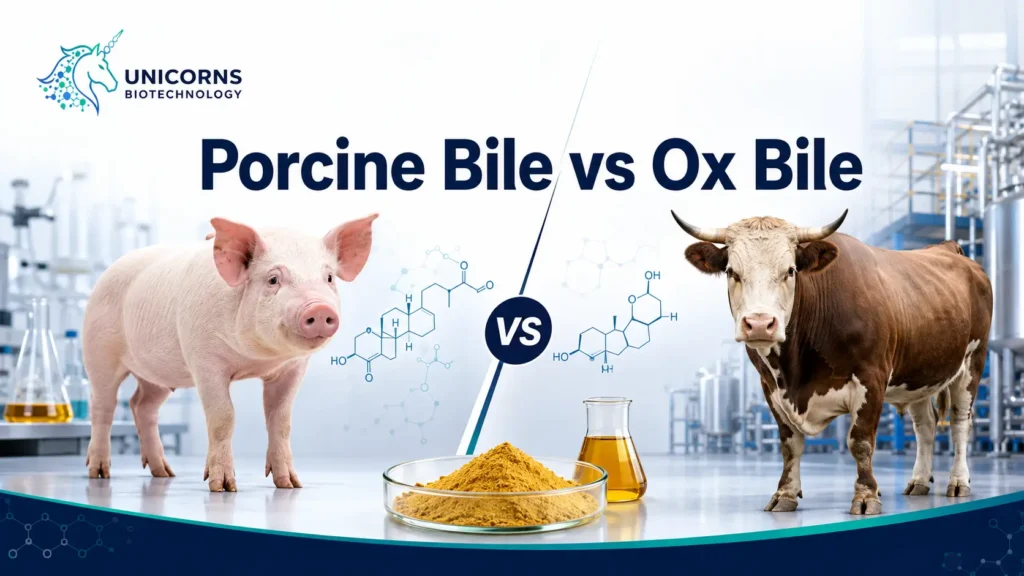
Porcine Bile vs Ox Bile looks like a simple species choice. It is not. Each material has a different bile acid profile, marker assay, compliance burden, and sourcing risk.
Porcine bile comes from pigs. Ox bile comes from cattle. Both materials contain bile acids, bile salts, and other bile components.
Procurement teams should compare signed specifications and batch data. Product names alone tell you little.
Unicorns Biotechnology standardizes its current Porcine Bile Extract to at least 2% taurohyodeoxycholic acid, or THDCA. The company standardizes its main Ox Bile Extract Powder to at least 45% cholic acid. Custom ox bile grades contain at least 25% or 40% cholic acid.
These percentages measure different compounds. They do not show that one product carries more strength or value.
The right choice depends on your formula, market, and test requirements. You also need to review processing, animal origin, cost, and import rules.
Key Takeaways
| Decision area | Main finding |
|---|---|
| Animal source | Porcine bile comes from pigs. Ox bile comes from cattle. |
| Porcine profile | Porcine bile features hyocholic and hyodeoxycholic acid families. |
| Ox bile profile | Ox bile often contains cholic, deoxycholic, and chenodeoxycholic acid families. |
| Unicorns porcine marker | THDCA ≥2% |
| Unicorns ox bile marker | Cholic acid ≥45%, with ≥25% and ≥40% custom grades |
| Percentage comparison | Buyers cannot compare THDCA and cholic acid percentages as equal actives. |
| Processing effect | Hydrolysis, purification and drying can change the bile acid profile. |
| Quality decision | Buyers should review the marker assay, total bile acids and chromatogram. |
| Regulatory decision | Porcine and bovine materials face different animal-origin and religious restrictions. |
| Sourcing decision | Neither source wins every project. The specification should drive the choice. |
Commercial Terms and Product Boundaries
Buyers often use several names for the same product. They also use the same name for different materials.
That creates risk during quotation, sampling, and batch approval.
Porcine Bile Extract and Pig Bile Powder
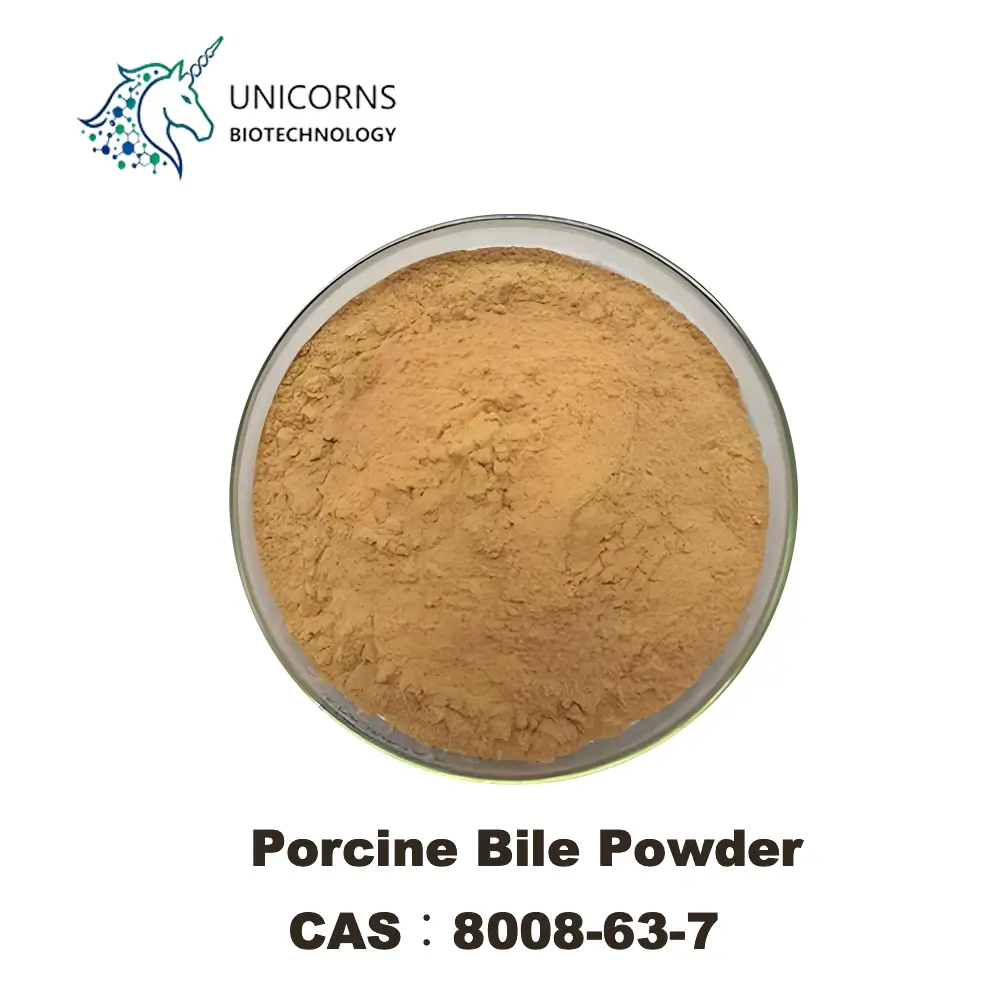
Buyers may call porcine material:
- Porcine Bile Extract
- Porcine Bile Powder
- Pig Bile Extract
- Pig Bile Powder
- Hog Bile Extract
- Dried Porcine Bile
- Porcine Gall Extract
- Pulvis Fellis Suis
“Pig Bile Powder” may describe dried whole bile. “Porcine Bile Extract” may indicate filtration, concentration, or standardization.
Never assume that the two names describe the same grade. Ask for the process flow and signed specification.
Ox Bile Extract and Oxgall Powder
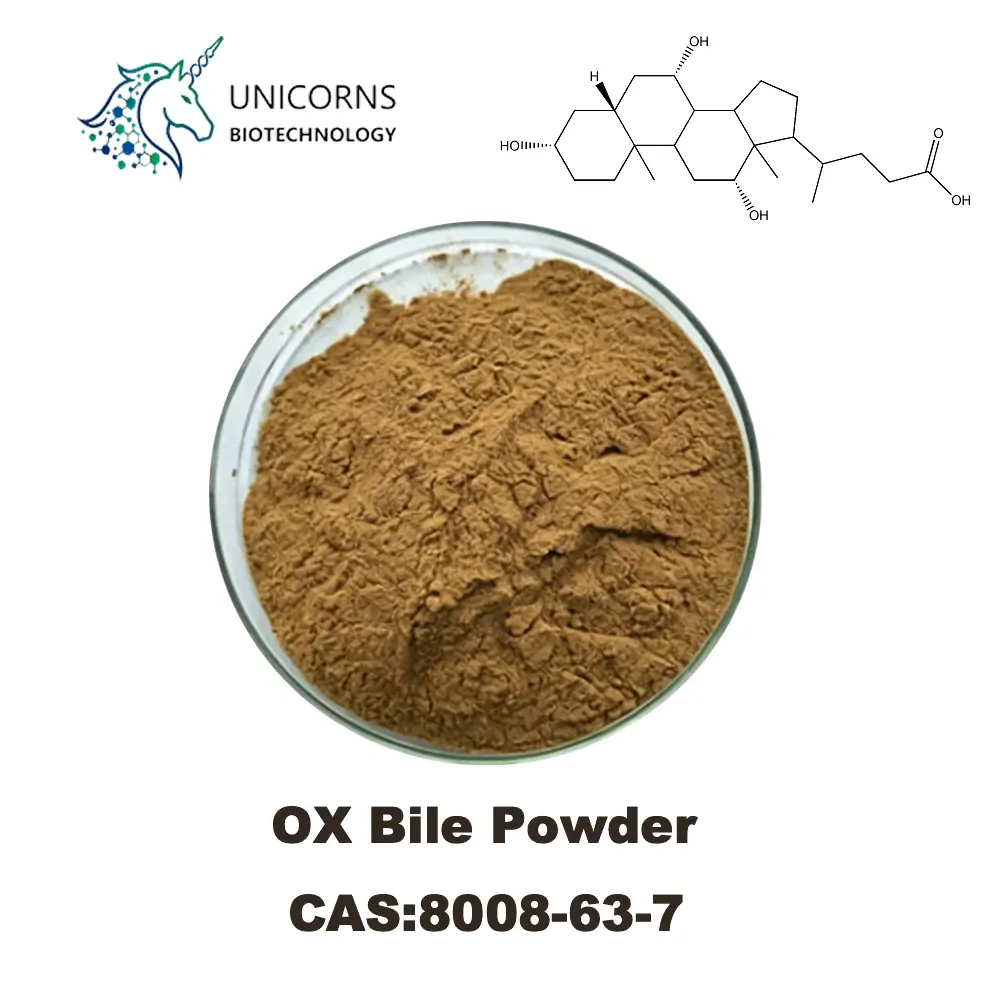
Buyers may call bovine material:
- Ox Bile Extract
- Ox Bile Powder
- Bovine Bile Extract
- Desiccated Ox Bile
- Oxgall Powder
- Ox Gall Extract
- Purified Oxgall
- Fel Bovis
Ox bile extract contains several compounds. It does not equal pure cholic acid.
A supplier may standardize ox bile with cholic acid. That marker helps control the product. It does not turn the extract into one chemical.
Bile Extract, Bile Acids Powder and Purified Bile Acids
The following materials require different specifications.
| Material | Commercial meaning | Main buyer focus |
|---|---|---|
| Whole dried bile | Dried biological bile with limited refinement | Source, moisture and microbiology |
| Bile extract | Filtered, concentrated or standardized bile material | Marker assay and retained bile matrix |
| Bile Acids Powder | Concentrated or purified bile acid fraction | Total bile acids and individual profile |
| Cholic acid | One defined bile acid | Purity, identity and related substances |
| TUDCA | One taurine-conjugated bile acid | Exact chemical form and purity |
| UDCA | One hydrophilic bile acid | Pharmaceutical or research specification |
| Pancreatin | A mixture of digestive enzymes | Lipase, protease and amylase activity |
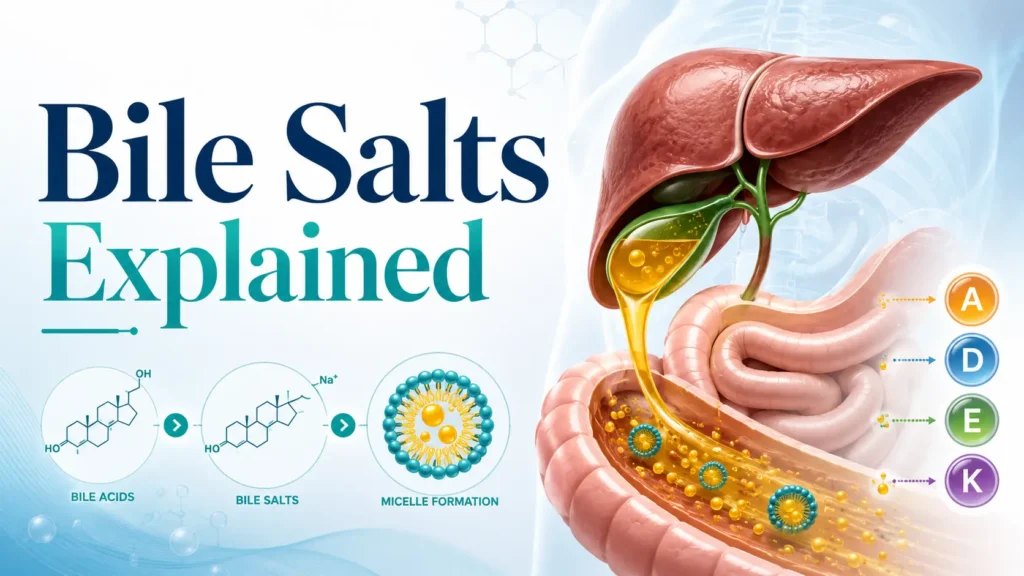
For a wider chemistry guide, read Bile Salts Explained.
Porcine Bile vs Ox Bile at a Glance
| Feature | Porcine Bile Extract | Ox Bile Extract |
|---|---|---|
| Species | Sus scrofa domesticus | Bos taurus |
| Source | Porcine gallbladder bile | Bovine gallbladder bile |
| Characteristic families | Hyocholic and hyodeoxycholic acid families | Cholic, deoxycholic and chenodeoxycholic acid families |
| Unicorns marker | THDCA | Cholic acid |
| Current standard assay | ≥2% THDCA | ≥45% cholic acid |
| Custom grades | Project-specific | ≥25% or ≥40% cholic acid |
| Typical appearance | Yellow powder | Yellow to brownish-yellow powder |
| Taste | Strongly bitter | Strongly bitter |
| Water behavior | Dissolves in water | Current grade dissolves in water |
| Moisture behavior | Hygroscopic and deliquescent | Hygroscopic |
| BSE/TSE review | No bovine BSE concern | Requires bovine-origin review |
| Halal and Kosher | Generally unsuitable | Depends on source and certification |
| Common position | Porcine formulas and specialized bile projects | Bovine digestive formulas |
| Direct substitute | No | No |
This table compares current Unicorns commercial grades. It does not set an industry-wide standard.
Animal Origin and Raw-Material Control
Cattle and pigs produce different bile acid pools. Species creates the first difference. Raw-material handling creates the next one.
Workers collect bile from gallbladders at qualified slaughterhouses. They must control contamination, storage time and temperature.
Poor handling can change the raw bile. Microbes can break conjugated bile acids into free forms. Heat can also alter the material.
Slaughterhouse and Veterinary Controls
A serious supplier should trace each raw-bile lot to its source. The records should identify the slaughterhouse, species and collection date.
The supplier should also review veterinary inspection records. Clean containers and fast transfer help protect the raw material.
Raw-Material Variability
Several factors can change the starting composition:
| Variable | Possible effect |
|---|---|
| Species and breed | Changes the natural bile acid pool |
| Animal diet | May influence relative bile acid levels |
| Age and health | May affect bile composition |
| Gallbladder concentration | Changes water and solid content |
| Collection method | Affects contamination risk |
| Storage time | Can increase degradation |
| Storage temperature | Can change microbial and chemical stability |
| Pooling of raw lots | Can smooth or hide natural variation |
A manufacturer should control these variables. It should also define how it pools and standardizes raw-bile lots.
Supply Availability
Bile supply depends on livestock processing. Animal disease events, import rules and slaughter volumes can disrupt supply.
Procurement teams should ask about safety stock and backup sources. They should also ask how the supplier handles raw-material changes.
Porcine Bile Acid Profile
Porcine bile has a distinct chemical pattern. Hyocholic and hyodeoxycholic acid families help separate it from bovine bile.
The exact ratio varies by raw material and processing. Buyers should avoid universal percentage claims.
Hyocholic Acid
Hyocholic acid, or HCA, belongs to a bile acid family associated with pigs. Commercial porcine bile products may contain HCA and its conjugated forms.
The presence of HCA does not prove a fixed amount. A batch chromatogram should support any quantitative claim.
Hyodeoxycholic Acid
Hyodeoxycholic acid, or HDCA, also marks porcine bile chemistry. Concentrated swine bile acid products often use HDCA as a primary component.
A published feed-grade preparation contained 70.23% HDCA, 7.88% HCA, and 18.01% CDCA. Those numbers describe only the tested preparation. They do not describe every Porcine Bile Extract. The researchers used LC-MS/MS to measure the profile.
Taurohyodeoxycholic Acid
Taurohyodeoxycholic acid combines HDCA with taurine. The industry shortens the name to THDCA.
Unicorns Biotechnology uses THDCA as the marker for its bulk Porcine Bile Extract. The standard grade contains at least 2% THDCA.
That marker does not represent total bile acids. The remaining material may contain other bile acids, pigments, phospholipids, cholesterol, mineral salts and minor proteins.
Other Porcine Bile Components
A porcine bile extract may contain:
| Component group | Examples |
|---|---|
| Porcine bile acids | HCA, HDCA, CDCA and related acids |
| Conjugated bile acids | Taurine-conjugated HCA and HDCA derivatives |
| Bile pigments | Bilirubin and related pigments |
| Lipid components | Phospholipids, cholesterol and fatty acids |
| Minor components | Proteins, mucins and mineral salts |
The manufacturing process changes how much of each group remains.
Ox Bile Acid Profile
Ox bile often contains free and conjugated forms of cholic, deoxycholic and chenodeoxycholic acids.
Manufacturers may hydrolyze, purify, or standardize the material. These steps can change the final profile.
Cholic Acid
Cholic acid carries the abbreviation CA. It uses CAS 81-25-4, the formula C₂₄H₄₀O₅, and a molecular weight of 408.57 g/mol.
Unicorns Biotechnology uses cholic acid as the marker for its Ox Bile Extract Powder. The main grade contains at least 45% cholic acid.
The company also offers custom grades with at least 25% or 40% cholic acid.
These chemical identifiers apply to cholic acid. They do not describe the complete ox bile extract.
Free Bile Acids
Commercial oxgall may contain three main free bile acids:
| Abbreviation | Full name |
|---|---|
| CA | Cholic acid |
| DCA | Deoxycholic acid |
| CDCA | Chenodeoxycholic acid |
The relative amounts can change between manufacturers and batches.
Glycine-Conjugated Bile Acids
Ox bile may contain:
| Abbreviation | Full name |
|---|---|
| GCA | Glycocholic acid |
| GDCA | Glycodeoxycholic acid |
| GCDCA | Glycochenodeoxycholic acid |
Glycine conjugation changes ionization and water behavior.
Taurine-Conjugated Bile Acids
Ox bile may also contain:
| Abbreviation | Full name |
|---|---|
| TCA | Taurocholic acid |
| TDCA | Taurodeoxycholic acid |
| TCDCA | Taurochenodeoxycholic acid |
A 2018 study analyzed three commercial oxgall powders. The researchers detected all nine free and conjugated bile acids listed above.
The three powders had similar total bile-acid content. Yet their individual profiles differed. The ratios of glycine and taurine conjugates also changed. The study shows why buyers should request batch-specific profiles.
Conjugation, Hydrophobicity and Micelle Formation
Bile acid structure affects solubility and detergent behavior. The number and position of hydroxyl groups change hydrophobicity.
Glycine or taurine conjugation also changes ionization. Conjugated bile salts often behave better in watery intestinal conditions.
Free and Conjugated Forms
A free bile acid does not carry glycine or taurine. A conjugated bile acid carries one of these amino acids.
Manufacturing can split that bond. Alkaline hydrolysis often increases the free bile acid fraction.
A non-hydrolyzed extract may retain more conjugated forms. Buyers should confirm this point with data.
Hydrophilic and Hydrophobic Behavior
Bile acids sit across a broad hydrophobicity range. Their structure affects membrane interaction, micelle formation and detergent strength.
A complete extract contains a mixture. Formulators should not judge its performance based on a single bile acid.
The bile acid chemistry review by Hofmann and Hagey explains how hydroxylation and conjugation shape bile acid behavior.
Fat Emulsification
Bile acids have water-compatible and fat-compatible surfaces. This structure lets them gather at the lipid-water interface.
They help break large fat droplets into smaller structures. They also support mixed micelle formation.
Pancreatic lipase then hydrolyzes triglycerides. Bile extracts do not replace lipase.
For a broader review of evidence, see Ox Bile Benefits.
Manufacturing Process and Composition
Species does not tell the whole story. Processing can create large differences within the same species.
A common production flow looks like this:
Qualified bile collection → inspection → filtration → clarification → pH adjustment → purification → concentration → drying → milling → sieving → standardization → testing → packaging
Process Variables
| Process step | Possible effect on the finished powder |
|---|---|
| Raw-bile storage | Changes microbial and chemical stability |
| Filtration | Removes tissue and suspended solids |
| pH adjustment | Changes solubility and separation |
| Hydrolysis | Releases free bile acids from conjugated forms |
| Decolorization | Reduces pigments and some minor compounds |
| Purification | Increases the target fraction |
| Concentration | Raises solids before drying |
| Drying | Creates a stable powder |
| Standardization | Adjusts the marker to its target |
| Blending | Improves batch uniformity |
Broad Bile Extracts
Broad extracts can retain bile pigments, phospholipids, cholesterol, and mineral salts. They may also retain several free and conjugated bile acids.
Their composition depends on purification depth.
Hydrolyzed and Purified Materials
Hydrolysis can increase the levels of free cholic, deoxycholic, or chenodeoxycholic acid. Purification can also remove pigments and lipids.
Some producers hydrolyze oxgall to release cholic acid. They can then use that cholic acid as a starting material for the production of CDCA or UDCA.
A supplement-grade extract does not, by default, qualify as a pharmaceutical intermediate. The pharmaceutical project needs tighter controls and validated specifications.
Cross-Species Controls
A manufacturer that processes bovine and porcine materials needs strong segregation.
It should use clear lot codes, validated cleaning, and controlled material flow. Species testing can support source claims.
PCR can verify porcine or bovine DNA when the method is appropriate for the processed matrix. Chromatographic fingerprints can provide another means of identity verification.
Marker Assay, Total Bile Acids and Full Profile
Procurement teams often confuse three different measurements.
A marker assay measures one selected compound. Total bile acid measurement assesses the combined bile acid fraction. A chromatogram measures individual components.
| Test | What it tells you | What it does not tell you |
|---|---|---|
| THDCA assay | Amount of the selected porcine marker | Complete porcine bile composition |
| Cholic acid assay | Amount of cholic acid | Full ox bile profile |
| Total bile acids | Combined bile acid content | Amount of each bile acid |
| HPLC profile | Individual free or conjugated acids | Finished-product performance |
| LC-MS/MS profile | Detailed identity and quantity | Clinical value |
| Solubility test | Behavior under stated conditions | Complete chemical identity |
Why 2% and 45% Do Not Compare
THDCA and cholic acid have different structures. They also play different roles in the two specifications.
A 2% THDCA result does not equal a 2% total bile-acid result. A 45% cholic acid result does not describe every acid in ox bile.
Buyers should also check the assay basis. Dry-basis and as-is results can differ.
The chemical form matters too. Free acid, conjugated acid, and sodium salt can carry different molecular weights.
Commercial Specification Comparison
The table below summarizes the current Unicorns grades.
| Specification | Porcine Bile Extract | Ox Bile Extract |
|---|---|---|
| Animal source | Healthy porcine bile | Bovine bile |
| Standard marker | THDCA | Cholic acid |
| Standard assay | ≥2.0% | ≥45.0% |
| Custom assay | Project-specific | ≥25% or ≥40% |
| Appearance | Yellow powder | Yellow powder |
| Particle size | ≥95% through 80 mesh | Customizable |
| Loss on drying | ≤5.0% | ≤5.0% |
| Arsenic | ≤2 ppm | ≤1 ppm |
| Lead | ≤2 ppm | ≤1 ppm |
| Cadmium | ≤1 ppm | ≤1 ppm |
| Mercury | ≤0.1 ppm | ≤0.1 ppm |
| Total plate count | ≤1,000 CFU/g | ≤1,000 CFU/g |
| Yeast and mould | ≤100 CFU/g | ≤100 CFU/g |
| E. coli | Negative | Negative |
| Salmonella | Negative | Negative |
| Staphylococcus | Negative | Negative |
| Typical packaging | Foil bags or PE-lined drums | 25 kg PE-lined drum |
| Capacity | 600 tons across relevant bile ingredients | Up to 700 tons annually |
The signed specification controls each order. The batch COA should report the agreed tests and methods.
A website table should never replace a signed quality agreement.
QA and QC Requirements
Strong quality control starts with identity. It then covers composition, contaminants, microbiology and physical performance.
Identity and Species
The quality team should confirm:
| Control | Purpose |
|---|---|
| Animal-origin declaration | Confirms bovine or porcine source |
| Raw-material traceability | Links the finished lot to source records |
| Chromatographic identity | Compares the sample with a reference |
| Species PCR | Screens for bovine or porcine DNA |
| Packaging reconciliation | Prevents label and lot mix-ups |
| Cleaning records | Controls cross-species carryover |
A single test may not answer every identity question. Use a risk-based testing plan.
Bile Acid Analysis
HPLC can measure selected free and conjugated bile acids. LC-MS/MS can provide greater selectivity.
An enzymatic colorimetric method can measure total bile acids. It cannot replace a full chromatographic profile.
The approved specification should name the method and reference standard. It should also state the assay basis.
Physical and Chemical Tests
A B2B specification may cover:
| Test | Procurement value |
|---|---|
| Appearance | Detects visible batch changes |
| Color | Supports consistency |
| Solubility | Guides formulation |
| Loss on drying | Controls moisture |
| Water activity | Supports microbial and stability review |
| Ash | Screens mineral and inorganic content |
| pH | Defines behavior in a stated solution |
| Particle size | Supports blending and filling |
| Bulk density | Helps calculate fill volume |
| Tapped density | Supports packaging and flow review |
Contaminants and Adulteration
Heavy metals form part of the standard panel. Buyers may also request veterinary drug and antibiotic residue tests.
Residual solvent testing depends on the process. A water-based process may not require the same panel as a solvent extraction process.
Targeted methods can also screen for undeclared carriers, synthetic bile acids and foreign species. An unexpected chromatographic peak should trigger an investigation.
Microbiological Control
Animal-derived materials require strict microbial limits. The panel should cover total count, yeast, mould and named pathogens.
Freeze-drying or spray drying does not guarantee sterilization. The manufacturer still needs raw-material controls and validated sanitation.
Batch Consistency
One passing batch does not prove long-term consistency.
Quality teams should compare marker trends and chromatograms across batches. They should also review deviations, complaints and out-of-specification results.
A supply agreement should require notice before the manufacturer changes the source, process, site, method or specification.
Applications Across Industries
Porcine bile and ox bile can serve several markets. The required grade changes with the application.
A supplement extract, feed additive, and pharmaceutical intermediate should not share one loose specification.
Dietary Supplements and Nutraceuticals
Ox Bile Formulas
Manufacturers often place ox bile in capsules and tablets. They may combine it with lipase, pancreatin or other digestive ingredients.
Many brands position ox bile around fat digestion. Some also use it in formulas for people without a gallbladder.
That market use does not prove that every person after gallbladder removal needs ox bile. Formulators should keep claims within local rules and available evidence.
Porcine Bile Formulas
Porcine Bile Extract is suitable for projects that require a pig source or a THDCA marker. It may also fit traditional porcine bile products where local regulations allow.
Do not market porcine bile as a proven liver treatment. A species-specific profile does not support a disease claim.
Combination Formulas
Bile extracts may appear with:
| Ingredient | Main role |
|---|---|
| Pancreatin | Supplies lipase, protease and amylase |
| Lipase | Hydrolyzes triglycerides |
| Protease | Hydrolyzes proteins |
| Amylase | Hydrolyzes starch |
| Pepsin | Supports protein digestion under acidic conditions |
| Betaine HCl | Supports an acidic gastric formula |
| Porcine pancreas powder | Supplies a whole-organ glandular component |
Compatibility matters. Moisture, pH, and storage can damage enzyme activity.
Pharmaceutical and Chemical Intermediates
Selected bile-derived materials can supply starting compounds for further processing.
A producer may hydrolyze oxgall and recover cholic acid. Chemical manufacturers can use cholic acid in routes that lead to CDCA or UDCA.
Porcine bile can also support projects targeting HDCA, HCA, or related compounds.
These applications require a purpose-built specification. Buyers may need tighter impurity limits, residual solvent data and related-substance profiles.
The supplier must also control traceability and change management. A supplement COA alone will not support a pharmaceutical project.
For a comparison of a natural bile extract and one defined bile acid, read Ox Bile vs TUDCA.
Microbiological and Research Uses
Laboratories often use oxgall in probiotic bile-tolerance tests. Culture-media developers may also use bile components as selective agents.
Researchers also study bile salt hydrolase activity, membrane transport and bile-acid metabolism.
The 2018 oxgall study found significant differences in profiles among commercial powders. Research teams should therefore specify the required bile acid pattern.
A broad name such as “oxgall” does not guarantee repeatable research conditions.
Feed Additives and Animal Nutrition
Porcine bile-acid products serve poultry, swine, aquaculture and other feed markets.
Feed formulators may use them in fat utilization and energy management systems. However, concentrated Bile Acids Powder differs from broad Porcine Bile Extract.
Researchers tested a swine-derived bile-acid preparation in laying hens. The preparation supported fat emulsification and vitamin A utilization under the study conditions. The results apply to that feed material and animal model.
Do not transfer those results to every porcine extract. Do not convert animal data into human treatment claims.
Feed buyers should confirm the intended species, dose, carrier, total bile acids, and local feed-additive status.
Formulation and Dosage Forms
Both materials create practical formulation problems. They taste bitter and absorb moisture.
A good formula controls those properties from the first pilot batch.
Taste Control
Capsules provide the simplest taste barrier. Film-coated tablets can also reduce direct exposure.
Powder drinks and chewables create greater challenges. The taste of bile can overpower common flavors.
Microencapsulation may help. It will also raise cost and change release behavior.
Moisture Control
Porcine Bile Extract can deliquesce in air. Ox Bile Extract also absorbs moisture.
Run dispensing and blending under controlled humidity. Keep intermediate containers closed.
Use moisture-barrier liners and desiccants where suitable. Reclose each package after sampling.
Capsule and Tablet Performance
An 80-mesh powder may support blending and filling. Mesh size alone does not guarantee flow.
Measure bulk density, tapped density, and flowability. Then calculate the expected capsule fill.
Tablet developers should test compressibility and ejection. They may need a carrier, glidant or binder.
Enzyme Compatibility
Moisture can reduce digestive enzyme stability. Acidic ingredients may also change activity.
Test the complete formula, not each ingredient alone. Run accelerated and real-time stability studies.
A finished-product assay should confirm enzyme activity when the label declares it.
Packaging and Storage
| Packaging control | Purpose |
|---|---|
| Aluminum foil bag | Protects smaller quantities from moisture |
| PE-lined fiber drum | Supports bulk storage and transport |
| Desiccant | Reduces moisture inside the package |
| Light barrier | Protects color and sensitive components |
| Tight closure | Limits humidity and contamination |
| Lot label | Preserves traceability |
Store the powder in a cool, dry place. Keep it away from heat, humidity and strong odors.
Regulatory and Religious Requirements
Animal-derived ingredients can trigger compliance with food, supplement, feed, pharmaceutical, and animal-health rules.
Classification depends on the country, species, processing method and intended use.
United States
FDA’s 21 CFR Part 111 requires dietary supplement manufacturers to set component specifications and verify identity. Manufacturers must also qualify supplier COAs before they rely on them. FDA explains these duties in its dietary supplement CGMP guide.
USDA APHIS controls many animal-derived imports. Some materials need a permit, treatment proof or other documentation. APHIS advises importers to check the exact commodity and animal-health risk.
Do not ship before the importer confirms eligibility.
European Union
EU rules may require animal health or official certificates for products of animal origin. The exact route depends on product classification and end use.
Importers should confirm the approved country, establishment and certificate model before production. The European Commission publishes current animal-product movement requirements.
Bovine BSE/TSE Review
Bovine origin triggers a BSE/TSE review. The buyer should request the country of origin, slaughterhouse approval, and animal-origin declaration.
The file may also need a BSE/TSE statement and specified-risk-material controls. Destination rules determine the final document set.
FDA prohibits certain cattle materials in human food, supplements and cosmetics. Buyers should confirm that the source and tissue comply with these restrictions. FDA summarizes the prohibited cattle materials.
Porcine Animal-Health Review
Porcine material does not create a bovine BSE concern. It still needs animal-health controls.
Buyers should review slaughterhouse approval, species identity, pathogens and veterinary residues. They should also confirm import eligibility.
“BSE-free” does not mean “risk-free.”
Halal and Kosher Markets
Porcine bile does not fit Halal or Kosher products.
Bovine origin alone does not make ox bile Halal or Kosher. Certification depends on the source, slaughter, segregation and processing.
Ask for a valid certificate with the correct product scope. Do not rely on a supplier logo.
Claims Control
Avoid claims that bile extracts:
- Treat gallbladder disease
- Dissolve gallstones
- Treat hepatitis
- Treat cholestasis
- Detoxify the liver
- Cure digestive disease
- Replace medical care after gallbladder surgery
Structure-and-function claims require evidence and legal review. Pharmaceutical claims require separate approval.
Export and Technical Documents
A serious B2B file should cover product quality, animal origin, and shipment requirements.
| Document | Main purpose |
|---|---|
| Batch COA | Reports results for the shipped lot |
| Signed specification | Defines agreed limits and methods |
| TDS | Describes technical properties |
| SDS or MSDS | Supports safe handling |
| Manufacturing flow chart | Shows the production route |
| Country-of-origin certificate | Supports customs and origin review |
| Animal-origin statement | Confirms porcine or bovine source |
| BSE/TSE statement | Supports bovine risk review |
| Veterinary or health certificate | Supports animal-health entry where required |
| Allergen statement | Supports label and risk review |
| Non-GMO statement | Supports buyer documentation |
| Non-irradiation statement | Confirms irradiation status |
| Residue statement | Covers antibiotics or veterinary drugs |
| Residual solvent statement | Supports process review |
| Stability data | Supports shelf-life decisions |
| Packaging specification | Defines pack materials and net weight |
| Third-party report | Provides independent test data |
| Change-control statement | Requires notice before material changes |
The buyer should define the document list before ordering. Late document requests can delay shipment.
Cost and Supply-Chain Analysis
The lowest price per kilogram may not produce the lowest finished-product cost.
Assay, testing, freight, and formulation loss can change the result.
Cost per Marker Gram
Use this formula when one marker drives the specification:
\frac{\text{Price per kilogram}}
{\text{Marker fraction} \times 1000}
]
For a 45% cholic acid grade, use 0.45 as the marker fraction. For a 2% THDCA grade, use 0.02.
Do not compare the two answers as equal active costs. THDCA and cholic acid are different compounds.
The calculation only helps when that marker has commercial value for the project.
Total Landed Cost
| Cost item | Why it matters |
|---|---|
| Raw-material price | Sets the starting cost |
| Custom assay | Adds laboratory expense |
| Third-party testing | Adds release time and cost |
| Packaging | Changes freight and storage |
| Import permits | May add fees and lead time |
| Freight and duties | Affect landed cost |
| Rejected-lot risk | Can stop production |
| Formulation loss | Reduces usable yield |
| Stability controls | Add packaging and testing cost |
| MOQ | Affects cash and inventory |
Supply Risks
Procurement teams should review raw-bile availability, animal disease events, and regulatory changes.
They should also assess cross-species contamination, long lead times and single-source dependence.
An annual agreement should define forecast volumes, reserved capacity and change notification. It should also cover complaints, rejected lots and recalls.
Supplier Qualification Framework
A low quotation does not qualify a supplier.
Procurement and quality teams should inspect the source, plant, process and records.
| Qualification area | Questions to ask |
|---|---|
| Manufacturer identity | Who processes and releases the powder? |
| Raw source | Which slaughterhouses supply the bile? |
| Traceability | Can the supplier trace one drum back to its raw lot? |
| Species control | How does the plant prevent porcine and bovine mix-ups? |
| Assay method | Which method and reference standard support the marker? |
| Profile control | Can the supplier provide an HPLC or LC-MS profile? |
| Batch consistency | How does the supplier compare batches? |
| Cleaning | Does the plant validate cleaning between species? |
| Capacity | Can the plant support forecast volume? |
| Change control | Will the supplier report source or process changes? |
| Third-party testing | Can an accredited laboratory confirm the result? |
| Regulatory support | Can the supplier provide destination-specific documents? |
Sample Qualification
Start with an approved draft specification. Then request a representative sample and matching COA.
Run identity, marker and contaminant tests. Compare the chromatogram with the supplier’s data.
Next, test the material in the real formula. Review flow, taste, moisture and stability.
Approve the first commercial batch against the qualified sample. Requalify the supplier at planned intervals.
Authenticity Checks
Species PCR can support animal-origin verification. HPLC can compare bile-acid fingerprints.
Testing can also screen for undeclared carriers and synthetic acids. Ash and mineral data may reveal unexpected material.
No single test proves full authenticity. Use several controls when the risk justifies them.
Selection Guide for B2B Buyers
| Project requirement | More likely starting point |
|---|---|
| Formula requires a porcine source | Porcine Bile Extract |
| THDCA drives the specification | Porcine Bile Extract |
| HCA or HDCA profile matters | Porcine-derived material |
| Formula requires standardized cholic acid | Ox Bile Extract |
| Existing formula names ox bile | Ox Bile Extract |
| Bovine source supports the product position | Ox Bile Extract |
| Market prohibits porcine material | Ox Bile, subject to certification |
| Project excludes bovine material | Porcine bile, if local rules allow it |
| Halal or Kosher market | Avoid porcine material and verify bovine certification |
| Formula needs high total bile acids | Consider concentrated Bile Acids Powder |
| Project needs one chemical | Choose the relevant purified bile acid |
| Research needs repeatable composition | Select by chromatogram |
| Project needs a pharmaceutical intermediate | Use a qualified intermediate grade |
| Cost drives the decision | Compare landed cost and usable assay |
Neither material wins every row.
Start with the intended use. Then define the chemical and regulatory specification.
Unicorns Biotechnology Supply Capabilities
Unicorns Biotechnology manufactures animal-derived powders and extracts in Henan, China.
The company states that its factory covers about 130 acres. It also reports GMP-compliant manufacturing and more than 5,000 tons of animal powders exported across its full portfolio.
Unicorns sources raw animal materials from government-certified slaughterhouses under official veterinary oversight. The company controls processing, standardization, testing, packaging and export documents.
The current bile portfolio includes:
| Product | Standard commercial offer |
|---|---|
| Porcine Bile Extract | THDCA ≥2% |
| Ox Bile Extract Powder | Cholic acid ≥45% |
| Custom Ox Bile Extract | Cholic acid ≥25% or ≥40% |
| Bile Acids Powder | Total or individual bile-acid specifications |
| Cholic Acid | Defined chemical raw material |
| TUDCA | High-purity defined bile acid |
| Bilirubin | Specialty bile pigment raw material |
The company lists 600 tons of annual capacity across relevant porcine bile-derived ingredients. It lists up to 700 tons for Ox Bile Extract.
Packaging options range from evaluation packs to 25 kg drums. Unicorns also supports custom specifications, third-party testing and OEM production.
Buyers can request capsules, tablets, powder blends and private-label packaging. They can also request COAs, specifications, SDS files and animal-origin documents.
Review the Unicorns Biotechnology factory and its guide to choosing a glandular powder manufacturer before supplier approval.
Frequently Asked Questions
Is porcine bile the same as ox bile?
No. Porcine bile comes from pigs, while ox bile comes from cattle.
The two materials contain different characteristic bile-acid families. They also require different origin and regulatory documents.
Which is better, porcine bile or ox bile?
Neither source wins every application.
Choose the material that matches your marker, profile, formula, market and document requirements.
Is 45% cholic acid stronger than 2% THDCA?
No direct comparison works.
The two assays measure different compounds. They do not express equal units of function or potency.
What distinguishes the porcine bile acid profile?
Porcine bile often features HCA, HDCA and their derivatives. THDCA can also serve as a commercial marker.
The exact profile depends on the raw material and process.
What distinguishes the ox bile acid profile?
Ox bile often contains CA, DCA and CDCA families. It may contain both glycine- and taurine-conjugated forms.
Commercial oxgall profiles can differ between manufacturers.
What is THDCA?
THDCA means taurohyodeoxycholic acid. It combines HDCA with taurine.
Unicorns uses THDCA as the marker for its current Porcine Bile Extract.
What is the difference between HDCA and THDCA?
HDCA means hyodeoxycholic acid. THDCA means its taurine-conjugated form.
They have different molecular identities and test methods.
Do porcine bile and ox bile have CAS numbers?
Ox bile extract often uses CAS 8008-63-7 as a mixture. Cholic acid uses CAS 81-25-4.
Do not assign the marker’s CAS number to the whole extract. Porcine Bile Extract also contains a mixture and has no single fixed formula.
Is Ox Bile Extract the same as cholic acid?
No. Ox Bile Extract contains several bile acids and other bile components.
Cholic acid is one defined compound and a common standardization marker.
Are bile extracts the same as Bile Acids Powder?
No. A bile extract may retain pigments, phospholipids, and other bile components.
Bile Acids Powder typically contains a more concentrated bile acid fraction.
Can porcine bile replace ox bile?
Not without a new technical review.
The formulator must compare the profile, marker, dose, label and regulatory status.
Can ox bile replace porcine bile?
Not as a drop-in replacement.
A formula that specifies THDCA or porcine origin may not accept ox bile.
Can bile extracts work with pancreatin or lipase?
Yes. Many digestive formulas combine bile extracts with enzymes.
The developer should test pH, moisture, enzyme activity, and stability.
Is porcine bile Halal or Kosher?
No. Porcine ingredients do not align with Halal or Kosher requirements.
Can ox bile qualify as Halal or Kosher?
It may qualify if the source, slaughter, and processing meet the required standard.
The buyer should verify that the certificate is current and has the correct scope.
Does ox bile require BSE/TSE documentation?
Bovine-origin projects often require BSE/TSE and animal-origin documents.
The exact requirements depend on the market and intended use.
Which bile source suits pharmaceutical intermediate production?
The process target should decide the source.
A project that targets cholic acid may start with qualified oxgall. A project that targets HDCA may favor a porcine source.
Which tests should appear on the COA?
The COA should report the agreed marker, identity, moisture, contaminants and microbiology.
It may also report total bile acids, individual profiles, particle size or residual solvents.
How should bulk bile extracts be stored?
Store them in sealed moisture-barrier packaging. Keep them in a cool and dry area.
Limit exposure during sampling and production.
What information should buyers include in an inquiry?
State the required species, marker assay and intended application.
Also provide the annual quantity, particle size, packaging, destination country and required documents.
Final Sourcing Decision
Porcine Bile vs Ox Bile requires more than a species comparison.
Porcine bile exhibits HCA-, HDCA-, and THDCA-related chemistry. Ox bile brings cholic, deoxycholic, and chenodeoxycholic acid families.
Manufacturing can change both profiles. Hydrolysis, purification, and standardization may create large differences within a single species.
Do not compare 2% THDCA with 45% cholic acid as equal actives. Compare the agreed specification, chromatogram and intended use.
Then review animal origin, formulation behavior, import rules and total landed cost.
Contact Unicorns Biotechnology to request current specifications, batch COAs, samples and chromatographic testing options. The technical team can also prepare a custom bulk quotation based on your marker, profile, quantity, and destination market.
References
- Hofmann, A. F., & Hagey, L. R. (2014). Key discoveries in bile acid chemistry and biology and their clinical applications: History of the last eight decades. Journal of Lipid Research, 55(8), 1553–1595. https://doi.org/10.1194/jlr.R049437
- Hu, P. L., Yuan, Y. H., Yue, T. L., & Guo, C. F. (2018). Bile acid patterns in commercially available oxgall powders used for the evaluation of the bile tolerance ability of potential probiotics. PLOS ONE, 13(3), e0192964. https://doi.org/10.1371/journal.pone.0192964
- Yang, B., Huang, S., Yang, N., Cao, A., Zhao, L., Zhang, J., Zhao, G., & Ma, Q. (2022). Porcine bile acids promote the utilization of fat and vitamin A under low-fat diets. Frontiers in Nutrition, 9, 1005195. https://doi.org/10.3389/fnut.2022.1005195
- Yang, B., et al. (2022). Safety evaluation of porcine bile acids in laying hens: Effects on laying performance, egg quality, blood parameters, organ indices and intestinal development. Frontiers in Veterinary Science, 9, 895831. https://doi.org/10.3389/fvets.2022.895831
- U.S. Food and Drug Administration. (2024). Small entity compliance guide: Current good manufacturing practice in manufacturing, packaging, labeling, or holding operations for dietary supplements. FDA dietary supplement CGMP guidance
- U.S. Department of Agriculture, Animal and Plant Health Inspection Service. (2026). Animal product imports. USDA APHIS
- European Commission. (2026). Animal products movements. European Commission food safety guidance