
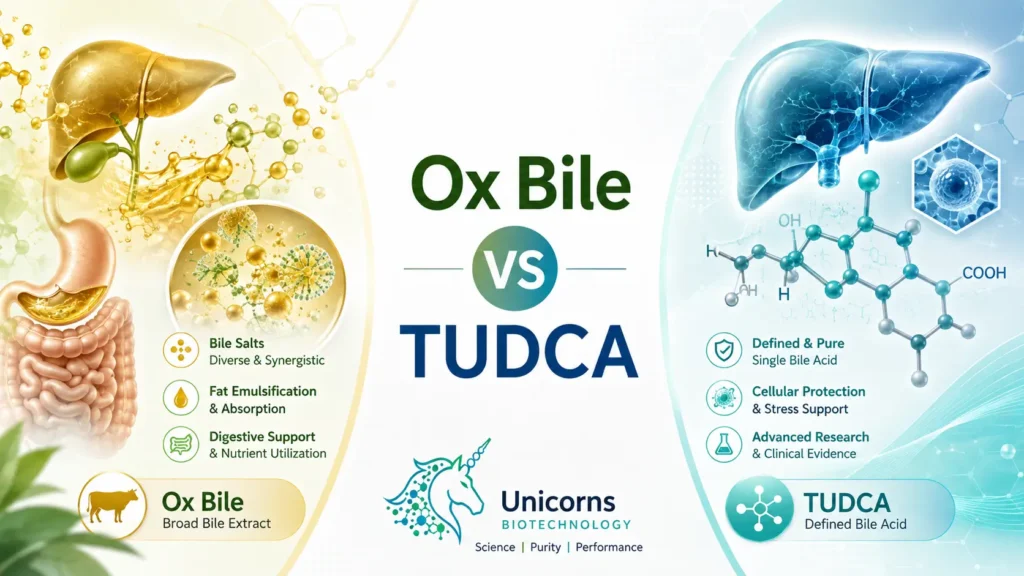
Ox Bile vs TUDCA is a common comparison because both ingredients belong to the world of bile acids and bile salts, yet they are very different materials. Ox bile is a natural bovine bile extract that contains a mixture of bile acids, conjugated bile salts, and other bile constituents. TUDCA, or tauroursodeoxycholic acid, is one defined taurine-conjugated bile acid.
The easiest way to understand the difference is this: ox bile is a broad bile-derived mixture used mainly for digestive bile support, while TUDCA is a specific bile acid with a much larger research base in liver, bile-acid, metabolic, and cellular biology.
That does not mean TUDCA is simply a “stronger ox bile” or that ox bile is a crude form of TUDCA. They differ in chemical identity, source, standardization, physical properties, research evidence, and common formulation goals.
This guide compares ox bile vs TUDCA for fat digestion, liver health, bile flow, gallbladder removal, nutrient absorption, ER stress, metabolic health, brain research, dosage, side effects, and supplement formulation.
Key Takeaways
Ox bile is a multi-component bovine bile extract. TUDCA is one defined bile acid molecule.
Ox bile has the more direct role when a formulation is designed around fat emulsification, mixed micelles, fat digestion, and absorption of fat-soluble nutrients.
TUDCA has the stronger research base for liver and hepatobiliary health, hydrophilic bile-acid biology, ER stress, mitochondrial function, insulin sensitivity, and other cellular pathways.
Neither ox bile nor TUDCA is a digestive enzyme.
They are not direct substitutes, and 500 mg of ox bile is not chemically equivalent to 500 mg of TUDCA.
Ox Bile vs TUDCA at a Glance
| Feature | Ox Bile | TUDCA |
|---|---|---|
| Full name | Ox bile / bovine bile extract | Tauroursodeoxycholic acid |
| Ingredient type | Natural biological mixture | Defined conjugated bile acid |
| Main source | Bovine bile | Purified or manufactured defined compound |
| CAS number | 8008-63-7 for ox bile extract | 14605-22-2 for TUDCA free acid |
| Molecular formula | No single formula, it is a mixture | C26H45NO6S |
| Molecular weight | No single molecular weight | 499.70 g/mol |
| Main components | Multiple bile acids, bile salts, phospholipids, cholesterol and minor constituents | One defined molecule |
| Main formulation role | Broad digestive bile support | Specialized bile-acid and cellular formulations |
| Fat digestion | Strong direct role | Narrower role |
| Liver research | Limited direct ox bile research | Much larger research base |
| ER stress research | Limited | Extensive |
| Digestive enzyme | No | No |
| Typical standardization | Cholic acid, total bile acids or bile-acid profile | TUDCA purity |
| Animal-derived | Yes | Depends on manufacturing route |
| Typical formats | Powder, capsules, tablets, digestive blends | Powder, capsules, tablets |
| Research context | Fat absorption and bile-acid replacement | Liver, metabolism, ER stress, mitochondria and neurobiology |
FDA lists ox bile extract under CAS 8008-63-7 and describes it as purified oxgall rather than a single pure chemical. PubChem lists TUDCA as a defined compound with CAS 14605-22-2, molecular formula C26H45NO6S, and molecular weight 499.7 g/mol.
Chemical and Physical Differences Between Ox Bile and TUDCA
One of the biggest differences between ox bile and TUDCA becomes clear before we even discuss benefits: one is a mixture and the other is a defined chemical compound.
Ox Bile vs TUDCA Chemical Identity
| Property | Ox Bile Extract | TUDCA |
|---|---|---|
| Chemical identity | Complex biological extract | Single defined bile acid |
| CAS number | 8008-63-7 | 14605-22-2 |
| Molecular formula | Not applicable to the whole mixture | C26H45NO6S |
| Molecular weight | No single value | 499.70 g/mol |
| Chemical structure | Many compounds | Defined steroid-derived bile acid structure |
| Major marker | Often cholic acid or total bile acids | TUDCA itself |
| Batch uniformity | Requires standardization | High when supplied at defined purity |
| Typical purity concept | Assay of selected marker or bile-acid fraction | Often ≥99% TUDCA |
This distinction is important for ingredient buyers.
A natural ox bile powder can have a CAS number as a material, but it cannot have one molecular formula or molecular weight for the whole extract. Those properties apply only to individual components such as cholic acid.
For example, Unicorns Biotechnology’s Ox Bile Extract Powder uses cholic acid as a standardized marker. The site distinguishes CAS 8008-63-7 for whole ox bile extract from CAS 81-25-4 for pure cholic acid.
TUDCA is different. High-purity Tauroursodeoxycholic Acid Powder can be defined by molecular identity, purity, related substances, and chemical form. Unicorns Biotechnology’s standard material is ≥99% TUDCA.
Physical Appearance and Solubility
Ox bile extract is typically yellow to yellowish-brown or yellowish-green, depending on its processing and specification. FDA describes purified ox bile extract as a yellowish-green material, while Unicorns Biotechnology supplies its commercial ox bile extract as a yellow powder.
TUDCA free acid is a much more chemically uniform material. Unicorns Biotechnology’s specification describes it as white crystals. Its solubility depends strongly on chemical form, so formulators should not assume that TUDCA free acid, TUDCA sodium salt, and hydrated TUDCA have identical physical behavior.
TUDCA Free Acid vs Sodium Tauroursodeoxycholate
“TUDCA” can refer loosely to several related commercial forms.
| Form | CAS Number | Molecular Formula | Molecular Weight |
|---|---|---|---|
| Tauroursodeoxycholic acid | 14605-22-2 | C26H45NO6S | 499.70 g/mol |
| Sodium tauroursodeoxycholate | 35807-85-3 | C26H44NNaO6S | 521.69 g/mol |
| TUDCA dihydrate | 117609-50-4 | C26H45NO6S·2H2O | 535.73 g/mol |
The form matters because water content, sodium content, solubility, molecular weight, and assay calculation can change. Finished-product manufacturers should confirm the exact CAS number and chemical form rather than relying only on the word “TUDCA.”
Bile, Bile Acids, Bile Salts, Ox Bile and Digestive Enzymes
Before comparing ox bile and TUDCA by benefit, it helps to separate several terms that are often mixed together.
Bile is the complete digestive fluid made by the liver. It contains water, bile acids and bile salts, phospholipids, cholesterol, bilirubin, electrolytes, and other components.
Bile acids are steroid-derived compounds formed from cholesterol.
Bile salts generally refers to conjugated, ionized bile acids. In humans, bile acids are commonly conjugated with glycine or taurine.
Ox bile is bovine bile material containing a mixture of these compounds.
TUDCA is one specific taurine-conjugated bile acid.
Digestive enzymes, such as lipase, protease, and amylase, are proteins that catalyze the chemical breakdown of nutrients.
Bile salts and enzymes therefore work together, but they do different jobs. For a more detailed explanation, see Bile Salts Explained.
What Is Ox Bile?
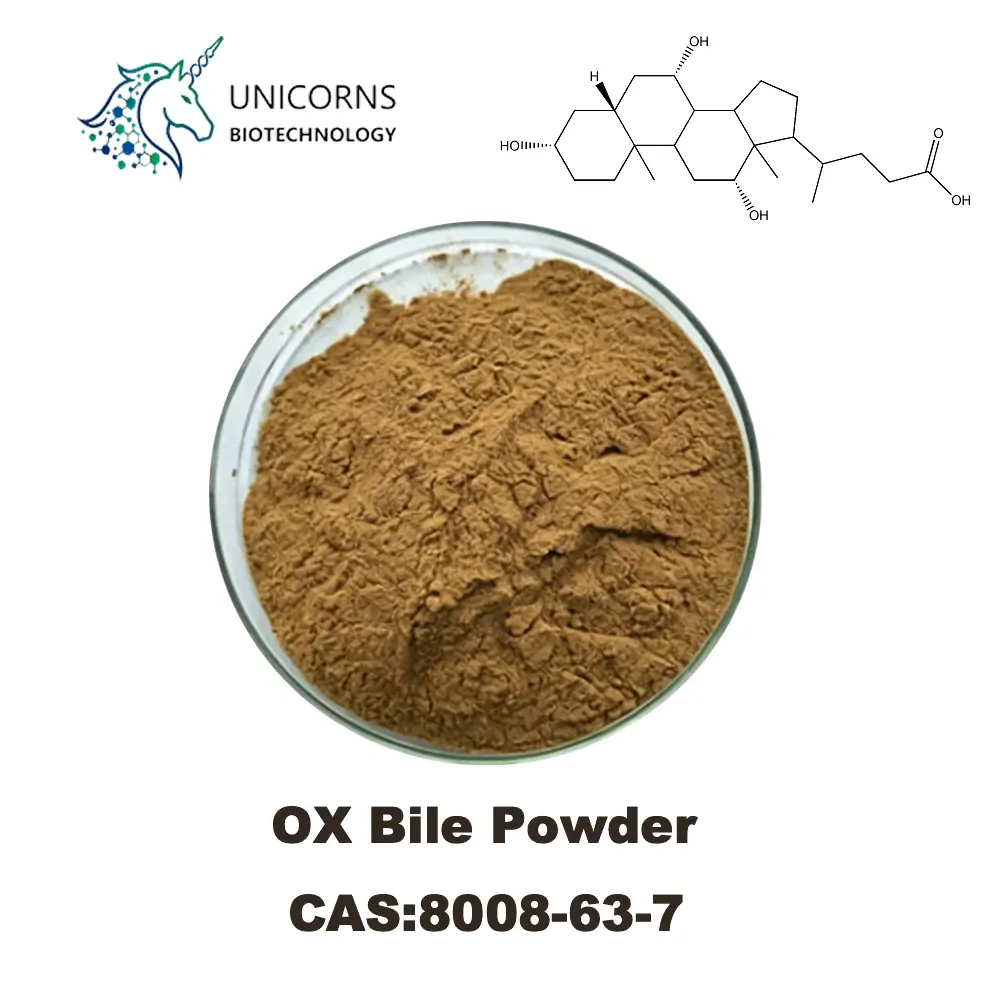
Ox bile, also called bovine bile, cow bile, ox gall, oxgall, bovine bile extract, or ox bile extract powder, comes from cattle.
It is not one chemical compound. It is a natural mixture.
Ox bile may contain cholic acid, conjugated cholic acid derivatives such as glycocholate and taurocholate, other bile acids, phospholipids, cholesterol, pigments, minerals, and minor bile components. The exact bile-acid profile depends on the raw material and manufacturing process.
How Does Ox Bile Work?
The main digestive role of ox bile comes from its bile acids and bile salts.
Dietary fat does not mix well with water. Bile salts are amphipathic molecules, meaning that one part can interact with water while another part interacts with lipids.
This allows them to disperse large fat droplets and help create mixed micelles.
The process can be simplified as:
Dietary fat → bile-salt emulsification → pancreatic lipase → fatty acids and monoglycerides → mixed micelles → intestinal absorption
Ox bile does not chemically cut triglycerides apart. Pancreatic lipase does that.
Human reports have shown that ox bile can increase fat absorption when the normal bile acid pool is severely depleted, such as after extensive ileal surgery. These are specialized clinical situations, not proof that everyone needs ox bile.
For a deeper evidence review, see Ox Bile Benefits.
What Is TUDCA?
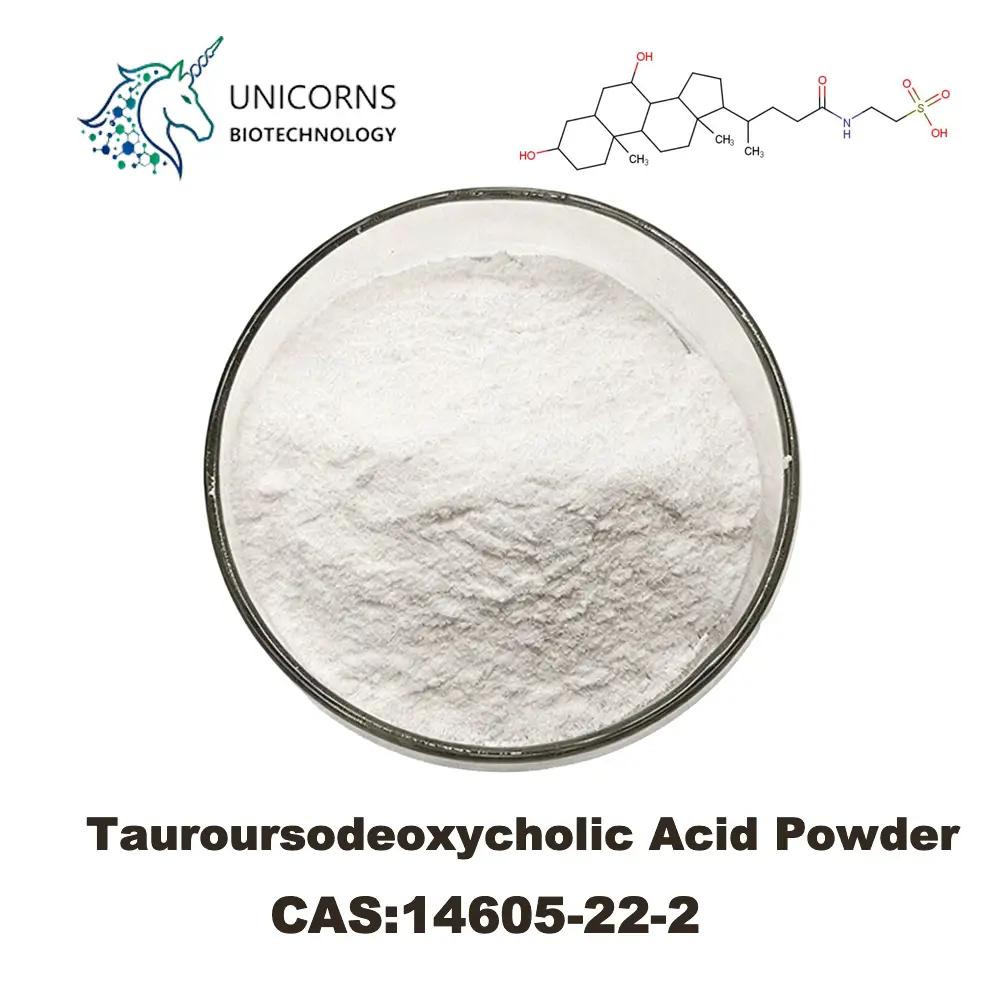
TUDCA stands for tauroursodeoxycholic acid.
It is the taurine-conjugated form of ursodeoxycholic acid, or UDCA:
UDCA + taurine → TUDCA
TUDCA is a relatively hydrophilic bile acid. The human body contains small amounts of it within the larger bile-acid pool.
Unlike ox bile, TUDCA can be studied as one specific molecule.
Researchers have examined TUDCA in relation to liver and bile biology, endoplasmic reticulum stress, protein folding, mitochondria, apoptosis, insulin sensitivity, cardiovascular function, and neurobiology.
For a full evidence review, see TUDCA Benefits.
Ox Bile vs TUDCA: 12 Key Differences
1. Ox Bile Is a Natural Mixture, TUDCA Is a Defined Molecule
This is the most important difference.
Ox bile may contain many bile acids and bile salts at the same time. Its value in formulation comes partly from this broad mixture.
TUDCA provides one defined chemical species.
This affects how the ingredients are tested. A TUDCA specification can state a purity such as 99%. Ox bile needs different quality markers, such as cholic acid assay, total bile acids, or a chromatographic bile-acid profile.
2. Ox Bile Has More Batch Variation Than High-Purity TUDCA
Natural biological extracts vary.
Bovine source, diet, raw-bile composition, processing method, hydrolysis, concentration, drying, and blending can all affect a finished ox bile extract.
That is why an ingredient labeled simply “500 mg ox bile” does not tell the whole story.
A high-purity TUDCA ingredient should be far more chemically consistent from batch to batch because the target is one defined molecule.
3. Ox Bile Is Inherently Animal-Derived, TUDCA Depends on Its Manufacturing Route
Ox bile comes from cattle. It is always animal-derived.
Commercial TUDCA can be produced through different chemical, semi-synthetic, purification, or enzyme-assisted routes. A product should not be described as vegan or animal-free unless the supplier can document its actual starting materials and production route.
For B2B buyers, this means the source statement matters as much as the product name.
4. Ox Bile Provides Broad Bile Support, TUDCA Provides One Targeted Bile Acid
A useful way to think about Ox Bile vs TUDCA is “broad mixture vs targeted molecule.”
Ox bile provides a wider range of bile-derived compounds.
TUDCA gives formulators one specific taurine-conjugated bile acid with a defined molecular dose.
This is why the two ingredients often appear in different types of supplements even though both belong to bile-acid biology.
Ox Bile vs TUDCA for Fat Digestion
When the primary goal is fat digestion, ox bile has the more direct formulation role.
Bile salts help disperse dietary fat and support formation of mixed micelles. These actions allow pancreatic lipase to work at the fat-water interface and help lipid digestion products move toward the intestinal lining.
Ox bile supplies a broad mixture of bile-derived compounds that can take part in this process.
TUDCA also belongs to the bile-acid pool, but it is one individual bile acid. It does not reproduce the broader composition of natural bovine bile.
For broad bile-related fat digestion, ox bile is generally the more direct fit.
That does not mean TUDCA has no digestive role. It means its main value and research history are different.
Ox Bile vs TUDCA for Fat-Soluble Vitamins A, D, E and K
Normal bile acid activity is important for absorption of vitamins A, D, E, and K.
These nutrients are fat-soluble. They depend on normal lipid digestion and micellar solubilization to move efficiently through the intestinal environment. Bile salts are central to this process.
Ox bile has a straightforward formulation rationale when the goal is broad support for bile-mediated lipid and fat-soluble nutrient absorption.
TUDCA can participate in the bile-acid system but represents only one molecule within a much larger natural bile-acid pool.
Ox Bile vs TUDCA for Liver Health
When the main question shifts from digestion to liver and hepatobiliary research, TUDCA has the stronger evidence base.
Direct ox bile human research is relatively limited. Much of it involves bile-acid depletion, steatorrhea, and fat malabsorption.
TUDCA has been studied much more widely in liver-related contexts.
A randomized trial of 199 patients with primary biliary cholangitis compared TUDCA with UDCA for 24 weeks. Both groups showed similar improvements in alkaline phosphatase, AST, and total bilirubin.
TUDCA is also widely studied for cellular mechanisms that may matter in liver injury, including ER stress, mitochondrial stability, oxidative stress, inflammation, and apoptosis.
For liver-focused research and specialized hepatobiliary formulations, TUDCA has the stronger scientific foundation.
This does not make TUDCA a universal treatment for liver disease.
Ox Bile vs TUDCA for Bile Flow and Bile Composition
Both ingredients relate to bile, but in different ways.
Ox bile adds bile-derived compounds directly to the intestinal lumen.
TUDCA is one hydrophilic bile acid and can influence the composition of the body’s bile-acid pool after absorption and enterohepatic recycling.
This is why statements such as “TUDCA thins toxic bile” can be misleading.
A more accurate explanation is that TUDCA can increase the relative contribution of a more hydrophilic bile acid in the overall pool and has been studied in cholestatic hepatobiliary conditions.
The difference is therefore not simply “ox bile helps digestion while TUDCA makes more bile.” Neither statement fully describes what happens.
Ox Bile vs TUDCA After Gallbladder Removal
Ox bile vs TUDCA after gallbladder removal is one of the most common questions in this topic.
The gallbladder stores and concentrates bile. It does not produce bile.
After cholecystectomy, the liver continues making bile, but there is no gallbladder to store a concentrated amount for release with a meal.
This is why some people investigate ox bile when they have trouble tolerating fatty foods after gallbladder removal.
Ox bile has the more direct digestive logic in this situation because it provides a broader mixture of bile acids and salts around the digestive process.
TUDCA is different. It is one defined bile acid with a stronger liver and cellular research profile.
More Bile Is Not Always the Answer After Cholecystectomy
This is an important point that many supplement comparisons miss.
Some people develop bile acid diarrhea after gallbladder removal. Excess bile acids entering the colon can stimulate water and electrolyte secretion and cause loose stools, urgency, and diarrhea.
A systematic review found post-cholecystectomy diarrhea in about 13% of pooled patients, although rates varied widely across studies.
So digestive symptoms after gallbladder surgery do not always mean that the person needs more bile acids.
For someone with persistent watery diarrhea, adding extra ox bile or TUDCA without understanding the cause could be counterproductive.
Ox Bile vs TUDCA for ER Stress and Mitochondria
TUDCA clearly has the larger research base here.
TUDCA is widely studied as a chemical chaperone, a compound that helps cells manage protein-folding stress in the endoplasmic reticulum.
Experimental research has linked TUDCA with changes in the unfolded protein response, mitochondrial function, oxidative stress, inflammation, and programmed cell death.
Ox bile has no comparable defined-molecule research literature in these pathways.
For ER stress, protein homeostasis, mitochondria, and cellular-stress research, TUDCA is the more relevant ingredient.
Ox Bile vs TUDCA for Insulin Sensitivity and Metabolic Health
TUDCA also has more direct research in metabolic health.
A small randomized human study gave TUDCA to obese adults for four weeks. Liver and skeletal-muscle insulin sensitivity improved by about 30%, although adipose-tissue insulin sensitivity did not show the same improvement.
Another small crossover study found that an acute TUDCA dose reduced glucose-induced endothelial dysfunction, although it did not change the glucose or insulin response itself.
Ox bile does not have a comparable clinical research base for insulin sensitivity.
This does not mean TUDCA is a diabetes treatment or a proven weight-loss supplement.
It means TUDCA has more research relevant to metabolic signaling than ox bile.
Ox Bile vs TUDCA for Brain and Nervous System Health
TUDCA again has the larger research literature.
Researchers have studied it in experimental models involving Alzheimer’s disease, Parkinson’s disease, Huntington’s disease, amyotrophic lateral sclerosis, ischemic brain injury, mitochondrial dysfunction, and protein misfolding.
Ox bile does not have a comparable neuroprotection research base.
However, TUDCA’s broader research history should not be confused with proven neurological treatment.
An early small ALS trial produced encouraging results, but later large Phase III research did not confirm an overall clinical benefit. That distinction is discussed in more detail in our TUDCA Benefits guide.
Ox Bile vs TUDCA for Gut Health and the Microbiome
Both ox bile and TUDCA can affect the intestinal bile-acid environment, but human microbiome evidence remains limited.
Bile acids interact closely with gut bacteria. Microbial bile salt hydrolases can remove glycine or taurine from conjugated bile acids, while other bacterial pathways convert primary bile acids into secondary bile acids.
Ox bile changes the mixture of bile-derived compounds entering the gut.
TUDCA introduces one specific conjugated bile acid.
These differences may produce different microbial effects, but there is not enough human evidence to say that one consistently produces a “better microbiome.”
Where Do Ox Bile and TUDCA Work?
Some comparisons describe ox bile as working only in the digestive tract and TUDCA as working throughout the body.
That is too simple.
Ox bile is mainly used for luminal digestive effects, meaning its best-known role takes place inside the intestinal tract.
However, bile acids from an ox bile mixture can also be absorbed and participate in enterohepatic circulation.
TUDCA also enters the digestive tract first. Because it is a defined bile acid that can be absorbed and recycled, it has been studied much more extensively for hepatobiliary and systemic cellular effects.
A better distinction is therefore:
Ox bile has a primarily digestive formulation role. TUDCA has a broader systemic research profile.
Ox Bile vs TUDCA vs Digestive Enzymes
These ingredients are often discussed together, but they are not interchangeable.
| Ingredient | What It Is | Main Function |
|---|---|---|
| Ox bile | Natural bovine bile extract | Supports lipid emulsification and micelle formation |
| TUDCA | Defined taurine-conjugated bile acid | Specialized bile-acid and cellular biology |
| Lipase | Digestive enzyme | Hydrolyzes triglycerides |
| Pancreatin | Pancreatic enzyme mixture | Provides lipase, protease and amylase activities |
| Protease | Digestive enzyme | Hydrolyzes proteins |
| Amylase | Digestive enzyme | Digests starch |
| Betaine HCl | Acidifying ingredient | Used in stomach-acidity formulations |
An ox bile formula may also contain pancreatin or lipase. That does not make ox bile an enzyme.
For ingredient buyers, this distinction matters because Ox Bile Extract Powder and pancreatic enzyme ingredients require different specifications, assay methods, and formulation logic.
Two Common Claims About Ox Bile and TUDCA That Need Correction
Does Ox Bile Contain Digestive Enzymes?
No.
Ox bile contains bile acids, bile salts, and other bile constituents. It does not inherently contain pancreatic digestive enzymes such as lipase, protease, or amylase.
The confusion often comes from finished digestive supplements that combine ox bile + pancreatin, ox bile + lipase, or other enzyme blends.
Bile salts help disperse and solubilize fats.
Lipase chemically hydrolyzes triglycerides.
They complement each other but are not the same.
Is Ox Bile a Primary Bile Acid?
No.
Ox bile is not one bile acid.
It is a mixture that may contain several types of bile acids and bile salts.
Cholic acid is a primary bile acid. Chenodeoxycholic acid is another primary bile acid. Deoxycholic acid is a secondary bile acid.
Ox bile as a complete extract cannot be classified as “a primary bile acid.”
Does Ox Bile Have the Same Composition as Human Bile?
No.
Bovine and human bile share important classes of bile acids and perform similar digestive functions, but they do not have identical bile-acid profiles.
Species differ in bile-acid composition, conjugation patterns, and relative abundance of individual compounds. Broad reviews of bile-acid chemistry show substantial diversity in bile-acid profiles across vertebrate species.
Ox bile may therefore function as a bovine bile-derived ingredient, but it should not be described as chemically identical to human bile.
Ox Bile vs TUDCA for Gallstones and Bile Sludge
Neither ox bile nor TUDCA should be presented as a general treatment for gallstones or biliary obstruction.
The best-established oral bile-acid history for selected cholesterol gallstones belongs to UDCA, not ox bile.
TUDCA is chemically related to UDCA, but it is not automatically interchangeable with prescription UDCA.
Ox bile is even further removed because it is a broad mixture rather than a defined gallstone-dissolving bile acid treatment.
People with signs that may point to biliary obstruction, such as jaundice, very pale stools, dark urine, or severe persistent upper abdominal pain, need medical assessment rather than supplement experimentation.
Ox Bile vs TUDCA by Goal
| Goal | Generally More Direct Fit | Why |
|---|---|---|
| Fat digestion | Ox bile | Provides a broad bile-acid and bile-salt mixture |
| High-fat meal formulation | Ox bile | More direct digestive role |
| Mixed micelle support | Ox bile | Broad bile-derived composition |
| Fat-soluble vitamin absorption | Ox bile | Direct link to broad bile-mediated lipid handling |
| Broad bile supplementation | Ox bile | Multi-component extract |
| Liver-focused research | TUDCA | Stronger hepatobiliary research base |
| Hydrophilic bile-acid formulation | TUDCA | Defined hydrophilic bile acid |
| ER stress research | TUDCA | Extensive chemical-chaperone research |
| Mitochondrial research | TUDCA | Larger cellular evidence base |
| Insulin-sensitivity research | TUDCA | Direct human study |
| Neuroprotection research | TUDCA | Much larger preclinical literature |
| Post-gallbladder digestive symptoms | Depends | Symptoms can have several different causes |
| Bile acid diarrhea | Neither by default | More bile acid may worsen symptoms |
The important word here is fit, not “better.”
The right ingredient depends on the goal.
Can You Take Ox Bile and TUDCA Together?
Ox bile and TUDCA are different enough that there is a logical formulation reason to combine them in some products.
Ox bile can provide broad digestive bile components, while TUDCA supplies one defined bile acid.
That does not prove the combination is superior.
Good clinical evidence showing that ox bile + TUDCA produces better outcomes than either ingredient alone is lacking.
A combined formula also increases the total bile-acid load. This may affect gastrointestinal tolerance, especially in people prone to loose stools or bile acid diarrhea.
For formulators, a combination should be based on the product goal, ingredient assay, delivery system, serving size, and target consumer rather than the assumption that “more bile acids are better.”
Ox Bile vs TUDCA Dosage: Why Milligrams Cannot Be Compared Directly
A common mistake is comparing the front-label milligrams.
For TUDCA, this is relatively simple because it is a defined ingredient.
A 500 mg serving of 99% TUDCA contains roughly 495 mg of the specified TUDCA material before considering the exact assay basis and chemical form.
Ox bile is different.
A 500 mg ox bile capsule could contain a material standardized to 25%, 40%, or 45% cholic acid, or a different total-bile-acid specification.
Two 500 mg ox bile products can therefore deliver very different amounts and profiles of bile acids.
This leads to an important rule:
500 mg ox bile is not equivalent to 500 mg TUDCA.
For ox bile, compare assay and bile-acid profile, not only powder weight.
For TUDCA, compare chemical form, assay, hydration state, and active-equivalent calculation.
Ox Bile vs TUDCA Supplement Forms and Delivery Systems
Ox bile is commonly formulated as capsules, tablets, powders, and multi-ingredient digestive blends.
It is often paired with lipase, pancreatin, protease, amylase, pepsin, or betaine HCl.
TUDCA is commonly supplied as powder, capsules, or tablets. It may also appear in specialized liver, bile-acid, or metabolic-health formulations.
Delivery design can matter.
A formulator may choose a standard capsule, delayed-release system, enteric-coated dosage form, or another delivery approach based on the desired site of release and chemical properties.
For ox bile, the question is often how to coordinate bile-derived ingredients with meal-related digestive action.
For TUDCA, the exact free acid, sodium salt, or hydrated form can affect formulation behavior and assay calculation.
Which Has More Scientific Evidence: Ox Bile or TUDCA?
TUDCA has the larger scientific literature overall.
Direct Ox Bile Evidence
Human research using ox bile has mainly focused on:
fat malabsorption, steatorrhea, bile-acid depletion, short bowel syndrome, and selected patients after ileal resection.
A case report found that ox bile reduced fecal fat from 134 g/day to 9 g/day in a patient with severe bile-acid depletion after ileectomy.
Another short-bowel study found that natural conjugated bile acids from ox bile reduced steatorrhea in two patients, although diarrhea worsened.
This is useful evidence, but it is small and applies to selected clinical situations.
TUDCA Evidence
TUDCA research includes human trials in hepatobiliary disease, insulin sensitivity, endothelial function, and neurological research, plus a much larger body of animal and cellular work on ER stress, mitochondria, apoptosis, and inflammation.
So the conclusion is not simply “TUDCA has more evidence.”
It is:
TUDCA has the broader research literature, while ox bile has the more direct role when the purpose is broad digestive bile supplementation.
Ox Bile vs TUDCA vs UDCA
UDCA is another term that often appears in this comparison.
| Feature | Ox Bile | TUDCA | UDCA |
|---|---|---|---|
| Full name | Bovine bile extract | Tauroursodeoxycholic acid | Ursodeoxycholic acid |
| Type | Biological mixture | Defined conjugated bile acid | Defined bile acid |
| Molecular formula | No single formula | C26H45NO6S | C24H40O4 |
| Molecular weight | No single value | 499.70 g/mol | 392.57 g/mol |
| Chemical relationship | Contains many bile compounds | UDCA conjugated with taurine | Parent bile acid of TUDCA |
| Digestive bile positioning | Stronger | Narrower | Narrower |
| Liver research | Limited | Moderate | Extensive clinical history |
| Defined molecular dose | No | Yes | Yes |
TUDCA is not another name for UDCA.
The added taurine group changes molecular weight, polarity, ionization, transport, and other chemical properties.
Ox Bile vs TUDCA Side Effects and Tolerance
Both ingredients can cause gastrointestinal effects because bile acids influence intestinal fluid, motility, and digestion.
Possible effects include diarrhea, loose stools, cramping, abdominal discomfort, and nausea.
The key principle is balance.
Too little effective bile acid in the small intestine can impair fat absorption.
Too much bile acid reaching the colon can cause secretory diarrhea.
This is why adding bile-related supplements based only on symptoms can be misleading.
In short-bowel research, natural conjugated ox bile acids sometimes improved fat absorption but also increased diarrhea. Post-cholecystectomy research likewise shows that excessive bile acids entering the colon can drive watery diarrhea.
Ox Bile vs TUDCA for Supplement Manufacturers and Ingredient Buyers
For supplement manufacturers, ingredient distributors, and contract manufacturers, the comparison goes beyond benefits.
The raw-material specifications are fundamentally different.
What to Check When Buying Ox Bile Extract
A professional ox bile specification should identify the bovine source and explain how the extract is standardized.
Important quality factors include cholic acid assay, total bile acids where relevant, bile-acid profile, water solubility, particle size, moisture, heavy metals, microbiological limits, residual-solvent requirements, BSE/TSE documentation, animal-origin statement, and raw-material traceability.
Unicorns Biotechnology supplies bulk Ox Bile Extract Powder with 45% cholic acid as the main specification, plus 25% and 40% custom grades.
What to Check When Buying TUDCA Powder
TUDCA requires a different approach.
Buyers should confirm the exact chemical form, CAS number, purity, HPLC identity, related substances, moisture or hydration state, residual solvents, heavy metals, microbiology, and assay basis.
Unicorns Biotechnology supplies bulk TUDCA Powder at ≥99% assay and lists specific impurity controls for related bile acids.
Verify the TUDCA Chemical Form
This deserves special attention.
TUDCA free acid, sodium tauroursodeoxycholate, and TUDCA dihydrate do not have the same molecular weight.
Using the wrong molecular form can lead to errors in:
assay calculations, active-equivalent dosing, sodium content, moisture correction, and formulation behavior.
Manufacturers should therefore make sure that the COA, specification, label, and actual raw material all refer to the same TUDCA form.
Formulation Options
Ox bile can be used in digestive formulations with pancreatin, lipase, protease, amylase, betaine HCl, or other digestive ingredients.
TUDCA is more often used in defined bile-acid, liver-support, or specialized cellular-health formulations.
A combined Ox Bile + TUDCA concept is possible, but the formula should be designed around total active bile-acid input rather than marketing appeal alone.
For a broader sourcing overview, see Unicorns Biotechnology’s glandular extracts and bile-derived ingredients.
Frequently Asked Questions About Ox Bile vs TUDCA
What is the main difference between ox bile and TUDCA?
Ox bile is a natural bovine bile extract containing several bile acids, bile salts, and other bile constituents. TUDCA is one defined taurine-conjugated bile acid.
Is TUDCA the same as ox bile?
No. TUDCA is one molecule. Ox bile is a multi-component biological extract.
Is TUDCA naturally found in ox bile?
Bovine bile can contain many taurine- and glycine-conjugated bile acids. The exact amount of TUDCA, if present, depends on the natural bile profile and processing. A standard ox bile extract should not be treated as a defined source of a known TUDCA dose unless analytical testing confirms it.
Is TUDCA a bile acid or a bile salt?
TUDCA is commonly described as a taurine-conjugated bile acid. The negatively charged form is tauroursodeoxycholate, and when paired with a counterion such as sodium it is a bile salt.
Is ox bile a bile salt?
No. Ox bile contains bile salts, but ox bile itself is a broader biological mixture.
Does ox bile contain digestive enzymes?
No. This is a common mistake.
Ox bile contains bile acids and bile salts. It does not inherently contain pancreatic enzymes such as lipase, protease, or amylase.
A supplement may combine ox bile with digestive enzymes, which is probably why the terms are sometimes confused.
Is ox bile a primary bile acid?
No.
Ox bile is not one bile acid, so it cannot be classified as a primary bile acid.
Cholic acid is a primary bile acid and can be one important component of ox bile. Ox bile itself is a mixture.
Is TUDCA simply a secondary bile acid?
UDCA is generally classified as a secondary bile acid in humans. TUDCA is the taurine-conjugated form of UDCA.
Calling TUDCA simply “a secondary bile acid” leaves out this important chemical distinction.
Does ox bile have the same composition as human bile?
No.
Bovine bile and human bile share related bile-acid chemistry, but their exact bile-acid profiles are different. Ox bile should not be described as chemically identical to human bile.
Is ox bile or TUDCA better for fat digestion?
Ox bile is generally the more direct fit because it supplies a broader mixture of bile acids and bile salts involved in fat emulsification and micelle formation.
Is TUDCA better than ox bile for liver health?
TUDCA has a much larger liver-focused research base. Ox bile research is more concentrated around digestion and bile-acid replacement.
That does not mean TUDCA is a treatment for every liver condition.
Ox bile vs TUDCA for bile flow: which is better?
They act differently.
Ox bile adds bile-derived compounds directly to the intestine. TUDCA is a hydrophilic bile acid that can alter bile-acid composition after absorption and recycling.
There is no universal “better” choice without defining the goal.
Ox bile vs TUDCA after gallbladder removal: which is better?
There is no universal answer.
Ox bile has the more direct digestive role when the concern is bile availability during fat digestion. TUDCA has a different, more specialized research profile.
Some people after cholecystectomy develop bile acid diarrhea, so adding more bile acids is not always appropriate.
Do you need ox bile after gallbladder removal?
Not automatically.
The liver continues producing bile without a gallbladder. Persistent symptoms should be assessed based on their cause.
Do you need TUDCA after gallbladder removal?
No universal recommendation exists. TUDCA is not a direct replacement for the missing gallbladder.
Can ox bile make diarrhea worse after gallbladder removal?
Potentially.
If excess bile acids are already reaching the colon, additional bile acids could worsen loose stools or urgency. Post-cholecystectomy bile acid diarrhea is a recognized condition.
What is bile acid diarrhea after gallbladder removal?
It occurs when excessive bile acids reach the colon and stimulate fluid and electrolyte secretion, leading to watery diarrhea, frequency, or urgency.
Can TUDCA replace ox bile?
Not directly.
TUDCA is one bile acid. Ox bile provides a broader mixture. They serve different formulation goals.
Can ox bile replace TUDCA?
Not when the goal requires a defined amount of tauroursodeoxycholic acid.
An ox bile assay cannot be assumed to provide the same TUDCA dose.
Can you take ox bile and TUDCA together?
They can appear in the same formulation, but a combination is not proven to be better for everyone.
Total bile-acid exposure and gastrointestinal tolerance should be considered.
Is ox bile plus TUDCA better than either one alone?
Clinical evidence proving superior results from the combination is lacking.
They have potentially complementary roles, but “complementary” does not mean “proven synergistic.”
Which is better for vitamins A, D, E and K?
Ox bile has the more direct formulation rationale for broad support of bile-mediated fat and fat-soluble nutrient absorption.
Which is better for fatty liver?
TUDCA has more relevant liver and metabolic research than ox bile, but TUDCA is not established as a universal treatment for fatty liver disease.
Which is better for high liver enzymes?
TUDCA has direct human studies involving liver biochemical markers. High liver enzymes have many possible causes, so this is not a reason for self-treatment without medical evaluation.
Which is better for insulin resistance?
TUDCA has more research. A small randomized human trial reported improved liver and skeletal-muscle insulin sensitivity.
Which has more research for brain health?
TUDCA has far more neurobiological research than whole ox bile.
Much of that evidence remains preclinical.
Ox bile vs TUDCA for gallstones: which is better?
Neither should be treated as a general gallstone therapy.
UDCA has the stronger established clinical history for selected cholesterol gallstones.
Does TUDCA dissolve gallstones?
TUDCA is related to UDCA, but evidence for UDCA should not automatically be transferred to TUDCA supplements.
Does ox bile dissolve gallstones?
Ox bile is not an established gallstone-dissolving treatment.
Which is better for bile sludge?
There is not enough evidence to say that either supplement is universally better for bile sludge.
Can ox bile cause diarrhea?
Yes. Excess bile acids reaching the colon can contribute to diarrhea, although individual responses vary.
Can TUDCA cause diarrhea?
Yes. Gastrointestinal effects, including loose stools or diarrhea, can occur with bile-acid products.
What is the difference between TUDCA and UDCA?
UDCA is ursodeoxycholic acid. TUDCA is UDCA conjugated with taurine.
This changes molecular weight, polarity, ionic behavior, and biological handling.
Ox bile vs TUDCA vs UDCA: what is the difference?
Ox bile is a natural mixture.
TUDCA is a defined taurine-conjugated bile acid.
UDCA is the parent bile acid from which TUDCA is formed through taurine conjugation.
What is the CAS number of ox bile?
Ox bile extract is identified as CAS 8008-63-7.
What is the CAS number of TUDCA?
Tauroursodeoxycholic acid free acid is CAS 14605-22-2.
Does ox bile have a molecular formula?
No single molecular formula applies to whole ox bile extract because it is a mixture.
Individual components such as cholic acid have their own molecular formulas.
What is the molecular formula of TUDCA?
TUDCA free acid has the molecular formula C26H45NO6S.
What is the molecular weight of TUDCA?
The molecular weight of TUDCA free acid is approximately 499.70 g/mol.
What is TUDCA sodium salt?
TUDCA sodium salt is sodium tauroursodeoxycholate, the sodium salt of the tauroursodeoxycholate anion.
It has different CAS, molecular formula, and molecular weight from TUDCA free acid.
Is TUDCA sodium salt the same as TUDCA free acid?
No.
They are closely related chemical forms, but their molecular weight, sodium content, ionization, and assay calculations differ.
Is 500 mg ox bile the same as 500 mg TUDCA?
No.
500 mg TUDCA refers to a defined chemical amount, subject to assay and form.
500 mg ox bile refers to 500 mg of a complex extract. Its actual bile-acid content depends on the product specification.
Can TUDCA be vegan?
Possibly, depending on the manufacturing route and starting materials.
A vegan or animal-free claim should be supported by the supplier’s source documentation.
Is ox bile always animal-derived?
Yes. Ox bile is bovine-derived by definition.
Are all ox bile extracts the same?
No.
Products can differ in source, cholic acid assay, total bile acids, bile-acid profile, processing, particle size, and quality limits.
Are all TUDCA powders chemically the same?
Not necessarily.
Buyers should distinguish TUDCA free acid, sodium tauroursodeoxycholate, hydrated forms, purity level, moisture, related substances, and assay basis.
Which ingredient is better for supplement formulation?
It depends on the product concept.
For digestive bile support, ox bile is usually the more direct choice.
For a defined bile-acid ingredient with liver and cellular research positioning, TUDCA is generally the more direct choice.
Are ox bile and TUDCA benefits scientifically proven?
Some functions have stronger evidence than others.
Bile acids and bile salts have a well-established physiological role in fat digestion and absorption. Limited human evidence also shows ox bile can improve fat absorption in selected people with severe bile-acid depletion.
TUDCA has direct human studies in selected hepatobiliary and metabolic contexts, plus extensive preclinical research in cellular and neurological biology.
Neither ingredient should be treated as proven for every health claim attached to it online.
Conclusion: Ox Bile or TUDCA?
Ox bile and TUDCA are closely related through bile-acid biology, but they should not be treated as interchangeable supplements.
Ox bile is a natural bovine bile extract. It contains a broad mixture of bile acids, bile salts, and other bile constituents. Its clearest role is in fat emulsification, mixed micelle formation, fat digestion, and broad digestive bile formulations.
TUDCA is one defined taurine-conjugated bile acid. It has a much larger research base in liver and hepatobiliary health, ER stress, mitochondrial biology, insulin sensitivity, and other cellular pathways.
So which is better?
For broad digestive bile support, ox bile is generally the more direct fit.
For a defined bile acid used in liver-focused and specialized cellular formulations, TUDCA is generally the more direct fit.
After gallbladder removal, neither should automatically be assumed necessary. Digestive symptoms can result from poor fat handling, but they can also result from excess bile acids reaching the colon.
For supplement manufacturers, the decision should be based on chemical identity, assay, evidence, dose, source, delivery system, quality documentation, and intended application, not simply on which ingredient sounds more advanced.
References
- Hofmann, A. F., & Hagey, L. R. (2008). Bile acids: Chemistry, pathochemistry, biology, pathobiology, and therapeutics. Cellular and Molecular Life Sciences, 65(16), 2461–2483. https://doi.org/10.1007/s00018-008-7568-6
- Ridlon, J. M., Kang, D. J., & Hylemon, P. B. (2006). Bile salt biotransformations by human intestinal bacteria. Journal of Lipid Research, 47(2), 241–259. https://doi.org/10.1194/jlr.R500013-JLR200
- Fordtran, J. S., Bunch, F., & Davis, G. R. (1982). Ox bile treatment of severe steatorrhea in an ileectomy-ileostomy patient. Gastroenterology, 82(3), 564–568. https://doi.org/10.1016/S0016-5085(82)80408-3
- Little, K. H., Schiller, L. R., Bilhartz, L. E., & Fordtran, J. S. (1992). Treatment of severe steatorrhea with ox bile in an ileectomy patient with residual colon. Digestive Diseases and Sciences, 37(6), 929–933. https://doi.org/10.1007/BF01300393
- Kapral, C., Wewalka, F., Praxmarer, V., Lenz, K., & Hofmann, A. F. (2004). Conjugated bile acid replacement therapy in short bowel syndrome patients with a residual colon. Zeitschrift für Gastroenterologie, 42(7), 583–589. https://doi.org/10.1055/s-2004-813059
- Ma, H., Zeng, M., Han, Y., et al. (2016). A multicenter, randomized, double-blind trial comparing the efficacy and safety of TUDCA and UDCA in Chinese patients with primary biliary cholangitis. Medicine, 95(47), e5391. https://doi.org/10.1097/MD.0000000000005391
- Kars, M., Yang, L., Gregor, M. F., et al. (2010). Tauroursodeoxycholic acid may improve liver and muscle but not adipose tissue insulin sensitivity in obese men and women. Diabetes, 59(8), 1899–1905. https://doi.org/10.2337/db10-0308
- Kusaczuk, M. (2019). Tauroursodeoxycholate, bile acid with chaperoning activity: Molecular and cellular effects and therapeutic perspectives. Cells, 8(12), 1471. https://doi.org/10.3390/cells8121471
- Walsh, L. K., Restaino, R. M., Neuringer, M., Manrique, C., & Padilla, J. (2016). Administration of tauroursodeoxycholic acid prevents endothelial dysfunction caused by an oral glucose load. Clinical Science, 130(21), 1881–1888. https://doi.org/10.1042/CS20160501
- Elia, A. E., Lalli, S., Monsurrò, M. R., et al. (2016). Tauroursodeoxycholic acid in the treatment of patients with amyotrophic lateral sclerosis. European Journal of Neurology, 23(1), 45–52. https://doi.org/10.1111/ene.12664
- Huang, R. L., Huang, W. K., Xiao, X. Y., Ma, L. F., Gu, H. Z. R., & Yang, G. P. (2023). Diagnosis and treatment of post-cholecystectomy diarrhoea. World Journal of Gastrointestinal Surgery, 15(11), 2398–2405. https://doi.org/10.4240/wjgs.v15.i11.2398